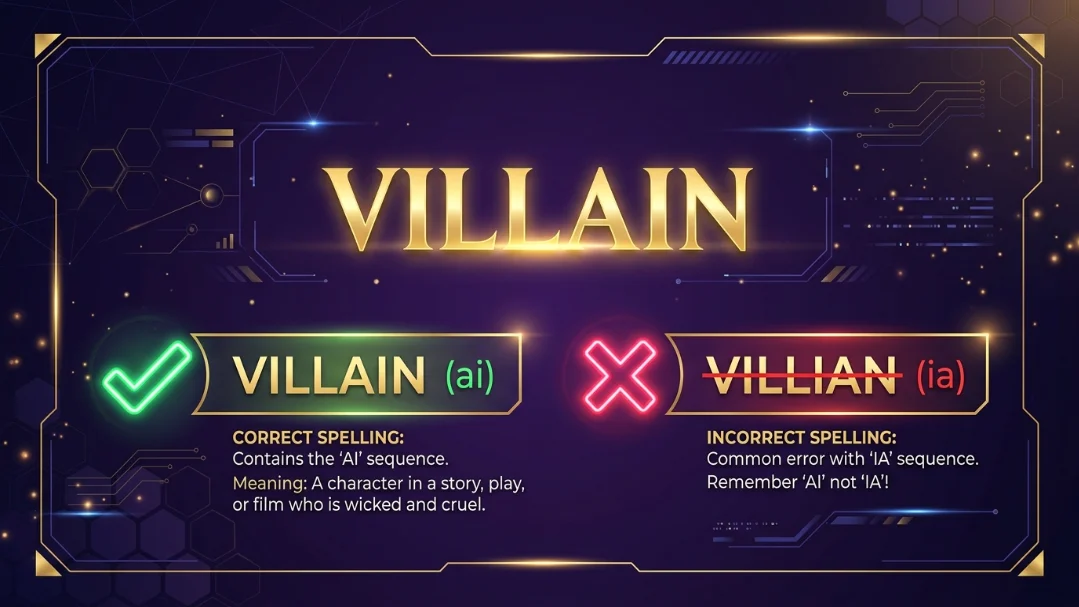
The correct spelling is villain, with the “ai” ending. The spelling “villian” is a common mistake and is considered incorrect in all standard English dictionaries.
Have you ever looked at a word and felt unsure about its letters? The spelling of villain or villian confuses many writers every single day. You might feel tempted to spell it with an “ia” at the end, as that pattern appears in many other English words. However, this word follows a unique path that catches even experienced authors off guard.
Understanding the correct spelling improves your writing quality and boosts your professional image. People often struggle with this specific term because English rules regarding suffixes can seem random or illogical. This article breaks down the history and structure of the word to make it easier for you to remember. We will explore simple tricks, common pitfalls, and real-world usage to ensure you always choose the right form. By following this guide, you will master this spelling once and for all. Let’s dive into the details and clear up the confusion surrounding this popular term.
The most essential fact to remember is that villain is the only correct spelling. You should always avoid the “villian” variation, as it does not exist in standard English. The word comes from an old Latin term, which explains its unique “ai” spelling pattern. By associating the word with its historical roots, you can make the correct spelling stick in your memory. Practice the “ai” sequence consistently, and you will soon stop making this common error. Accurate spelling builds trust with your readers and ensures your work appears polished and reliable.
Definition and Explanation
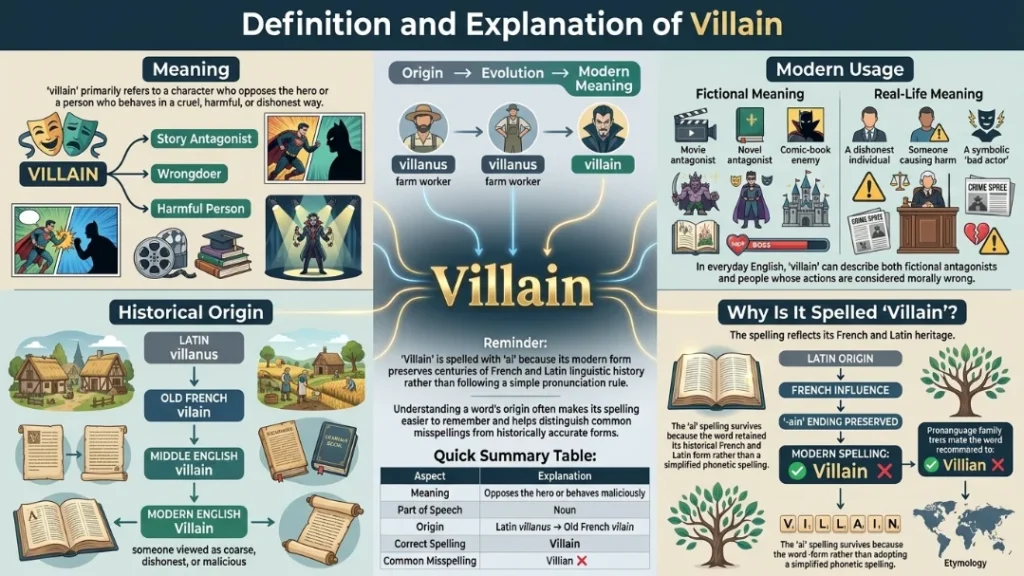
A villain is typically a character in a story, movie, or play who opposes the hero. Outside of fiction, the word describes a person who performs wicked actions or causes harm to others. The term originated from the Latin word villanus, which once referred to a farm worker or a rustic person. Over time, the meaning shifted from a simple laborer to someone who acts maliciously.
Understanding this history helps explain the spelling. Many words that ended in “-ain” evolved through French and Latin influences. Because the word kept its connection to these older languages, the “ai” spelling persisted despite other words following the “ia” pattern. When you see the “ai” ending, you are looking at a historical remnant that has survived for centuries. Recognizing this pattern allows you to categorize the word properly in your mind.
Advantages and Disadvantages of Proper Spelling
Maintaining high standards in your spelling offers significant benefits for your career and creative projects. Professionalism relies on precision. Readers often judge the quality of a message based on how it looks on the page.
| Aspect | Impact of Correct Spelling | Impact of Incorrect Spelling |
| Credibility | High; establishes authority. | Low; undermines your message. |
| Clarity | High; prevents reader confusion. | Low; distracts the audience. |
| Professionalism | High; shows attention to detail. | Low; appears sloppy or rushed. |
| Readability | High; keeps the flow natural. | Low; forces readers to pause. |
Real-World Examples
Seeing the correct form in action makes the spelling easier to recall. Writers frequently use this term to describe antagonists in literature or problematic figures in real-world scenarios.
- The main villain of the novel seeks to conquer the entire kingdom.
- Every great story requires a complex villain to challenge the protagonist.
- The CEO was labeled a corporate villain after the massive scandal broke.
- He played the role of the villain perfectly in the school play.
Each of these examples demonstrates the proper use of the “ai” ending. Notice how the word flows naturally within the sentence structure. When you use the correct form, your writing remains immersive and professional for your audience.
Regional and Global Usage
Spelling standards for this word remain consistent across all English-speaking countries. Whether you live in the United States, the United Kingdom, Canada, or Australia, you must use villain. No regional variation allows for the “villian” spelling.
This global consistency simplifies your writing process. You do not need to worry about adjusting your spelling based on your target audience’s location. Whether you are writing for an American journal or a British news outlet, the double “l” and “ai” sequence is the universal standard. Following this standard ensures that your work remains accessible to readers everywhere. Consistency across regions is a hallmark of high-quality writing.
Common Mistakes and Corrections
The “ia” versus “ai” mistake occurs because many English words use the “-ian” suffix. Think of words like “musician,” “politician,” or “comedian.” Because these are so common, your brain naturally tries to apply that same rule to “villain.”
To correct this mistake, you must treat “villain” as an exception to the suffix rule. Instead of linking it to “musician,” try linking it to words like “captain,” “curtain,” or “mountain.” These words all share the “-ain” ending. Creating this mental group helps override the urge to use “ia.” Whenever you doubt your spelling, quickly list these “-ain” words to verify the pattern. This technique effectively blocks the incorrect “villian” spelling from your mind.
Exercises with Answers
Test your knowledge with these quick exercises to see how well you have learned the correct spelling.
- The story featured a dark and mysterious __________. (villain/villian)
- She insisted that the __________ was responsible for the crime. (villain/villian)
- Why do people often spell the word as _________? (villain/villian)
- Every superhero needs a worthy __________. (villain/villian)
Answers:
- Villain (Correct spelling).
- Villain (Correct spelling).
- Villian (Incorrect, but this is the common mistake).
- Villain (Correct spelling).
Related Concepts and Comparisons
It helps to look at other words that people often misspell due to similar patterns. Understanding these related terms broadens your vocabulary and spelling accuracy.
- Antagonist: A formal term for a person who opposes the protagonist.
- Protagonist: The leading character in a story or play.
- Malefactor: Someone who does wrong or commits a crime.
- Captain: A word that shares the “-ain” spelling pattern with our focus word.
Comparing these terms helps you understand the nuance of each word. While “villain” is common, using “antagonist” might be better for academic or formal literary analysis. Building this range of vocabulary improves the depth of your writing.
FAQs
Is villian ever correct?
No, “villian” is always considered a misspelling. You should always use the “ai” ending found in villain.
Why do people keep spelling it villian?
People often misspell it because they confuse it with common suffixes like “-ian,” which appear in words like “musician.”
Is there a difference between British and American spelling?
No, the spelling of villain is the same in all major forms of English across the globe.
How can I remember to use ai instead of ia?
Try associating the word with other “-ain” words like “captain” or “curtain” to help the spelling pattern stick.
Does the word villain have any other forms?
Yes, you can use “villainy” for the behavior or “villainous” for the adjective form.
Should I capitalize villain?
No, you should only capitalize it if it appears at the start of a sentence or as part of a proper title.
Can I use the word villain in formal essays?
Yes, it is perfectly acceptable in formal writing, especially when discussing literature or film analysis.
Are there any exceptions to the spelling?
No, there are no accepted exceptions. Always use the “ai” spelling to maintain professional standards.
Does spellcheck usually catch this error?
Yes, most modern word processors will highlight “villian” as an error and suggest “villain” as the replacement.
Where can I find more spelling help?
Dictionaries like Merriam-Webster or the Oxford English Dictionary provide comprehensive guides for tricky words.
Conclusion
Mastering the correct spelling of villain is a small but meaningful way to improve your writing skills. By recognizing the pattern of “-ain” words and consciously avoiding the common “-ian” suffix trap, you can eliminate this mistake from your work forever. Precise spelling shows that you care about your message and respect your reader’s time.
Start practicing by using the word in your sentences and mentally grouping it with “captain” or “curtain.” Over time, this spelling will become second nature, and you will no longer have to double-check your work for this specific error. Strong writing relies on these foundational habits. Continue building your vocabulary and spelling knowledge to ensure your messages remain clear and authoritative. You now have the tools to write this word correctly in every situation. Keep writing with confidence and attention to detail.

Jack Murphy is a language writer with a passion for word meanings, synonyms, and effective communication. He creates informative and easy to understand content to help readers enhance their vocabulary and language skills.




1 thought on “Villain or Villian| The Correct Spelling Explained”