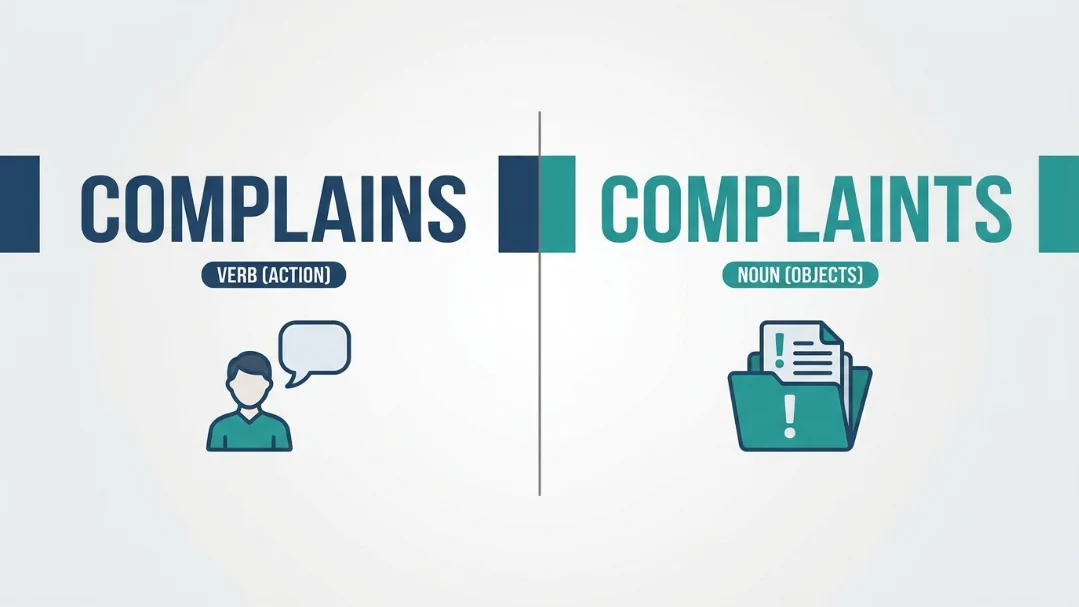
The primary difference between “complains” and “complaints” is their part of speech. Complains is a verb that describes the action of expressing dissatisfaction, whereas complaints is a plural noun that refers to the actual statements of dissatisfaction themselves. Consequently, you use “complains” for actions (e.g., “He complains often”) and “complaints” for things (e.g., “We received three complaints”).
Choosing between complains or complaints can confuse even experienced writers. While these two words look and sound similar, they perform completely different jobs in a sentence. Mixing them up can make your professional emails, customer service responses, or academic papers look unprofessional. Therefore, understanding how to use each word correctly is essential for clear communication.
This comprehensive guide will break down the rules surrounding complains or complaints. We will explore their definitions, look at real-world examples, and analyze common mistakes. Additionally, you will find practice exercises to test your knowledge. By the end of this article, you will confidently choose the right word every single time.
If you are looking for a quick way to remember the rule, think about action versus object. Specifically, “complains” is an action word, while “complaints” is a object word.
| Complains | Verb (Present Tense) | Shows the action of expressing unhappiness. | She complains about the cold weather. |
| Complaints | Noun (Plural) | Refers to the actual issues or reports. | The manager handled the complaints. |
Definition and Explanation
To understand the core difference between these terms, we must look at how they function grammatically within English sentences.
What is “Complains”?
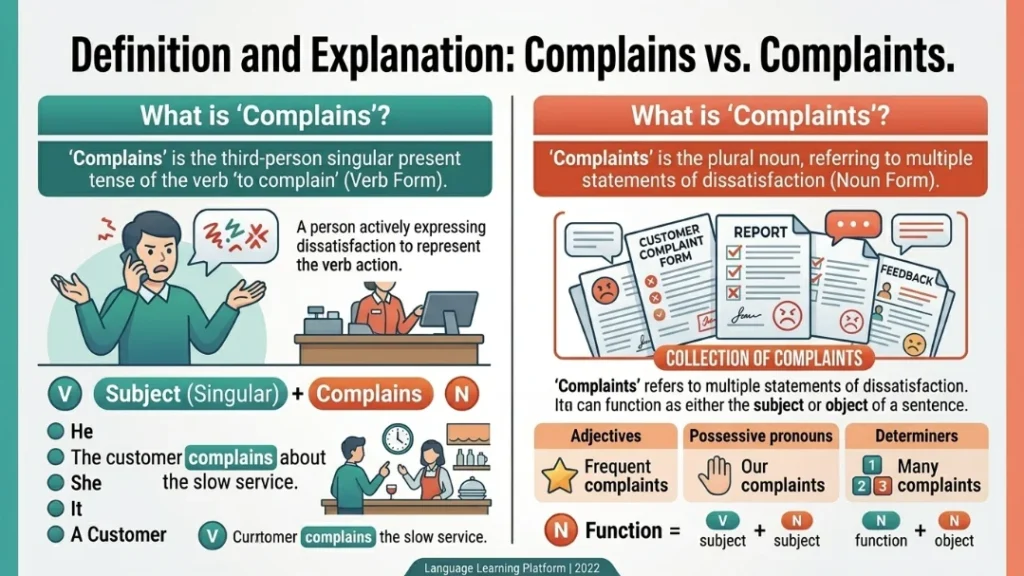
The word complains is the third-person singular form of the verb to complain. It indicates that someone is actively voicing pain, dissatisfaction, or resentment in the present tense. Because it is a verb, it always requires a singular subject like he, she, it, or a specific person’s name.
Grammar Note: Subject (Singular) + Complains
For example, in the sentence “The customer complains about the slow service,” the word complains acts as the action performed by the customer.
What is “Complaints”?
In contrast, complaints is a plural noun. It represents the plural form of complaint. A complaint is a statement that a situation is unsatisfactory or unacceptable. Because complaints is a noun, it can serve as the subject or the object of a sentence. It often follows adjectives, possessive pronouns, or articles like the or many.
Advantages and Disadvantages of Clear Expression
Using the correct term yields significant benefits in professional settings. Conversely, misusing these words creates distinct disadvantages.
Advantages of Correct Usage
- Enhanced Professionalism: Writing accurately builds trust with colleagues and clients.
- Clearer Documentation: Human resource reports and legal documents remain unambiguous.
- Better SEO Performance: Search engines index high-quality, grammatically correct content more favorably.
Disadvantages of Incorrect Usage
- Reader Distraction: Grammatical errors pull the reader’s focus away from your main message.
- Loss of Credibility: Clients may question your attention to detail if basic words are mixed up.
- Communication Breakdown: In automated sentiment analysis tools, mixing nouns and verbs can confuse data tracking systems.
Real-World Examples
To solidify your understanding, let us examine how these words function across various industries.
Customer Service
- Correct Verb: When a guest complains about room cleanliness, the hotel staff offers a discount immediately.
- Correct Noun: Our support team resolved over fifty customer complaints before closing time on Friday.
Corporate HR
- Correct Verb: If an employee complains regarding workplace safety, management must investigate the issue within twenty-four hours.
- Correct Noun: The human resources director filed the formal complaints in the secure corporate database.
Everyday Conversation
- Correct Verb: My neighbor complains whenever our dog barks in the backyard.
- Correct Noun: After weeks of minor complaints, the landlord finally fixed the broken plumbing.
Regional and Global Usage
English speakers across the globe recognize both words, yet subtle contextual variations exist in international business communication.
In British and Australian legal systems, the word complaints often triggers formal statutory procedures. For instance, a citizen lodges official complaints with an ombudsman. Meanwhile, American corporate environments frequently replace the noun complaints with euphemisms like “feedback” or “support tickets” to soften the tone. However, the grammatical mechanics of complains versus complaints remain identical across all global dialects, including American, British, Canadian, and Australian English.
Common Mistakes and Corrections
People frequently substitute one word for the other because they confuse the singular noun complaint with the verb complains. Let us look at some typical errors and how to fix them.
Mistake 1: Using the Verb Instead of the Plural Noun
- Incorrect: The company received many complains about the software bug.
- Correct: The company received many complaints about the software bug.
Why it is wrong: The word “many” modifies nouns, not verbs. Therefore, you must use the plural noun complaints.
Mistake 2: Using the Noun Instead of the Verb
- Incorrect: He always complaints when the project deadline changes.
- Correct: He always complains when the project deadline changes.
Why it is wrong: The sentence lacks a verb to show what the subject (“He”) is doing. Thus, complains is required.
Mistake 3: Confusing “Complaint” (Singular) with “Complains” (Verb)
- Incorrect: This is a formal complains against the vendor.
- Correct: This is a formal complaint against the vendor.
Why it is wrong: The article “a” signals that a singular noun must follow. If you mean one item, use complaint. If you mean multiple items, use complaints.
Related Concepts and Comparisons
To deepen your mastery of this topic, it helps to compare complains or complaints with other words that follow similar grammatical patterns.
The Singular vs. Plural Noun vs. Verb Dynamic
The relationship between complain, complains, complaint, and complaints matches several other common English words. Understanding this pattern makes it easier to remember the rules.
| Complain | Complains | Complaint | Complaints |
| Deliver | Delivers | Delivery | Deliveries |
| Respond | Responds | Response | Responses |
Synonyms for “Complains” (Verbs)
If you want to vary your language, you can use these verbs instead of complains:
- Grumbles
- Whines
- Protests
- Objects
Synonyms for “Complaints” (Nouns)
If you need alternative nouns to replace complaints, consider these options:
- Grievances
- Objections
- Criticisms
- Accusations
Exercises with Answers
Practice is the most effective way to lock in these rules. Try to fill in the blanks in the following sentences with either complains or complaints.
Practice Questions
- The operations manager reviewed the client __________ from last quarter.
- Every time it rains, our delivery driver __________ about the slick roads.
- We must log all formal __________ into the system for auditing purposes.
- If she __________ again, we will need to escalate the issue to the director.
- The consumer protection agency monitors public __________ against local businesses.
- Nobody likes a coworker who constantly __________ without offering solutions.
- Executive management requested a detailed summary of the product __________.
- Our technical support team handles technical __________ via our online helpdesk.
Answers and Explanations
- complaints (Noun: Refers to the actual items reviewed by the manager.)
- complains (Verb: Describes the action performed by the driver.)
- complaints (Noun: Serves as the object of the verb “log”.)
- complains (Verb: Follows the conditional pronoun “she” to indicate action.)
- complaints (Noun: Refers to the collection of feedback monitored by the agency.)
- complains (Verb: Shows the continuous action of the coworker.)
- complaints (Noun: Indicates the specific reports requested by executives.)
- complaints (Noun: Represents the plural issues handled by the helpdesk.)
Frequently Asked Questions
What is the main difference between complains or complaints?
The primary difference rests on their parts of speech. Specifically, complains functions as a verb that describes the act of expressing dissatisfaction, whereas complaints operates as a plural noun representing the statements of dissatisfaction themselves.
Can you use complaints as a verb?
No, you cannot use complaints as a verb. It functions exclusively as a plural noun. If you need a verb form for a plural subject, you should use the base verb complain instead.
Is it correct to say many complains?
No, saying “many complains” is grammatically incorrect. Because the word “many” must modify a plural countable noun, the correct phrasing is always “many complaints.”
How do you spell the singular noun version of complaints?
The singular noun form is spelled complaint without an “s” at the end. For example, you would say, “The customer filed a formal complaint yesterday.”
What are some common synonyms for complaints in business writing?
In professional environments, writers frequently substitute complaints with more neutral synonyms like grievances, feedback, issues, concerns, or objections.
Is complains considered present tense or past tense?
The word complains belongs strictly to the present tense. If you need to describe the action of complaining in the past, you should use the past-tense verb complained.
Why do people often mix up complains or complaints?
People mix them up primarily because they sound very similar when spoken quickly. Additionally, writers confuse the “s” at the end of the verb complains with the pluralizing “s” at the end of the noun complaints.
How do I know whether to use complaint or complaints?
You should evaluate the quantity of the issues you are referencing. Use the singular complaint when discussing one single issue, and use the plural complaints when discussing two or more issues.
What part of speech is the word complains?
The word complains is a present-tense verb. Specifically, it represents the third-person singular form, meaning it pairs naturally with subjects like he, she, it, or singular nouns.
Can a sentence contain both complains and complaints?
Yes, a sentence can easily contain both words if it describes someone acting upon an issue. For instance: “The supervisor handles the complaints whenever an employee complains about scheduling.”
Conclusion
Mastering the distinction between complains or complaints ensures your writing remains polished, precise, and authoritative. By remembering that complains is an action verb while complaints is a plural noun, you can eliminate simple errors that undermine your professional credibility.
Whenever you write, take a moment to look at the words surrounding your choice. If you are describing an action that a single person is performing, choose complains. Alternatively, if you are discussing a collection of issues, reports, or feedback items, select complaints. Implementing these simple checkpoints will elevate your communication standards across all platforms.