Finding the right vocabulary can transform a repetitive piece of writing into something engaging and precise. The word “common” is one of the most frequently used adjectives in the English language, but relying on it too often can make your sentences feel flat. Whether you are drafting an academic essay, writing a business report, or chatting with a friend, changing up your word choice helps keep your audience engaged.
When searching for synonyms for common, it helps to realize that a single alternative will not fit every sentence. The perfect word depends entirely on your specific meaning, the tone of your text, the setting, and how much emphasis you want to give the idea.
Best Synonyms for Common
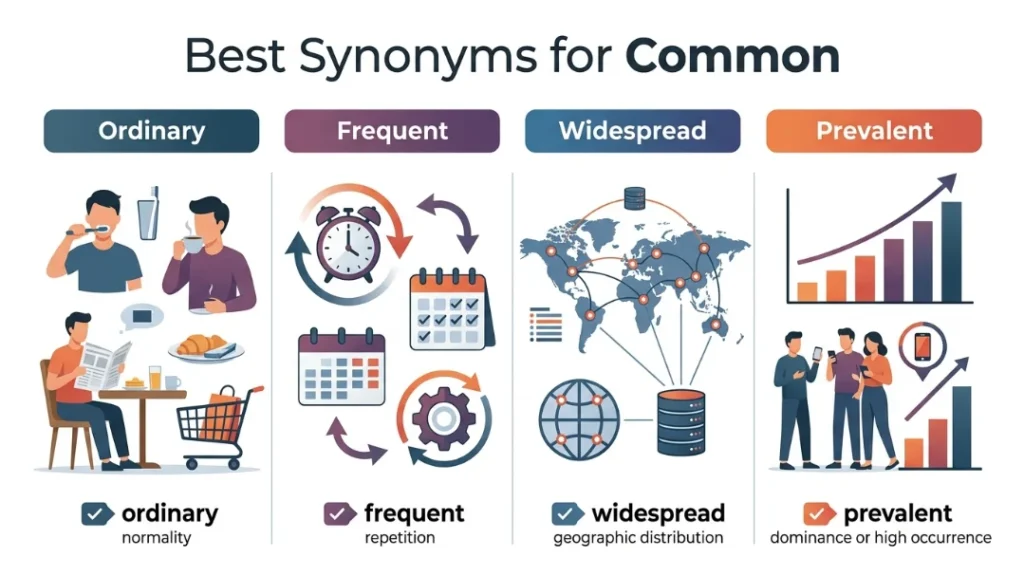
The best synonyms for common are ordinary, frequent, widespread, and prevalent. The right choice depends on tone, context, and intensity.
- If you mean something is normal or unexceptional, use ordinary.
- If you mean something happens often, use frequent.
- If you mean something exists over a large area, use widespread.
- If you mean something is highly dominant or common at a specific time, use prevalent.
What Does Common Mean?
Before substituting a word, you must understand its core definitions. The word “common” is an adjective that primarily covers three distinct ideas:
- Happening often, found in large numbers, or easily noticed.
- Shared by or belonging to two or more people or a whole community.
- Ordinary, standard, or lacking special or premium qualities.
Common Usage
Because of these distinct definitions, the phrase “a common problem” implies that many people experience the issue. On the other hand, “a common goal” means a shared objective.
- Example 1: It is common for birds to migrate south when winter approaches.
- Example 2: We need to find some common ground if we want this project to succeed.
Core Meaning of Common
At its heart, the word “common” describes things that lack rarity, exclusivity, or isolation. It points to experiences, objects, or traits that form the background of daily life rather than the exceptions. When something is common, it requires no special effort to find, see, or experience. It represents the baseline or the standard expectation within a given environment.
Grammar and Usage Notes
“Common” functions beautifully as an adjective, but its behavior changes depending on how you structure your sentence.
Common Sentence Patterns
- Before a noun (Attributive): This is a common mistake among new drivers.
- After a linking verb (Predicative): In July, thunderstorms are common.
Phrases or Collocations for Common
- Common sense: Sound, practical judgment.
- Common courtesy: Polite behavior that people naturally expect.
- In common: Shared interests, traits, or characteristics.
When to Replace the Word
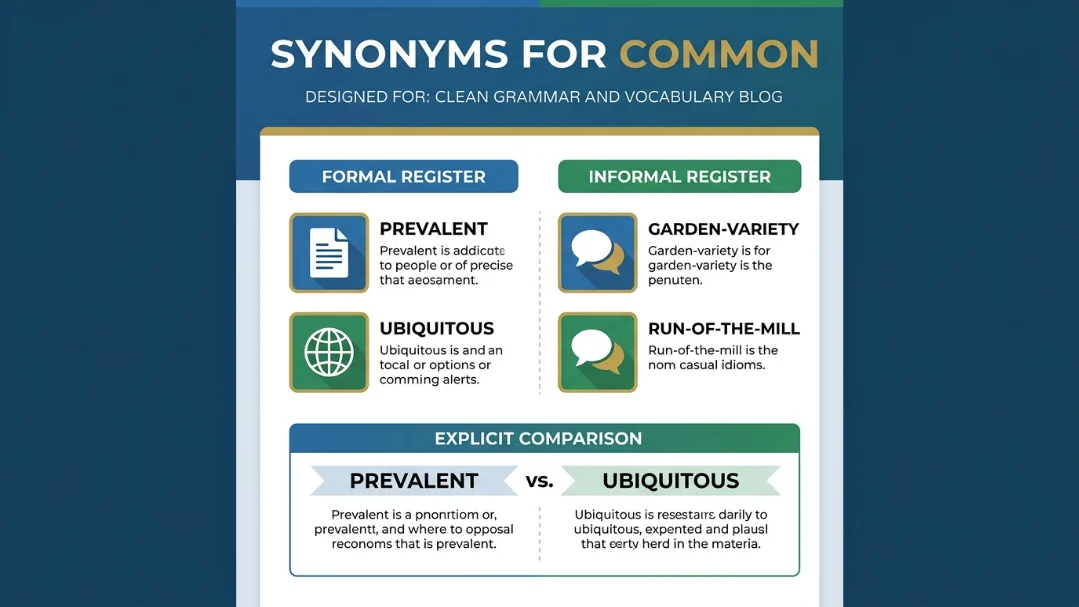
“Common” sounds perfectly natural in daily conversation and simple statements. However, a specific synonym works better when you want to highlight exact scale, scale of time, or social formality. For instance, using “common” in a formal scientific report might sound too casual, whereas a term like “prevalent” or “ubiquitous” adds professional precision.
Best Synonyms for Common
The table below breaks down the top alternatives based on their specific meanings and the ideal situations for using them.
| Synonym | Meaning | Tone | Best Use Case | Example Sentence |
| Ordinary | With no special or distinctive features; normal. | Neutral | Describing everyday objects or people. | She was just an ordinary citizen doing her job. |
| Prevalent | Widespread or highly dominant in a particular area or time. | Formal | Medical, social, or statistical contexts. | This specific flu strain is prevalent during the winter months. |
| Frequent | Occurring or happening often at short intervals. | Neutral | Describing recurring events or actions. | The commuter made frequent stops along the train route. |
| Ubiquitous | Present, appearing, or found everywhere at once. | Formal / Literary | Describing technology, trends, or inescapable habits. | Smartphones have become ubiquitous in modern society. |
| Conventional | Following traditional or generally accepted standards. | Neutral / Professional | Describing methods, choices, or behaviors. | He opted for a conventional medical treatment instead of alternative therapy. |
Common Synonyms for Common
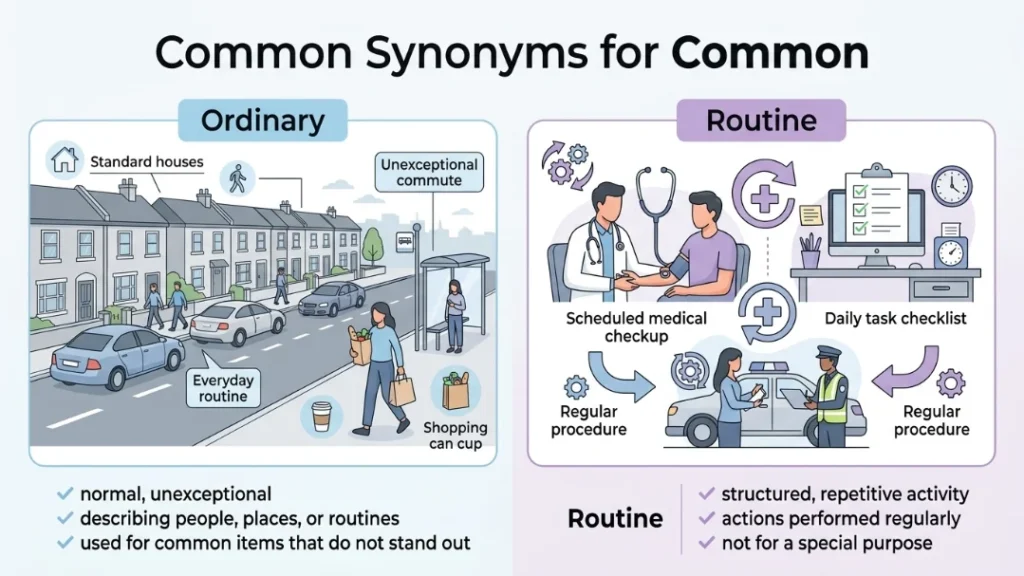
These everyday words work well in standard writing, storytelling, and conversational contexts where you do not need extreme formality.
Ordinary
- Meaning: Normal, standard, or lacking any special, outstanding qualities.
- Best Context: Describing daily life, items, or routines that do not stand out.
- Example: The restaurant serves excellent food in a completely ordinary building.
Routine
- Meaning: Performed as part of a regular procedure rather than for a special reason.
- Best Context: Describing procedures, checks, medical appointments, or habits.
- Example: The police officer pulled the car over for a routine traffic inspection.
Familiar
- Meaning: Well-known from long or close association.
- Best Context: Discussing places, faces, sights, or sounds that you recognize easily.
- Example: It was a relief to see a familiar face in the large, crowded room.
Standard
- Meaning: Regular, normal, or matching a specific approved model or level of quality.
- Best Context: Discussing products, operating procedures, sizes, or rules.
- Example: The vehicle comes equipped with standard safety features like airbags.
Formal Synonyms for Common
When writing research papers, business proposals, academic essays, or executive summaries, you want words that sound objective and professional.
Prevalent
- Meaning: Widely existing, generally practiced, or dominant within a specific group or region.
- Best Context: Discussing economic conditions, health statistics, or social trends.
- Example: Chronic back pain is highly prevalent among workers who sit at desks all day.
Ubiquitous
- Meaning: Seemingly present everywhere at the exact same time.
- Best Context: Describing massive cultural shifts, popular tech tools, or widespread physical elements.
- Example: Microplastics are now ubiquitous across the marine environments of the world.
Pervasive
- Meaning: Spreading widely throughout an area, group, or system, often with a subtle or unwelcome effect.
- Best Context: Discussing smells, systemic issues, cultural attitudes, or moods.
- Example: A pervasive sense of optimism spread through the company after the successful launch.
Customary
- Meaning: According to a person’s or group’s habitual or traditional way of doing things.
- Best Context: Describing legal norms, cultural traditions, or business practices.
- Example: It is customary to shake hands firmly at the start of a job interview.
Informal Synonyms for Common
Casual language adds color and flavor to natural conversations, personal text messages, creative dialogue, or relaxed blog posts.
A dime a dozen
- Meaning: Very abundant, cheap, and easy to find, which often makes them feel less valuable.
- Best Context: Speaking casually about common skills, generic items, or overused ideas.
- Example: Graphic designers who only use basic templates are a dime a dozen these days.
Garden-variety
- Meaning: Ordinary, unexceptional, and completely typical of its kind.
- Best Context: Describing minor illnesses, everyday problems, or plain objects.
- Example: Don’t worry too much; it is just a garden-variety cold that will clear up in a week.
Run-of-the-mill
- Meaning: Lacking unusual or special features; completely average.
- Best Context: Critiquing entertainment, appliances, work tasks, or consumer items.
- Example: The movie had great special effects, but the plot was a run-of-the-mill action story.
Strong Synonyms for Common
Sometimes you want an alternative that carries more emotional weight, scale, or dramatic impact. These words emphasize just how widespread or undeniable something is.
Rife
- Meaning: Widespread, abundant, and common, particularly when referring to harmful or unpleasant things.
- Best Context: Describing negative conditions like rumors, diseases, errors, or corruption.
- Example: The old financial report was rife with mathematical errors and missing data.
Universal
- Meaning: Existing everywhere or involving all people, things, or situations in a particular group.
- Best Context: Stating absolute facts, fundamental human truths, or comprehensive rules.
- Example: The desire for safety and comfort is a universal human trait.
Rampant
- Meaning: Growing, spreading, or flourishing unchecked and unchecked, usually in a negative direction.
- Best Context: Discussing crime, inflation, weed growth, or uncontrolled rumors.
- Example: Wild speculation about the company’s future ran rampant across the internet.
Mild Synonyms for Common
If you want to keep your writing understated, objective, or completely neutral without sounding overly dramatic, use these softer alternatives.
Regular
- Meaning: Happening or recurring at uniform intervals; standard.
- Best Context: Scheduling, describing steady customers, or normal patterns.
- Example: The bus runs on a regular schedule every hour on the hour.
Typical
- Meaning: Exhibiting the essential traits of a particular group, class, or type.
- Best Context: Analyzing data points, behavior patterns, or weather conditions.
- Example: A typical workday for him involves responding to client emails and writing code.
Unexceptional
- Meaning: Not out of the ordinary; completely standard and unlikely to attract criticism or praise.
- Best Context: Keeping expectations modest or describing plain experiences neutrally.
- Example: The hotel room was clean but entirely unexceptional in its decor and amenities.
Synonyms for Common by Context
Context dictates which words sound natural and which ones feel completely out of place. Below are the best options grouped by where they fit best.
Professional and Business Writing
In professional emails, proposals, or project summaries, clarity and professional distance matter most. Avoid slang terms like “garden-variety.” Instead, opt for terms that imply established systems or clear data.
- Standard: Use when discussing guidelines, procedures, or baselines (e.g., “standard operational protocol”).
- Conventional: Perfect for contrasting new methods with established systems (e.g., “conventional marketing strategies”).
Academic and Scientific Research
Research papers require exact terminology. Words should clearly show statistics, geographic presence, or universal laws without adding emotional bias.
- Prevalent: Ideal for documenting conditions or data points within a specific study population.
- Ubiquitous: Use when a physical element or concept is demonstrably present across all studied areas.
Creative Writing and Fiction
Fiction writing thrives on voice, imagery, and mood. Using dry words like “standard” can kill the narrative rhythm.
- Run-of-the-mill / Garden-variety: Excellent for dialogue or character perspectives that feel grounded and human.
- Mundane: Great for highlighting the boring, repetitive, or unexciting parts of a character’s lifestyle.
Another Word for Common in a Sentence
Here is how you can use different alternative words in real-world sentences to shift the style and flavor of your writing:
- Ordinary: It was a perfectly ordinary afternoon until the surprise package arrived at the door.
- Frequent: The airline offers frequent flights between New York and London to handle the heavy travel demand.
- Widespread: The new policy caused widespread confusion among employees across all branches.
- Prevalent: Dietary deficiencies are surprisingly prevalent in communities that lack access to fresh food markets.
- Ubiquitous: Coffee shops have become ubiquitous fixtures in almost every urban neighborhood.
- Conventional: She rejected conventional wisdom and decided to launch her business without external loans.
- Routine: The mechanic conducted a routine check on the brakes and found no major issues.
- Familiar: The soft, comforting melody of the song sounded familiar to everyone in the audience.
- Standard: It is standard practice to back up all sensitive data to an encrypted external cloud server.
- A dime a dozen: Cheap plastic souvenirs are a dime a dozen near the popular beach boardwalk.
- Garden-variety: The homeowner dealt with a garden-variety plumbing leak under the kitchen sink.
- Run-of-the-mill: The restaurant serves a run-of-the-mill breakfast menu that satisfies without surprising.
- Rife: During the election cycle, social media channels were rife with unverified political rumors.
- Universal: Access to clean drinking water should be recognized as a universal human right.
- Typical: It was a typical Monday morning, filled with heavy traffic and back-to-back meetings.
Common Synonyms Compared
Sometimes two synonyms look identical on the surface, but swapping them changes your meaning. Let’s look closely at where they differ.
Prevalent vs. Ubiquitous
While both words mean something is highly visible or widespread, they differ in scope and intensity. Prevalent means something is common within a specific context, group, or timeframe (e.g., a prevalent opinion among teens). Ubiquitous takes it a step further, implying the item is everywhere you look, globally and simultaneously (e.g., the ubiquitous nature of the internet).
Ordinary vs. Typical
Ordinary describes the quality of an object or experience, noting that it is plain, unexceptional, and standard. Typical, however, means that something serves as an accurate representation or sample of its specific group or class. A day can be typical for a busy surgeon without being ordinary compared to the lives of most other people.
Words Similar to Common
The words below share a close relationship with “common,” but they are not exact replacements. They belong to the same family of ideas but carry distinct structural requirements.
Mutual
- Why it is related: It involves shared ownership or feeling, matching the “shared by many” definition of common.
- Why it cannot directly replace it: “Common” refers to things shared generally by a group or found anywhere. “Mutual” specifically implies a directed, reciprocal relationship or feeling between two distinct parties (e.g., mutual respect or a mutual friend).
Shared
- Why it is related: It describes resources, spaces, or goals held jointly by a collective.
- Why it cannot directly replace it: “Common” describes a natural state of availability or status. “Shared” implies an active division, distribution, or joint use of something specific (e.g., a shared document or a shared driveway).
Antonyms of Common
When you need to express the exact opposite idea of “common,” these antonyms offer precision based on context.
Rare
- Meaning: Not occurring often; highly uncommon, unique, and valuable.
- Example Sentence: The collector spent decades searching for a rare silver coin from the Roman era.
Unusual
- Meaning: Remarkable, interesting, or atypical because it alters from the norm.
- Example Sentence: It is highly unusual to experience freezing temperatures in this region during May.
Exclusive
- Meaning: Restricted to a specific person, group, or class; not accessible to the general public.
- Example Sentence: Members of the private club enjoy exclusive access to the seaside golf course.
Extraordinary
- Meaning: Very unusual or remarkable; far beyond what is ordinary or expected.
- Example Sentence: The young pianist showed an extraordinary talent for classical composition.
How to Choose the Right Synonym for Common
To pick the perfect word and avoid making your sentences sound clunky, keep these practical tips in mind:
- Determine your sub-definition: Are you trying to say something happens often (use frequent), is found everywhere (use widespread), or is plain and unexciting (use ordinary)?
- Match the setting and reader: If you are writing a scientific paper, stay away from informal terms like run-of-the-mill. Stick to data-friendly options like prevalent.
- Check the emotional weight: Do not use rampant or rife unless you are describing a negative situation that is truly out of control.
- Read the sentence aloud: Swapping in a synonym should never disrupt the natural rhythm of your text. If the sentence feels forced, look for a simpler alternative.
Common Mistakes When Using Synonyms for Common
Using a thesaurus without checking context leads to several frequent writing mistakes:
- Misusing negative words for positive topics: Words like rife and rampant carry bad connotations. Saying a neighborhood is “rampant with beautiful flowers” sounds strange and contradictory to native English speakers.
- Over-elevating simple sentences: Swapping out a simple word for a heavy academic term can backfire. Changing “It’s a common cold” to “It’s a ubiquitous respiratory condition” sounds unnatural and overdone.
- Confusing “mutual” and “common”: Remember that a “common interest” is a hobby that many people share. A “mutual interest” means two specific people are interested in one another or share a specific bond.
Quick Synonym List for Common
Use this clean, scannable reference list when you need a quick vocabulary choice:
- Common Synonyms: Ordinary, standard, frequent, familiar, everyday, regular.
- Formal Synonyms: Prevalent, ubiquitous, pervasive, conventional, customary.
- Informal Synonyms: A dime a dozen, garden-variety, run-of-the-mill.
- Strong Synonyms: Universal, rife, rampant, widespread.
- Mild Synonyms: Typical, unexceptional, normal.
- Related Words: Shared, mutual, public, collective.
FAQs
What is the best synonym for common?
The best synonym depends on your sentence. If you mean something is plain, ordinary is the best choice. If you mean something spreads across a large area, widespread is the most accurate alternative.
What is a formal synonym for common?
Prevalent and ubiquitous are excellent formal substitutes. Use prevalent for social trends or medical statistics, and use ubiquitous when describing something that appears everywhere at once.
What is a stronger word for common?
Universal or rampant are much stronger alternatives. Universal implies an absolute baseline that applies to everyone, while rampant indicates something is spreading completely unchecked.
Are “common” and “mutual” the exact same thing?
No, they are different. A common interest is an interest that many people share individually. A mutual interest specifically describes a shared, reciprocal feeling or connection between two or more designated parties.
What is an informal word for common?
Idioms like a dime a dozen, garden-variety, and run-of-the-mill are highly popular, casual ways to describe something that is ordinary or unexceptional.
What is the opposite of common?
The most accurate antonyms for common are rare, unusual, extraordinary, and exclusive.
Conclusion
Expanding your vocabulary makes your writing more dynamic, clearer, and far more engaging to read. While “common” is a highly useful word, replacing it with specialized terms like ordinary, prevalent, frequent, or ubiquitous gives your text greater precision.
Always keep your reader in mind when making a choice. By matching the definition, tone, and environment of your sentence, you can pick the perfect synonym with complete confidence.