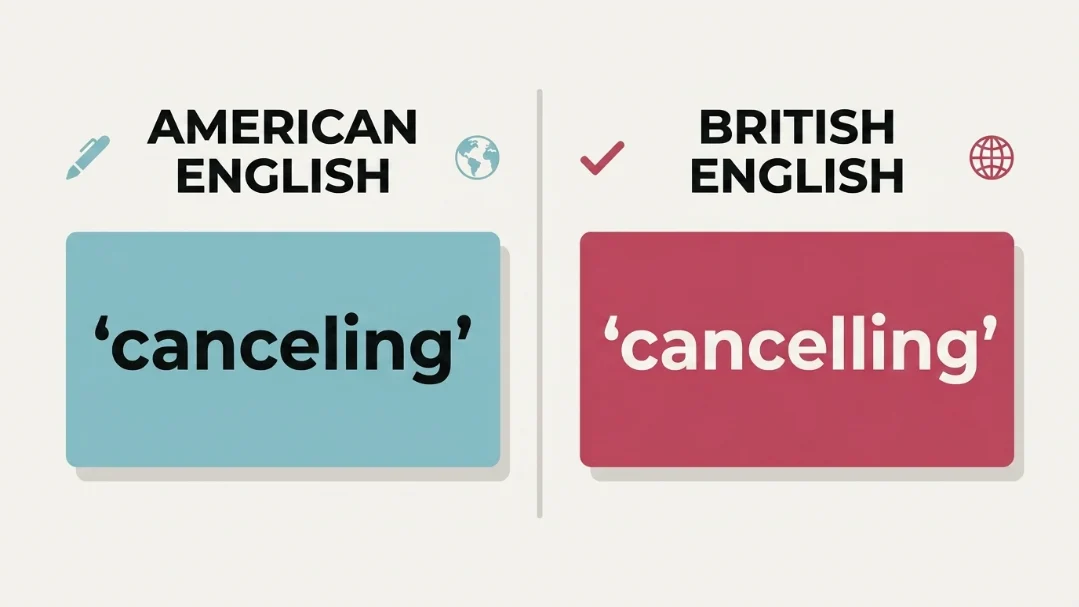
The difference between “cancelling” and “canceling” comes down to geography. In American English, the correct spelling is “canceling” with one “l.” In British, Canadian, and Australian English, the standard spelling is “cancelling” with a double “l.” Both forms are correct depending on your audience, but consistency throughout your document is essential.
Have you ever found yourself pausing while typing, unsure whether to double the “l” in the word “cancelling”? It is a common moment of hesitation that many writers face. Consequently, this small spelling dilemma can interrupt your flow and create uncertainty about your grammar. Therefore, understanding the difference between cancelling and canceling is a simple way to boost your confidence and ensure your writing is consistent and professional .
This confusion exists because both spellings are actually correct. The variation stems from a key difference between American and British English conventions. This article will help you navigate this spelling rule with ease. Consequently, you will gain a clear understanding of when to use each spelling. Moreover, we will explore the broader uses of the verb “cancel,” from its everyday meanings to its role in modern idioms like “cancel culture.” Ultimately, this guide will equip you with the knowledge to write clearly and correctly for your intended audience.
Key Takeaway & Summary
The core of this article is simple: the choice between “cancelling” and “canceling” depends on your audience. It is a classic example of the spelling variations that exist between different forms of English.
For a quick summary, remember these main points:
- American English uses canceling .
- British English (and most other English-speaking countries) use cancelling .
- The noun form, cancellation, is almost always spelled with a double “l” everywhere .
- The spelling difference also applies to the past tense: “canceled” (US) and “cancelled” (UK) .
- The verb “cancel” has multiple meanings, including calling off an event, invalidating something, or counterbalancing an effect .
Definition and Explanation
The Core Meaning of Cancel
The verb “to cancel” generally means to decide that something which has been planned will not happen. Similarly, it means to revoke or annul an agreement or an arrangement. For example, you might cancel a reservation or a subscription. Furthermore, it can mean to mark or stamp something to make it invalid, such as a postage stamp or a check. In a more modern context, it can refer to withdrawing support from a public figure, a phenomenon often referred to as “cancel culture” .
A less common but equally valid meaning is to “cancel out,” which means to neutralize the effect of something. For instance, the positive aspects of a job could be cancelled out by a long commute. Therefore, the word has several applications in both everyday and professional language .
The Spelling Rule
The spelling debate exists because English has different standards. As a result, the present participle and past tense of the verb “cancel” are formed differently. The general rule is based on whether a final “l” is doubled when adding suffixes like “-ing” or “-ed.” For example, in American English, the “l” is not usually doubled when the stress is not on the final syllable. Consequently, “cancel” becomes “canceled” and “canceling.” However, in British English, the “l” is almost always doubled. As a result, it becomes “cancelled” and “cancelling” .
Here is a summary table for quick reference:
| American English | Canceling | Canceled | Cancellation |
| British English | Cancelling | Cancelled | Cancellation |
This difference is similar to other words. For instance, “traveling” and “travelling” follow the same pattern. However, a notable exception is the noun “cancellation.” In both American and British English, spelling it with two “l’s” is the standard. While “cancelation” does occasionally appear, it is not the recommended spelling and is generally avoided to ensure clarity and professionalism .
Advantages and Disadvantages of the Two Spellings
Which Spelling Should You Choose? The Advantages of Consistency
The primary advantage of choosing the correct spelling is clarity and credibility. Using the right variant for your audience demonstrates professionalism. For example, an American business using “cancelling” might appear to have a British influence, which could be a stylistic choice. However, it could also look like a spelling error. Therefore, knowing your audience is the most significant advantage.
On the other hand, a potential disadvantage is confusion. Mixing the two spellings within a single document is a common mistake. This inconsistency can distract the reader and undermine your authority. Consequently, it is a simple but important rule to follow for polished writing.
The “One L” vs. “Double L” Rule in the World
There are no inherent pros and cons to the spelling itself. Instead, the advantage is being aware of the regional rule. The American spelling is often seen as a simplified version, as championed by Noah Webster in the early 19th century . Conversely, the British spelling is more conservative and follows the traditional pattern of doubling the final consonant.
Ultimately, the “disadvantage” is only realized when you fail to consider your reader. A document for a UK-based client will be better received if it uses British spellings. Meanwhile, an American audience will find the single “l” more natural. Therefore, the key is to be adaptable and consistent.
Real-World Examples
American English Examples
Let us look at examples from different contexts to see “canceling” in action. For instance, a news headline from an American publication might read: “The network is canceling the show after its first season.” Similarly, a business email might state: “I am canceling my account effective immediately.” Furthermore, a social media post could declare: “Fans are canceling the celebrity after the scandal.” .
Here are more examples to illustrate this:
- “After reviewing the budget, we are canceling the conference.”
- “The manager is canceling all non-essential meetings.”
- “She is canceling her credit card due to fraudulent activity.”
These sentences clearly demonstrate the preferred American spelling of the present participle .
British and Commonwealth Examples
In British English, the spelling is distinctly different. The same sentences would be written with a double “l.” For example, a British newspaper might headline: “The government is cancelling all major public events.” Additionally, a UK-based customer service representative might say: “I am cancelling your subscription as requested.” Similarly, in Canada or Australia, which follow British conventions, you would see: “The committee is cancelling the annual fundraiser.” .
Consider these examples:
- “Due to the strike, the train company is cancelling dozens of services.”
- “We are cancelling the order and will be seeking a refund.”
- “The school is cancelling the outdoor trip because of the forecast.”
These examples highlight how the spelling is standardized across the UK and many Commonwealth nations .
Regional and Global Usage
A Look at the English-Speaking World
The world is effectively divided into two main camps for this spelling. The United States predominantly uses the single “l” in “canceling.” This preference is rooted in the efforts of lexicographer Noah Webster, who aimed to simplify and standardize American English spelling . As a result, all major American style guides and dictionaries recommend this spelling.
Conversely, the rest of the English-speaking world, including the United Kingdom, Ireland, Australia, New Zealand, and Canada, predominantly use the double “l” in “cancelling.” This adherence to British English spelling rules means that most countries, especially those with historical ties to the British Empire, follow this tradition. Similarly, countries like India and South Africa also use the British spelling .
However, it is important to note that the prevalence of American media and technology has made the American spelling more visible globally. Nevertheless, for formal writing, it is essential to follow the standard of the country in which your audience resides.
Common Mistakes
Mixing Spellings in One Document
One of the most frequent errors is a lack of consistency. For instance, a writer might use “canceling” in one paragraph and “cancelling” in another. This inconsistency can be jarring to a careful reader. As a result, it suggests a lack of attention to detail. Therefore, you should always choose one style and apply it throughout your entire text.
Using ‘Cancelation’ for the Noun
Another common mistake is attempting to write the noun as “cancelation.” This is almost always incorrect. The correct spelling, even in American English, is “cancellation” with a double “l.” For example, you should write: “The cancellation of the flight caused a major delay.” You should never write: “The cancelation of the flight.” This is a key exception to the rule .
Forgetting the Rule for the Past Tense
Writers often forget that the same rule applies to the past tense. Therefore, you should write “canceled” in American English and “cancelled” in British English. For instance, you might say: “The event was canceled due to rain” (US) or “The event was cancelled due to rain” (UK). This rule is consistent across all verb tenses .
Here is a table with common mistakes and their corrections:
| I am cancelling my appointment. (in the US) | I am canceling my appointment. | Use “canceling” for American English . |
| The cancelation was a surprise. | The cancellation was a surprise. | The noun is always “cancellation” . |
| They canceled the show. (in the UK) | They cancelled the show. | Use “cancelled” for British English . |
Related Concepts and Comparisons
Cancelling vs. Canceling: A Broader Look
The difference between “cancelling” and “canceling” is just one example of the wider variation between American and British English. Other verbs follow the same pattern. For example, “traveling” vs. “travelling,” “modeling” vs. “modelling,” and “labeling” vs. “labelling” all follow the same rule . Therefore, understanding the “cancel” rule can help you with many other words.
Moreover, the concept of “cancelling” extends beyond spelling. In mathematics, “cancelling out” means to remove a common factor from both sides of an equation. In finance, it can mean to offset one debit with a credit. These various uses show that the word has rich and varied applications .
“Cancel Culture” and Modern Usage
In recent years, the word “cancel” has taken on a new social meaning. “Cancel culture” refers to the practice of withdrawing support from public figures or companies after they have done or said something considered offensive. Consequently, you might see headlines like “Fans are calling for the actor to be canceled.” This usage is informal but has become a significant part of modern vocabulary .
Exercises and Answers
Exercise 1: Choose the Correct Spelling
Decide whether to use “canceling” or “cancelling” in the following sentences.
- The airline is __ all flights to London for safety reasons. (American English)
- We are __ our reservation at the restaurant due to a change of plans. (British English)
- The manager was __ the meeting as the client had not arrived. (Canadian English)
- The coach is __ practice because of the extreme heat. (American English)
Answers:
- canceling (American English)
- cancelling (British English)
- cancelling (Canadian English)
- canceling (American English)
Exercise 2: Identify the Error
Find the incorrect spelling in the following sentences and provide the correct one.
- The cancellation of the project was a surprise.
- She is canceling her subscription to the magazine. (British English text)
- The picnic was cancelled due to a thunderstorm. (American English text)
- We apologize for the cancelation of the event.
Answers:
- No error. “Cancellation” is correct in both American and British English.
- Error. In British English, it should be “cancelling.”
- Error. In American English, it should be “canceled.”
- Error. The correct spelling is “cancellation.”
Exercise 3: Fill in the Blanks
Complete each sentence with the correct form of the verb “cancel” based on the context.
- The flight was __ due to heavy snowfall. (American English)
- The school is __ the field trip due to a lack of funding. (British English)
- The high cost of the car was __ out by its excellent fuel efficiency. (Global English)
- The event organizers announced the __ of the concert. (American English)
Answers:
- canceled
- cancelling
- canceled or cancelled (This is a neutral statement)
- cancellation
Frequently Asked Questions
What is the main difference between cancelling and canceling?
The main difference is a matter of regional spelling. Canceling (one “l”) is the standard spelling in American English. Conversely, cancelling (two “l’s”) is the standard in British English and other Commonwealth countries. Both forms are grammatically correct .
Is one spelling considered more correct than the other?
No, neither is more correct than the other. They are both accepted spellings. However, the best choice depends entirely on the audience you are writing for. Therefore, you should tailor your spelling to your reader’s location .
How do I remember if it’s cancelling or canceling?
A simple way to remember is that American English often uses a shorter spelling. Therefore, American = one ‘l’ (canceling). British English often retains a more traditional spelling. Therefore, British = two ‘l’s’ (cancelling) .
Is there a difference in pronunciation?
No, there is no difference in pronunciation. Both words are pronounced with three syllables: CAN-sul-ing or CAN-sling. Because the “l” is already pronounced, doubling it does not affect the sound. Therefore, they are homophones .
What about ‘canceled’ vs. ‘cancelled’?
The same rule applies to the past tense and past participle. In American English, it is “canceled.” In British English, it is “cancelled.” For instance, you might write “The game was canceled” (US) or “The game was cancelled” (UK) .
What is the correct spelling of the noun: ‘cancellation’ or ‘cancelation’?
The correct spelling in both American and British English is “cancellation” with two “l’s.” The spelling “cancelation” is very rare and not recommended by major style guides .
Should I use cancelling or canceling in Canada?
Canadians typically follow British English conventions. As a result, “cancelling” with two “l’s” is the preferred and standard spelling in Canada .
Is there a different meaning if I use one spelling over the other?
No, the meaning is identical in all forms. The difference in spelling is purely a regional convention and does not carry any difference in meaning or tone. They are both correct spellings of the same verb .
Why is ‘cancelation’ not as common?
Noah Webster’s simplified spelling of “cancelation” never gained wide acceptance. Consequently, the traditional “cancellation” remained standard in all English-speaking countries, including the United States. Therefore, it is always safer to use two “l’s” for the noun .
Does the ‘cancel’ in ‘cancel culture’ get spelled differently?
The spelling rule remains the same. In American English, you would write “The celebrity is being canceled.” In British English, it would be “The celebrity is being cancelled.” The meaning, however, is the same. It refers to withdrawing support from a public figure .
Conclusion
In summary, the choice between “cancelling” and “canceling” is a clear example of the variations between American and British English. The primary takeaway is to know your audience. If you are writing for a US-based audience, you should use “canceling” (with one “l”). However, if your readers are in the UK, Canada, Australia, or other Commonwealth nations, you should use “cancelling” (with two “l’s”). This distinction is simple to remember. Furthermore, it is a sign of professional and culturally aware writing.
It is also crucial to remember the rule for the past tense and the noun. Similarly, “canceled” and “cancelled” follow the same pattern. However, “cancellation” is a notable exception and is almost always spelled with a double “l,” regardless of where you are. Consequently, you can avoid common errors by keeping these rules in mind.
Ultimately, this knowledge empowers you to write with greater confidence and precision. Therefore, the next time you are unsure, take a moment to consider your reader. By making this small adjustment, you will ensure your message is clear and your spelling is impeccable. Consistency is key, so choose your style and stick with it. This will help you avoid being “canceled” for your grammar.

Charlotte Wilson is a language writer passionate about word meanings, synonyms, and clear communication. She creates accurate and engaging content to help readers expand their vocabulary and language skills.






7 thoughts on “Cancelling or Canceling| The Complete Guide to Spelling, Usage and Regional Differences”