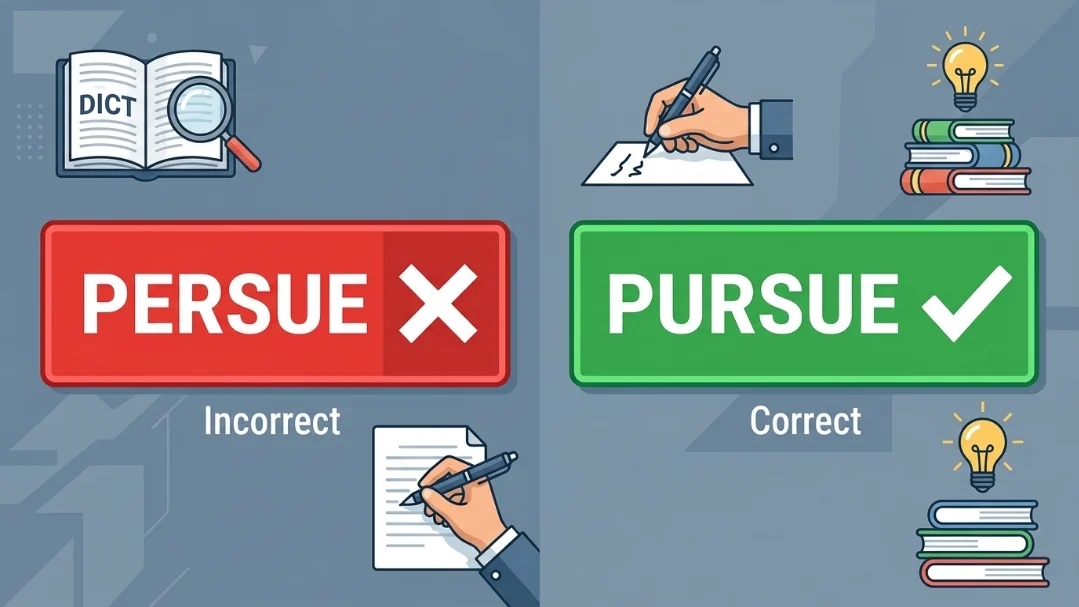
English spelling can be incredibly tricky, especially when vowels sound different than how they look on paper. A perfect example of this is the confusion between persue or pursue.
If you have ever paused while typing an email to wonder which version is correct, you are not alone. It is a mistake made by students, professionals, and native English speakers alike. The prefix per- is incredibly common in the English language, appearing in words like persuade, perceive, and securing a permit. Because the first syllable of the word sounds like “per,” your brain naturally wants to spell it with an “e.
However, using the wrong spelling can undermine your credibility in professional, academic, or creative writing. Choosing the correct term ensures your message is polished and clear. This comprehensive guide will break down everything you need to know about this word. You will learn its history, see how it functions in sentences, and master tricks to ensure you never use the incorrect spelling again.
Key Takeaway & Summary
To put it as simply as possible: pursue is a real word, while persue is a spelling error.
Correct:  To pursue a career in medicine requires years of dedication.
Incorrect: To persue a career in medicine requires years of dedication.
The word is a verb. It requires a subject and an object because it describes an action directed toward something or someone. Whether you are chasing a thief down the street, working toward a university degree, or following a lifelong passion, you are performing the action of the correct verb.
Definition and Etymology of Pursue
To fully understand a word, it helps to look at where it came from and how its meaning is structured.
Modern Definition
The verb has a few closely related meanings in modern English:
- To follow someone or something in order to catch or attack them.
- To follow a course of action or a systematic path over a long period.
- To strive to gain, find, or accomplish something.
- To proceed along a specific route or path.
Linguistic Origins
The word travels to modern English through a fascinating historical path. It originated in Old French as the word poursuivor, which meant to chase after, follow up, or prosecute. Going back even further, the Old French term came from the Latin word prosequi. In Latin, pro- means “forward” and sequi means “to follow.”
When you look at the Latin root, the spelling makes perfect sense. The “u” in the first syllable is a direct remnant of that linguistic history. Over centuries, the spelling shifted in English to use the pur- prefix, but it retained the core concept of following forward.
Advantages of Correct Spelling and Disadvantages of Typos
Using the correct spelling might seem like a small detail, but consistency in language has major real-world impacts. Let us compare the results of using the correct word versus making a mistake.
| Professionalism | Signals attention to detail, high literacy, and respect for the reader. | Looks careless and may cause an employer or client to question your competence. |
| Academic Performance | Ensures essays, research papers, and applications pass spell-check tools. | Results in dropped grades and shows a lack of editing. |
| Digital Communication | Enhenses search engine optimization (SEO) performance and keeps text easily searchable. | Makes your text harder to find via digital search functions. |
| Clarity | The reader focuses entirely on your ideas and your message. | The reader gets distracted by the error, breaking the flow of communication. |
Detailed Grammatical Breakdown
The verb is dynamic and changes shape depending on the tense of your sentence. To use it correctly across all types of writing, you must understand its various conjugations.
Present Tense
In the simple present tense, the word stays as it is for most subjects, but adds an “s” for the third-person singular.
- I pursue my hobbies on the weekend.
- You pursue greatness every day.
- He/She/It pursues a higher education standard.
- We pursue answers together.
- They pursue financial independence.
Past Tense
Because it is a regular verb, you form the past tense by simply adding a “d” to the end of the base word.
- Yesterday, the police officer pursued the suspect through the alley.
- She pursued a degree in structural engineering during the early 2010s.
Present Participle
When describing an ongoing action, drop the silent “e” at the end of the word and add “ing.”
- They are currently pursuing a merger with a larger technology corporation.
- Pursuing happiness is a fundamental human right.
Noun and Adjective Forms
The word can also transform into other parts of speech. The noun form is pursuit, which refers to the act of chasing or striving for something. The adjective form is pursuable, describing a goal or path that can realistically be followed.
Real-World Examples Across Different Contexts
To fully grasp how to use this word naturally, let us look at how it appears across different industries and writing scenarios.
1. Career and Education Context
In professional resumes, cover letters, and performance reviews, this word is used to talk about ambitions, training, and career progression.
“After working as a paralegal for three years, Sarah decided to pursue a Juris Doctor degree to become a fully licensed attorney.”
“Our company encourages employees to pursue professional development certifications to enhance their technical skill sets.”
2. Legal and Law Enforcement Context
In legal documents and news reports, the word frequently describes physical chases or legal actions.
“The private investigator continued to pursue the lead despite a lack of cooperation from the local authorities.”
“The plaintiff elected to pursue legal action against the manufacturer for breach of contract.”
3. Personal Growth and Lifestyle Context
When writing about hobbies, relationships, or personal development, the word describes dedication to an interest or lifestyle choice.
“If you want to live a fulfilling life, you must find the courage to pursue your creative passions.”
“He chose to pursue a minimalist lifestyle, selling most of his belongings to travel the world.”
Regional and Global Usage Patterns
Is there a difference in how this word is spelled in American English versus British English? The short answer is no. Unlike words like color/colour or organize/organise, the spelling of this word is entirely unified across the globe.
- United States: “Americans pursue the American Dream.”
- United Kingdom: “The Crown Prosecution Service decided to pursue the case.”
- Australia: “Students are encouraged to pursue vocational training.”
- Canada: “The government will pursue environmental green policies.”
No matter where your audience lives, persue is universally recognized as incorrect. You do not need to alter your spelling based on regional styles.
Why Do We Make This Mistake?
To defeat a common spelling error, it helps to analyze exactly why our brains trick us into making it. There describe three primary psychological and linguistic reasons for this specific typo:
The “Per-” Prefix Dominance
The English language contains hundreds of words that begin with per-. Think about how often you type words like perfect, perform, percentage, period, permission, or permanent. Because your fingers are deeply accustomed to typing the p-e-r sequence, your muscle memory takes over when you start writing a word that sounds similar.
The Phonetic Trap
When spoken aloud in casual conversation, the first syllable sounds identical to the first syllable of person or persuade. The vowel sound is unstressed, reducing it to a neutral vocal sound known as a schwa. Because you cannot hear a distinct “oo” sound in the first syllable when spoken quickly, your brain defaults to the most common spelling pattern.
Lack of Visual Exposure
Because automated spell-check programs instantly fix typos on our phones and computers, we rarely look closely at our mistakes. If you frequently type persue, your computer might be silently fixing it for you, meaning you never consciously learn the correct format.
Visual Memory Aid
To lock the correct spelling into your mind, try using visual and mental memory tricks.
+-------------------------------------------------------------+
|                     THE PURSE TRICK                         |
|                                                             |
|   To PURsue your goals, you need money in your PURse.       |
|                                                             |
|                  P - U - R - S - E                          |
+-------------------------------------------------------------+
Think of a purse. Both words start with the exact same three letters: P-U-R. Whenever you are writing about someone chasing a dream or a career, remember that they are chasing a bag of success—just like a purse.
Common Mistakes and Corrections
Let us look at a breakdown of common sentences where this error appears, along with the exact corrections required to fix them.
- Incorrect: The company will persue a new marketing strategy next quarter.
- Correct: The company will pursue a new marketing strategy next quarter.
- Why it matters: In corporate communications, a typo like this reduces the authority of your proposal.
- Incorrect: I am persuing a passion project in my spare time.
- Correct: I am pursuing a passion project in my spare time.
- Why it matters: When changing to the participle form, ensure the “u” remains in place.
- Incorrect: The cat persued the laser pointer across the living room rug.
- Correct: The cat pursued the laser pointer across the living room rug.
- Why it matters: In the past tense, ensure you do not slip an extra “e” into the first syllable.
Related Concepts and Word Comparisons
To deepen your vocabulary, it helps to understand how this word interacts with other words that sound similar, look similar, or share a similar meaning.
Pursue vs. Persuade
These two words are often confused because they sound remarkably alike, and both involve moving toward an objective. However, their definitions are entirely distinct.
- Pursue: To follow or chase something. (“I will pursue a degree.”)
- Persuade: To convince someone to do or believe something through reasoning or argument. (“I will persuade my manager to give me a raise.”)
Pursue vs. Follow
While these words are synonyms, they carry different levels of intensity.
- Follow: A neutral term that means to move behind something or go along a path. You can follow someone blindly without much effort.
- Pursue: Implies an active, determined, and energetic effort to catch or achieve something. It suggests obstacles must be overcome.
Pursue vs. Prosecute
In legal terms, these two words can overlap, but they have distinct applications.
- Pursue: To initiate or carry on a legal claim or case.
- Prosecute: To conduct legal proceedings against a specific person accused of a crime.
Interactive Learning Exercises
Practice makes permanent. Work through these exercises to test your understanding of the concepts covered in this guide.
Part 1: Fill in the Blank
Choose the correct spelling (pursue, pursues, pursued, or pursuing) to complete each sentence.
- The detective stubbornly __________ the suspect through the crowded train station.
- Are you planning to __________ a master’s degree after graduation?
- Small business owners face many challenges when __________ digital growth.
- He always __________ his dreams, no matter how difficult they seem.
- We have chosen not to __________ further legal action at this time.
Part 2: Spot the Error
Read the paragraph below and identify the spelling errors related to the focus keyword.
“Starting a new business requires immense focus. Founders must persue funding from venture capitalists while simultaneously persuing product market fit. If a founder loses the drive to persue their vision, the startup will likely fail. Those who successfully persue their goals often find that the journey was worth the struggle.”
Answer Key and Explanations
Part 1 Answers
- pursued (Past tense required for an action that occurred in a specific past event).
- pursue (Base verb form required following the helper verb “to”).
- pursuing (Present participle form required to indicate an ongoing process).
- pursues (Third-person singular form matching the subject “He”).
- pursue (Base verb form following the negative helper “not to”).
Part 2 Answers
There are four spelling errors in the paragraph. Every single instance of “persue” or “persuing” must be corrected to use a “u.” Here is the corrected text:
“Starting a new business requires immense focus. Founders must pursue funding from venture capitalists while simultaneously pursuing product-market fit. If a founder loses the drive to pursue their vision, the startup will likely fail. Those who successfully pursue their goals often find that the journey was worth the struggle.”
Frequently Asked Questions
Is persue a word in the dictionary?
No. It is not recognized as a valid word in any major English dictionary, including Oxford, Merriam-Webster, or Cambridge. It is classified strictly as a misspelling of the verb pursue.
How do you spell the past tense of pursue?
The past tense is spelled pursued. You drop the final “e” from the base word and add “ed.” Make sure you do not change the first syllable to “per” when changing the tense of the word.
What is the noun form of the word pursue?
The noun form is pursuit. It refers to the actual act of chasing or searching for something, such as in the famous historical phrase “the pursuit of happiness.”
Why does spellcheck not always catch the word persue?
Most modern spell-checkers will catch this error. However, if you accidentally added the incorrect spelling to your personal device’s custom dictionary in the past, your device will skip over it without alerting you.
Is there ever a time when persue is correct?
No. There are no archaic, historical, or regional dialects of English where this spelling is considered acceptable. It is universally incorrect across all forms of writing.
What are some good synonyms for pursue?
Depending on the context of your sentence, excellent synonyms include chase, follow, seek, track, shadow, strive for, court, hunt, or work toward.
How do you pronounce the word pursue correctly?
The word is pronounced as /pərˈsuː/. The first syllable has a very soft, unaccented vocal sound, while the second syllable sounds exactly like the word “sue.”
What is the opposite of pursuing something?
The opposite actions would be abandoning, avoiding, fleeing, retreating, or relinquishing a goal or a physical chase.
Can you use pursue when talking about romance?
Yes. In literature and formal contexts, it is common to say someone is looking to follow a romantic relationship with a partner, though it can sound a bit old-fashioned in casual conversations today.
Conclusion and Summary of Key Takeaways
Mastering the difference between persue or pursue comes down to recognizing a common phonetic trap and retraining your muscle memory. Writing is one of the most direct ways we project our intelligence, capability, and professionalism to the world. Eliminating simple typos from your vocabulary ensures that your ideas are always judged on their merits, rather than being dragged down by mechanical errors.
Always remember the core rules we have established:
- Pursue with a “u” is the only correct spelling.
- Persue with an “e” is an invalid typo that should be removed from your writing.
- Use the “purse” memory trick whenever you are uncertain about how to start writing the word.
Take the time to carefully proofread your work, update your device’s auto-correct dictionary if necessary, and confidently apply the correct spelling across all your professional and creative endeavors.

Harry Edwards is a language writer specializing in word meanings, synonyms, and language usage. He creates clear, accurate, and engaging content to help readers improve their vocabulary and communication skills.








2 thoughts on “Persue or Pursue? Clear Guide to the Correct Spelling”