When you search for synonyms for experiences, you want more than a word list. You need to know which word fits your tone, your audience, and your meaning. The best synonyms for experiences include encounters, events, episodes, adventures, occurrences, and impressions. But each of these carries a slightly different weight. One word might suit a travel blog perfectly and sound out of place in a job application. This guide covers every useful alternative, explains the differences, and helps you pick the right word every time.
Best Synonyms for Experiences
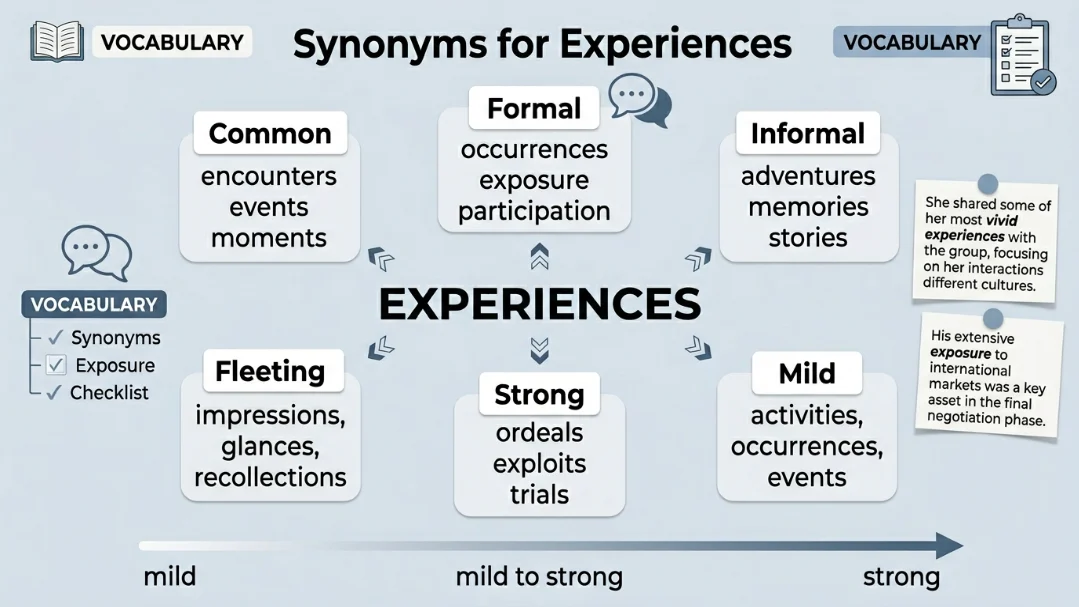
The best synonyms for experiences are encounters, events, episodes, adventures, occurrences, and impressions. The right choice depends on tone, context, and intensity. For professional writing, encounters or events tend to work well. For personal or emotional writing, moments or memories often feel more natural. For formal or academic contexts, occurrences or exposure may be the better fit.
What Does “Experiences” Mean?
Experiences is the plural form of experience. As a noun, it refers to things that have happened to a person — events, situations, or activities that have been lived through or participated in. The word can also refer to the knowledge or skill someone gains over time through those events.
Part of speech: Noun (plural)
Common uses:
- “Her experiences abroad shaped her outlook.”
- “He listed his experiences on his résumé.”
The word covers both single events (a job interview, a trip) and the broader collection of things someone has gone through over a lifetime. That broad range is exactly why you sometimes need a more specific synonym.
Core Meaning of “Experiences”
At its heart, experiences describes the things we live through. They can be big or small, positive or painful, deliberate or accidental. What unites them is that they happen to or with a person — and they leave some kind of mark. That mark might be a skill, a memory, an emotion, or a change in perspective.
Because the word covers such wide ground, the synonym you choose should narrow the focus. Adventures suggests excitement and movement. Ordeals suggests difficulty or suffering. Impressions focuses on what was felt or perceived. Choosing carefully makes your writing sharper.
Grammar and Usage Notes
Part of speech: Noun (plural)
Common sentence patterns:
- “My experiences in [place/situation] taught me…”
- “These experiences have shaped who I am.”
- “She brought valuable experiences to the team.”
Common collocations:
- life experiences — things learned through living
- work experiences — professional history
- childhood experiences — events from early life
- shared experiences — things people go through together
- new experiences — fresh, unfamiliar events or activities
When experiences sounds natural: When talking about a broad range of things someone has lived through, or when listing events that built a person’s skills or perspective.
When a synonym works better: When you want to highlight the emotional impact (impressions, memories), the excitement (adventures, exploits), the difficulty (ordeals, trials), or when the writing calls for more specific language.
Best Synonyms for Experiences
| Synonym | Meaning | Tone | Best Use Case | Example Sentence |
| Encounters | Meetings or interactions with people or situations | Neutral to formal | Professional, travel, personal writing | “Her encounters with local communities changed her view.” |
| Events | Things that happen, often notable | Neutral | General writing, reporting | “The events of that year stayed with him.” |
| Episodes | Distinct periods or incidents | Neutral to literary | Storytelling, memoir, journalism | “Each episode in her journey added a new lesson.” |
| Adventures | Exciting or unusual events | Warm, positive | Travel writing, casual, creative | “His adventures in Southeast Asia were unforgettable.” |
| Occurrences | Things that take place, especially unexpectedly | Formal | Academic, technical, legal writing | “These occurrences were well documented.” |
| Impressions | Feelings or perceptions left by events | Reflective | Personal essays, reviews, memoir | “Her impressions of the city shifted after a week.” |
| Exploits | Bold or daring actions or events | Strong, dramatic | Stories, biographies, casual speech | “His exploits during the expedition became legend.” |
| Memories | Recollections of past events | Warm, personal | Personal writing, emotional contexts | “Childhood memories shape who we become.” |
| Ordeals | Difficult or painful experiences | Heavy, intense | Serious writing, memoir, journalism | “The survivors shared their ordeals with the press.” |
| Moments | Brief but meaningful events | Warm, gentle | Everyday writing, personal, emotional | “Those quiet moments meant everything to her.” |
Common Synonyms for Experiences
These are everyday alternatives that fit most general writing without sounding too formal or too casual.
Events Means things that happened, often with some significance. Works well when you want a neutral, clean word. “The events of that summer changed everything between them.”
Episodes Suggests distinct, separate occurrences — each one its own chapter. Works well in storytelling or memoir. “Each episode in his career taught him something new.”
Encounters Refers to meetings, situations, or interactions someone has gone through. Works in both personal and professional writing. “Her encounters with different cultures broadened her thinking.”
Moments Softer and more personal. Points to brief, often meaningful events. Best in emotional or reflective writing. “She treasured the quiet moments they shared.”
Happenings An informal word for events or occurrences. Has a slightly dated or quirky feel but works in casual writing. “The strange happenings that week still puzzled him.”
Formal Synonyms for Experiences
These alternatives suit academic papers, professional profiles, reports, and formal essays.
Occurrences Refers to things that take place, especially distinct or notable events. Precise and academic in tone. Best for: Research writing, formal reports “These occurrences were recorded and analyzed systematically.”
Encounters Works formally when describing interactions or situations faced in a professional or clinical context. Best for: Professional writing, résumés, business documents “Her professional encounters with cross-functional teams improved her collaboration skills.”
Exposure Refers to contact with or involvement in something over time, particularly skills, environments, or fields. Strong on a résumé. Best for: Job applications, academic portfolios “His early exposure to fieldwork shaped his research approach.”
Participation Refers to active involvement in activities or events. Formal and precise. Best for: Academic writing, professional summaries “Her participation in international conferences expanded her network.”
Engagements Refers to scheduled interactions or professional involvement. Slightly more formal than encounters. Best for: Business or professional writing “His engagements with local nonprofits were listed in the report.”
Informal Synonyms for Experiences
Use these in conversations, social media posts, personal messages, or casual writing.
Adventures Suggests something fun, exciting, or out of the ordinary. Upbeat and energetic. “Can’t wait to share all my adventures from the road trip!”
Times Simple and conversational. Works when you want to sound relaxed. “Those were some of the best times of my life.”
Memories Warm and personal. Points to past events through the lens of feeling and recollection. “We laughed about our old memories for hours.”
Escapades Suggests adventure with a hint of mischief or fun. Light and playful. “Her college escapades were the stuff of family legend.”
Stories Casual and relatable. Points to experiences that are worth telling. “He had so many stories from his years traveling.”
Strong Synonyms for Experiences
These carry more emotional intensity, drama, or significance. Use them when the situation genuinely calls for stronger language.
Ordeals Heavy and serious. Implies suffering, hardship, or challenge. Don’t use it for mildly difficult events. “The survivors recounted their ordeals with remarkable calm.”
Exploits Bold and impressive. Suggests daring actions or remarkable feats. Works well in biographies or dramatic storytelling. “His wartime exploits became the subject of three books.”
Trials Suggests hardship, difficulty, and testing. More formal than ordeals and often used in serious contexts. “The trials of that first year abroad made her stronger.”
Feats Suggests accomplishment or impressive action. More positive in tone than ordeals or trials. “Her athletic feats inspired younger players across the country.”
Use strong synonyms carefully. Calling a minor inconvenience an ordeal sounds dramatic and can undermine your credibility.
Mild Synonyms for Experiences
These gentler alternatives work when you want to describe events without adding weight or drama.
Moments Light and personal. Perfect when the experience is small but meaningful. “She smiled at the small moments that made up her day.”
Impressions Focuses on perception rather than the event itself. Subtle and reflective. “His impressions of the city were mostly positive.”
Encounters Neutral and mild when used for general interactions or situations. “Her casual encounters with locals made the trip feel real.”
Activities Very neutral. Points to things done rather than things felt or experienced. “The program offered a wide range of enrichment activities.”
Mild synonyms are useful in professional settings, when writing about sensitive topics, or when understatement serves the tone better than drama.
Synonyms for Experiences by Context
Everyday Conversation
In casual talk, adventures, times, memories, and stories feel most natural. These words are friendly, relatable, and easy to understand. “We had the best adventures last summer” lands better in conversation than “We had notable occurrences last summer.”
Professional Writing
On a résumé or in a cover letter, exposure, encounters, participation, and engagements signal professional precision. They show range and involvement without sounding casual.
Academic Writing
Occurrences, exposure, and participation work well in formal academic contexts. These words are measurable and specific — exactly what academic writing calls for.
Creative Writing
Episodes, exploits, encounters, ordeals, and moments give creative writing texture and variety. Each carries a different emotional color, letting writers shape tone sentence by sentence.
Emotional Expression
When writing about feeling, memory, or personal meaning, memories, moments, and impressions are the strongest choices. They shift the focus from what happened to what was felt.
Marketing Copy
In marketing, experiences itself is often the power word — think “curated experiences” or “unforgettable experiences.” When you need variety, adventures, moments, and encounters tend to perform well in headings and taglines.
Another Word for “Experiences” in a Sentence
Here are natural example sentences using different synonyms for experiences:
- “Her encounters with refugees reshaped her understanding of resilience.”
- “The events of his childhood left a lasting impression on him.”
- “Each episode of the trip brought a new challenge and a new lesson.”
- “Their adventures through the highlands were full of unexpected beauty.”
- “These occurrences were noted in the official record.”
- “Her impressions of the culture shifted after just a few days.”
- “He rarely spoke about the ordeals of his early years.”
- “Her exploits as a young journalist became the talk of the newsroom.”
- “The memories they made that summer never really faded.”
- “Those small moments are what she remembers most about the journey.”
- “His exposure to different teaching methods improved his own approach.”
- “The trials of building the business from nothing made her tougher.”
- “She had collected so many stories from her years of travel.”
- “Their shared activities helped build a stronger team culture.”
- “His participation in volunteer programs added real depth to his application.”
“Experiences” Synonyms Compared
Some synonyms are close but carry different connotations. Here’s how several key words compare:
| Word | Tone | Intensity | Best For |
| Encounters | Neutral to formal | Mild to moderate | Professional, personal writing |
| Events | Neutral | Mild | General, factual writing |
| Episodes | Neutral to literary | Mild to moderate | Storytelling, memoir |
| Adventures | Warm, positive | Moderate to strong | Travel, casual, creative |
| Ordeals | Heavy, serious | Strong | Hardship, difficult events |
| Moments | Warm, gentle | Mild | Personal, emotional writing |
| Memories | Personal, reflective | Mild | Looking back, nostalgic writing |
| Occurrences | Formal, clinical | Mild | Academic, technical writing |
Encounters vs. Events: Encounters implies personal involvement or interaction, while events can describe things that happened without any personal connection. Use encounters for things you experienced directly; use events for things that occurred.
Episodes vs. Moments: Episodes implies a distinct, separate incident with some narrative arc. Moments suggests something brief and emotionally significant. Episode is better for storytelling; moment is better for personal reflection.
Ordeals vs. Trials: Both suggest hardship, but ordeals feels more physical and immediate — something endured. Trials is slightly more formal and often implies a sustained period of difficulty or testing.
Words Similar to “Experiences”
These words belong to the same semantic world as experiences but don’t always work as direct replacements.
Exposure Refers specifically to contact with something over time, especially in a learning or professional context. It’s not always interchangeable with experiences because it focuses on what someone was introduced to rather than what they went through. “His early exposure to classical music shaped his taste, but his real experiences as a performer came later.”
Background Often used in professional contexts to describe someone’s collected history of work and life events. Too broad to swap directly for experiences in most sentences. “Her background in public health gave her a strong foundation.”
Involvement Focuses on active participation rather than lived events. Use it when you want to stress that someone took part in something deliberately. “Her involvement in the campaign gave her political insight.”
History The full record of what has happened to someone or something. Much broader than experiences and harder to use as a direct synonym. “His personal history includes years of fieldwork in remote regions.”
Perspectives Not a synonym, but often used alongside experiences to describe the viewpoints shaped by lived events. Use it to talk about what experiences produce, not the experiences themselves.
Antonyms of “Experiences”
| Antonym | Meaning | Example Sentence |
| Inexperience | Lack of knowledge or skill from not having done something | “Her inexperience in the field showed in her first report.” |
| Ignorance | Absence of knowledge or awareness | “His ignorance of local customs caused several misunderstandings.” |
| Naivety | Lack of worldly experience or judgment | “Her naivety gave way to confidence as she learned more.” |
| Unawareness | State of not knowing or noticing something | “His unawareness of the risks came from never having faced them.” |
How to Choose the Right Synonym for “Experiences”
Match the context. Ask where the word will live — in a résumé, a travel blog, a research paper, a personal letter? The setting determines the register.
Match the tone. Warm and personal? Go with memories or moments. Neutral and professional? Try encounters or exposure. Dramatic and intense? Use ordeals or exploits.
Check the intensity. Not every experience is an ordeal. Not every trip is an adventure. Use words that match the actual weight of what you’re describing.
Think about the reader. A casual reader will connect with stories and memories more easily than occurrences or engagements.
Check whether the synonym is exact. Words like background, history, and involvement are related to experiences but aren’t always interchangeable. Swap them only when the meaning still holds.
Keep the sentence natural. Read the sentence out loud after swapping the word. If it feels forced or strange, choose differently.
When in doubt, use a simpler word. Clarity almost always wins over cleverness.
Common Mistakes When Using Synonyms for “Experiences”
Using ordeals for minor difficulties. Calling a rough commute an ordeal overstates it. Save heavy words for genuinely difficult events.
Using formal words in casual writing. Writing “These occurrences defined our friendship” in a personal text sounds stiff and cold. Use moments or memories instead.
Using casual words in professional writing. “My adventures in accounting…” on a résumé would strike most hiring managers as odd. Use exposure or involvement.
Treating memories as an exact synonym. Memories refers to what you recall about experiences — it focuses on recollection, not the events themselves. Don’t confuse them.
Ignoring connotation. Episodes can sometimes imply something slightly negative or problematic, as in “another episode of poor judgment.” Context matters.
Replacing experiences without reading the full sentence. Synonyms change the flavor of a sentence, not just a single word. Always re-read the whole sentence after swapping.
Stacking related words unnecessarily. Writing “her experiences, events, and episodes” as if they mean different things just creates clutter.
Synonym List for “Experiences”
Common synonyms: encounters, events, episodes, moments, happenings
Formal synonyms: occurrences, exposure, participation, engagements, encounters
Informal synonyms: adventures, times, memories, stories, escapades
Strong synonyms: ordeals, exploits, trials, feats
Mild synonyms: moments, impressions, encounters, activities
Related words (not always direct replacements): background, history, involvement, perspectives, exposure
FAQs
What is the best synonym for “experiences”?
The best synonym depends on your context. For professional writing, encounters or exposure works well. For personal writing, memories or moments is often the stronger choice. For neutral, general writing, events or episodes tends to fit most situations cleanly.
What is another word for “experiences”?
Common alternatives include encounters, events, episodes, adventures, occurrences, and moments. The right choice depends on whether you want a formal, informal, strong, or mild tone.
What is a formal synonym for “experiences”?
The most formal synonyms for experiences are occurrences, exposure, participation, and engagements. These work well in academic papers, professional reports, and formal correspondence.
What is an informal synonym for “experiences”?
Casual alternatives include adventures, stories, times, memories, and escapades. These feel natural in conversation, social media, and personal writing.
What is a stronger word for “experiences”?
Ordeals, trials, exploits, and feats are stronger alternatives. They carry more emotional weight or intensity. Use them when the experience itself was genuinely dramatic, difficult, or impressive.
What is a milder word for “experiences”?
Moments, impressions, and activities are softer alternatives. They tone down the significance of the events being described, which works well when understatement is the right choice.
What words are similar to “experiences” without being exact synonyms?
Background, history, involvement, and exposure are closely related but not always interchangeable. They focus on different aspects — what someone has been part of or introduced to — rather than the lived events themselves.
What is the opposite of “experiences”?
The clearest antonyms are inexperience, ignorance, naivety, and unawareness. All suggest the absence of what experiences provides: knowledge, skill, or familiarity gained through living through events.
How do I choose the right synonym for “experiences”?
Start with context and tone. Ask whether the writing is formal or casual, personal or professional. Then consider the intensity — how significant were the events? Finally, read the sentence out loud with the synonym in place. If it sounds natural, you’ve found the right word.
Conclusion
The word experiences does a lot of work in English. It covers everything from childhood memories to professional backgrounds, from exciting adventures to painful ordeals. That breadth is useful — but it also means a more specific word will often serve you better.
For formal writing, reach for occurrences, exposure, or participation. For personal or emotional writing, memories, moments, or impressions carry more feeling. For stories and creative writing, episodes, encounters, adventures, and exploits give you texture and variety. For difficult events, ordeals or trials signal the appropriate weight.
The best synonym for experiences is always the one that fits your tone, suits your reader, and says exactly what you mean. Use this guide as a reference whenever you need the right word — not just a different word.