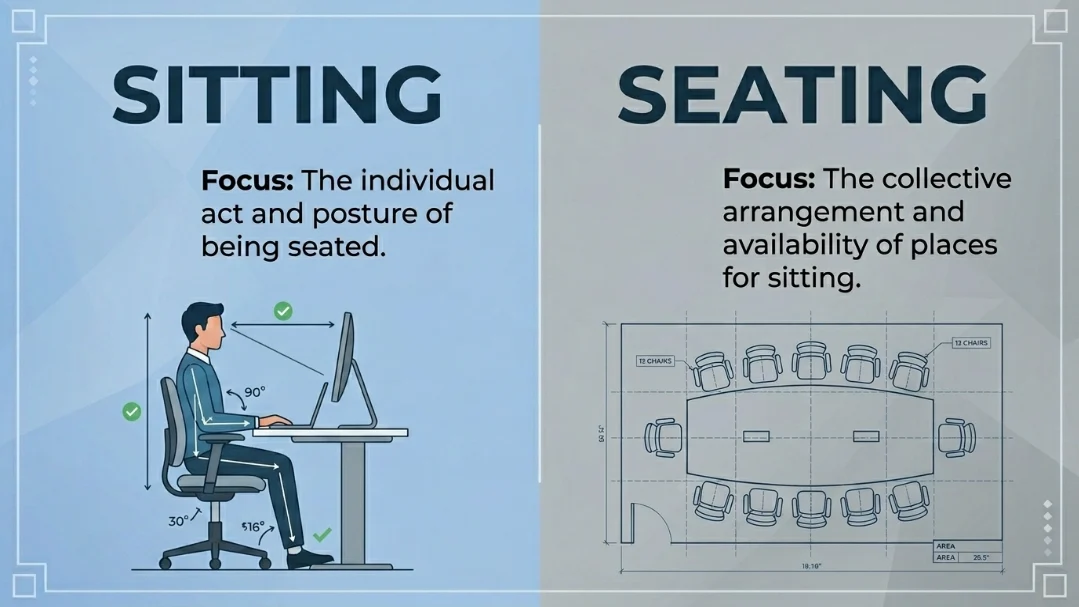
The main difference between sitting or seating comes down to action versus capacity. Sitting is the continuous physical act of resting your body on a support like a chair or stool. Seating refers to the physical objects provided for people to sit on, the arrangement of those objects, or the maximum capacity of a venue.
People often mix up sitting or seating because both words relate to the exact same human position. However, using them incorrectly in writing or business can confuse your audience. Choosing the wrong word can change the entire meaning of a sentence, turning a description of a physical action into a statement about furniture layout.
Whether you are writing an essay, planning an office space, or managing a large restaurant, using these terms correctly is highly important. Misusing them can make professional documents look amateur. On the other hand, mastering their use helps you communicate clearly with colleagues, clients, and readers.
This article breaks down everything you need to know about sitting or seating. We will explore grammar rules, real world examples, workplace ergonomic standards, and industry designs. By the end of this guide, you will know exactly which word to choose for any situation.
Overview of Sitting or Seating
To get started, let us look at a simple summary of how these two words function in daily language.
| Part of Speech | Verb (present participle) or Noun (gerund) | Noun or Verb (action of assigning seats) |
| Primary Meaning | The physical act of resting on a seat | The actual furniture, layout, or capacity |
| Focus | Individual human action and posture | Objects, arrangements, and spaces |
| Dynamic | Active movement or stationary posture | Structural design or spatial organization |
Detailed Definitions and Explanations
To understand the deeper differences, we must look at how each word functions under a grammatical microscope.
What is Sitting
Sitting comes from the root verb “to sit”. When used as a present participle, it describes a continuous action happening right now. For example: He is sitting by the window.
It can also act as a gerund, which is a verb form that functions as a noun. For example: Sitting for long hours can cause back pain. In this case, the word represents the concept of the activity itself.
The focus of this word is always on the body. It describes the physical position where your weight rests on the lower part of your torso rather than your feet. It implies a state of rest, focus, or stagnation.
What is Seating
Seating is primarily used as a noun. It refers to the collective group of chairs, benches, stools, or sofas available in a specific area. When a theater manager says, The venue has excellent seating, they are praising the quality and availability of the chairs, not the behavior of the audience.
Seating can also refer to the total capacity of a room. For example: The stadium has a total seating capacity of fifty thousand people.
Finally, it can be used as a verb form when someone is actively guiding people to their places. For example: The usher is seating the guests in the front row. Here, it is an active, transitive verb because it requires an object (the guests) receiving the action.
Advantages and Disadvantages of Spatial Design Choices
In professional fields like architecture, office management, and event planning, the focus shifts heavily toward optimizing seating options. Let us look at the benefits and drawbacks of different arrangements.
Fixed Seating
Fixed seating refers to chairs that are bolted to the floor. You commonly see this style in movie theaters, lecture halls, and stadiums.
- Advantages: It creates an orderly flow of traffic. People know exactly where to go, and aisles remain completely clear. This setup maximizes the safety of the room during an emergency evacuation.
- Disadvantages: It offers zero flexibility. You cannot move the chairs to clear space for a dance floor or a collaborative group project. It can also feel restrictive for individuals who require more physical space.
Flexible Seating
Flexible seating involves movable furniture like individual rolling chairs, bean bags, couches, and height adjustable stools. This setup is highly popular in modern offices and school classrooms.
- Advantages: It boosts collaboration and teamwork. People can move their chairs together in seconds to brainstorm ideas. It also allows individuals to choose the exact type of chair that feels comfortable for their body.
- Disadvantages: It can easily become messy and chaotic. If people move furniture without a plan, they might accidentally block emergency exits or fire lanes. It also requires constant maintenance to keep the room organized.
Real World Examples and Case Studies
Let us explore how different industries use these concepts to solve daily problems and improve user experiences.
The Corporate Office Landscape
In a modern corporate office, managers must balance individual employee sitting habits with the overall office seating plan.
Consider a tech company that noticed a drop in employee energy levels. After analyzing the workplace, human resource experts found that employees spent an average of nine hours a day sitting down without moving. This poor habit led to physical fatigue and lower mental focus.
To solve this, the company redesigned its layout. They introduced a hot desking model, which is a flexible seating strategy where employees do not have assigned desks. Instead, they choose a new work area each day based on their tasks.
They also installed standing desks alongside standard ergonomic chairs. This new approach allowed workers to alternate between sitting and standing throughout the day, which boosted productivity by twenty percent.
The Restaurant Industry
For a restaurant owner, understanding seating arrangements is the secret to maximizing daily revenue.
Imagine a popular downtown bistro with limited floor space. The owner initially installed large, heavy booths across the entire dining room. While these booths provided a cozy sitting experience for customers, they severely limited the restaurant’s total seating capacity during peak weekend hours. A party of two would often sit at a booth built for six people, wasting valuable space.
The owner hired a restaurant consultant who recommended replacing half of the booths with flexible two person tables that could be pushed together for larger parties. This simple change increased the total seating capability by thirty five percent and dramatically reduced guest wait times.
Regional and Global Usage Differences
Language shifts depending on where you travel in the world. The way people use sitting or seating can vary across different cultures and English speaking countries.
North American Usage
In the United States and Canada, the term seating is heavily used in business, real estate, and hospitality marketing. A real estate listing for a home will often boast a large outdoor seating area rather than a sitting area. The word seating carries a professional, premium tone that implies the space was intentionally designed for hosting guests.
British and Commonwealth Usage
In the United Kingdom, Australia, and New Zealand, the term sitting room is still widely used to describe what Americans typically call a living room or family room.
Additionally, in British English, you will frequently hear people use the phrase is sat instead of is sitting. For example, a British person might say, He was sat on the bench for an hour. While this is completely acceptable in casual British conversation, it is technically incorrect in formal grammar writing worldwide. The proper phrase is always was sitting.
Common Mistakes and How to Correct Them
Even experienced writers sometimes trip over these terms. Here are the most frequent errors and how to fix them instantly.
1: Using Sitting to Describe Objects
- Incorrect: The restaurant has a beautiful outdoor sitting area.
- Correct: The restaurant has a beautiful outdoor seating area.
- Why it matters: An area consists of physical furniture and space, so it requires the noun form that represents objects.
2: Using Seating to Describe Personal Posture
- Incorrect: I have been seating at my desk all morning.
- Correct: I have been sitting at my desk all morning.
- Why it matters: You are describing your personal continuous physical action, which requires the present participle verb form.
3: Misapplying Transitive Meanings
- Incorrect: The host is sitting the family at table four.
- Correct: The host is seating the family at table four.
- Why it matters: The action is being directed toward an object (the family). The verb “to seat” is transitive and fits perfectly here, whereas “to sit” is typically intransitive in this context.
Exercises with Detailed Answers
Test your knowledge with these practical exercises. Read each sentence and decide whether sitting or seating is the correct choice.
Questions
- The stadium officials upgraded the luxury ________ options before the big tournament started.
- Please remain ________ until the airplane comes to a complete stop at the airport gate.
- We need to calculate the total ________ capacity of the conference hall before printing tickets.
- She prefers ________ on a stability ball instead of a traditional office chair to improve her posture.
- The wedding planner designed a beautiful custom ________ chart for the reception dinner.
- He spent the entire afternoon ________ on the porch reading a fantasy novel.
- The theater offers tier based ________, with premium tickets costing more near the front stage.
- I noticed a strange cat ________ on top of my car hood this morning.
Answers and Explanations
- seating (It refers to the physical chairs and choices available to the customers.)
- seated or sitting (In this passive context, seated is preferred, but sitting works if phrased as “remain sitting” to describe the continuous state.)
- seating (It modifies capacity to describe the maximum number of chairs or spaces available.)
- sitting (It describes the active, ongoing physical posture of the person.)
- seating (It describes the structural arrangement plan showing where guests will be placed.)
- sitting (It describes the individual’s physical action over a long period.)
- seating (It refers to the organized layout and classification of the venue’s chairs.)
- sitting (It describes the physical position and active state of the cat.)
Related Concepts and Comparisons
To fully grasp this topic, it helps to compare sitting or seating with other closely related terms used in professional industries.
Sitting versus Standing
With the rise of ergonomic wellness, companies frequently compare sitting and standing.
Sitting lowers energy expenditure but can put high pressure on the lower lumbar spine if done poorly. Standing increases your heart rate slightly and burns more calories, but standing for too long can cause foot fatigue and leg swelling. Experts recommend a balanced mix of both throughout the workday.
Seating versus Bedding
In hotel management and interior design, professionals look at seating versus bedding ratios. Seating refers to furniture designed for upright or relaxed wakeful relaxation, such as armchairs and sectionals. Bedding refers to furniture and fabrics designed specifically for sleep. A well designed hotel room must balance these two elements to maximize guest comfort.
Frequently Asked Questions
What is the main grammatical difference between sitting or seating?
Sitting is primarily a verb form that describes a person’s physical posture or active state of resting on a surface. Seating is primarily a noun that refers to physical chairs, an arrangement layout, or the total capacity of a specific room.
Can I say a room has a lot of sitting space?
It is much better to say a room has a lot of seating space. Seating space implies that the area is physically equipped with furniture or room designed for people to sit down comfortably.
Is it correct to say I am seating on a chair?
No, that is incorrect. You should say I am sitting on a chair. You are performing the physical action yourself, so you use the active verb form.
What does seating capacity mean in building codes?
Seating capacity means the maximum number of people who can safely sit inside a venue based on the number of installed chairs or total square footage. Fire marshals strictly enforce these limits to ensure safe evacuations.
Why do restaurants use a seating chart?
Restaurants use a seating chart to organize the dining room floor, track open tables, and ensure that waiters receive an equal number of guests throughout their work shifts.
What is ergonomic seating?
Ergonomic seating refers to chairs designed to fully support the human body’s natural posture. These chairs help reduce muscle strain, prevent back pain, and improve comfort during long hours of work.
Can seating be used as an active verb?
Yes, seating can be used as an active verb when someone is guiding or directing others to their designated spots. For example, the usher is seating the audience members now.
Is sitting down for eight hours a day dangerous?
Health experts state that sitting down for eight straight hours without breaks can increase health risks. It slows your metabolism and strains your back. It is best to stand up and stretch every thirty minutes.
What is the difference between a sitting room and a living room?
Historically, a sitting room was a smaller, intimate space meant for quiet conversation or reading. A living room is typically larger and designed for general family activities, entertainment systems, and hosting larger groups.
Conclusion
Understanding the distinction between sitting or seating ensures your writing remains clear and accurate. Sitting focuses entirely on the human body, its movement, and its physical posture. Seating centers on the physical environment, including the furniture, the structural layout, and the overall capacity of a room.
In professional environments, balancing these two elements is essential. Business owners must design comfortable seating layouts to maximize spatial efficiency and safety. At the same time, they must encourage healthy sitting habits to protect the physical well being of their employees and clients. By applying the rules outlined in this guide, you can eliminate grammatical errors and make informed design decisions for any project.