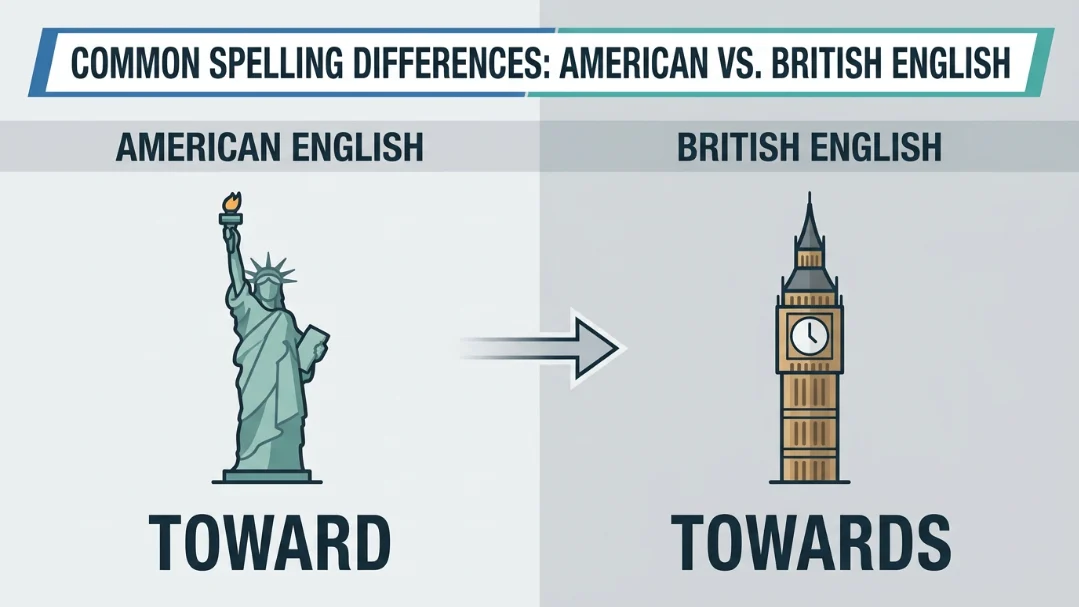
Both toward and towards are grammatically correct and mean the exact same thing, which is “in the direction of.” The only real difference between them is regional preference. Writers in the United States and Canada typically prefer toward, whereas writers in the United Kingdom, Australia, and other parts of the Commonwealth usually choose towards.
Choosing between toward and towards can feel like navigating a grammatical minefield, especially when you are writing for an international audience. Many professional writers, students, and grammar enthusiasts frequently stall mid-sentence, wondering if that final “s” is a necessary addition or an embarrassing error. Because spell-checkers flip-flop depending on their regional settings, this tiny letter causes an immense amount of unnecessary anxiety across the globe.
Understanding the distinction is highly important because consistency reflects professionalism in your writing. Whether you are drafting a corporate report, writing a university essay, or crafting marketing copy, using the preferred regional variant establishes immediate credibility with your readers. Consequently, mixing up these styles randomly within a single document can make your text look careless and unpolished.
Fortunately, the underlying rule is incredibly simple to learn and apply. By mastering a few basic regional patterns, you can confidently eliminate this confusion from your daily writing routine forever. This comprehensive guide will break down the history, usage, and regional rules governing these two identical prepositions so you can always write with absolute certainty.
If you are looking for a quick, definitive answer to keep your writing on track, the fundamental truth is that toward and towards are completely interchangeable in terms of meaning. Neither word holds a superior grammatical status over the other, and both function perfectly as prepositions in any sentence.
To help you visualize the core differences instantly, look over this quick reference summary:
| Primary Region | United States and Canada | United Kingdom, Australia, and New Zealand |
| Grammatical Part of Speech | Preposition | Preposition |
| Core Meaning | In the direction of | In the direction of |
| Style Guide Preference | AP Style, Chicago Manual of Style | Oxford Style, Guardian Style |
| Tone Feeling | Modern and direct | Traditional and rhythmic |
Ultimately, your choice depends entirely on your target audience. If your readers live in North America, you should omit the “s” to align with local standards. Conversely, if your content targets a British or Commonwealth audience, adding the “s” will make your prose sound entirely natural to their ears.
Definition and Explanation
To understand these words deeply, we must look at how they function within the English language. Both words serve exclusively as prepositions, which means they show the spatial, temporal, or conceptual relationship between a noun and other words in a sentence. Specifically, they indicate movement, direction, or progress regarding a specific point or goal.
[Subject + Verb] ---> (Movement/Direction) ---> [Toward / Towards] ---> [Destination/Goal]
The origin of the words dates back to Old English, where the root word toweard meant “directed forward” or “imminent.” Over time, the English language developed a habit of adding an adverbial genitive suffix, the “s” sound, to various directional words. This linguistic evolution explains why we also have pairs like forward and forwards, backward and backwards, or upward and upwards.
When you analyze their definitions in major dictionaries like Merriam-Webster or Oxford, you will find that they share the exact same meanings, which include:
- In the direction of a physical location.
- Along a course leading to a specific result or objective.
- In relation to or concerning a particular person or topic.
- Close to a specific time or date.
Because these definitions mirror each other perfectly, you never have to worry about changing the fundamental meaning of your sentence when switching between the two terms. The variation is purely a matter of spelling and regional style rather than a matter of semantic definition.
Advantages and Disadvantages of Each Variant
While both options are grammatically valid, using one over the other carries distinct advantages and disadvantages depending on your specific writing context. Evaluating these pros and cons can help you decide which word fits your project best.
Using Toward
Selecting the track without the “s” offers several distinct benefits for writers focusing on clean, streamlined communication.
Advantages:
- North American Compliance: This spelling aligns perfectly with the strict requirements of major American publishing houses and journalistic outlets.
- Space Efficiency: It saves a character, which is a minor benefit but helpful when you are working with strict character limits in digital advertising or journalism.
- Modern Appearance: Many contemporary readers view the shorter form as cleaner and less cluttered on the page.
Disadvantages:
- Commonwealth Distraction: It can look jarring or overly Americanized to readers in London, Sydney, or Johannesburg, potentially pulling their focus away from your message.
Using Towards
Opting for the version with the final “s” brings its own set of stylistic considerations.
Advantages:
- Global Standard: It fits naturally into the vast majority of English-speaking countries outside of North America, ensuring your text reads smoothly for a global audience.
- Rhythmic Flow: Many poets and creative writers find that the soft “s” sound provides a gentler phonetic transition to the next word in a sentence.
Disadvantages:
- American Style Violations: It will trigger immediate corrections from editors using the Associated Press (AP) Stylebook or the Chicago Manual of Style, costing you extra editing time.
Real-World Examples
To solidify your understanding, it helps to see how these prepositions operate in everyday sentences. Since their meanings are identical, we can examine how they look across physical, abstract, and time-based contexts.
Physical Direction
When describing actual movement through space, both words illustrate the path an object or person takes.
- Example A: The young boy turned and ran toward the safety of his home when the storm began.
- Example B: The cruise ship sailed slowly towards the tropical island as the sun began to set.
Abstract Goals or Progress
Writers frequently employ these terms to describe progress along a non-physical path, such as an emotional journey, a financial target, or a career milestone.
- Example A: Every dollar we save this month goes toward building our emergency fund.
- Example B: The diplomatic teams are working tirelessly towards a peaceful resolution to the border dispute.
Attitudes and Feelings
You can use either option to express a mental posture, emotion, or behavioral stance directed at someone or something else.
- Example A: Her warm attitude toward the new employees made everyone feel welcome in the office.
- Example B: The public sentiment towards the new tax law remains overwhelmingly negative.
Approaching a Point in Time
When a specific event or deadline draws near, these prepositions effectively signal that chronological progression.
- Example A: The temperature always drops significantly toward the end of November.
- Example B: We noticed a sudden surge in website traffic towards midnight.
Regional and Global Usage Patterns
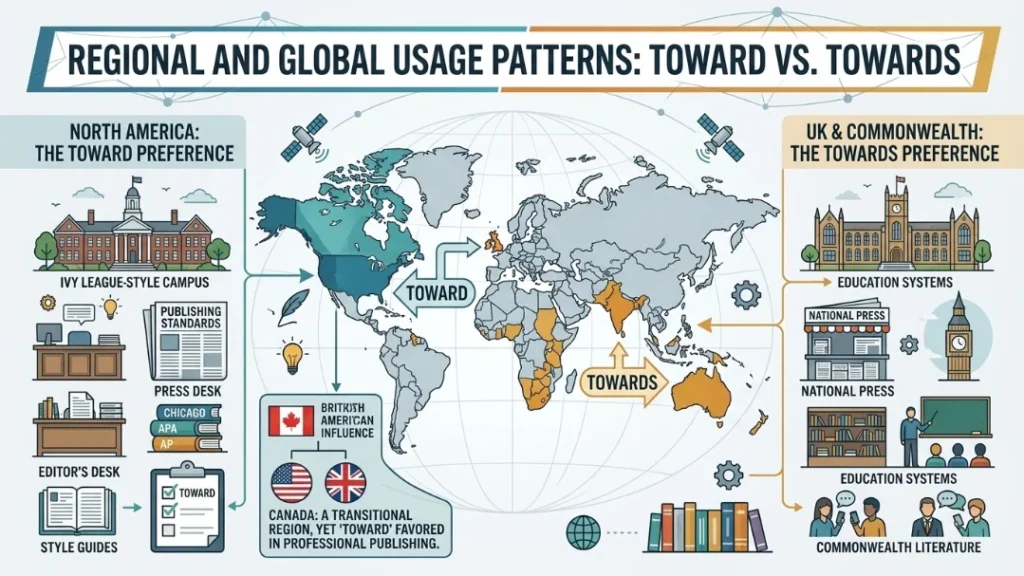
The split between these two words is one of the clearest examples of the divide between American English and British English. Exploring these regional habits reveals exactly when and where you should use each spelling to match local expectations.
[Global Usage Map]
North America (USA, Canada) ----------> Prefers TOWARD
Rest of the World (UK, Aus, NZ, etc.) -> Prefers TOWARDS
In the United States and Canada, toward reigns supreme. This dominance is heavily reinforced by standard academic curricula and major institutional style guides. For instance, journalists adhering to the AP Stylebook are strictly forbidden from using towards. Similarly, authors following the Chicago Manual of Style are taught that the “s” is entirely superfluous and should be removed during the editing process.
Conversely, the situation reverses entirely once you cross the Atlantic Ocean. Throughout the United Kingdom, towards is the undisputed default choice in newspapers, books, and everyday speech. The Oxford English Dictionary lists toward as an older or less common variant. Furthermore, this preference extends across the entire Commonwealth of Nations, including Australia, New Zealand, India, and South Africa.
Interestingly, Canada occupies a somewhat unique middle ground due to its proximity to the United States and its historical ties to Britain. However, major Canadian authorities, including The Canadian Press Stylebook, firmly recommend toward for consistency with their domestic publishing industry. Therefore, if you are writing for a North American audience, leave the “s” off, but keep it on for the rest of the world.
Common Mistakes and How to Avoid Them
Even though the basic rule is straightforward, many writers still stumble into predictable errors when using these terms. Recognizing these pitfalls allows you to clean up your prose and maintain a high standard of professional writing.
Mixing Variants in a Single Document
The most frequent mistake is switching between toward and towards within the same piece of writing. For example, using toward on page one and towards on page three signals to an editor that you did not decide on a target audience or a specific style guide before writing.
- Incorrect: We walked toward the stadium, but as we got closer towards the entrance, the crowd grew dense.
- Correct: We walked toward the stadium, but as we got closer toward the entrance, the crowd grew dense.
Treating Them as Different Parts of Speech
Some writers mistakenly believe that one form is an adjective and the other is a preposition. They might try to use toward to mean something good or appropriate, confusing it with the rare adjective untoward (which means inappropriate or unexpected).
- Incorrect: The business deal yielded a very towards outcome for our startup.
- Correct: The business deal yielded a very favorable outcome for our startup.
Overusing the Preposition
Another common issue is overstuffing sentences with these directional prepositions when a more direct verb or a simpler preposition like to or for would make the sentence punchier.
- Wordy: The manager took a few steps toward the direction of the conference room.
- Streamlined: The manager walked into the conference room.
Exercises with Answers
Practicing with real sentences is an excellent way to train your eye to spot correct regional usage. Complete the following exercises by choosing the best option based on the requested regional style or style guide requirement.
Exercise 1
Choose the correct word for an article being submitted to the New York Times.
The marathon runners advanced slowly (toward / towards) the finish line in Central Park.
Exercise 2
Select the appropriate word for a corporate blog post targeted at customers in London and Sydney.
Our company is making incredible strides (toward / towards) reducing our carbon footprint by 2030.
Exercise 3
Identify the option that complies with the Associated Press (AP) Stylebook.
Financial analysts are optimistic (toward / towards) the tech sector’s performance in the upcoming quarter.
Exercise 4
Fix the inconsistency in the following sentence:
While she felt a deep pull toward the arts, her academic studies directed her towards engineering.
Answers and Explanations
- toward — Because the New York Times is an American publication, it adheres to American English standards which reject the final “s.”
- towards — Since the target audience is located in the UK and Australia, the Commonwealth variation is the most natural and appropriate choice.
- toward — The AP Stylebook strictly mandates the use of the singular form without the “s” for all journalistic writing.
- Correction: Change towards to toward (for North American style) OR change toward to towards (for British style). The critical goal is making sure both prepositions match perfectly.
Related Concepts and Comparisons
To truly elevate your command of the language, it is highly beneficial to look at how this toward versus towards dynamic mirrors other directional words in English. The exact same regional division applies to an entire family of spatial terms.
[Directional Word Patterns]
US/Canada Style:  Forward,  Backward,  Upward,  Downward,  Outward
UK/Global Style:  Forwards, Backwards, Upwards, Downwards, Outwards
When you examine words like forward, backward, upward, downward, outward, and inward, you will find the exact same “s” suffix pattern at play. American English consistently drops the “s” across this entire group when they are used as adverbs or prepositions. On the flip side, British English retains the “s” for the adverbial forms while occasionally using the non-s form for adjectives.
For example, an American author will write, “He looked upward at the sky,” while a British author will write, “He looked upwards at the sky.” However, note that when these words function purely as adjectives preceding a noun, both dialects drop the “s.” You would always write “an upward trend” or “a backward glance,” regardless of whether you are standing in New York or London.
Understanding this overarching linguistic pattern makes it much easier to memorize the rules. Instead of learning a dozen separate grammar rules for a dozen different words, you can simply remember one comprehensive guideline: North American English prefers to drop the final “s” on directional terms, while British English actively prefers to keep it.
FAQs
Here are clear, direct answers to the most common questions regarding the usage of toward and towards.
Is towards grammatically incorrect in the United States?
No, towards is not grammatically incorrect in America, but it is highly unconventional and violates almost every major American professional style guide.
Can I use toward and towards interchangeably in the same essay?
You must never mix them within the same essay because maintaining a consistent regional style is vital for professional readability.
Which version should I use if I am writing for an international audience?
You should choose towards for a broad international audience, as it is the preferred default throughout the United Kingdom, Europe, Australia, and Africa.
Why does my spell-checker flag towards as a mistake?
Your word processor flags towards because its language settings are currently set to English (United States) instead of English (United Kingdom).
Does standard Canadian English prefer toward or towards?
Standard Canadian English leans firmly toward toward, matching the general linguistic patterns of the broader North American publishing market.
Are there any meaning differences between these two words?
There are absolutely no differences in meaning, usage, or definition between these two words; they are completely identical twins in the English vocabulary.
What is the adjectival form of toward?
The word toward can occasionally serve as an archaic adjective meaning “favorable,” but today it is almost exclusively seen in its negative form, untoward, which means inappropriate.
Which form is older in the history of the English language?
The form without the “s”, toward, appeared first in Old English documents, while the towards variation emerged slightly later as an adverbial genitive form.
Does the Chicago Manual of Style allow towards?
The Chicago Manual of Style explicitly states that the preferred North American form is toward and routinely strips the “s” during professional copyediting.
Conclusion
Navigating the choice between toward and towards does not need to be a source of ongoing writing frustration. By stripping away the academic jargon, we can see that this common spelling dilemma comes down to a simple geographical preference. Toward belongs in North American content, while towards shines in British and Commonwealth publications.
The ultimate key to success is establishing absolute consistency throughout your entire document. Before you type your very first paragraph, take a moment to identify your target readers and select the corresponding regional style guide. Once you make that initial decision, stick to it deliberately across every single page.
By applying these straightforward guidelines, you will instantly enhance the professionalism, clarity, and authority of your writing. You can confidently hit the publish button knowing that your language choices align perfectly with the expectations of your global audience.