Have you ever used the word “complete” and wondered whether another word would express your meaning better? Finding the right complete synonym can make your writing more precise, natural, and professional. The best synonym for complete depends on the context, as “complete” can mean finished, whole, entire, perfect, or comprehensive. This guide explores useful complete synonyms and synonyms of complete, including alternatives for academic, professional, creative, and everyday writing. For Hindi learners, we also explain पूर्ण meaning, पूर्ण का अर्थ, पूर्ण अर्थ, and पूर्ण का मतलब क्या होता है in simple language. You will also find related vocabulary such as पूर्ण का पर्यायवाची and पूरा का पर्यायवाची शब्द, with clear contextual explanations. Based on trusted dictionaries and established English usage, this guide goes beyond a basic word list. It explains the meaning, tone, and appropriate use of each alternative, helping you choose the right word with confidence.
Best Synonyms for Complete
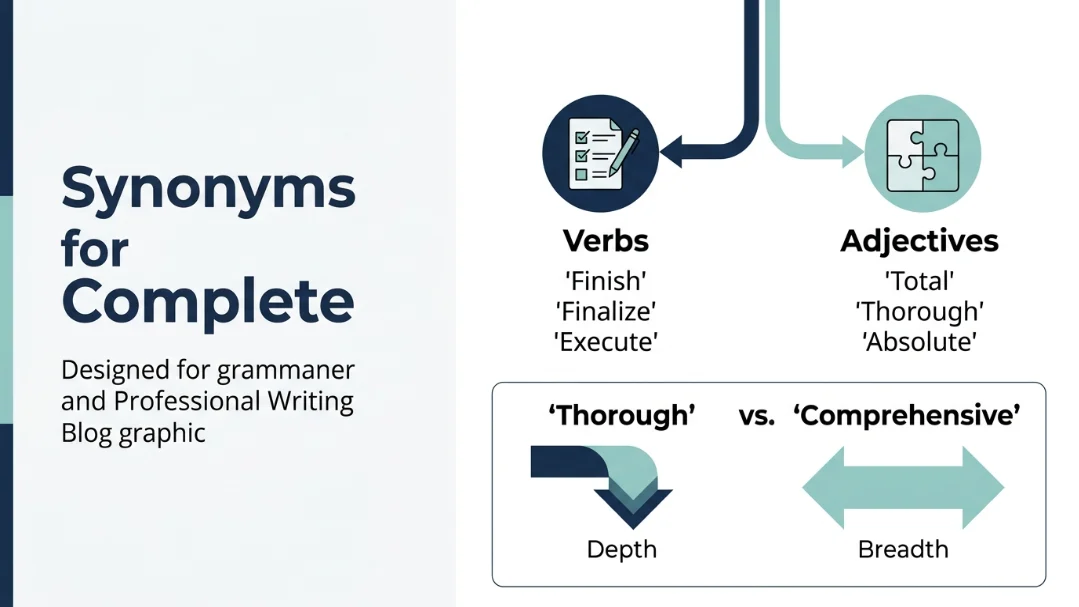
The best synonyms for complete depend on how you use the word. As a verb (an action), the best synonyms are finish, finalize, and conclude. As an adjective (a description), the best synonyms are whole, total, thorough, and absolute.
What Does Complete Mean?
To pick the perfect alternative, we first need to look at how “complete” functions in a sentence. It is a unique word because it regularly flips between two different parts of speech.
- As a Verb: To bring something to an end, to finish making or doing something.
- As an Adjective: Having all the necessary parts; entire, whole, or total.
- Common Usage: Used everywhere from software development (download complete) to everyday emotions (complete surprise).
Example Sentence (Verb): She needs two more weeks to complete the manuscript.
Example Sentence (Adjective): The puzzle is finally complete now that we found the last piece.
Core Meaning of Complete
The central idea behind “complete” is the total absence of gaps, missing pieces, or remaining work. It represents a state of fullness or fulfillment. When something is complete, there is nothing left to add, fix, or alter. It implies structural or operational integrity—whether you are talking about a physical object, a task, or an abstract concept like chaos.
Grammar and Usage Notes
Before swapping “complete” out for another word, keep these grammatical nuances in mind:
- Identify the Part of Speech: Ensure your synonym matches the function. You cannot swap the adjective total into a sentence where complete acts as a verb (e.g., “I need to total my homework” changes the meaning entirely).
- Gradable vs. Non-Gradable: Grammatically, complete is often considered an absolute (non-gradable) adjective. Something is either complete or it isn’t. However, in casual speech, people often modify it (e.g., “more complete”). When choosing synonyms, words like absolute are non-gradable, while words like thorough can be gradable.
- Transitive Action: When used as a verb, complete is transitive—it always takes a direct object. You complete a task, you finish a race. Your synonym must fit this pattern.
Best Synonyms for Complete
The table below breaks down the top alternatives based on how they alter the meaning, tone, and impact of your sentences.
| Synonym | Part of Speech | Meaning | Tone | Best Use Case | Example Sentence |
| Finish | Verb | To bring an action or activity to an end | Neutral / Common | Everyday tasks, races, meals | Please finish your dinner before checking your phone. |
| Total | Adjective | Comprising the whole number or amount; absolute | Direct / Strong | Quantities, financial tallies, disasters | The storm resulted in a total loss of power across the city. |
| Finalize | Verb | To put into final form; settle the last details | Professional | Business agreements, travel plans | We need to meet tomorrow to finalize the project budget. |
| Thorough | Adjective | Executed with great care and attention to detail | Analytical | Investigations, cleanups, reviews | The mechanics performed a thorough inspection of the aircraft. |
| Absolute | Adjective | Not qualified or limited in any way; total | Emphatic | Emphasizing certainties or extremes | The surprise party was an absolute success. |
Common Synonyms for Complete
These everyday terms are highly versatile and work naturally in casual writing, storytelling, and daily speech.
Wrap up (Verb)
- Meaning: To bring something to a successful or satisfactory conclusion.
- Best Context: Meetings, workdays, casual projects.
- Example: Let’s wrap up this meeting so everyone can get to lunch on time.
Entire (Adjective)
- Meaning: With no part left out; whole.
- Best Context: Describing physical objects, time spans, or groups.
- Example: He ate the entire pizza by himself.
Comprehensive (Adjective)
- Meaning: Including or dealing with all or nearly all elements or aspects of something.
- Best Context: Guides, insurance policies, lists, examinations.
- Example: The textbook offers a comprehensive overview of European history.
Formal Synonyms for Complete
If you are drafting an academic paper, a legal document, a corporate presentation, or a formal essay, use these sophisticated alternatives.
Consummate (Verb or Adjective)
- Meaning: As a verb: to bring to completion or perfection. As an adjective: showing a high degree of skill or flair.
- Best Context: High-level business deals, artistic achievements, legal marriages.
- Example (Verb): The two tech giants expect to consummate the merger by the end of the fiscal quarter.
Execute (Verb)
- Meaning: To carry out or put into effect a plan, order, or course of action.
- Best Context: Project management, military operations, legal contracts.
- Example: The team executed the marketing strategy flawlessly.
Exhaustive (Adjective)
- Meaning: Fully comprehensive; leaving nothing unexamined or unsaid.
- Best Context: Research papers, background checks, medical testing.
- Example: After an exhaustive search of the archives, the historian found the missing letter.
Informal Synonyms for Complete
These casual terms and idioms add personality and a relaxed tone to dialogue, personal blogs, or friendly messages.
Knock out (Verb)
- Meaning: To finish a task quickly or effortlessly.
- Best Context: To-do lists, chores, daily work assignments.
- Example: I’m going to knock out these last three emails before I head home.
Dead (Adjective)
- Meaning: Used as an intensifier to mean complete or absolute.
- Best Context: Casual speech, expressions of certainty or silence.
- Example: There was dead silence in the room when she dropped the glass.
Clean (Adjective)
- Meaning: Complete or total, usually describing a break, win, or separation.
- Best Context: Sports, lifestyle changes, arguments.
- Example: The runner made a clean break from the rest of the pack at the final turn.
Strong Synonyms for Complete
When you need to emphasize massive scale, intense emotion, or undeniable finality, choose one of these high-impact words.
Utter (Adjective)
- Meaning: Complete and absolute, usually paired with negative or chaotic situations.
- Best Context: Expressing disbelief, frustration, or shock.
- Example: The concert layout was an utter disaster from start to finish.
Outright (Adjective)
- Meaning: Wholly, completely, or undisguised.
- Best Context: Rejections, lies, bans, or victories.
- Example: The board issued an outright refusal to grant the budget increase.
Conclude (Verb)
- Meaning: To bring something to an official, definitive end.
- Best Context: Legal trials, formal investigations, major speeches.
- Example: The judge concluded the court proceedings after a long week of testimonies.
Mild Synonyms for Complete
Sometimes a quieter, more neutral, or understated word is better suited to maintain a calm and objective tone.
Round out (Verb)
- Meaning: To complete or perfect a collection, team, or experience in a balanced way.
- Best Context: Collections, skillsets, meals, resumes.
- Example: Adding a short internship will neatly round out your academic resume.
Intact (Adjective)
- Meaning: Whole and undamaged; complete after a trial or passage of time.
- Best Context: Surviving items, ancient structures, reputations.
- Example: Despite the bumpy flight, the fragile ancient pottery arrived perfectly intact.
Unbroken (Adjective)
- Meaning: Not interrupted or broken; continuous and whole.
- Best Context: Records, sleep cycles, horizons.
- Example: She finally enjoyed eight hours of calm, unbroken sleep.
Synonyms for Complete by Context
Selecting the ideal word depends heavily on the setting and domain of your writing.
Professional & Business Writing
In a corporate setting, words should imply efficiency, teamwork, and polished results.
- Use finalize when referring to contracts, schedules, or deals.
- Use implement or execute when talking about strategies, procedures, or software updates.
Academic Research
Academic tone demands precision, objectivity, and thorough verification.
- Use exhaustive to describe literature reviews or data collection.
- Use integral to describe a component that is essential to make a theory or system complete.
Creative Writing
In fiction, changing this word highlights a character’s internal feelings or the atmosphere of a scene.
- Use stark to describe complete emptiness or contrast (“stark naked,” “stark reality”).
- Use unmitigated to emphasize a complete, unsoftened emotional state (“unmitigated joy” or “unmitigated gall”).
Another Word for Complete in a Sentence
Review these practical, real-world examples to see how these substitutes sound in context:
- Instead of completing the project, the engineers finalized the blueprints.
- The detective conducted a thorough review of the evidence.
- The unexpected news brought utter chaos to the peaceful small town.
- The legal team managed to consummate the contract negotiations at midnight.
- The historic cathedral remained completely intact after the earthquake.
- Our marketing department plans to wrap up the summer ad campaign this afternoon.
- The novel provides a comprehensive account of the historical events.
- They demanded absolute loyalty from every member of the inner circle.
- The athlete’s record-breaking run was an outright victory for the school.
- A luxury dessert was ordered to round out the five-course dinner.
- The archeologists uncovered an entire buried village beneath the sands.
- The symphony concluded its performance with a dramatic, booming crescendo.
Complete Synonyms Compared
It is easy to mix up words that seem interchangeable on the surface but carry distinct shades of meaning.
Finish vs. Complete (Verbs)
While often used interchangeably, there is a classic, subtle nuance:
- To complete something often implies bringing it to a state of ideal perfection, wholeness, or fulfillment. It means you have added all necessary components.
- To finish something simply means you have reached the end of the activity. You can finish writing a messy first draft, but you complete a polished thesis.
Thorough vs. Comprehensive (Adjectives)
- Thorough focuses on the depth and careful execution of an action. A thorough investigation looks deeply into every tiny detail.
- Comprehensive focuses on the breadth and scope. A comprehensive list covers a wide variety of items across the entire subject, even if it doesn’t dive deep into each one.
Words Similar to Complete
These terms are related to the idea of completeness but carry specific limitations that prevent them from being direct drop-in replacements.
- Complement: This means to add to something in a way that enhances or improves it, making it whole together (e.g., “The red wine complements the steak”). Do not confuse it with the verb complete.
- Perfect: This implies reaching the absolute highest standard of quality, leaving no flaws, rather than just being finished.
- Saturate: This means to thoroughly soak or fill something to the point where no more can be absorbed.
Antonyms of Complete
When you need to express the opposite of wholeness or finality, use these standard antonyms:
Incomplete
- Meaning: Not full, finished, or whole; missing essential parts.
- Example: Please do not submit an incomplete application form to the office.
Partial
- Meaning: Existing only in part; incomplete or biased.
- Example: The company offered a partial refund for the damaged shipping box.
Initiate
- Meaning: To cause a process or action to begin, rather than ending it.
- Example: The manager decided to initiate a new training program for the staff.
How to Choose the Right Synonym for Complete
To keep your text natural and engaging, run through this quick checklist before selecting a replacement word:
- Determine the part of speech: Am I replacing a verb (action) or an adjective (description)?
- Evaluate the scale: Is it a small daily task (finish, wrap up) or a major milestone (consummate, execute)?
- Check the tone: Does this context require formal academic weight (exhaustive) or casual daily ease (knock out)?
- Verify the syntax: Read the sentence aloud to make sure the surrounding prepositions and nouns still flow smoothly with the new word choice.
Common Mistakes When Using Synonyms for Complete
Avoid these frequent slip-ups to ensure your writing remains clear and accurate:
- Redundant Phrasing: Writing phrases like “completely finalized” or “totally absolute” creates awkward redundancies. Both words mean the same thing; pick just one.
- Mismatched Negative Connotations: Using utter or outright for purely positive events can sound slightly off. “It was an utter masterpiece” is sometimes used colloquially, but words like absolute or consummate fit positive framing much cleaner.
- Confusing Complement vs. Complete: Writing “This artwork completes the room” means it finishes the room. Writing “This artwork complements the room” means it looks great with the existing decor. Match your true intent.
Quick Synonym List for Complete
Use this structured list as a quick cheat sheet during your next editing pass:
- Common Verbs: Finish, Finalize, Conclude, Wrap up
- Common Adjectives: Whole, Total, Entire, Comprehensive
- Formal Alternatives: Consummate, Execute, Exhaustive, Thorough
- Informal / Idioms: Knock out, Dead silence, Clean break
- Strong / Emphatic: Utter, Outright, Absolute
- Mild / Understated: Round out, Intact, Unbroken
- Related Ideas: Complement, Perfect, Saturate
FAQs
What is the best synonym for complete?
The best synonym depends on its grammatical function. If you need a verb, finish is the most common and versatile. If you need an adjective, total or whole work best.
What is another word for “complete a task”?
You can say finish, finalize, execute, or casually wrap up a task.
Is there a difference between complete and finish?
Yes. Finish focuses on stopping or reaching the end of an activity. Complete carries an added nuance of achieving wholeness or adding all necessary components.
What is a formal word for complete?
Excellent formal alternatives include consummate (for agreements), execute (for actions), and exhaustive (for research descriptions).
What is the opposite of complete?
The direct antonyms are incomplete or partial for the adjective form, and start, begin, or initiate for the verb form.
What does “complete surprise” mean?
In that phrase, complete acts as an adjective meaning absolute or total. It means there was no suspicion or warning whatsoever.
Conclusion
Mastering the various synonyms for complete allows you to paint a far more accurate picture for your reader. Whether you are finalizing a crucial business deal, conducting a thorough scientific study, or describing an utter failure, picking the exact alternative ensures your writing remains polished, precise, and highly engaging.