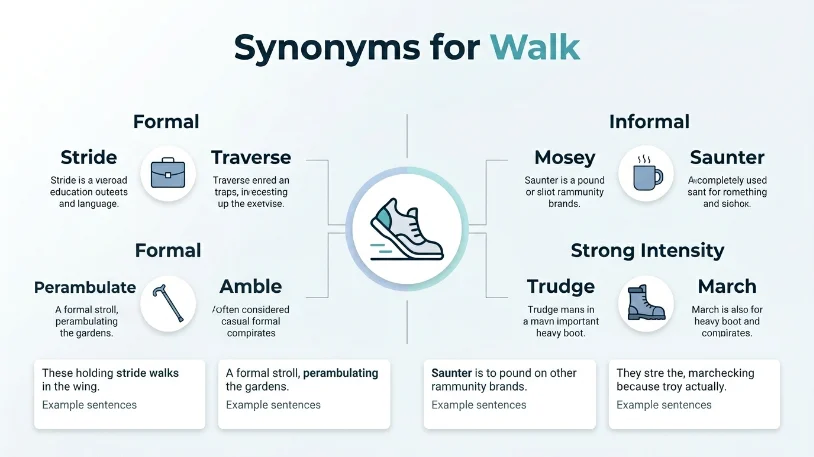
When you sit down to write a story, an essay, or a professional email, it is easy to rely on everyday vocabulary. The word “walk” is an excellent example of a basic verb we use constantly. However, using the same word repeatedly can make your writing feel flat and uninspired. By expanding your vocabulary and exploring synonyms for walk, you can add vivid detail, convey specific emotions, and match the exact tone your piece requires.
The best synonym for walk depends entirely on meaning, tone, context, and intensity. For instance, a relaxed afternoon stroll feels entirely different from a frantic, high-stress stride to a business meeting. Choosing the right alternative changes how a reader visualizes the scene.
Best Synonyms for Walk
The best synonyms for walk are stroll, stride, pace, and march. The right choice depends heavily on the tone, context, and intensity of the movement you want to describe.
What Does Walk Mean?
To choose a great alternative, it helps to look at how the base word operates. At its core, the word means to move forward on foot by lifting and setting down each foot in turn. Unlike running, walking requires that at least one foot is always touching the ground.
- Core Idea: Forward locomotion on foot at a moderate speed.
- Part of Speech: Can function as both a verb (an action) and a noun (a path or an outing).
- Common Usage: Used daily in both literal contexts (walking to the store) and figurative contexts (a walk through life).
Example Sentence (Verb): We decided to walk down to the neighborhood park after dinner.
Example Sentence (Noun): A brisk walk in the morning clearing is highly refreshing.
Core Meaning of Walk
The foundational concept behind walking is simple transit. It represents unassisted, steady human movement. It implies a steady, moderate pace that is neither rushing nor completely stationary. When you look deeper into the word, it carries a sense of baseline human activity—it is the default way we navigate our physical space.
Grammar and Usage Notes
Before swapping out words in your text, keep these grammatical nuances in mind:
- Transitive vs. Intransitive: “Walk” can be intransitive (“I walk every day”) or transitive (“I walk the dog”). Many synonyms only work one way. For example, you can stroll along a path (intransitive), but you cannot stroll a dog (transitive).
- Collocations: We naturally pair certain words together. We take a leisurely stroll or a forced march, but rarely a leisurely march.
- Sentence Patterns: When replacing the verb form, ensure the accompanying prepositions still make sense. You walk to a destination, but you might meander through a space.
Best Synonyms for Walk
The table below breaks down the top alternatives based on how they change the meaning of your sentence.
| Synonym | Meaning | Tone | Best Use Case | Example Sentence |
| Stroll | To walk in a relaxed, leisurely way | Casual / Warm | Vacation scenes, relaxed weekends | They spent Sunday morning strolling through the botanical gardens. |
| Stride | To walk with long, purposeful steps | Confident / Formal | Business settings, showing determination | She strode into the boardroom ready to present her ideas. |
| Pace | To walk back and forth nervously or deliberately | Tense / Neutral | Waiting rooms, deep concentration | He paced the hallway while waiting for the test results. |
| March | To walk with steady, rhythmic, military steps | Serious / Strict | Protests, organized groups, anger | The band marched down Main Street during the parade. |
| Amble | To walk at a slow, easy-going pace | Gentle / Descriptive | Nature paths, relaxed storytelling | We ambled along the river bank as the sun began to set. |
Common Synonyms for Walk
These are everyday words that work beautifully in casual writing, storytelling, and daily conversation.
Hike
- Meaning: A long, energetic walk, especially in the countryside or wilderness.
- Best Context: Outdoor adventures, fitness tracking, mountain trails.
- Example: We plan to hike the entire mountain trail this weekend.
Wander
- Meaning: To move about without a fixed course or destination.
- Best Context: Exploring a new city, daydreaming, open spaces.
- Example: Lost in thought, she wandered through the cobblestone streets.
Trek
- Meaning: A difficult or long journey made on foot.
- Best Context: Challenging environments, backpacking trips, long distances.
- Example: The travelers had to trek through thick mud to reach the camp.
Formal Synonyms for Walk
If you are working on an academic essay, a business report, or legal documentation, you need words that sound professional and polished.
Perambulate
- Meaning: To walk through or around a place, often to inspect it.
- Best Context: Formal literature, historical essays, official descriptions.
- Example: The security team perambulated the perimeter of the estate every hour.
Traverse
- Meaning: To travel across or through an area on foot.
- Best Context: Technical reports, geography writing, academic journals.
- Example: Researchers must traverse difficult terrain to collect soil samples.
Promenade
- Meaning: To walk in a public place for pleasure or to be seen by others.
- Best Context: Historical contexts, formal social gatherings, coastal pathways.
- Example: Guests were invited to promenade around the grand ballroom terrace.
Informal Synonyms for Walk
These casual terms are ideal for relaxed conversations, texting friends, or writing dialogue for a modern story.
Mosey
- Meaning: To walk slowly or leisurely.
- Best Context: Friendly chat, lighthearted storytelling, rural settings.
- Example: Let’s mosey on over to the food trucks and grab some lunch.
Hoof it
- Meaning: To walk somewhere because you lack transportation.
- Best Context: Slang, urban settings, missing a bus or train.
- Example: Our car broke down, so we had to hoof it all the way home.
Saunter
- Meaning: To walk in a slow, relaxed manner without effort or worry.
- Best Context: Describing a confident, laid-back character.
- Example: He sauntered into the café as if he had all the time in the world.
Strong Synonyms for Walk
When you want to convey high energy, deep emotion, or a commanding physical presence, use these impactful alternatives.
Trudge
- Meaning: To walk slowly and heavily because of exhaustion or harsh conditions.
- Best Context: Heavy snow, deep mud, extreme fatigue, emotional burdens.
- Example: The tired soldiers trudged through the deep winter snow.
Stomp
- Meaning: To walk with heavy, loud, angry steps.
- Best Context: Outbursts of temper, frustration, heavy boots.
- Example: He stomped out of the room after losing the argument.
Plod
- Meaning: To walk heavily or laboriously, showing slow but steady progress.
- Best Context: Routine tasks, endless chores, physical exhaustion.
- Example: The farming horses plodded across the muddy fields.
Mild Synonyms for Walk
Sometimes you want a softer, more understated word that does not draw too much attention to the action itself.
Tioptoe
- Meaning: To walk quietly on the balls of your feet to avoid being heard.
- Best Context: Sneaking around, quiet houses, staying silent near a sleeping child.
- Example: She tiptoed past the baby’s room so she wouldn’t wake him up.
Creep
- Meaning: To move slowly and stealthily close to the ground.
- Best Context: Suspenseful stories, hunting, quiet environments.
- Example: A shadow crept quietly along the backyard fence.
Shuffle
- Meaning: To walk by dragging your feet along the ground without lifting them fully.
- Best Context: Weariness, old age, morning grogginess.
- Example: He shuffled into the kitchen to pour his morning coffee.
Synonyms for Walk by Context
Using the right word depends entirely on the setting. Here is a breakdown of how to match your vocabulary to specific writing genres.
Creative Writing
In fiction, how a character moves tells the reader how they feel.
- Use swagger to show pride or overconfidence.
- Use stagger to show physical weakness, injury, or intoxication.
- Use slink to show guilt, shame, or secrecy.
Professional Writing
In a workplace setting, your words should sound decisive and organized.
- Use advance when describing progress or movement toward a corporate goal.
- Use patrol when talking about facility safety or oversight management.
Marketing Copy
Marketing requires words that paint an appealing, stress-free picture for consumers.
- Use meander to describe a delightful shopping experience or a wine tour.
- Use explore to invite customers to walk through a retail space or tourist destination.
Another Word for Walk in a Sentence
To see how these options function in real-world scenarios, review these practical examples:
- Instead of walking, the toddlers toddled across the playroom floor.
- The fashion models strutted confidently down the brightly lit runway.
- We watched the tourists meander through the local open-air market.
- Angry at the decision, the manager marched straight into the executive suite.
- The hikers rambled across the open green hillsides for hours.
- The injured athlete had to limp back to the sidelines.
- The teenagers loitered near the shop doors before moving along.
- The explorers had to footslog through miles of dense tropical jungle.
- She paced the waiting area while her car was being repaired.
- The children scampered along the beach collecting colorful seashells.
- We ambled past the storefronts, enjoying the warm evening air.
- The old gentleman strolled through his favorite neighborhood park.
Walk Synonyms Compared
It is easy to confuse words that seem identical but carry vastly different visual weights. Let’s compare a few close terms.
Stroll vs. Saunter vs. Amble
While all three mean walking slowly, their underlying attitudes differ:
- A stroll is purely leisure-focused. You do it for fresh air or conversation.
- A saunter has an air of cool, effortless confidence. It often looks stylish or slightly arrogant.
- An amble is relaxed and unhurried, often used when describing animals or people in complete harmony with nature.
Trudge vs. Plod
Both words imply heavy movement, but the cause is different:
- You trudge because the physical conditions are miserable (like deep snow or heavy boots).
- You plod because you are mentally tired, bored, or just going through the motions of a long day.
Words Similar to Walk
The following words are closely related to walking but carry additional meanings that prevent them from being direct replacements in every sentence.
- Gait: This refers to the style or manner of walking rather than the action itself (e.g., “He had a strange, sweeping gait”).
- Pace: This denotes the speed of your movement rather than the physical steps taken.
- Footing: This describes your stability while walking on slippery or uneven surfaces.
Antonyms of Walk
When you want to express the exact opposite of walking, consider these terms:
Run
- Meaning: To move at a speed faster than a walk, where both feet leave the ground at points.
- Example: He had to run to catch the departing train.
Halt
- Meaning: To bring movement to an immediate, complete stop.
- Example: The officer commanded the crowd to halt at the gate.
Ride
- Meaning: To travel in or on a vehicle, animal, or conveyance instead of moving your feet.
- Example: We decided to ride the subway instead of making the long trip on foot.
How to Choose the Right Synonym for Walk
To keep your writing natural and impactful, follow this quick checklist before picking a word:
- Check the speed: Is the movement fast, slow, or moderate?
- Identify the emotion: Is the character angry (stomp), nervous (pace), or happy (stroll)?
- Look at the environment: Are they moving through deep mud (trudge) or a smooth corporate office (stride)?
- Keep it natural: Do not use an overly complex word like perambulate if a simple word like stroll keeps your writing crisp and readable.
Common Mistakes When Using Synonyms for Walk
Using a thesaurus without checking context can lead to awkward phrasing. Avoid these frequent pitfalls:
- Mismatched Formality: Writing “The CEO moseyed into the high-stakes merger meeting” sounds jarringly informal. Use strode instead.
- Overdoing the Drama: Using words like stomp or march when a character is simply moving across a quiet room can confuse readers about their emotional state.
- Grammar Breaks: Substituting stroll into a phrase like “I need to walk the dog” creates a broken sentence structure (“I need to stroll the dog” does not work in English).
Quick Synonym List for Walk
Save this clean list for quick reference during your next editing session:
- Common: Hike, Wander, Trek, Amble
- Formal: Perambulate, Traverse, Promenade, Advance
- Informal: Mosey, Hoof it, Saunter, Toddle
- Strong: Trudge, Stomp, Plod, Swagger, Stagger
- Mild: Tiptoe, Creep, Shuffle, Slink
- Related Words: Gait, Pace, Footing, Locomotion
FAQs
What is the best synonym for walk?
The best synonym depends entirely on your context. For a relaxed situation, stroll is ideal. For a business or purposeful situation, stride works best.
What is another word for walk slowly?
Excellent options for walking slowly include amble, saunter, meander, and mosey.
What is a formal synonym for walk?
In professional or academic settings, use traverse or proceed on foot.
What is a stronger word for walk?
If you want to emphasize difficulty or power, use trudge (for exhaustion) or stride (for confidence).
What is the opposite of walk?
The most direct opposites are run (faster movement), halt (no movement), or ride (vehicular movement).
Can I use “stroll” to describe walking an animal?
No. “Stroll” is an intransitive verb in this context. You can stroll with your pet, but you cannot “stroll a pet” the way you “walk a dog.”
Conclusion
Expanding your vocabulary by learning synonyms for walk is an incredibly simple way to instantly improve your prose. Whether you need to depict a confident leader striding into an office, a tired student trudging through rain, or a relaxed traveler meandering down an old alleyway, matching the exact word to the situation keeps your writing engaging, accurate, and completely natural for your readers.