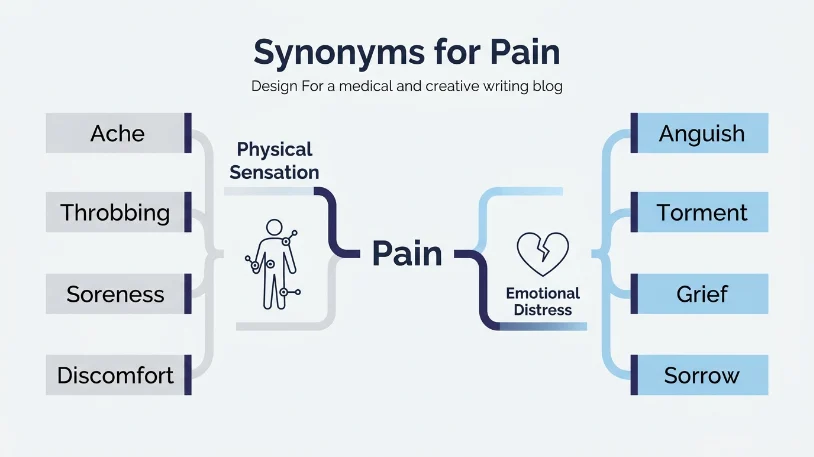
Pain is a universal human experience, but it rarely feels the same way twice. A papercut doesn’t feel like a broken bone, and a physical injury feels entirely different from the grief of a personal loss. Because the word covers everything from a mild muscle tweak to deep emotional heartbreak, finding the right synonyms for pain is all about accuracy.
The best synonyms for pain include ache, discomfort, suffering, anguish, and distress. Whether you are writing a medical report, a personal essay, or a piece of fiction, choosing a specific word helps your reader understand the exact type of sensation or emotion you mean.
Best Synonyms for Pain
The best synonyms for pain depend entirely on the type of suffering:
- For mild physical sensations, use ache, soreness, or discomfort.
- For intense physical injuries, use agony, throbbing, or pang.
- For emotional or mental distress, use anguish, grief, or suffering.
What Does Pain Mean?
Understanding how to substitute the word requires looking at its grammatical function and definitions.
- Part of Speech: Noun (can also be used as a verb).
- Core Meanings:
- Highly unpleasant physical sensation caused by illness or injury.
- Mental or emotional suffering.
- Example 1 (Physical): “He felt a sharp pain in his lower back after lifting the heavy boxes.”
- Example 2 (Emotional): “The pain of moving away from her childhood friends was hard to bear.”
Core Meaning of Pain
The word “pain” traces its roots back to the Greek word poine, which meant “penalty” or “punishment.” This historical connection highlights why pain feels fundamentally threatening or negative—it feels like an affliction.
Physically, pain is a warning system from our nervous system signaling that something needs attention. Emotionally, it acts as a marker for loss or stress. When choosing an alternative word, consider whether your subject is experiencing a brief warning flash (a sting), a long-term burden (an ache), or a deep emotional weight (grief).
Grammar and Usage Notes
“Pain” can function as both a countable and uncountable noun. You can experience “chronic pain” (uncountable) or feel “sharp pains” (countable) in a specific area.
- Common Phrases: “Chronic pain,” “pain management,” “groan in pain,” “a pain in the neck” (idiom meaning an annoyance), “take pains to” (meaning to take great care).
- Preposition Patterns: We typically feel pain in a body part (“pain in my knee”) or experience pain from an event (“pain from the breakup”).
Best Synonyms for Pain
| Synonym | Meaning | Tone | Best Use Case | Example Sentence |
| Ache | Continuous, dull physical pain | Neutral | Everyday health | A dull ache in his shoulder kept him awake. |
| Anguish | Severe mental or physical distress | Heavy / Literary | Emotional trauma | The missing child’s parents were in deep anguish. |
| Discomfort | Mild pain or awkward physical sensation | Mild / Clinical | Medical / Customer service | You may feel slight discomfort during the test. |
| Agony | Extreme physical or mental suffering | Intense | Emergency / Drama | He lay on the field in agony after twisting his knee. |
| Soreness | Muscle tenderness from overexertion | Casual | Fitness / General | I expect some leg soreness after tomorrow’s workout. |
| Distress | Anxiety, sorrow, or pain | Professional | Psychology / Legal | The sudden market crash caused widespread economic distress. |
Common Synonyms for Pain
These everyday terms easily replace “pain” in casual conversation or standard content writing without changing the simplicity of your message.
Physical Variations:
1. Ache
- Meaning: A steady, continuous dull pain, often associated with a specific body part.
- Best Context: Describing sickness, colds, or long-term joint issues.
- Example: “A persistent head ache made it impossible to focus on the screen.”
2. Soreness
- Meaning: Feeling painful or tender, typically when touched or moved.
- Best Context: Post-exercise descriptions, bruises, or minor injuries.
- Example: “Hot baths are great for relieving muscle soreness.”
Emotional Variations:
3. Suffering
- Meaning: The state of undergoing pain, distress, or hardship.
- Best Context: Discussing structural hardships, health conditions, or emotional trials.
- Example: “The charity aims to reduce the suffering of stray animals in the winter.”
Formal Synonyms for Pain
In medical settings, academic essays, legal paperwork, or literature, you need words that offer analytical precision or dramatic gravity.
Medical & Clinical Terms:
1. Discomfort
- Meaning: A lack of physical comfort or ease. Doctors prefer this to avoid alarming patients.
- Best Context: Clinical instructions, dental work, or recovery descriptions.
- Example: “The medication should minimize any postoperative discomfort.”
2. Affliction
- Meaning: Something that causes pain or suffering over a long duration.
- Best Context: Academic history, literature, or discussing chronic illnesses.
- Example: “Arthritis is a painful affliction that impacts millions of older adults.”
Literary & Legal Terms:
3. Anguish
- Meaning: Extreme distress, torment, or anxiety.
- Best Context: Describing deep grief, psychological trauma, or heavy fiction writing.
- Example: “She expressed her anguish over the loss of her home in a moving poem.”
4. Torment
- Meaning: Severe physical or mental suffering.
- Best Context: Describing continuous pestering or intense internal struggles.
- Example: “The memory of his mistake became a source of constant mental torment.”
Informal Synonyms for Pain
When writing a casual blog, speaking to a friend, or posting on social media, lighter or more colloquial phrases work beautifully.
1. Hurt
- Meaning: Injury or pain. It simplifies the sentiment for quick communication.
- Best Context: Casual conversations, speaking with children, or relational issues.
- Example: “There is a lot of hurt behind those angry words.”
2. Throbbing
- Meaning: A sensation of pain that starts and stops rhythmically, matching a heartbeat.
- Best Context: Describing minor injuries like stubbed toes, burns, or migraines.
- Example: “I felt a nasty throbbing in my thumb after hitting it with the hammer.”
3. Tweak
- Meaning: A minor, sudden sharp pain or strain in a muscle.
- Best Context: Gym talk, sports contexts, or active lifestyles.
- Example: “I felt a slight tweak in my hamstring during the sprint, so I stopped.”
Strong Synonyms for Pain
When standard words fail to convey the extreme intensity of a situation, deploy these high-impact alternatives.
1. Agony
- Meaning: The absolute peak of physical or mental torture.
- Best Context: Traumatic accidents, emergencies, or unmanageable sorrow.
- Example: “Waiting for the rescue team to arrive was pure agony.”
2. Excruciating Sensation
- Meaning: Pain so severe it feels like torture.
- Best Context: Describing kidney stones, severe nerve damage, or intense physical trials.
- Example: “A sudden, excruciating flash of pain shot through his lower jaw.”
3. Pang
- Meaning: A sudden sharp spasm of pain or painful emotion.
- Best Context: Hunger spikes, sudden moments of guilt, or sharp physical twinges.
- Example: “He felt a sharp pang of regret as he watched the plane take off.”
Mild Synonyms for Pain
Use these softer options when you want to minimize a complaint or describe an irritation rather than a full-scale crisis.
1. Tenderness
- Meaning: Soreness when pressure is applied to a specific area.
- Best Context: Medical exams, checking on minor bruises or skin conditions.
- Example: “The doctor checked the abdomen for any localized tenderness.”
2. Irritation
- Meaning: Inflammation or mild discomfort in a body part, often skin or eyes.
- Best Context: Allergies, skincare discussions, or minor physical contact issues.
- Example: “The rough collar caused minor skin irritation around his neck.”
3. Twinge
- Meaning: A sudden, brief prick of physical or emotional discomfort.
- Best Context: Minor joint issues, unexpected memories, or brief muscle pulls.
- Example: “An occasional twinge in her left knee reminded her of the old injury.”
Synonyms for Pain by Context
Because pain bridges the gap between our bodies and our emotions, picking a synonym depends completely on your exact scenario.
Fitness & Physical Therapy (Soreness)
When discussing post-exercise body states, use words that imply natural recovery rather than a dangerous injury.
- Top Picks: Soreness, tightness, fatigue, stiffness.
- Why: These terms signal to athletes and clients that their muscles are adapting to a workout, not tearing or failing.
Fiction & Creative Writing (Emotional Distress)
If a character experiences a emotional loss, your word choices should build atmospheric weight.
- Top Picks: Anguish, sorrow, grief, heartache, torment.
- Why: These terms expand the horizon of the scene, showing that the pain is deep, internal, and shifting the character’s perspective.
Healthcare & Patient Communication (Clinical Precision)
When treating patients or explaining symptoms, use words that measure intensity accurately without inducing panic.
- Top Picks: Discomfort, tenderness, throbbing, dull ache, acute sensation.
- Why: These precise descriptions help doctors identify the root cause—whether it is nerve-based, muscular, or inflammatory.
Another Word for Pain in a Sentence
Here are 15 realistic examples showing how to vary your vocabulary when replacing the word “pain.
- Ache: “A persistent ache in his lower joints warned him of the coming rain.”
- Soreness: “She used a foam roller to ease the soreness in her calves.”
- Discomfort: “Please let the technician know if you experience any discomfort.”
- Agony: “The long hours of isolation during the storm were absolute agony.”
- Anguish: “The novel captures the deep anguish of a family torn apart by war.”
- Suffering: “Modern medicine has done wonders to alleviate physical suffering.”
- Hurt: “Time eventually heals the hurt caused by a broken trust.”
- Throbbing: “A painful throbbing behind her eyes signaled the arrival of a migraine.”
- Tweak: “He felt a minor tweak in his back while bending over to tie his shoes.”
- Pang: “She felt a sudden pang of jealousy when she saw her friend’s new car.”
- Tenderness: “There was some tenderness around the wound, but no sign of infection.”
- Irritation: “Eyedrops will quickly clear up the irritation from the smoke.”
- Twinge: “He felt an occasional twinge of guilt for skipping the family dinner.”
- Torment: “The prisoner survived years of physical and mental torment.”
- Distress: “The ship sent out a signal to report that the crew was in severe distress.”
Pain Synonyms Compared
Using related terms improperly can confuse your audience. Let’s look at how these closely related words compare.
- Pain vs. Ache: Pain can be sharp, sudden, and blinding. An ache is distinctively dull, steady, and long-lasting. You feel an ache after working out all day; you feel pain if you cut your finger.
- Pain vs. Anguish: Pain is an all-encompassing term. Anguish is specifically reserved for intense, complex emotional or mental trauma, though it can occasionally refer to horrific physical torture.
- Discomfort vs. Agony: These two represent opposite ends of the intensity spectrum. Discomfort is a minor annoyance you can ignore; agony completely takes over your ability to function.
Words Similar to Pain
These terms exist within the same conceptual cloud as “pain” but have specific definitions that keep them from being direct replacements.
- Injury: Damage done to a person’s body. An injury causes pain, but the injury is the physical damage itself (like a cut), while pain is the sensation you feel as a result.
- Grief: Deep sorrow, especially caused by someone’s death. Grief is a complex emotional ecosystem that includes pain, alongside anger, denial, and confusion.
- Spasm: A sudden involuntary muscular contraction. A spasm often results in pain, but the spasm itself is the movement of the muscle tissue.
Antonyms of Pain
Examining the opposites of pain helps pinpoint its exact meaning in your sentences.
Opposites of Physical Pain:
- Pleasure: A feeling of happy satisfaction and enjoyment.
- Comfort: A state of physical ease and freedom from pain.
- Relief: A feeling of reassurance and relaxation following the release from pain.
Opposites of Emotional Pain:
- Joy: A feeling of great pleasure and happiness.
- Peace: Freedom from disturbance; tranquility.
- Contentment: A state of happiness and satisfaction.
How to Choose the Right Synonym for Pain
- Separate Body from Mind: Decide if you are writing about a physical injury or an emotional struggle. Don’t use soreness for a sad memory, and avoid using grief for a sprained ankle.
- Measure the Intensity: Pick a word that matches the true scale of the issue. If you use agony to describe a tiny scratch, your writing will sound overly dramatic. Use sting instead.
- Identify the Rhythm: Is the sensation constant (ache), rhythmic (throbbing), or sudden and brief (twinge)?
- Match the Document Style: If you are building a professional user interface or writing a technical document, stick to clean terms like discomfort or irritation.
Common Mistakes When Using Synonyms for Pain
- Using Medical Jargon in Fiction: Writing “He felt deep thoracic discomfort when she left him” sounds cold and clinical. In creative writing, lean into emotional realities with words like heartache or torment.
- Confusing Ache with Sharp Pain: Telling a physical therapist you have a “sharp ache” can be confusing. Clear communication is key: aches are dull, while stabs, tweaks, and pangs are sharp.
- Overusing “Agony”: If every bad day or minor headache is described as “agony,” you leave yourself nowhere to go when describing a genuinely catastrophic event. Conserve your high-intensity words.
Quick Synonym List for Pain
- Physical Synonyms: Ache, soreness, throbbing, discomfort, tenderness, pang, tweak, twinge.
- Emotional Synonyms: Anguish, suffering, distress, torment, grief, sorrow, heartache.
- High Intensity: Agony, excruciating sensation, torture.
- Low Intensity: Irritation, discomfort, mild soreness.
- Related terms: Injury, spasm, affliction.
FAQs
What is the best synonym for pain?
The best synonym depends on the situation. For everyday muscle issues, ache or soreness is ideal. For emotional trauma, anguish or distress works best.
What is another word for emotional pain?
The most accurate words for emotional pain are anguish, heartache, grief, sorrow, or mental distress.
What is the medical term for pain?
In professional settings, physicians often use specific terms like discomfort, nociception (the nervous system’s processing of injury), or describe it by quality, such as acute or chronic tenderness.
Can discomfort replace the word pain?
Yes, particularly in professional, clinical, or customer service contexts. It softens the tone, making a situation sound manageable rather than frightening.
What is a sharp, sudden pain called?
A sharp, momentary burst of pain is best described as a pango, twinge, tweak, or sting.
Conclusion
The language of pain requires a delicate touch. Because the word spreads across both physical injuries and emotional wounds, relying on a single term can blunt the impact of your writing.
By upgrading your vocabulary to include contextual alternatives like ache for long-running physical fatigue, anguish for deep emotional trials, or discomfort for professional settings you respect the real boundaries of human experience. Take time to assess the intensity, rhythm, and origin of the sensation to select the alternative that fits perfectly.