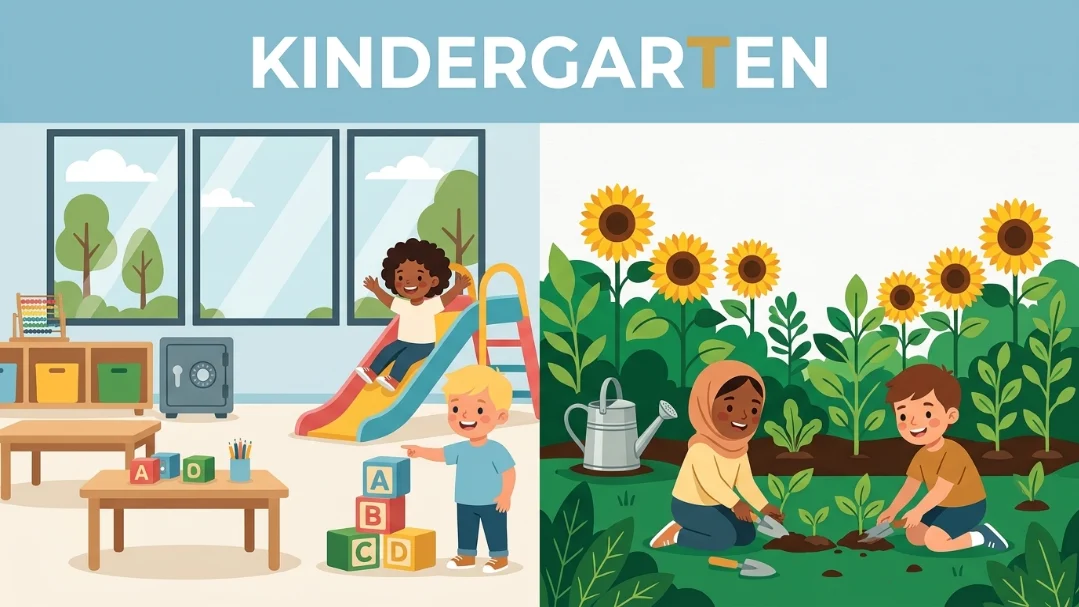
The correct spelling is kindergarten with a “t” at the end. The spelling “kindergarden” with a “d” is a common misspelling caused by phonetic confusion with the English word “garden.” The term comes from the German language, where it literally translates to a garden for children.
Dropping a child off for their very first day of formal schooling is a massive milestone for parents and children alike. It marks the transition from early toddlerhood into a world of structured learning, social development, and foundational growth. Yet, as you sit down to fill out the registration paperwork, a subtle question might make you pause. Do people spell it “kindergarten” or “kindergarden”?
This exact spelling confusion trips up millions of people every single year. It is one of those words that we hear constantly but rarely stop to analyze. Because the English word “garden” is so familiar, our brains naturally want to graft it onto the end of this educational term.
Understanding the right spelling is more than just a win for your spellchecker. It opens up a fascinating look into the history of early childhood education. This article will break down the origins of the word, explain why the common mistake happens, and provide practical tools to help you remember the correct form every time.
Key Takeaway & Summary
If you are looking for a fast, definitive answer to settle a bet or check your writing, here it is. The only recognized, grammatically correct spelling in standard English is kindergarten.
Correct:   K-I-N-D-E-R-G-A-R-T-E-N
Incorrect: K-I-N-D-E-R-G-A-R-D-E-N
The word is a direct loanword from German. Loanwords are words adopted into English from a foreign language with little to no modification. Because English has a long history of absorbing vocabulary from across the globe, it frequently retains foreign spellings that conflict with local phonetic rules.
When you replace the “t” with a “d,” you are creating a hybrid word that does not officially exist in any standard dictionary. While a reader will undoubtedly understand what you mean, using the incorrect version in professional, academic, or formal writing can undermine your credibility.
Definition and Deep Etymology
To truly understand why the word is spelled with a “t,” we must trace its origins to nineteenth-century Germany. The term was coined in 1837 by the visionary German educator Friedrich Fröbel.
Fröbel was deeply dissatisfied with the rigid, authoritarian schooling methods of his era. He believed that educators and society were treating young children like empty vessels that they could forcefully fill with facts, or worse, like miniature adults capable of enduring strict labor and intense discipline. Fröbel viewed children through a far gentler, more organic lens.
Kinder (Children) + Garten (Garden) = Kindergarten
He looked at children as young plants and viewed educators as patient gardeners. A garden is not a place where you force a plant to grow by pulling on its leaves. Instead, it is a protected space where you provide rich soil, clean water, and ample sunlight, allowing the plant to unfold naturally according to its own internal biological timeline.
When Fröbel opened his first play and activity institute in Bad Blankenburg, he struggled to find the right name for it. Eventually, he settled on Kindergarten. In German, the word Kinder means children, and Garten means garden.
The Journey into English
In the mid-nineteenth century, German immigrants began moving to the United States, England, and Australia in massive waves. Among these immigrants were trained educators who carried Fröbel’s revolutionary philosophy across the oceans.
- In 1856, Margarethe Schurz opened the very first German-language kindergarten in Watertown, Wisconsin.
- In 1860, Elizabeth Peabody opened the first English-speaking version in Boston, Massachusetts.
Rather than translating the phrase into “children’s garden,” these pioneers brought the German word over intact. Over the last century and a half, the word has become thoroughly integrated into the English vocabulary, yet it stubbornly preserves its native German spelling.
Advantages and Disadvantages of Loanword Integration
Preserving the original spelling of foreign words like kindergarten has a distinct set of trade-offs within the English language ecosystem.
Advantages
- Historical Preservation: The spelling serves as a linguistic monument. It honors Friedrich Fröbel’s original philosophical intent and acknowledges Germany’s foundational contribution to modern global education.
- International Standardization: Keeping the word close to its original form makes it instantly recognizable across dozens of languages that have also adopted the term.
- Conceptual Clarity: By retaining a distinct spelling, the word serves as a unique term for an educational stage rather than being mistaken for a literal garden filled with children.
Disadvantages
- Phonetic Confusion: The biggest downside is the mental friction it creates for native English speakers. Because the English word “garden” sounds almost identical to the German Garten when spoken aloud, it sets a natural linguistic trap.
- Spelling Errors: It creates a persistent source of minor errors in school enrollment forms, educational blogs, and professional teaching resumes.
- Learning Barriers: For children who are just beginning to read and write phonetically, the word violates the standard spelling rules taught in early elementary school.
The Core Linguistic Problem: Why We Make the Mistake
The tendency to write “kindergarden” is a textbook example of a linguistic phenomenon known as folk etymology. Folk etymology occurs when speakers take an unfamiliar, foreign, or archaic word and alter its spelling or pronunciation to match words that they already know and understand.
Consider how the human brain processes language. We naturally seek patterns and shortcuts to save cognitive energy. When you say the word aloud, the “g” sound in the middle transitions quickly into the trailing syllables. In rapid American and British English speech, the “t” sound often softens into a flap consonant, making it sound remarkably like a “d.”
Because your brain hears a soft sound and already possesses a highly active, deeply embedded vocabulary word called “garden,” it automatically glues the two concepts together. You know that young children love to play outside on grass and dirt, so a “children’s garden” makes perfect logical sense. Your brain rationalizes the incorrect spelling before you even have a chance to think about it.
Real-World Examples and Scenarios
To help solidify the context of how this word should appear in everyday writing, let us examine a few realistic scenarios across different industries.
1. A Parent Emailing a School Principal
- Incorrect: Dear Principal Green, I am writing to check the enrollment deadlines for the upcoming kindergarden class. My daughter turns five this September.
- Correct: Dear Principal Green, I am writing to check the enrollment deadlines for the upcoming kindergarten class. My daughter turns five this September.
2. A Professional Resume for a Teacher
- Incorrect: Dedicated educator with over six years of classroom experience specializing in early childhood development and kindergarden curriculum design.
- Correct: Dedicated educator with over six years of classroom experience specializing in early childhood development and kindergarten curriculum design.
3. A Local News Article
- Incorrect: The school board voted last night to approve funding for full-day kindergarden programs across the entire district starting next fall.
- Correct: The school board voted last night to approve funding for full-day kindergarten programs across the entire district starting next fall.
Regional and Global Usage Variations
While the spelling of the word remains consistent across the English-speaking world, the actual meaning and structure of the grade vary wildly depending on the country you are in. It is vital to understand these regional differences if you are writing for an international audience.
| United States | Ages 5 to 6 | Varies by State | It serves as the official first year of elementary school (K-12 system). |
| Germany | Ages 3 to 6 | No | It is an optional, play-based preschool system before formal grade school (Grundschule). |
| Australia | Ages 4 to 5 | Yes | Terminology varies by state; it can mean preschool or the first formal year of school. |
| United Kingdom | Ages 3 to 4 | No | The term is rarely used; they prefer words like “Nursery” or “Reception.” |
| Canada | Ages 4 to 6 | Varies by Province | It offers one to two years of early education before the first grade. |
The United States System
In the US, the word is almost universally abbreviated as “K” in the phrase “K-12 education.” It is a fundamental building block of the public and private school systems. It bridges the gap between informal preschool and the rigorous academic work of the first grade.
The United Kingdom System
If you travel to England, Scotland, or Wales, you will rarely hear the word used in conversation. Instead, British families send their children to “Nursery” or “Pre-school” for early years education. The actual first year of primary school is officially designated as “Reception.”
The Modern German System
In its homeland, the concept remains true to Friedrich Fröbel’s vision. It is completely separate from the primary school system. It focuses heavily on social interactions, outdoor play, emotional regulation, and creative expression rather than reading worksheets or early math testing.
Common Mistakes and Misconceptions
Beyond the foundational “t” versus “d” debate, there are several other common pitfalls that writers stumble into when using this word. Let us systematically address and correct them.
Capitalization Errors
Many writers mistakenly assume that the word must always be capitalized because of its German origins. Although modern German grammar capitalizes all nouns, a word that has been fully adopted into English follows English capitalization rules.
- Incorrect: My son is excited to start Kindergarten this week.
- Correct: My son is excited to start kindergarten this week.
Note: You only capitalize the word if it is part of a specific proper noun or formal school title.
- Example: He is enrolled at the Oak Creek Kindergarten Center.
Pronunciation Pitfalls
Because of regional accents, people often mispronounce the word, which directly fuels the spelling issue. Many speakers completely drop the “t” sound, pronouncing it as “kinder-gar-den” or even “kinder-gar-nin.” Training your tongue to hit a crisp, clean “t” sound when speaking will naturally translate into cleaner spelling in your written work.
Pluralization Mistakes
When dealing with multiple classrooms or multiple years of the program, the plural form follows standard English rules. Simply add an “s” to the very end of the word.
- Incorrect: The school operates three separate kindergarten room.
- Correct: The school operates three separate kindergartens.
Practical Exercises to Master the Spelling
The best way to lock a word into your long-term muscle memory is through active practice. Work through the following exercises to test your understanding.
Exercise 1: Spot the Error
Read the sentences below. Identify which sentences use the correct spelling and which ones contain errors. Write down the corrected version for any sentence that is wrong.
- The local library offers a special morning story hour tailored specifically for kindergarden students.
- We need to purchase new art supplies, safety scissors, and finger paints for the kindergarten building.
- Many developmental psychologists argue that kindergarden should focus entirely on play-based learning.
- Our neighborhood has a beautiful community garden right next to the municipal kindergarten.
Answer Key for Exercise 1
- Incorrect. (Change kindergarden to kindergarten)
- Correct. (The word is spelled correctly with a “t” and properly lowercase)
- Incorrect. (Change kindergarden to kindergarten)
- Correct. (This sentence showcases both words correctly; notice the “t” in kindergarten and the “d” in the standalone word garden)
Exercise 2: Sentence Completion
Fill in the blanks with either kindergarten or garden.
- My grandmother spends every Saturday morning pulling weeds in her rose __________.
- The state department of education recently updated its learning standards for __________ readiness.
- We planted tomatoes, cucumbers, and bell peppers in our backyard __________.
- The transition from preschool to full-time __________ can be emotionally exhausting for young children.
Answer Key for Exercise 2
- garden
- kindergarten
- garden
- kindergarten
Related Concepts and Educational Comparisons
To fully grasp the role of this grade level, it helps to compare it to the educational steps that sit immediately around it. Parents often confuse these terms when looking at early childhood program options.
Preschool versus Kindergarten
Preschool is an optional, typically private educational program designed for children between the ages of two and four. The focus is almost exclusively on basic socialization, fine motor skills, and learning to follow a simple classroom routine.
Kindergarten, on the other hand, is a more formal academic environment. It serves as the official launchpad for elementary school. While it still incorporates plenty of play, it introduces structured reading instruction, foundational phonics, basic arithmetic, and scientific observation.
Daycare versus Kindergarten
Daycare is primarily a caregiving service designed to supervise children while parents are at work. It can accommodate infants all the way up to school-age kids. While many modern daycares include educational components, their primary mandate is safety, supervision, and basic care.
Kindergarten is an academic institution run by licensed professional teachers who follow a strict, state-mandated curriculum aimed at hit specific cognitive and developmental milestones.
Frequently Asked Questions
Is kindergarden ever acceptable in any English dialect?
No, the spelling with a “d” is universally recognized as an error across American, British, Canadian, Australian, and New Zealand English. It does not appear as an acceptable alternative spelling in any major authoritative dictionary.
Why did English keep the German spelling instead of translating it?
When the concept was brought to the West by German immigrants in the mid-1800s, the German language was highly respected in academic and scientific fields. Keeping the original terminology was a way to preserve the specific educational philosophy attached to Friedrich Fröbel’s work.
How do I spell the abbreviation for kindergarten?
The most common and widely accepted abbreviation is the single capital letter K. You see this most often in the educational phrase “K-12,” which represents the entire journey from kindergarten through the twelfth grade of high school.
What age do children typically start kindergarten?
In most countries that use the system, children enter the classroom between the ages of five and six. Most school districts require a child to have turned five years old by a specific cutoff date, usually in late August or September, to enroll for that school year.
Is kindergarten mandatory for all children in the United States?
Surprisingly, it is not mandatory in every state. While every single state guarantees free access to a kindergarten program, only about nineteen states require children to attend it before moving into the first grade. In other states, parents can legally choose to keep their children home until grade one.
What is a kindergarten teacher called?
They are simply referred to as kindergarten teachers. They are fully certified elementary school educators who hold specific endorsements or degrees in early childhood education.
Does the word need a hyphen?
No, it is written as a single, solid compound word without any hyphens or spaces between the syllables.
What are some good memory tricks to remember the correct spelling?
Think of the letter T as standing for Teacher or Toddler. Remind yourself that a kin-der-gar-ten needs a Teacher to help the Toddlers grow.
Conclusion
Linguistic details can be tricky, but they carry immense weight in our daily communication. The debate between kindergarten and kindergarden is easily solved once you look into the historical rearview mirror. By remembering that the word was born in Germany as a combination of Kinder and Garten, you can permanently bypass the phonetic trap that catches so many native English speakers.
Using the proper spelling shows an attention to detail that is highly valued in academic, professional, and personal environments alike. It honors a beautiful educational philosophy that views our youngest learners not as objects to be forced into molds, but as delicate, unique plants worthy of a careful, intentional garden.
As you write your next school email, update your educational blog, or assist your own child with their foundational spelling lists, keep that German “t” firmly in place. It is a small letter that makes a massive difference in maintaining clear, professional, and accurate communication.