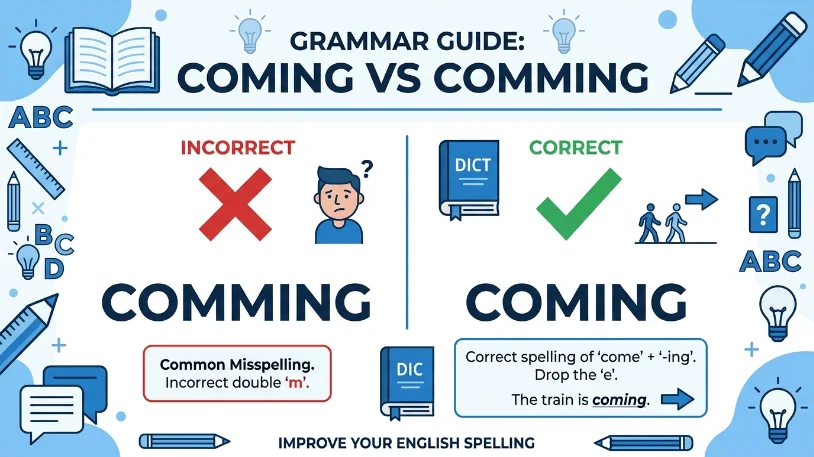
Coming is the correct English spelling and is used when referring to arriving, approaching, happening soon, or moving toward a place. Comming is a common spelling mistake and is not recognized as a correct English word in standard grammar. If you are writing emails, articles, academic papers, or professional content, always use coming instead of comming.
English spelling can be confusing, especially when similar words appear correct at first glance. One of the most common mistakes people make is writing comming instead of coming.
This error often happens because many English words double their consonants before adding -ing. For example, run becomes running and swim becomes swimming. Because of this pattern, many learners assume that come should become comming. However, English does not work that way in this case.
Understanding the difference between comming or coming is important for students, professionals, bloggers, content writers, and anyone who communicates in English. Using the wrong spelling can make writing appear less professional and may even affect credibility in academic or business settings.
In this guide, you’ll learn the correct spelling, grammar rules, practical examples, common mistakes, and easy tricks to remember the difference forever.
Quick Answer: Comming or Coming?
Which Spelling Is Correct?
The correct spelling is:
✅ Coming
The incorrect spelling is:
❌ Comming
Example
Correct:
- I am coming home now.
- The meeting is coming soon.
- Winter is coming.
Incorrect:
- I am comming home now.
- The meeting is comming soon.
The word comming is considered a spelling error in modern English.
What Does Coming Mean?
Definition of Coming
The word coming is the present participle form of the verb come.
It means:
- Moving toward a place
- Arriving somewhere
- Happening in the future
- Approaching in time
Simple Examples
- She is coming to the party.
- My parents are coming tomorrow.
- Summer is coming soon.
- A big change is coming.
In all these examples, coming indicates movement, arrival, or something approaching.
Why Is “Comming” Incorrect?
Understanding the Grammar Rule
Many learners wonder why come does not become comming.
The reason is simple.
When a verb ends with a silent e, English grammar usually removes the e before adding -ing.
Rule
Verb + ing
If the verb ends with silent e:
Remove e + add ing
Examples
| Base Verb | Correct Form |
|---|---|
| Come | Coming |
| Make | Making |
| Take | Taking |
| Write | Writing |
| Drive | Driving |
Notice that none of these words double the final consonant.
Therefore:
Come → Coming ✅
Come → Comming ❌
When Do English Words Double a Consonant?
The Rule for Doubling
Some English words double the last consonant before adding -ing.
This usually happens when:
- The word has one syllable
- Ends with consonant-vowel-consonant pattern
Examples
| Base Word | Correct Form |
|---|---|
| Run | Running |
| Swim | Swimming |
| Sit | Sitting |
| Stop | Stopping |
| Get | Getting |
Because of these examples, people mistakenly write:
Come → Comming
However, come follows a different rule because it ends with a silent e.
Common Situations Where “Coming” Is Used
Coming for Arrival
Used when someone is moving toward a location.
Examples:
- I am coming to your house.
- They are coming tonight.
- She is coming with us.
Coming for Future Events
Used for upcoming events.
Examples:
- The festival is coming next month.
- Exams are coming soon.
- A new update is coming.
Coming for Progress or Movement
Used to show something approaching.
Examples:
- The train is coming.
- Rain is coming.
- Better days are coming.
Comming or Coming in Professional Writing
Emails
Correct:
- Thank you for coming to the meeting.
- I look forward to coming back next week.
Incorrect:
- Thank you for comming to the meeting.
Business Communication
Professional writing requires accurate spelling.
Using “comming” may:
- Create a poor impression
- Reduce credibility
- Appear careless
Academic Writing
Students should always use:
- coming assignment
- coming semester
- coming examination
Never:
- comming assignment
- comming semester
Comming or Coming in Everyday English
Conversations
Examples:
- Are you coming?
- I’m coming right now.
- She’s coming later.
Social Media
People frequently write:
❌ I’m comming.
Correct version:
✅ I’m coming.
Text Messages
Even in informal messages, using the correct spelling improves clarity.
Example:
- I’m coming in five minutes.
Real-World Examples
Example 1
Incorrect:
I am comming to the office tomorrow.
Correct:
I am coming to the office tomorrow.
Example 2
Incorrect:
Winter is comming soon.
Correct:
Winter is coming soon.
Example 3
Incorrect:
Thank you for comming to the event.
Correct:
Thank you for coming to the event.
Example 4
Incorrect:
The package is comming today.
Correct:
The package is coming today.
Common Mistakes and How to Fix Them
Adding an Extra M
Many people think:
Come + ing = Comming
This is incorrect.
Correct:
Come + ing = Coming
Confusing It With Running or Swimming
People compare:
- run → running
- swim → swimming
and assume:
- come → comming
This assumption is wrong because come ends with a silent e.
Typing Too Fast
Many spelling mistakes occur during fast typing.
Always proofread words like:
- coming
- making
- taking
- writing
Regional and Global Usage
American English
Uses:
- coming
Example:
- The movie is coming next week.
British English
Also uses:
- coming
Example:
- The train is coming shortly.
Australian English
Uses:
- coming
Example:
- Summer is coming soon.
Canadian English
Uses:
- coming
Example:
- Snow is coming tomorrow.
Across all major English-speaking countries, coming is the accepted spelling.
Related Grammar Concepts
Come vs Came
| Word | Meaning |
|---|---|
| Come | Present form |
| Came | Past form |
| Coming | Present participle |
Examples:
- I come here often.
- I came yesterday.
- I am coming now.
Coming vs Going
| Coming | Going |
|---|---|
| Moving toward | Moving away |
| Arriving | Leaving |
Examples:
- She is coming home.
- She is going home.
Upcoming vs Coming
Both can refer to future events.
Examples:
- Upcoming conference
- Coming conference
However, “upcoming” is often more formal.
Exercises with Answers
Exercise 1
Choose the correct word:
I am _____ to the meeting.
A. Comming
B. Coming
Answer: B. Coming
Exercise 2
Choose the correct sentence:
A. Winter is comming.
B. Winter is coming.
Answer: B. Winter is coming.
Exercise 3
Fill in the blank:
The guests are _____ tomorrow.
Answer: Coming
Exercise 4
Is this sentence correct?
“Thank you for comming.”
Answer: No
Correct version:
“Thank you for coming.”
Exercise 5
Which spelling is accepted in standard English?
A. Comming
B. Coming
Answer: B. Coming
FAQs
Is comming or coming correct?
Coming is correct. Comming is a spelling mistake and should not be used in formal or informal writing.
Why is coming spelled with one m?
Because the verb come ends with a silent e, which is removed before adding -ing.
Is comming a real word?
No. Standard English dictionaries do not recognize comming as the correct spelling of the verb form.
How do you remember the correct spelling of coming?
Think of the rule: remove the silent e from come and add ing.
Can I use comming in casual writing?
No. Even in text messages and social media posts, coming is the correct spelling.
Why do people write comming?
Many people apply the consonant-doubling rule used in words like running and swimming.
Is coming used in American English?
Yes. American English uses coming as the standard spelling.
Is coming used in British English?
Yes. British English also uses coming.
What is the past tense of come?
The past tense of come is came.
How do I avoid the comming spelling mistake?
Remember this formula:
Come → remove e → Coming
Never add an extra m.
Conclusion
The debate over comming or coming is actually quite simple once you understand the grammar rule. The correct spelling is always coming, while comming is a spelling mistake that should be avoided in all forms of writing.
The confusion usually comes from English words such as running, swimming, and stopping, where consonants are doubled before adding -ing. However, the verb come follows a different rule. Since it ends with a silent e, the e is removed and -ing is added, creating the correct form: coming.
Whether you’re writing an email, school assignment, blog post, business document, or social media update, using the correct spelling improves professionalism and clarity. A simple spelling mistake can affect how readers perceive your writing, especially in professional and academic settings.
The easiest way to remember the rule is:
Come → Coming
No extra m. No exceptions.
Mastering this small grammar point will help you write more confidently and avoid one of the most common English spelling errors.