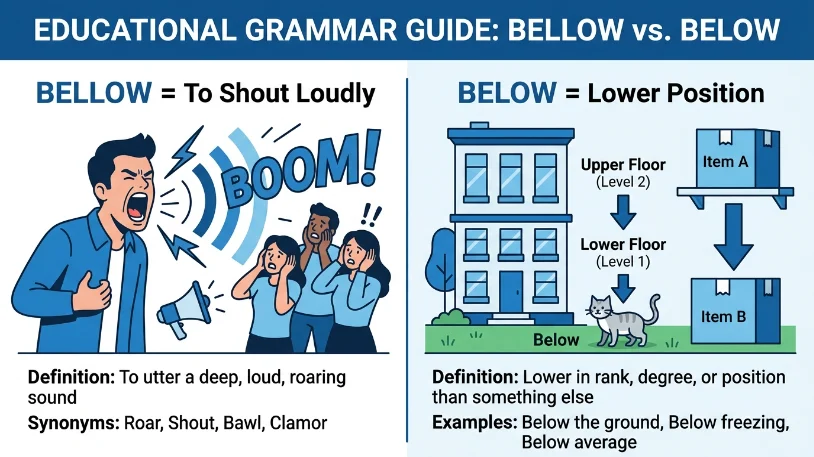
The difference between bellow and below is simple but important. Bellow means to shout loudly or make a deep roaring sound, while below refers to a lower position, level, or place. Although the words look similar, they have completely different meanings and uses in English grammar.
English contains many words that look almost identical but have very different meanings. One common example is bellow or below. These two words differ by only one letter, yet using the wrong one can completely change the meaning of a sentence.
Many students, writers, and even native English speakers occasionally confuse these words because they sound somewhat similar when spoken quickly. However, understanding the distinction is quite easy once you know their definitions and see them used in real situations.
Whether you’re writing an email, preparing academic work, improving your grammar, or simply trying to communicate more clearly, knowing when to use bellow and when to use below will help you avoid mistakes and write with confidence.
This guide explains everything you need to know, including definitions, examples, common errors, exercises, FAQs, and practical tips for remembering the difference.
Quick Answer: Bellow or Below?
The easiest way to remember the difference is this:
| Word | Meaning | Example |
|---|---|---|
| Bellow | To shout loudly or roar | The coach began to bellow at the players. |
| Below | In a lower position or place | The answer is written below. |
If the sentence relates to location, position, rank, level, or something underneath, use below.
If the sentence relates to shouting, roaring, yelling, or making a loud sound, use bellow.
Understanding the Word Bellow
What Does Bellow Mean?
The word bellow is usually used as a verb. It means to shout loudly, roar, or make a powerful deep sound.
People often bellow when they are:
- Angry
- Excited
- Giving commands
- Trying to be heard over noise
Animals can also bellow.
Examples of Bellow in Sentences
- The captain bellowed instructions during the storm.
- The teacher bellowed across the playground.
- The bull bellowed loudly in the field.
- The manager bellowed at the team after the mistake.
Common Situations Where Bellow Is Used
You may encounter the word bellow in:
- Literature
- News reports
- Sports writing
- Military communication
- Storytelling
The word creates a strong image of loud and powerful speech.
Understanding the Word Below
What Does Below Mean?
The word below refers to a lower place, level, position, amount, or rank.
It is commonly used as:
- A preposition
- An adverb
- Sometimes an adjective
Examples of Below in Sentences
- Please read the instructions below.
- The temperature dropped below freezing.
- The village lies below the mountain.
- Your score is below average.
Common Situations Where Below Is Used
The word below frequently appears in:
- Websites
- Forms
- Emails
- Academic writing
- Technical documents
Examples include:
- Click the link below.
- See details below.
- Read the information below.
Because of its widespread use online, below is far more common than bellow in everyday writing.
Bellow vs Below: Side-by-Side Comparison
| Feature | Bellow | Below |
|---|---|---|
| Part of Speech | Usually Verb | Adverb, Preposition, Adjective |
| Meaning | To shout loudly | Lower position or level |
| Related Words | Roar, yell, shout | Under, beneath, underneath |
| Frequency of Use | Less common | Very common |
| Typical Context | Speaking loudly | Position and location |
Why People Confuse Bellow and Below
Similar Spelling
The two words differ by only one letter.
- Bellow
- Below
This similarity makes typing mistakes common.
Similar Pronunciation
Although the pronunciations are different, many learners hear them as similar sounds, especially during fast conversations.
Autocorrect Issues
Spell-check tools often fail to catch the mistake because both words are valid English words.
For example:
Incorrect:
“The details are bellow.”
The sentence contains a real word, so grammar software may not flag it.
Advantages of Learning the Difference
Better Writing Accuracy
Using the correct word improves professionalism and clarity.
Improved Communication
Readers understand your message immediately.
Stronger Academic Performance
Grammar accuracy is important in exams, assignments, and professional documents.
Better SEO Content Writing
Content writers must avoid grammar mistakes because poor language can affect user trust and engagement.
Real-World Examples
Example in Business Writing
Incorrect:
Please see the information bellow.
Correct:
Please see the information below.
Example in Storytelling
Incorrect:
The lion below through the jungle.
Correct:
The lion bellowed through the jungle.
Example in Education
Incorrect:
The chart bellow explains the results.
Correct:
The chart below explains the results.
Example in Sports
The coach bellowed instructions from the sideline.
This example clearly refers to shouting.
Common Mistakes and Corrections
Mistake: Using Bellow for Position
Incorrect:
The answers are listed bellow.
Correct:
The answers are listed below.
Mistake: Using Below for Loud Sounds
Incorrect:
The bull belowed loudly.
Correct:
The bull bellowed loudly.
Mistake: Assuming Both Words Mean the Same Thing
These words are unrelated.
Below refers to location.
Bellow refers to sound.
Memory Tricks to Remember Bellow and Below
Remember the “Yell” Inside Bellow
Notice this:
Bellow → sounds similar to yell.
Both involve loud voices.
Remember the “Low” Inside Below
The word below contains “low.”
Low means lower position.
This makes below easy to remember.
Related Words and Comparisons
Bellow vs Yell
Both mean speaking loudly.
However:
- Yell is more common.
- Bellow is stronger and deeper.
Below vs Beneath
Both indicate lower position.
Examples:
- The keys are below the shelf.
- The keys are beneath the shelf.
In many situations, they are interchangeable.
Below vs Under
Both suggest lower position.
However, under often implies direct coverage.
Example:
- The cat is under the table.
- The apartment is below mine.
Practice Exercises
Exercise 1
The teacher began to ______ at the noisy students.
Answer: Bellow
Exercise 2
Please review the instructions ______.
Answer: Below
Exercise 3
The temperature fell ______ zero.
Answer: Below
Exercise 4
Choose the correct word.
The angry bull started to ______.
Answer: Bellow
Exercise 5
Choose the correct word.
The comments section is located ______.
Answer: Below
FAQs
What is the difference between bellow and below?
Bellow means to shout loudly, while below means in a lower position or level.
Is it “see below” or “see bellow”?
The correct phrase is “see below.”
Can bellow be used as a noun?
Yes. A bellow can refer to a loud roar or deep shout.
Which word is more common in writing?
Below is far more common because it appears frequently in emails, websites, and documents.
Why do people confuse bellow and below?
They have very similar spellings and are often mistyped.
Does below mean underneath?
In many situations, yes. Below often means under or at a lower level.
Can animals bellow?
Yes. Bulls, elephants, and other large animals can bellow.
How do I remember bellow vs below?
Think of “yell” inside bellow and “low” inside below.
Is “details are bellow” correct?
No. The correct phrase is “details are below.”
Can grammar checkers detect this mistake?
Not always. Since both words are valid English words, some tools may miss the error.
Conclusion
Understanding the difference between bellow or below is easier than many people think. Although the words look similar, their meanings are completely different.
Use bellow when talking about loud shouting, roaring, or powerful sounds. Use below when referring to something lower in position, rank, level, or location.
A simple memory trick can help: bellow relates to yell, while below relates to low. Once you remember this connection, you’ll rarely confuse the two words again.
Whether you’re writing emails, creating content, completing assignments, or improving your English skills, using the correct word helps your writing appear more professional and easier to understand. Taking a few seconds to choose the right term can prevent confusion and improve communication significantly.