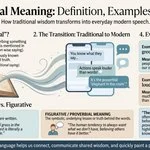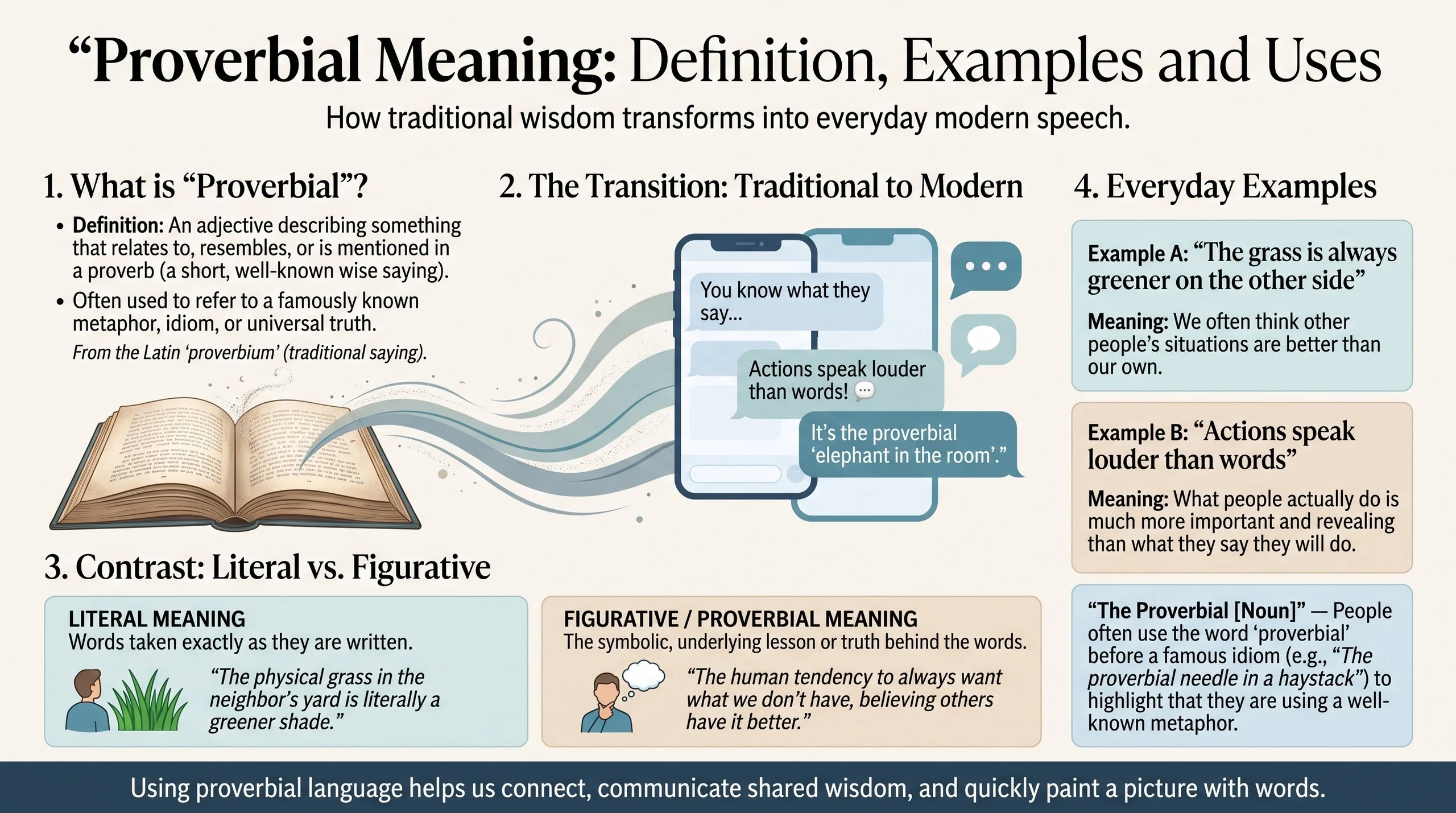
The proverbial meaning refers to the figurative or commonly understood meaning associated with a proverb, saying, or familiar expression. It often differs from the literal meaning and communicates a broader lesson, idea, comparison, or cultural truth.
Proverbial meaning explains what a familiar saying communicates beyond its literal words. For example, “Actions speak louder than words” does not describe actual sound. Instead, it suggests that behavior often provides stronger evidence than promises.
Understanding figurative language helps readers interpret conversations, books, articles, movies, social media posts, and everyday speech. However, a proverb can carry cultural assumptions that make its meaning less obvious to language learners.
In American English, people often use familiar sayings without explaining them. Therefore, recognizing the intended idea can make communication much easier. A speaker may also adapt an old saying to fit a modern situation.
QUICK ANSWER BOX
| Meaning | Context | Primary Platforms | Example | Tone |
| Figurative or commonly understood lesson behind a proverb or saying | Conversation, writing, literature, education | General communication, social media, texting, books | “The early bird gets the worm” suggests that acting early can bring advantages | Educational, conversational, reflective |
What Does proverbial meaning Mean?
The term describes the figurative idea, lesson, or accepted interpretation behind a proverb.
A proverb usually contains a short statement that communicates a broader observation about life. Its words may describe one situation, while its intended message applies to many situations.
For example:
“Don’t count your chickens before they hatch.”
The literal image involves chickens and eggs. However, the intended message concerns expectations. It advises people not to assume that a hoped for result will definitely happen.
Literal meaning versus figurative meaning
Understanding the difference between literal and figurative language is essential.
| Type | Meaning | Example |
| Literal | The words mean exactly what they say | “The glass is on the table.” |
| Figurative | The words communicate an idea beyond their direct meaning | “Time is money.” |
| Proverbial | A familiar saying communicates a broader lesson | “Better late than never.” |
| Idiomatic | A fixed expression has a meaning that cannot always be understood literally | “Break the ice.” |
A proverb does not always function exactly like an idiom. A proverb generally communicates advice, observation, wisdom, or a general principle.
An idiom, by comparison, often describes a situation through a fixed expression.
Where did the concept come from?
Proverbs have existed across cultures for centuries. People have used short sayings to preserve practical knowledge, social values, warnings, humor, and observations.
English contains sayings influenced by many historical sources. Some entered English through literature, religion, folklore, oral traditions, and everyday speech.
Consequently, the meaning of a proverb can depend on cultural history.
Why can a proverb sound confusing?
A proverb compresses a larger idea into a small number of words. Therefore, readers must often infer the intended message.
Consider:
“The grass is always greener on the other side.”
The statement is not normally about grass. Instead, it suggests that people may believe another situation looks better than their current one.
The context determines whether the speaker is offering advice, making an observation, criticizing unrealistic expectations, or simply making a humorous comment.
Contextual Dynamics and Nuances of the Term
The intended interpretation can change according to context, speaker, audience, and tone.
Context determines the message
Imagine someone complaining about their job.
- Person A: “Everyone at that company seems happier than we are.”
- Person B: “The grass is always greener on the other side.”
Person B probably does not mean that literal grass looks better elsewhere. Instead, the response suggests that the other workplace may not be as perfect as it appears.
Tone can change the effect
A proverb can sound:
| Tone | Possible effect |
| Helpful | Offers practical advice |
| Serious | Communicates a life lesson |
| Humorous | Makes an observation playfully |
| Sarcastic | Challenges someone’s assumption |
| Critical | Points out questionable behavior |
| Reflective | Encourages deeper thought |
The same saying can therefore feel supportive in one conversation and dismissive in another.
Cultural knowledge matters
Some sayings depend heavily on shared cultural knowledge.
For example, an American English speaker may immediately recognize:
“When in Rome, do as the Romans do.”
A language learner might understand the individual words but miss the broader message.
The saying encourages people to adapt to local customs when visiting or participating in another culture.
Modern speakers often adapt old sayings
People do not always repeat proverbs exactly.
For example:
“Well, I guess the early bird gets the worm.”
A speaker may use this after arriving at a store early and finding a good parking space.
The proverb becomes a casual commentary rather than a formal lesson.
Real Life Conversation Examples Using proverbial meaning
These examples show how familiar sayings work naturally in everyday American English.
Conversation 1: Taking action
Maya: “I keep thinking about applying for that job, but I haven’t sent my résumé.”
Jordan: “You should go for it. The early bird gets the worm.”
Maya: “You’re right. I’ll apply tonight.”
Here, the saying encourages early action.
Conversation 2: Managing expectations
Chris: “I already started planning my vacation with the money from my new contract.”
Alex: “You haven’t signed the contract yet.”
Chris: “True.”
Alex: “Don’t count your chickens before they hatch.”
The speaker uses the proverb as a warning against assuming success too early.
Conversation 3: Comparing situations
Nina: “I wish I worked at your company. Everyone there seems relaxed.”
Taylor: “It isn’t always that easy. The grass is always greener on the other side.”
Nina focuses on the positive appearance of another workplace. Taylor reminds her that appearances can be misleading.
Conversation 4: Learning from mistakes
Sam: “I missed the deadline because I waited until the last minute.”
Jordan: “Well, better late than never. At least you finished it.”
Here, the proverb softens the situation and emphasizes the value of completing something despite the delay.
Conversation 5: Teamwork
Lena: “I thought I could finish the whole project alone.”
Marcus: “Many hands make light work.”
Lena: “I should have asked for help earlier.”
The proverb communicates the idea that shared effort can make difficult work easier.
Platform Specific Breakdown
Proverbs do not belong exclusively to one social media platform. However, people use them differently depending on the communication environment.
Short form platforms encourage concise language. Messaging encourages conversational language. Visual platforms often pair sayings with captions or images.
How It Is Used on Snapchat
Snapchat conversations tend to be informal and brief. Users may place a familiar saying over a photo, video, or short message.
For example:
“Early start today. The early bird gets the worm.”
The purpose is usually casual. The speaker may be sharing a thought rather than teaching a formal lesson.
A proverb can also appear as a humorous caption.
For instance, someone might post a picture of an early morning coffee with a familiar saying. The visual context supplies much of the meaning.
The Role of proverbial meaning on TikTok
TikTok supports short videos, captions, spoken commentary, and text overlays. Consequently, creators can explain a proverb through storytelling or demonstrate it through a situation.
A creator might present a short scenario:
“I ignored every warning and bought the car anyway. Now I understand why people say, ‘Look before you leap.’”
The proverb becomes part of the story.
TikTok also allows creators to reinterpret familiar sayings. A creator may intentionally reverse an old saying for comedy.
For example, someone might jokingly create a video about ignoring the idea that “the early bird gets the worm.”
The platform itself does not assign a special technical definition to the term. Instead, the expression works as ordinary English within short form content.
Instagram and Texting Dynamics
Instagram captions often use sayings to summarize an experience.
A photograph from a difficult hiking trip might include:
“The journey of a thousand miles begins with a single step.”
In texting, people usually use shorter and more conversational versions.
Text message:
“I know it looks hard, but one step at a time.”
The underlying idea remains similar even when the exact proverb disappears.
Therefore, people often communicate the lesson without quoting the complete saying.
Alternative Meanings and NLP Variations of the Phrase
Search engines and language models may encounter several related forms.
| Variation | Meaning |
| Meaning of a proverb | Explanation of a particular proverb |
| Proverb definition | Basic dictionary style explanation |
| Figurative meaning | Meaning beyond literal wording |
| Meaning behind a saying | Intended idea communicated by an expression |
| Proverb interpretation | Deeper explanation of a proverb |
| Moral of the proverb | Lesson or principle communicated by it |
| Figurative expression | Language that communicates more than literal facts |
| Common saying | Familiar expression used in everyday communication |
| Traditional saying | Expression passed through cultural or social use |
These expressions overlap, but they are not always interchangeable.
For example, a proverb usually communicates a general lesson. A common saying may simply express a familiar observation.
Proverb versus idiom
Consider these two examples:
“Every cloud has a silver lining.”
“Spill the beans.”
The first generally communicates an optimistic lesson about difficult situations.
The second is an idiom meaning to reveal information or a secret.
Therefore, both expressions use figurative language, but they serve different linguistic functions.
Proverb versus metaphor
A metaphor compares one thing with another to create meaning.
For example:
“Life is a journey.”
This is a metaphor.
A proverb can contain metaphorical language:
“You can’t judge a book by its cover.”
The proverb uses a book as a comparison for people or situations.
Misinterpretations: When NOT to Use proverbial meaning
The phrase is useful when discussing the meaning of a proverb. However, it is not necessary in every conversation involving figurative language.
Do not confuse it with literal meaning
If someone says:
“The dog is under the table.”
There is no need to search for a proverbial interpretation.
The statement normally communicates a literal fact.
Do not assume every saying is a proverb
Some expressions are idioms, clichés, metaphors, slogans, or quotations.
For example:
“Break a leg.”
This is an idiomatic expression used to wish someone good luck.
It is not normally treated as a traditional proverb.
Avoid forcing a proverb into formal writing
Academic writing requires precision. A proverb can work in an essay when it supports the argument, but it should not replace clear evidence.
Instead of writing:
“As everyone knows, the early bird gets the worm.”
A formal writer might explain the specific evidence directly.
Do not use a proverb when the audience may not understand it
International audiences may not recognize culturally specific sayings.
In that situation, provide the explanation.
For example:
“As the saying goes, ‘The grass is always greener on the other side,’ meaning that other situations can seem better than they really are.”
This approach improves clarity.
Do not treat every proverb as universal truth
Proverbs express cultural observations. They are not scientific laws.
For example, “Practice makes perfect” encourages repeated practice. However, practice alone does not guarantee perfection.
Therefore, interpret proverbs according to context rather than treating them as absolute facts.
How to Respond in Chat Comfortably
When someone uses a proverb in a conversation, you do not always need to explain it.
Your response should depend on whether you understand the intended message.
When you understand the saying
You can respond naturally:
“Exactly.”
“That makes sense.”
“I agree with that.”
“That’s a good point.”
When you understand but want clarification
Try:
“Do you mean that we should wait and see what happens?”
This confirms your interpretation without interrupting the conversation.
When you do not understand
A simple question works well:
“What do you mean by that?”
Or:
“Can you explain that saying?”
These responses sound natural and polite.
When someone uses a proverb sarcastically
Pay attention to tone.
For example:
Alex: “I forgot my umbrella again.”
Jordan: “Well, better safe than sorry.”
If Jordan says this after Alex gets soaked, the tone may be humorous or ironic rather than serious.
Therefore, words alone do not always reveal the speaker’s intention.
FAQs
1. What does proverbial meaning mean?
It refers to the figurative or commonly understood idea behind a proverb or familiar saying. The meaning usually extends beyond the literal words.
2. Is proverbial meaning the same as literal meaning?
No. Literal meaning focuses on the direct meaning of words. Proverbial interpretation usually focuses on the broader lesson or idea communicated by a saying.
3. What is an example of proverbial meaning?
“The grass is always greener on the other side” suggests that people may view another situation as better than their current situation, even when that assumption may not be accurate.
4. Is proverbial meaning used in everyday English?
Yes. People regularly use familiar proverbs and sayings in conversations, writing, social media captions, and storytelling.
5. Is a proverb the same as an idiom?
No. A proverb usually communicates advice, wisdom, or a general observation. An idiom is a fixed expression whose meaning may differ substantially from its individual words.
6. Can a proverb have more than one interpretation?
Yes. Context, culture, speaker intention, and tone can affect how listeners understand a proverb.
7. Why do people use proverbs?
People use proverbs to communicate ideas quickly. A familiar saying can summarize a complicated thought in just a few words.
8. Are proverbs appropriate in professional communication?
They can be appropriate in informal professional conversations. However, writers should consider the audience and purpose. Direct language often works better in formal reports and technical documents.
9. Can social media change how people understand proverbs?
Yes. Social media can popularize, shorten, remix, parody, and reinterpret traditional sayings. However, the original cultural meaning may remain relevant.
10. How can English learners understand proverbs more easily?
Learn the figurative message rather than memorizing individual words. Then study several examples and observe how native speakers use the expression in different contexts.
Conclusion
The proverbial meaning of a saying comes from the broader idea that the expression communicates. The literal words provide the surface image. The cultural or figurative message provides the deeper interpretation.
Proverbs remain useful because they compress complex observations into memorable statements. People use them in classrooms, workplaces, conversations, books, movies, captions, and digital communication.
Modern platforms have also changed how people present traditional expressions. A proverb can now appear as a caption, video script, meme, text message, or humorous adaptation.
However, the basic linguistic principle remains the same. Context determines meaning.
When interpreting a familiar saying, consider three things: the literal words, the situation, and the speaker’s intention. This approach helps you understand both traditional expressions and their modern adaptations.
For English learners, studying these distinctions can improve reading comprehension, conversational fluency, and cultural awareness. It also makes figurative language easier to recognize across everyday American English.