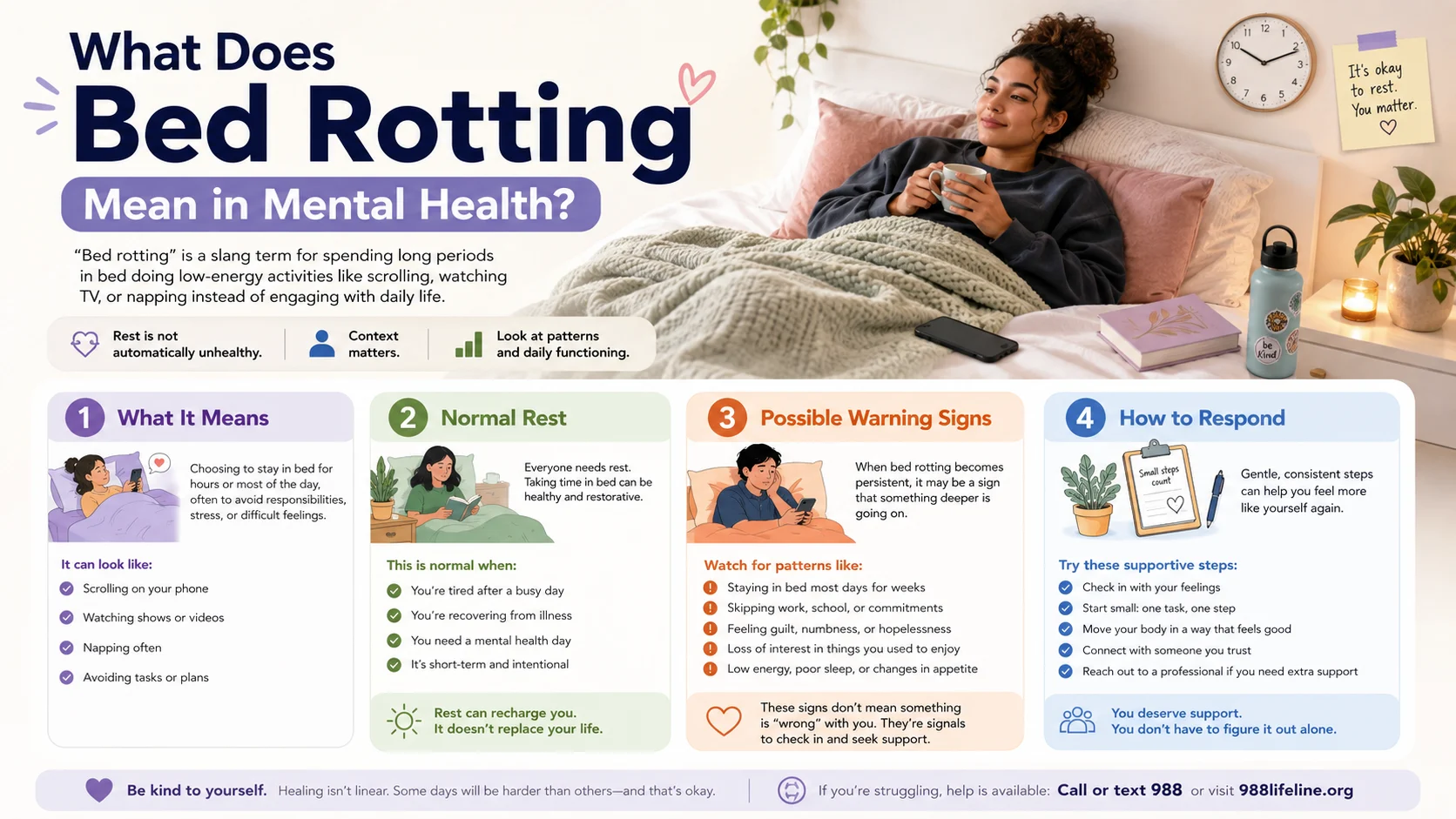
What does bed rotting mean in mental health? It describes spending extended time in bed while awake, often to rest, escape stress, or recover emotionally. It can be harmless self care, but frequent withdrawal may also accompany low mood or burnout.
What does bed rotting mean in mental health? The phrase describes a behavior where someone stays in bed for a long period while awake, often because they feel exhausted, overwhelmed, emotionally drained, or simply want to disconnect from daily demands.
However, the expression does not automatically describe a mental illness. People sometimes use it casually after a stressful week or demanding schedule. For example, someone might spend a Saturday watching shows, scrolling through social media, eating snacks, and avoiding plans.
The meaning changes with context.
Occasional rest can support recovery. Furthermore, deliberately creating a quiet day can feel comforting after intense work, school, travel, or social activity. On the other hand, regularly staying in bed because getting up feels impossible can point to a deeper problem.
That distinction matters.
Online culture has also turned the phrase into a recognizable piece of internet vocabulary. TikTok, Instagram, Snapchat, memes, group chats, and casual texting have helped popularize the expression. Consequently, people may use it humorously even when they are simply taking a lazy morning.
This guide explains the phrase without treating ordinary rest as a diagnosis. It also explores how people use the expression online, what it can communicate emotionally, when it may become concerning, and how to respond naturally.
QUICK ANSWER BOX
| Element | Answer |
| Meaning | Staying in bed for an extended period while awake, usually for rest, comfort, avoidance, or emotional recovery |
| Context | Casual internet slang, self care discussions, burnout conversations, mental health discussions |
| Primary Platforms | TikTok, Instagram, Snapchat, texting, Reddit, and other social platforms |
| Example | “I have no plans today. I’m just bed rotting and watching movies.” |
| Tone | Usually casual, humorous, relatable, or self aware |
What Does Bed Rotting Mean in Mental Health?
The expression refers to spending a significant amount of time in bed without necessarily sleeping. A person might scroll, watch television, read, listen to music, snack, text friends, or simply lie under the covers.
In mental health conversations, the phrase can carry a second layer.
Someone may use it to describe emotional withdrawal. They might feel overwhelmed by responsibilities and choose the bed as a temporary refuge. In that situation, the behavior can represent a desire for comfort rather than simple laziness.
Still, context remains essential.
The basic definition
At its simplest, the phrase means intentionally or unintentionally remaining in bed for a prolonged period while awake.
The person might say:
“I’m bed rotting today.”
They usually mean:
“I’m staying in bed and doing very little today.”
The statement does not automatically mean:
“I have a mental health disorder.”
That distinction prevents unnecessary assumptions.
Where the expression comes from
The phrase follows a familiar internet naming pattern. Online communities often create playful labels for everyday behaviors.
Terms such as “doomscrolling,” “girl dinner,” “quiet quitting,” and “couch potato” show how digital culture turns recognizable habits into compact expressions.
“Bed rotting” uses exaggerated imagery. The word “rotting” makes ordinary inactivity sound dramatic and humorous. As a result, the phrase can make a low energy day easier to discuss.
People can say something serious without making the conversation feel overly clinical.
Why people relate to the expression
Modern schedules often create constant demands. Work notifications, school assignments, social commitments, family responsibilities, and digital communication can make people feel mentally overloaded.
Therefore, staying in bed may feel like a temporary escape from those demands.
Someone might think:
“I don’t want to make decisions today.”
Another person might feel:
“I need a day where nobody expects anything from me.”
The behavior can therefore function as a form of temporary decompression.
Rest versus withdrawal
The most important distinction involves function.
Healthy rest usually helps someone recover. After resting, the person often feels more capable of returning to normal activities.
Withdrawal tends to reduce engagement. The person may continue avoiding responsibilities, relationships, hygiene, meals, work, school, or other ordinary activities.
| Occasional Rest | Concerning Withdrawal |
| Happens occasionally | Happens frequently |
| Feels refreshing | Feels difficult to escape |
| Person can resume normal activities | Normal activities become increasingly difficult |
| Chosen for comfort | Driven by hopelessness or exhaustion |
| Responsibilities remain manageable | Responsibilities repeatedly go unfinished |
| Usually short lived | May continue for days or longer |
The behavior itself does not provide enough information to determine someone’s mental health.
The surrounding pattern matters more.
Contextual Dynamics & Nuances of the Term
The phrase can communicate several different things depending on who says it, where they say it, and why they use it.
It can describe harmless relaxation
A person might finish a difficult project and spend Sunday in bed.
They may order food, watch movies, play games, and ignore their phone for several hours.
In that situation, the phrase functions like humorous shorthand for relaxation.
For example:
“After that exam, I’m bed rotting all weekend.”
The speaker probably does not intend a clinical meaning.
It can describe emotional exhaustion
Another person may use the expression after an emotionally difficult experience.
For example:
“Everything has been overwhelming lately. I just want to bed rot.”
Here, the phrase communicates more than physical tiredness.
It can suggest emotional depletion.
The person may want comfort, reduced stimulation, or temporary isolation.
It can describe burnout
Burnout can involve profound exhaustion and reduced motivation. Someone experiencing burnout may struggle to begin ordinary tasks.
Therefore, bed based inactivity can become part of a larger pattern.
However, the phrase itself does not establish burnout.
A person can experience one without the other.
It can become a humorous coping mechanism
Internet language often softens uncomfortable subjects.
Someone might joke:
“My productivity plan today is bed rotting.”
The humor can make vulnerability easier.
Furthermore, shared slang can create a feeling of community. Someone discovers that other people experience the same urge to withdraw, rest, or escape pressure.
Why “rotting” sounds stronger than “resting”
The word “resting” sounds positive and intentional.
“Rotting” sounds exaggerated, passive, and slightly absurd.
That contrast creates the humor.
The phrase therefore communicates:
“I am doing almost nothing.”
It can also communicate:
“I know I am doing almost nothing, and I am making a joke about it.”
That self awareness explains much of its popularity.
The mental health distinction
Mental health professionals generally look at patterns, symptoms, duration, distress, and functional impact rather than internet labels.
So, someone saying they are bed rotting does not tell you enough to diagnose depression, anxiety, burnout, or another condition.
Instead, consider questions such as:
- How often does this happen?
- How long does it last?
- Does the person want to get up but feel unable?
- Are work or school responsibilities suffering?
- Are relationships becoming harder to maintain?
- Is personal care being neglected?
- Does the person feel persistently hopeless or unusually low?
- Does resting actually help?
These questions provide far more useful context than slang alone.
Real Life Conversation Examples Using What Does Bed Rotting Mean in Mental Health?
People rarely use the phrase in formal language. Most examples appear in casual chats, captions, comments, or conversations between friends.
Example 1: Weekend relaxation
Alex: What are you doing today?
Maya: Honestly? Bed rotting.
Alex: Productive plans, I see.
Maya: Absolutely not. Movies, snacks, and zero responsibilities.
Alex: Honestly, sounds deserved.
Here, the expression means relaxing without plans.
It does not necessarily suggest emotional distress.
Example 2: After a stressful week
Jordan: You coming out tonight?
Sam: I don’t think so. I’m completely exhausted.
Jordan: Everything okay?
Sam: Yeah. I just need to bed rot for a few hours and reset.
Jordan: Fair. Text me if you need anything.
Here, the phrase communicates temporary recovery.
Example 3: Possible emotional withdrawal
Taylor: You haven’t left your room much lately. Are you okay?
Chris: I’ve mostly been bed rotting.
Taylor: Like relaxing, or are you struggling to get up?
Chris: Honestly, struggling.
Taylor: I’m glad you told me. Want to talk?
This example shows why context matters.
The same expression can describe ordinary rest or significant difficulty functioning.
Example 4: Social media humor
Nina: New self care routine.
Leah: What is it?
Nina: Bed rotting, iced coffee, and pretending Monday doesn’t exist.
Leah: A revolutionary strategy.
The phrase works as humorous internet language.
Example 5: Supportive conversation
Chris: I spent almost the entire day in bed again.
Jamie: Do you feel rested?
Chris: Not really.
Jamie: Has that been happening a lot?
Chris: Pretty much every day this week.
Jamie: Maybe we should talk about what’s making things feel so heavy.
This conversation avoids judgment.
It also avoids diagnosing the person.
That approach works better than immediately saying, “You have depression.”
Platform Specific Breakdown
Internet slang changes slightly across platforms. The audience, content format, and social expectations all influence interpretation.
How It Is Used on Snapchat
Snapchat conversations often favor short, informal expressions.
A user might send a photo from bed with a caption such as:
“Bed rotting all day.”
The phrase can function as a status update.
It may communicate boredom, relaxation, exhaustion, or humor.
Snapchat also encourages conversational context. A friend who knows the person well can interpret the message differently from a stranger.
For example, if someone normally posts energetic updates but suddenly says they cannot get out of bed, a friend might check in.
However, a weekend story showing someone watching movies does not necessarily indicate distress.
The Role of What Does Bed Rotting Mean in Mental Health on TikTok
TikTok helped popularize many informal expressions related to modern routines and emotional experiences.
Videos about staying in bed may frame the behavior as:
- A recovery day
- A self care routine
- A burnout response
- A humorous lifestyle choice
- An emotionally difficult period
- A relatable lazy day
The visual format also changes the meaning.
A creator might show blankets, snacks, television, skincare products, books, and a phone. The content may portray inactivity as comforting and intentional.
Another creator may discuss feeling unable to leave bed for several days.
Those videos describe very different experiences.
Therefore, viewers should avoid treating every use of the phrase as evidence of a mental health condition.
TikTok language also changes quickly. A term can move from niche communities into mainstream conversation within a short period.
Consequently, definitions can become broader over time.
Instagram and Texting Dynamics
Instagram captions often use the phrase as lifestyle humor.
A person might post a photo of their bed and write:
“Today’s agenda: bed rotting.”
Texting tends to make the expression more personal.
For example:
“I can’t deal with people today. I’m staying in bed.”
A close friend might understand the emotional meaning immediately.
Instagram also creates an important distinction between performance and reality.
A polished “bed day” post may show candles, coffee, blankets, and entertainment. Someone else may privately experience severe exhaustion while using exactly the same phrase.
Social media content rarely provides the entire context.
Other online spaces
The expression can also appear in group chats, Reddit discussions, memes, comments, and short form videos.
Different communities may use it differently.
A meme community may use it almost entirely for humor. A mental health community may use it more seriously.
Therefore, platform context can influence interpretation.
Alternative Meanings & NLP Variations of the Phrase
People rarely repeat one exact sentence. Instead, they use related expressions that communicate similar concepts.
Common variations
| Expression | Typical Meaning |
| Bed rotting | Staying in bed for an extended period |
| Rotting in bed | Similar informal meaning |
| Rot day | A day focused on doing very little |
| Bed day | Spending much of the day in bed |
| Staying in bed all day | Literal description |
| Hiding under the covers | Figurative or literal withdrawal |
| Doing absolutely nothing | Emphasizes inactivity |
| Taking a reset day | Frames inactivity as recovery |
| Decompressing | Recovering after stress |
| Cocooning | Creating a protected, low stimulation environment |
These expressions overlap, but they do not always mean exactly the same thing.
“Reset day,” for example, sounds more intentional and positive.
“Rotting in bed” sounds more humorous and exaggerated.
Semantic relationship to “doomscrolling”
Doomscrolling describes repeatedly consuming distressing or negative content online.
Bed rotting can include doomscrolling, but the terms are not synonyms.
Someone can stay in bed without scrolling.
Likewise, someone can doomscroll while sitting at a desk.
Semantic relationship to “hibernating”
“Hibernating” often describes withdrawing from social activity for an extended period.
People sometimes use it metaphorically.
For example:
“I’m hibernating this weekend.”
The phrase sounds playful and temporary.
Semantic relationship to “self care”
Self care involves actions intended to support physical, emotional, or psychological well being.
Staying in bed can sometimes form part of self care.
However, prolonged inactivity does not automatically qualify as healthy self care.
That distinction matters because social media can label almost any comforting behavior as self care.
Misinterpretations: When NOT to Use What Does Bed Rotting Mean in Mental Health
The phrase works well in casual communication, but it can create confusion in serious situations.
Do not use the phrase as a diagnosis
Saying:
“They’re bed rotting, so they’re depressed.”
makes an unsupported assumption.
A behavior alone cannot establish a diagnosis.
Instead, describe what you actually observe.
For example:
“They’ve been staying in bed most days and struggling with normal responsibilities.”
That statement communicates observable behavior without making a clinical claim.
Do not dismiss serious distress as laziness
The opposite mistake can also cause harm.
Someone who repeatedly stays in bed may be experiencing significant emotional distress.
Calling them lazy can increase shame.
Instead, ask what they are experiencing.
Do not assume every long bed day is unhealthy
People need downtime.
Someone recovering from travel, intense work, illness, exams, or social exhaustion may genuinely benefit from extra rest.
Context makes the difference.
Do not use internet slang in formal clinical communication
A doctor, therapist, teacher, employer, or other professional may need more precise language.
Instead of saying:
“I have been bed rotting.”
A clearer description might be:
“I’ve been spending several hours in bed during the day, and it’s becoming difficult to complete my normal responsibilities.”
That wording provides useful information.
When the pattern deserves more attention
Consider seeking professional support when prolonged bed based withdrawal consistently interferes with daily life.
Potential warning signs can include persistent low mood, major changes in sleep, loss of interest, severe fatigue, difficulty caring for yourself, or increasing isolation.
The key issue is not the slang.
The key issue is the person’s overall functioning and well being.
How to Respond in Chat Comfortably
If someone tells you they are bed rotting, avoid jumping to conclusions.
A simple response can match the context.
Casual response
“Honestly, enjoy your lazy day.”
This works when the person clearly sounds relaxed.
Supportive response
“Sounds like you really needed a break. Hope you get some rest.”
This acknowledges the person’s need without assuming a diagnosis.
Check in gently
“Is this a chill day, or are you having a rough time?”
This question creates space for honesty.
When they sound distressed
Try:
“I’m sorry you’re feeling that way. Want to talk about what’s making things difficult?”
This response focuses on the person rather than the label.
What to avoid
Avoid statements such as:
“You’re just being lazy.”
Also avoid:
“That definitely means you’re depressed.”
Both responses oversimplify the situation.
A useful response framework
| Situation | Comfortable Response |
| Clearly joking | “Honestly, enjoy the lazy day.” |
| Recovering from stress | “Sounds like you needed a reset.” |
| Uncertain context | “Chill day or rough day?” |
| Sounds emotionally overwhelmed | “Want to talk about what’s going on?” |
| Repeated difficulty functioning | “Have you been feeling like this often?” |
| Serious distress | Encourage appropriate professional support |
The goal is not to diagnose.
The goal is to understand.
FAQs
1. What does bed rotting mean in mental health?
It generally describes spending a long time in bed while awake, often for comfort, rest, avoidance, or emotional recovery. The phrase itself does not indicate a mental health diagnosis.
2. Is bed rotting always bad?
No. Occasional downtime can be completely normal. However, frequent or prolonged withdrawal can become concerning when it interferes with everyday responsibilities or leaves someone feeling worse.
3. Is bed rotting the same as depression?
No. Depression involves a broader pattern of symptoms and requires proper assessment. Spending a day in bed does not establish depression.
4. Why do people say they are bed rotting?
People may use the phrase because they feel tired, stressed, overwhelmed, socially drained, bored, or simply ready for a quiet day.
5. Is staying in bed all day considered self care?
Sometimes, but not automatically. Rest can support recovery. However, self care generally helps someone function better over time. If staying in bed repeatedly makes daily life harder, the situation deserves closer attention.
6. Is bed rotting a TikTok term?
The phrase became widely visible through internet and social media culture, particularly short form content. However, online slang can spread across multiple platforms and communities.
7. What is the difference between resting and withdrawing?
Rest usually provides recovery and allows someone to return to normal activities. Withdrawal can involve increasing avoidance, isolation, or difficulty completing basic responsibilities.
8. What should I say when someone tells me they are bed rotting?
Match your response to their tone. If they sound playful, respond casually. If they sound distressed, ask whether they are having a difficult time and offer support.
9. Can bed rotting be caused by burnout?
It can occur alongside burnout, especially when someone feels mentally and physically exhausted. However, the phrase does not prove that burnout exists.
10. When should someone take prolonged bed time seriously?
Take it seriously when it happens repeatedly, lasts unusually long, causes significant distress, or interferes with work, school, relationships, personal care, or other everyday activities.
Conclusion
What does bed rotting mean in mental health? Ultimately, the phrase describes extended time spent in bed while awake, but its emotional meaning depends heavily on context.
Sometimes, it simply means taking a lazy day.
Sometimes, it describes recovery after stress.
In other situations, it can describe a pattern of withdrawal that deserves attention.
That flexibility explains why the expression became popular online. It turns a familiar behavior into memorable, humorous language. Furthermore, it gives people an easy way to describe feeling exhausted, overwhelmed, antisocial, or simply comfortable under the covers.
However, internet slang should not replace careful observation.
A caption cannot diagnose a mental health condition. A meme cannot reveal someone’s complete emotional state. Likewise, one day spent in bed does not automatically indicate a problem.
The more useful questions involve frequency, duration, distress, and functioning.
If someone rests and returns to normal activities, the behavior may simply represent downtime. If someone repeatedly feels unable to get up, withdraws from ordinary life, or struggles with basic responsibilities, the situation deserves greater attention.
Therefore, the healthiest interpretation remains balanced.
Rest can be valuable. Humor can make difficult experiences easier to discuss. Yet persistent withdrawal should not be ignored simply because social media gives it a catchy name.
Modern internet slang evolves quickly. The best way to understand it is not only by defining the words, but also by understanding the human experiences behind them.

Charlotte Wilson is a language writer passionate about word meanings, synonyms, and clear communication. She creates accurate and engaging content to help readers expand their vocabulary and language skills.








8 thoughts on “What Does Bed Rotting Mean in Mental Health| The Ultimate Guide and Meaning”