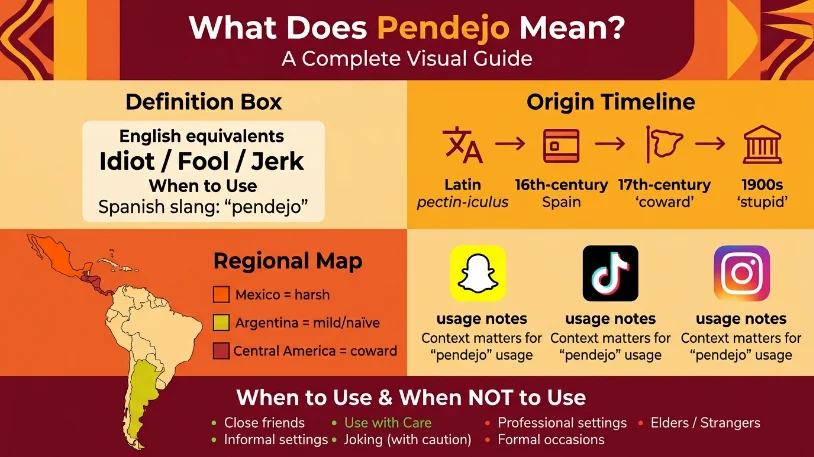
What does pendejo mean? Pendejo is a Spanish slang insult that translates to “idiot,” “fool,” or “foolish person.” It literally means “pubic hair” from Latin roots but is almost never used that way. Instead, it functions as a mild-to-moderate curse word depending on tone, region, and relationship between speakers.
If you have ever asked yourself what does pendejo mean after hearing it in a song, movie, or social media post, you are not alone. This Spanish slang term pops up everywhere from TikTok comments to casual conversations among friends. Yet its meaning shifts dramatically based on who is speaking, where they are from, and how they say it. Some people use it as a playful tease; others wield it as a sharp insult. Understanding this word requires more than a simple translation it demands cultural awareness, context, and a feel for the nuances of Spanish-language communication.
Quick Answer Box
| Aspect | Details |
| Meaning | Idiot, fool, foolish person, jerk, or asshole (depending on context) |
| Literal Translation | Pubic hair (from Latin pectiniculus) |
| Primary Platforms | TikTok, Snapchat, Instagram, texting, movies, music |
| Example | “No seas pendejo, piensa antes de hablar.” (“Don’t be an idiot, think before you speak.”) |
| Tone | Ranges from playful/friendly to harsh/offensive; depends entirely on context |
What Does Pendejo Mean?
At its core, what does pendejo mean boils down to a simple answer: it is a Spanish slang insult meaning “idiot,” “fool,” or “foolish person.” English equivalents include “jerk,” “asshole,” “dummy,” and “foolish .” The word functions as a noun and has a feminine form, pendeja, for female subjects.
However, the literal translation tells a very different story. The word traces back to the Latin pectiniculus, a diminutive of pecten meaning “comb” or “pubic region.” In 16th-century Spain, pendejo literally meant “pubic hair.” People originally used it to describe pubescent teenagers who thought they were adults simply because they had grown body hair.
Over the centuries, the meaning evolved significantly. By the 17th century, it shifted to mean “coward” as a mocking reference. In the 19th century, it carried connotations of laziness. By the early 1900s, especially in the Americas, it had transformed into an insult targeting someone’s intelligence calling them inconsiderate or foolish.
Today, the term remains popular across Spanish-speaking communities, particularly in Mexico and among Mexican Americans in the United States. It has also crossed over into mainstream English pop culture through movies, music, and social media.
Contextual Dynamics & Nuances of the Term
Understanding what does pendejo mean in real life requires grasping the contextual dynamics that govern its use. This word does not have a fixed emotional weight. Instead, it fluctuates along a spectrum from affectionate teasing to vicious insult.
Regional Variations
Different countries attach different levels of intensity and meaning to pendejo:
| Region | Meaning & Intensity |
| Mexico | Usually means “idiot” or “jerk” and can be quite harsh |
| Argentina | Often means “naïve” or “immature” and can be used lightly |
| Peru & Colombia | Refers to someone inexperienced or gullible |
| Central America | Can mean “coward” |
| Spain | Less common; when used, means foolish or foolish |
Tone and Relationship
The same word can sound completely different depending on who says it and how. Among close friends, calling someone pendejo might be no more offensive than calling them “silly” or “goofy.” In a heated argument, however, the same word can escalate tension and cause real hurt.
Emotional Impact
Being called pendejo can trigger embarrassment, disrespect, or dismissal. Yet among trusted peers, it may foster bonding and familiarity. The word often reflects power dynamics who holds authority in the conversation and who is being judged.
Real-Life Conversation Examples Using Pendejo
To fully grasp what does pendejo mean in action, here are five distinct dialogue scripts showing the word in natural chat scenarios.
Scenario 1: Friendly Teasing Among Friends
Alex: “Dude, I locked my keys in the car again.”
Maya: “Ay, pendejo. You do this every week.”
Alex: “I know, I know. Can you just help me call a locksmith?”
Maya: “Fine. But you owe me coffee, pendejo.”
Scenario 2: Road Rage Incident
Driver 1: “¡Pendejo! Learn how to use your turn signal!”
Driver 2: (Rolls down window) “What did you call me?”
Driver 1: “You heard me. Pendejo.”
Scenario 3: Parent Scolding a Child
Mom: “¿Qué hiciste? You broke the remote?”
Child: “It was an accident!”
Mom: “No seas pendejo. You need to be more careful.”
Scenario 4: Coworker Frustration
Carlos: “Who left the printer jammed again?”
Elena: “Probably the new intern. He’s a total pendejo with technology.”
Carlos: “Be nice. He’s still learning.”
Scenario 5: Affectionate Banter Between Partners
Jesse: “You forgot our anniversary dinner reservation?”
Riley: “I was so busy at work. I’m sorry.”
Jesse: “You’re my favorite pendejo. Let’s just order takeout.”
Platform-Specific Breakdown
The meaning and usage of pendejo vary across different social media platforms and messaging apps. Here is how the term functions in each digital space.
How It Is Used on Snapchat
On Snapchat, pendejo appears frequently in casual, ephemeral messages between friends. Users often include it in snaps with funny faces, memes, or reaction videos. Because Snapchat emphasizes quick, informal communication, the term leans toward the playful end of the spectrum. A Snapchat user might caption a photo of a friend doing something silly with “pendejo” without any real malice. The fleeting nature of the platform also reduces the stakes if someone takes offense, the snap disappears within seconds.
The Role of Pendejo on TikTok
TikTok has amplified the reach of pendejo far beyond Spanish-speaking communities. Creators use the word in skits, reaction videos, and comedic commentary. One notable trend involved a parody edit of MC Hammer’s “Can’t Touch This,” where the chorus was replaced with the word “Pendejo.” The platform’s algorithm also surfaces the term in hashtags like #pendejo and #pendejomoment, which compile clips of embarrassing or foolish behavior. On TikTok, the word carries a distinctly humorous and meme-friendly vibe.
Instagram and Texting Dynamics
Instagram users deploy pendejo in comments, DMs, and story reactions. The term often appears in memes, reaction GIFs, and humorous posts about everyday failures. In texting, the meaning hinges heavily on emoji usage. A pendejo followed by a laughing emoji signals playful teasing. The same word with an angry emoji or all caps reads as genuine frustration. Bilingual speakers frequently code-switch, dropping pendejo into otherwise English sentences for added emphasis or cultural flavor.
Alternative Meanings & NLP Variations of the Phrase
When exploring what does pendejo mean, it helps to recognize that the term carries several alternative meanings and semantic variations depending on context.
Primary Semantic Variations
- Idiot/Fool: The most common meaning across Latin America
- Jerk/Asshole: A more aggressive, insulting usage
- Naïve/Gullible Person: Someone easily tricked
- Youngster/Kid: In Argentina and some other regions
- Coward: In parts of Central America
Related Terms and Synonyms
Spanish has several synonyms that overlap with pendejo but carry different nuances:
- Tonto: “Silly” or “foolish” milder and less offensive
- Foolish: “foolish” more direct and often harsher
- Imbécil: “foolish” similar intensity
- Cabrón: Can mean “bastard” or “dude” depending on context
- No mames wey: A phrase meaning “no way, dude” often used alongside pendejo
NLP Variations for Search Engines
Search engines and AI models recognize pendejo through various lexical variations. Common search queries include:
- “pendejo meaning in English”
- “what does pendejo mean in Spanish”
- “pendejo slang definition”
- “is pendejo a bad word”
- “pendejo vs pendeja”
Misinterpretations: When NOT to Use Pendejo
Knowing what does pendejo mean is only half the battle. Understanding when not to use it is equally important.
Formal and Professional Settings
Never use pendejo in professional environments, job interviews, formal meetings, or any setting where respect and decorum matter. The word is fundamentally informal and often vulgar. Using it in a workplace can damage professional relationships and reflect poorly on your judgment.
With Strangers or Elders
Calling a stranger or an elder pendejo is almost always inappropriate. The term carries disrespect, and older generations often find it more offensive than younger ones. In many Latin American cultures, respect for elders remains paramount, and using vulgar slang toward them constitutes a serious social breach.
When You Are Unsure of the Tone
If you cannot read the room, do not use the word. Pendejo depends heavily on tone, relationship, and shared understanding. What sounds like a joke to one person may land as an insult to another. Non-native speakers should exercise particular caution.
Literal Misunderstanding
Some people mistakenly believe pendejo simply means “pubic hair” and use it in that literal sense. This almost always leads to confusion or embarrassment because native speakers rarely use the word that way.
How to Respond in Chat Comfortably
If someone calls you pendejo in a chat or text message, your response should match the tone of the conversation.
Playful or Friendly Context
When a friend uses pendejo jokingly, you can respond with equal humor:
- “Jaja, okay pendejo. You’re one to talk.”
- “Takes one to know one.”
- “Whatever, pendejo. See you later.”
Offensive or Hostile Context
If the word feels genuinely insulting, set a clear boundary:
- “That wasn’t cool. Please don’t call me that.”
- “I don’t appreciate being called that.”
- “Let’s keep it respectful.”
When You Are Unsure
If you cannot tell whether the tone is friendly or hostile, ask for clarification:
- “Are you joking or serious?”
- “I can’t tell if that was playful or not.”
As a Non-Native Speaker
If you are learning Spanish and someone calls you pendejo, you might respond with humor about your language skills:
- “I don’t even know what that means yet!”
- “Hey, I’m still learning be nice!”
FAQs
What does pendejo mean in English?
Pendejo translates to “idiot,” “fool,” “jerk,” or “foolish person” in English.
Is pendejo a bad word?
Yes, it is a mildly vulgar insult. However, its severity depends on context, tone, and relationship between speakers.
What is the feminine version of pendejo?
The feminine form is pendeja.
Where did the word pendejo come from?
It comes from the Latin pectiniculus, meaning “pubic hair.” It evolved over centuries from a literal term to an insult for foolishness.
Can pendejo be used affectionately?
Yes. Among close friends and family, it can function as playful teasing similar to “dummy” or “silly.”
How do you use pendejo in a sentence?
Example: “No seas pendejo, piensa antes de hablar.” (“Don’t be an idiot, think before you speak.”)
What does pendejo mean on TikTok?
On TikTok, it appears in comedic skits, reaction videos, and meme trends, often carrying a humorous tone.
Is pendejo offensive in Mexico?
Yes, it can be quite offensive in Mexico, depending on context and tone.
What is the difference between pendejo and cabrón?
Both are Spanish slang insults, but cabrón can mean “bastard” or “dude” and carries different connotations. Pendejo focuses more on foolishness or foolish.
Should non-native speakers use pendejo?
Non-native speakers should use it cautiously, if at all, because tone and context are critical.
Conclusion
So, what does pendejo mean in the grand scheme of language evolution? It represents something fascinating: a word that began as a literal anatomical reference, shifted through centuries of cultural change, and now thrives in the fast-paced world of social media and digital communication. Its journey from 16th-century Spain to TikTok trends illustrates how language adapts, migrates, and reinvents itself across time and geography.
The term survives because it fills a linguistic need. It offers a flexible way to express frustration, affection, humor, or disrespect all depending on a single variable: context. For Spanish speakers, pendejo is more than an insult; it is a cultural marker, a social signal, and sometimes even a term of endearment.
For English speakers encountering the word, understanding what does pendejo mean opens a window into Spanish-language culture and the rich tapestry of slang that colors everyday communication. As internet culture continues to blur linguistic boundaries, words like pendejo will only grow more prevalent. The key is to use them wisely, respect their cultural weight, and always read the room before letting one fly.

Harry Edwards is a language writer specializing in word meanings, synonyms, and language usage. He creates clear, accurate, and engaging content to help readers improve their vocabulary and communication skills.







4 thoughts on “What Does Pendejo Mean | The Ultimate Guide and Meaning For 2026”