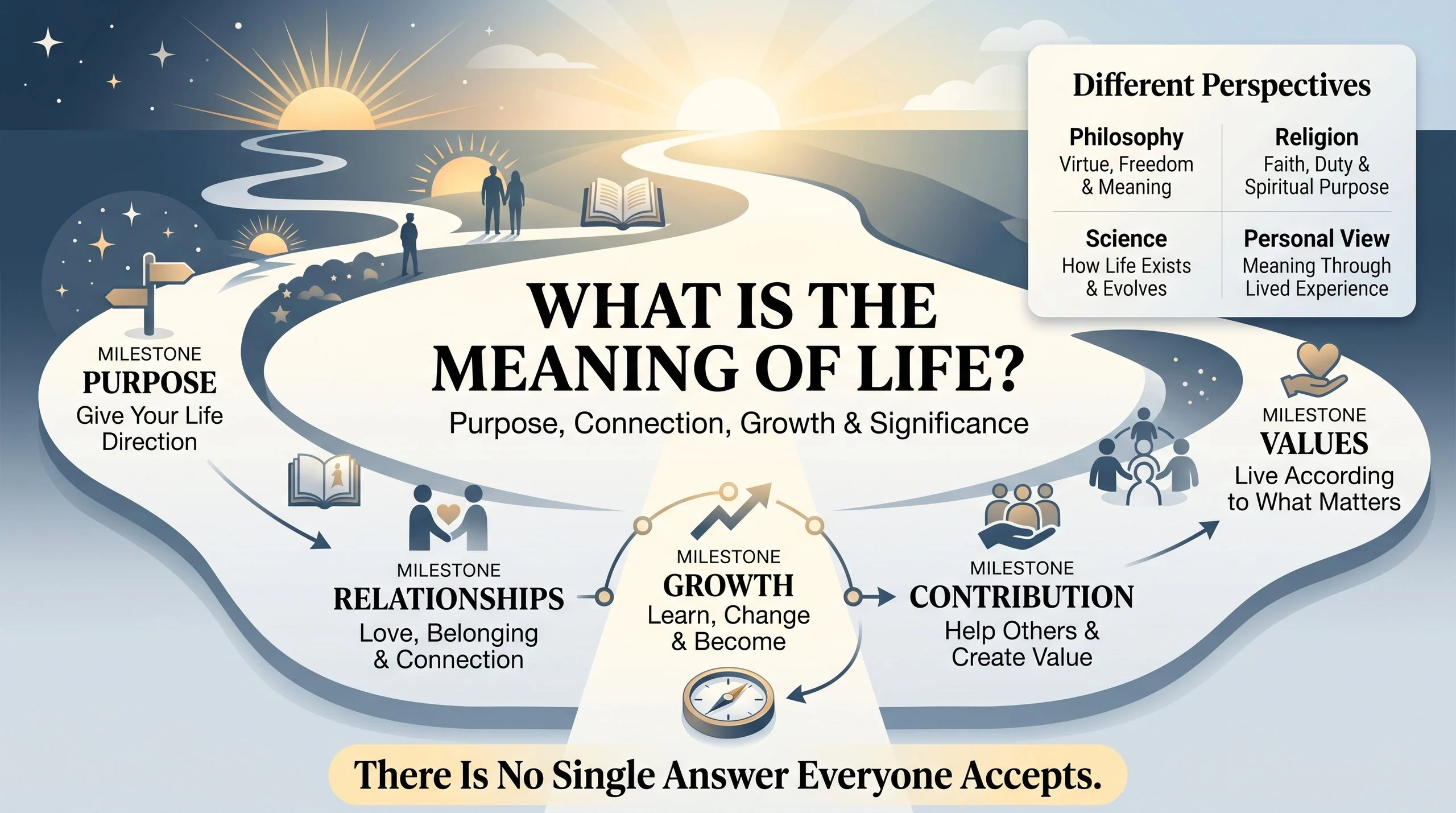
The question “what is the meaning of life?” has no universally accepted answer. Philosophers, scientists, religious traditions, writers, and ordinary people have approached it in very different ways. Some believe life’s meaning comes from a divine purpose, while others see meaning as something humans create through relationships, values, experiences, creativity, and contribution.
At its simplest, the meaning of life refers to the deeper purpose or significance people believe their existence has. For some, that purpose may involve faith and service. For others, it may involve love, family, knowledge, personal growth, helping others, or simply experiencing life fully.
The important point is that meaning does not necessarily have to come from one single answer. Instead, it can develop through the way a person chooses to live.
What Is the Meaning of Life?
The meaning of life is the sense of purpose, value, or significance that gives human existence direction.
There is no single answer accepted by everyone. Religious traditions may connect life’s meaning to God, spiritual growth, or an afterlife. Philosophical traditions may focus on virtue, freedom, happiness, responsibility, or creating one’s own meaning.
Meanwhile, science can explain many aspects of how life exists and develops, but it does not establish one universal purpose for human existence.
For many people, a meaningful life involves some combination of:
- loving and being loved
- building meaningful relationships
- pursuing worthwhile goals
- learning and growing
- helping others
- creating something valuable
- living according to personal values
- experiencing beauty, curiosity, and wonder
- contributing to a community
- accepting both joy and difficulty
What Does “Meaning of Life” Mean?
The phrase meaning of life asks a deeper question than simply asking why living organisms exist.
Biology can describe how life develops, reproduces, adapts, and survives. However, the philosophical question asks something different:
Why does human existence matter, and what should we do with the time we have?
That distinction is important.
For example, someone may ask:
“Why am I alive?”
They could be asking about biology or circumstances.
Another person might ask:
“What should I do with my life?”
That question concerns purpose.
A third person might wonder:
“Does my life have significance?”
That question concerns meaning.
These questions overlap, but they are not identical.
Meaning vs. Purpose: What Is the Difference?
The words meaning and purpose are often used together, yet they describe slightly different ideas.
Meaning concerns why something matters.
Purpose concerns what something is directed toward or what it is intended to accomplish.
For example, a person might find meaning in caring for their family. Their purpose might involve raising children, supporting loved ones, or building a stable home.
Similarly, someone could find meaning through education while having a purpose of teaching others.
| Concept | Main Question |
|---|---|
| Meaning | Why does this matter? |
| Purpose | What am I trying to accomplish? |
| Value | What do I consider important? |
| Fulfillment | What makes life feel worthwhile? |
| Happiness | What brings pleasure or positive emotion? |
A meaningful life can include all of these elements.
Why Do People Ask About the Meaning of Life?
People often think about life’s meaning during major transitions or difficult periods.
For instance, someone may ask the question after:
- graduating
- starting a new career
- falling in love
- becoming a parent
- losing someone
- experiencing failure
- changing beliefs
- reaching a major goal
- facing uncertainty
- questioning their identity
- entering a new stage of life
These moments can challenge familiar assumptions.
When everyday routines stop providing clear direction, deeper questions often become more noticeable. Consequently, wondering about life’s meaning can be a normal part of human reflection.
Philosophical Perspectives on the Meaning of Life
Philosophy has explored the meaning of life for centuries. Different thinkers have reached very different conclusions.
There is no single philosophical answer. Instead, several major approaches offer different ways of understanding existence.
1. The Search for Virtue
Ancient Greek philosophy often connected a good life with virtue and human flourishing.
From this perspective, merely experiencing pleasure is not enough. A meaningful life involves developing good character and using one’s abilities well.
Qualities such as courage, wisdom, justice, moderation, and integrity can therefore become important parts of a meaningful existence.
2. The Search for Happiness
Another approach connects life’s purpose with happiness or well-being.
However, happiness does not necessarily mean constant pleasure. A deeper form of well-being may involve healthy relationships, achievement, personal growth, and a sense that one’s life is going well.
Thus, a meaningful life can contain temporary sadness without becoming meaningless.
3. Existentialism
Existentialist philosophy often emphasizes human freedom, responsibility, and the challenge of creating meaning in an uncertain world.
From this perspective, people may not discover a universal purpose waiting for them. Instead, they can take responsibility for their choices and construct meaning through how they live.
This approach places considerable importance on authenticity.
4. Absurdism
Absurdist thought focuses on the tension between the human desire for meaning and a universe that may not provide clear answers.
Rather than treating uncertainty as a reason to stop living meaningfully, absurdism can encourage people to confront uncertainty directly and continue engaging with life.
The absence of a guaranteed cosmic answer does not necessarily prevent a person from experiencing love, beauty, creativity, or purpose.
5. Nihilism
Nihilism takes a more skeptical position toward objective meaning or value.
Some forms of nihilism argue that life has no inherent meaning or that objective moral values do not exist.
This perspective is important to distinguish from simply feeling lost. Philosophical nihilism is an intellectual position, whereas personal hopelessness is an emotional state.
Religious Perspectives on the Meaning of Life
Religious traditions provide some of the most influential answers to questions about human purpose.
Although beliefs differ substantially, many traditions connect life’s meaning with relationships among human beings, moral responsibility, spiritual development, and a higher reality.
1. Christianity
Many Christian perspectives understand human life in relation to God, love, faith, moral living, and spiritual salvation.
Love of God and love of others are central themes in Christian teachings. Consequently, meaning may be understood through faith, service, compassion, forgiveness, and spiritual relationship.
2. Islam
Islamic perspectives generally connect human existence with worship of God, moral responsibility, righteous action, and accountability.
Life can therefore be understood as a test and an opportunity to live according to divine guidance while doing good and avoiding wrongdoing.
3. Judaism
Jewish thought contains diverse approaches to life’s purpose. Themes can include relationship with God, ethical responsibility, community, learning, justice, and fulfilling religious commandments.
Meaning may therefore emerge through both spiritual commitment and ethical action.
4. Hindu Traditions
Hindu traditions contain diverse philosophical schools and interpretations. Major concepts associated with life’s purpose include dharma, artha, kama, and moksha.
These ideas broadly address duty, material well-being, legitimate desires, and spiritual liberation.
Rather than reducing life to one simple objective, these traditions can present human existence as involving several dimensions.
5. Buddhism
Many Buddhist traditions focus less on discovering a permanent cosmic purpose and more on understanding suffering, developing wisdom, practicing compassion, and cultivating liberation.
The path involves transforming one’s relationship with desire, attachment, suffering, and the self.
Consequently, meaning may be closely connected with awakening, compassion, ethical conduct, and freedom from destructive patterns.
What Does Science Say About the Meaning of Life?
Science can answer many questions about how life works, but the question of ultimate meaning belongs partly to philosophy, ethics, and personal interpretation.
Biology explains life through processes such as evolution, reproduction, inheritance, adaptation, and metabolism. Neuroscience studies consciousness and the brain. Psychology examines motivation, relationships, well-being, and human behavior.
However, scientific observations alone do not establish one universal purpose that every human must follow.
For example, evolution can explain why organisms develop traits that improve survival and reproduction. That explanation does not automatically tell an individual whether they should pursue family, art, education, service, adventure, or spirituality.
In other words:
Science can explain mechanisms without necessarily providing an ultimate purpose.
Can Life Have Meaning Without Religion?
Yes. Many people develop a strong sense of meaning without following a religious tradition.
Secular approaches can emphasize:
- relationships
- compassion
- creativity
- knowledge
- personal growth
- ethical behavior
- community
- service
- exploration
- responsibility
- leaving something valuable behind
Someone might find deep meaning in teaching children, creating art, developing useful technology, caring for family members, protecting nature, or helping people in need.
Meaning does not have to look identical from one person to another.
Is Happiness the Meaning of Life?
Happiness can contribute to a meaningful life, but the two concepts are not identical.
A person can experience happiness without feeling that their life has direction. Conversely, someone can experience hardship while still believing their life has deep meaning.
Consider a parent caring for a sick child. The situation may be emotionally difficult, yet the parent may consider that responsibility deeply meaningful.
Similarly, an athlete training for an important goal may experience exhaustion and frustration. Those difficult experiences do not necessarily make the goal meaningless.
Therefore, meaning is often broader and more durable than momentary happiness.
Can Suffering Have Meaning?
This is one of the most difficult questions surrounding human existence.
Suffering itself should not automatically be described as good or necessary. Pain, loss, injustice, and tragedy can be genuinely harmful.
Nevertheless, people sometimes create meaning from difficult experiences.
Someone may become more compassionate after experiencing hardship. Another person might use a painful experience to help others avoid similar problems. A difficult period can also lead to changes in priorities, relationships, or personal values.
That does not mean suffering was required or desirable.
Instead, the idea is that people can sometimes create meaning from what happened to them.
How Relationships Give Life Meaning
Relationships are among the most common sources of meaning.
Family, friendship, love, mentorship, and community can provide people with:
- belonging
- responsibility
- emotional support
- shared memories
- mutual care
- identity
- connection
- opportunities to contribute
Human beings are social creatures, so relationships can influence how people understand themselves and their place in the world.
A meaningful life does not have to be extraordinary. Everyday acts of kindness, loyalty, patience, and care can have significant personal value.
How Work Can Give Life Meaning
Work can be another source of purpose.
Some people find meaning through careers that directly help others. Teachers, doctors, caregivers, researchers, engineers, artists, builders, and countless other professionals may connect their work with a larger contribution.
However, meaningful work does not have to be someone’s entire identity.
A person can have an ordinary job while finding deeper meaning through family, hobbies, friendships, volunteering, creativity, or community involvement.
Therefore, career success and life’s meaning should not be treated as the same thing.
How Personal Values Shape Meaning
Values influence the choices people make and the lives they build.
Common values include:
- honesty
- kindness
- freedom
- loyalty
- curiosity
- justice
- creativity
- family
- courage
- learning
- compassion
- responsibility
When daily actions align with deeply held values, people may experience a stronger sense of authenticity.
For example, someone who values creativity might feel most fulfilled when writing, painting, designing, or making music. Another person who values service may find greater meaning through helping others.
The important factor is not which value is objectively “best” for everyone. Rather, it is whether the person’s actions genuinely reflect what they consider important.
How to Find Meaning in Life
There is no universal formula for finding meaning. Still, several questions can help clarify what matters to you.
1. Ask What You Care About
Think about the people, activities, causes, and experiences you would protect even if they brought no status or financial reward.
Those answers can reveal important values.
2. Notice What Feels Worth Doing
Pay attention to activities that leave you feeling engaged rather than merely distracted.
Meaning often appears through sustained involvement.
3. Identify Who Matters to You
Consider the relationships you want to strengthen.
Sometimes purpose becomes clearer when you think about whom you want to support, love, teach, or encourage.
4. Choose Meaningful Goals
A meaningful goal does not need to change the world.
Learning a skill, raising a family, writing a book, improving your health, helping your community, or mastering a craft can all provide direction.
5. Contribute to Something Beyond Yourself
Helping another person can create a powerful sense of significance.
Contribution might involve volunteering, mentoring, creating useful work, supporting loved ones, or simply making someone’s day easier.
6. Accept That Meaning Can Change
Your purpose at one stage of life may not remain your purpose forever.
A teenager, parent, retiree, artist, and business owner may each have different priorities.
Changing direction does not necessarily mean that your previous life lacked meaning.
Does Everyone Need a Purpose?
Not necessarily.
Some people find the idea of having one grand life purpose inspiring. Others find it restrictive.
Life can contain several smaller purposes rather than one enormous mission.
For example, someone might simultaneously have a purpose to:
- care for their family
- become better at their profession
- maintain friendships
- learn new things
- contribute to their community
- enjoy nature
- create art
Together, these purposes can form a meaningful life.
You do not necessarily need to discover one extraordinary destiny.
Can Ordinary Life Be Meaningful?
Absolutely.
Meaning does not require fame, wealth, or historical importance.
Cooking dinner for your family, helping a friend, teaching a child, caring for an elderly relative, doing honest work, enjoying a conversation, or creating something beautiful can all matter.
Modern culture sometimes connects meaning with achievement and recognition. Yet significance can exist without an audience.
A quiet life can still be a deeply meaningful life.
Meaning of Life vs. Success
Success and meaning are related but different.
Success often refers to achieving a desired outcome.
Meaning concerns why the outcome matters.
A person can become wealthy and successful while feeling disconnected from their values. Another person may have modest financial resources while experiencing strong purpose and fulfillment.
Consequently, achievement alone cannot guarantee meaning.
A better question may be:
“What kind of success would make my life feel worthwhile?”
That question connects achievement with personal values.
Common Misconceptions About the Meaning of Life
1. There Must Be One Correct Answer
There may not be a single answer that satisfies every person, culture, and worldview.
2. Meaning Requires Greatness
A meaningful life does not require fame or extraordinary accomplishments.
3. Meaning Means Constant Happiness
Meaning can coexist with sadness, struggle, uncertainty, and failure.
4. You Must Find Your Purpose Early
Many people change direction several times throughout life.
5. Money Automatically Creates Meaning
Financial security can improve certain aspects of life, but money alone does not determine significance.
6. A Meaningful Life Must Be Religious
Religion provides meaning for many people, but secular philosophies can also offer frameworks for purpose and values.
What Makes a Life Meaningful?
Although people disagree about ultimate purpose, several elements commonly appear in discussions of meaningful living:
| Source of Meaning | How It Can Help |
|---|---|
| Relationships | Creates love, belonging, and responsibility |
| Purpose | Gives direction to choices |
| Values | Provides principles for living |
| Contribution | Creates a sense of usefulness |
| Growth | Encourages learning and development |
| Creativity | Allows expression and creation |
| Faith | Provides spiritual framework |
| Community | Creates connection and shared identity |
| Knowledge | Satisfies curiosity and understanding |
| Service | Connects personal actions with others’ well-being |
These elements can overlap. In fact, the strongest sense of meaning may come from combining several of them.
The Meaning of Life in Everyday Language
When someone casually asks “What is the meaning of life?”, they may not be asking for a complicated philosophical theory.
Sometimes the question is humorous.
For example:
“After working all weekend, I’m questioning the meaning of life.”
Here, the phrase expresses frustration or exhaustion.
At other times, the question is genuinely philosophical:
“I’ve achieved everything I wanted, but I still wonder about the meaning of life.”
In that case, the speaker is asking about purpose, fulfillment, and significance.
Therefore, the phrase can function both seriously and humorously.
A Simple Way to Think About the Meaning of Life
A useful framework is to consider four questions:
1. What Do I Love?
Think about people, experiences, subjects, and activities that matter deeply to you.
2. What Do I Value?
Identify the principles you want your decisions to reflect.
3. What Can I Contribute?
Consider how your skills, time, attention, or resources can benefit others.
4. What Do I Want to Experience or Become?
Think about the person you want to develop into and the experiences you want to have.
These questions do not produce a universal answer. Instead, they can help you construct a personal direction.
Quick Guide to the Meaning of Life
| Question | Short Answer |
|---|---|
| What is the meaning of life? | The purpose or significance people associate with existence |
| Does everyone agree on one meaning? | No |
| Does science provide one ultimate purpose? | Not by itself |
| Can religion provide an answer? | Many religious traditions do |
| Can life have meaning without religion? | Yes |
| Is happiness the same as meaning? | No |
| Can suffering and meaning coexist? | Yes |
| Do relationships create meaning? | They can be a major source of meaning |
| Does everyone need one life purpose? | No |
| Can meaning change over time? | Yes |
| Can an ordinary life be meaningful? | Absolutely |
FAQs About the Meaning of Life
1. What is the meaning of life in simple words?
The meaning of life is the sense of purpose, value, or significance that makes existence feel worthwhile.
2. What is the purpose of human life?
There is no universally accepted answer. Different religious, philosophical, and secular perspectives emphasize different purposes, including spiritual development, virtue, relationships, service, happiness, personal growth, and creating meaning.
3. Why are we here?
Science can explain aspects of how humans evolved and how life developed, but the ultimate question of why humans exist is philosophical and religious rather than something science has answered universally.
4. Does life have an objective meaning?
Different worldviews answer this differently. Some religious and philosophical traditions affirm an objective meaning, while some secular and existential perspectives argue that meaning is created rather than discovered.
5. Can you create your own meaning in life?
Yes. Many philosophical and secular approaches argue that people can develop meaning through choices, relationships, values, goals, creativity, and contribution.
6. Is the meaning of life happiness?
Not necessarily. Happiness can be part of a good life, but meaning can also come from responsibility, love, achievement, service, growth, and commitment.
7. Can money give life meaning?
Money can provide security, freedom, and opportunities, but it does not automatically create meaning. What people do with their resources and how those actions connect with their values may matter more.
8. Can suffering make life meaningful?
Suffering itself is not automatically meaningful or beneficial. However, people can sometimes find meaning through how they respond to difficult experiences.
9. Does everyone have the same purpose?
Not necessarily. People have different beliefs, values, circumstances, abilities, and goals. Their sources of meaning can therefore differ considerably.
10. Can your purpose change?
Yes. Meaning and purpose can evolve as people enter different stages of life, develop new relationships, change careers, encounter new experiences, or reconsider their values.
11. Can a simple life have meaning?
Yes. Meaning does not require fame or extraordinary accomplishments. Relationships, kindness, family, creativity, learning, and contribution can make an ordinary life deeply meaningful.
12. How can I find meaning in life?
Start by identifying what you value, who matters to you, what you enjoy learning or creating, and how you can contribute to others. Then turn those insights into realistic goals and daily actions.
Conclusion
So, what is the meaning of life? There is no single answer accepted by every person or worldview. Philosophy offers ideas about virtue, freedom, happiness, responsibility, and existence. Religious traditions provide spiritual explanations involving God, moral living, enlightenment, salvation, or liberation. Science explains the biological processes behind life but does not establish one universal purpose for human existence.
For many people, meaning develops through the way they live rather than through one sentence that solves the entire question.
Love can create meaning. So can friendship, family, learning, creativity, service, faith, curiosity, personal growth, and contribution. Even an ordinary life can matter deeply when it reflects genuine values and meaningful relationships.
Ultimately, the question may be less about discovering a secret answer and more about asking:
What do I want my existence to stand for?
That question turns the search for meaning into an opportunity to live deliberately, care deeply, and use the limited time we have in ways that feel worthwhile.

Jack Murphy is a language writer with a passion for word meanings, synonyms, and effective communication. He creates informative and easy to understand content to help readers enhance their vocabulary and language skills.




5 thoughts on “What Is the Meaning of Life? Exploring Purpose, Perspectives & the Search for Meaning 2026”