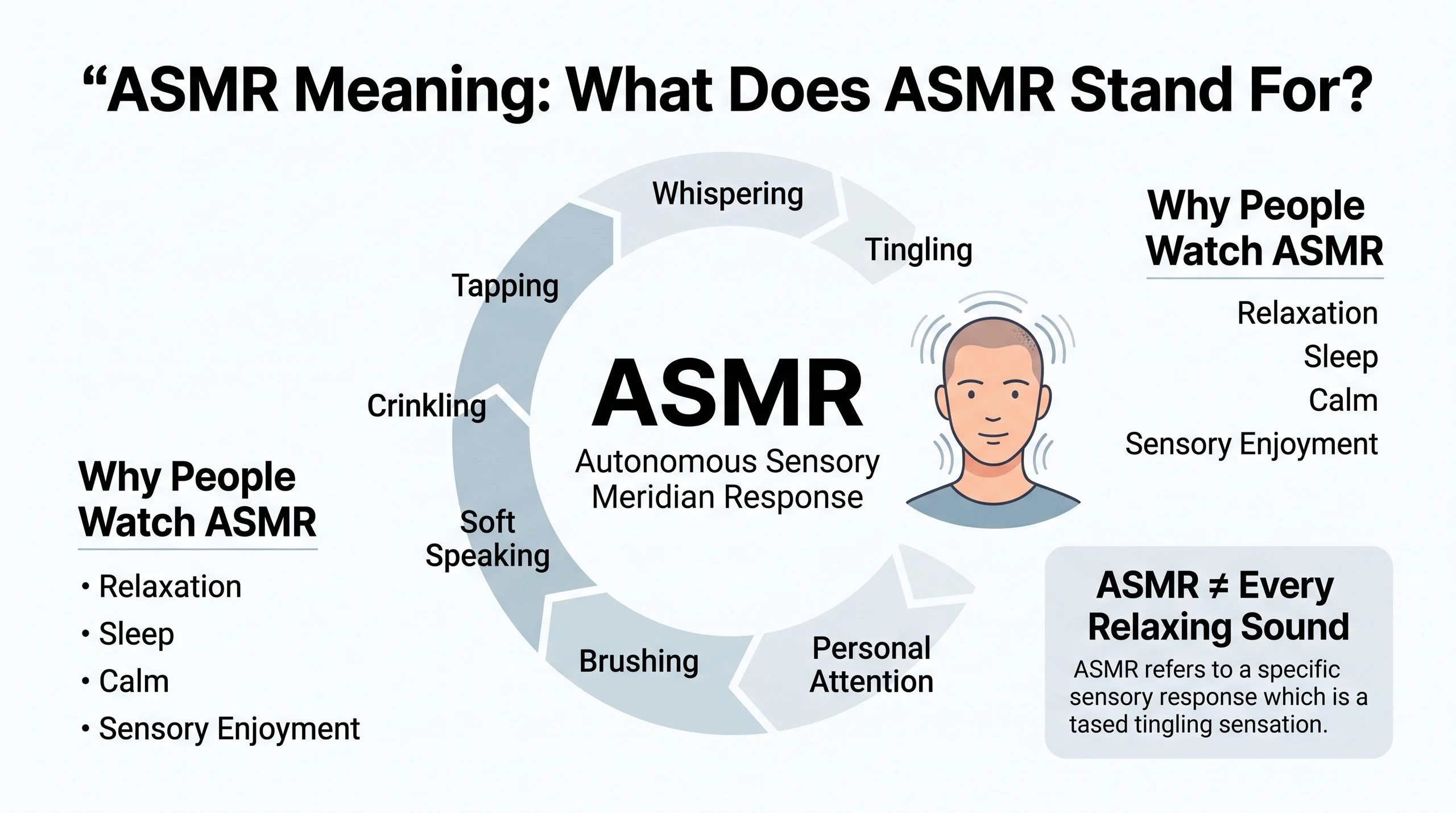
The ASMR meaning is “Autonomous Sensory Meridian Response.” It describes a relaxing tingling sensation that some people experience in response to specific sounds, visuals, touch, or forms of personal attention. The sensation often begins around the scalp or back of the head and may move down the neck or upper body.
ASMR has become especially popular through online videos featuring whispering, tapping, soft speaking, scratching, crinkling, and gentle personal-attention scenarios. Many people watch ASMR content because they find it calming or helpful when winding down before sleep.
However, not everyone experiences ASMR. Some people feel a distinct tingling sensation, while others simply find ASMR sounds relaxing without experiencing the characteristic response.
What Does ASMR Mean?
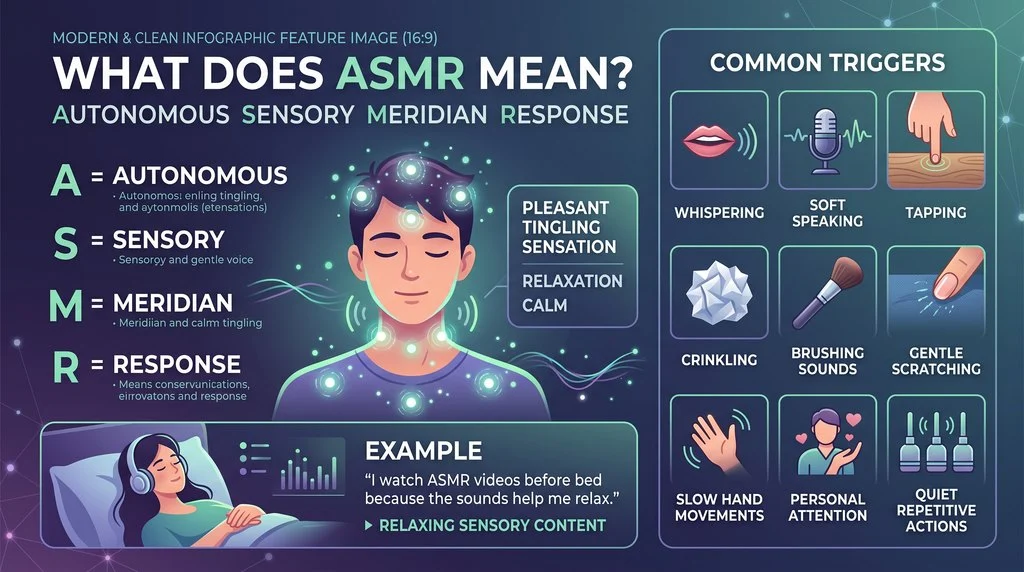
ASMR stands for “Autonomous Sensory Meridian Response.”
It refers to a sensory experience that can involve a pleasant tingling sensation, usually around the head, scalp, neck, or upper body.
People may experience ASMR after hearing or seeing certain triggers, including:
- Whispering
- Soft speaking
- Tapping
- Crinkling
- Brushing sounds
- Gentle scratching
- Slow hand movements
- Personal attention
- Quiet repetitive actions
For example:
“I watch ASMR videos before bed because the sounds help me relax.”
In this sentence, ASMR refers to relaxing sensory content rather than a specific sound.
What Does ASMR Stand For?
ASMR stands for:
A — Autonomous
S — Sensory
M — Meridian
R — Response
Together, these words form Autonomous Sensory Meridian Response.
The phrase describes a particular sensory reaction rather than a single activity.
1. Autonomous
“Autonomous” refers to something that happens without conscious control.
In the context of ASMR, the response can occur naturally when a person encounters a trigger.
2. Sensory
“Sensory” relates to the senses, including hearing, sight, and touch.
ASMR triggers can therefore involve sounds, visual movements, or certain tactile experiences.
3. Meridian
“Meridian” is used in the name to suggest a peak or central point.
It does not mean that ASMR follows a specific physical pathway in the body.
4. Response
“Response” describes the body’s or mind’s reaction to a particular trigger.
Together, the four words describe the sensory response commonly associated with ASMR.
What Is ASMR?
ASMR is a sensory phenomenon that some people experience as a pleasant tingling or calming sensation.
The feeling is often described as beginning near the scalp and sometimes spreading toward the neck, shoulders, or upper body.
Triggers vary significantly from person to person.
One person might respond strongly to whispering, while another may prefer tapping sounds. Someone else might experience ASMR during a quiet personal-attention interaction.
Therefore, there is no single sound or activity that produces ASMR for everyone.
What Does ASMR Feel Like?
People who experience ASMR often describe it as a gentle, pleasant tingling sensation.
The sensation may:
- Begin around the scalp
- Move toward the neck
- Spread across the shoulders
- Create a feeling of calm
- Encourage relaxation
- Make the person feel sleepy
Some people describe the sensation as similar to “brain tingles” or “head tingles.”
However, experiences differ from person to person.
Some viewers experience strong tingles, while others mainly enjoy the relaxing sounds and atmosphere without feeling a physical response.
Common ASMR Triggers
ASMR triggers are sounds, sights, actions, or situations that may produce the response.
1. Whispering
Whispering is one of the most recognizable ASMR triggers.
A creator may speak very softly into a microphone to create a close, intimate listening experience.
2. Tapping
Gentle tapping on objects can create repetitive sounds that many viewers find calming.
Common examples include tapping on:
- Glass
- Wood
- Plastic
- Books
- Boxes
- Containers
3. Crinkling
Paper, plastic packaging, foil, and other materials can create repetitive crinkling sounds.
These sounds are frequently used in ASMR videos.
4. Soft Speaking
ASMR does not always require whispering.
Some people prefer a quiet, slow speaking voice instead.
Creators may read stories, explain objects, answer questions, or simply talk softly.
5. Scratching
Gentle scratching sounds can be created by moving fingernails across suitable surfaces.
The sound is often recorded with sensitive microphones to make subtle details easier to hear.
6. Brushing
Brushing sounds can come from hairbrushes, makeup brushes, paintbrushes, or similar objects.
The slow, repetitive movement can create a soothing atmosphere.
7. Personal Attention
Some ASMR videos simulate situations in which someone receives calm personal attention.
Examples include:
- Haircuts
- Makeup appointments
- Eye examinations
- Spa treatments
- Medical checkups
- Friendly conversations
The goal is usually to create a sense of calm, care, and focused attention.
8. Hand Movements
Slow hand movements close to the camera are another common ASMR trigger.
Creators may move their hands gently from side to side or perform repetitive gestures.
ASMR Meaning in Texting
When someone uses ASMR in texting, they are usually referring to the sensory experience or ASMR content.
For example:
“Do you watch ASMR?”
This means the person is asking whether you watch videos or listen to content designed around ASMR triggers.
Another example is:
“That sound is so ASMR.”
Here, the person means that the sound feels especially soothing or produces an ASMR-like sensation.
Therefore, ASMR can function as both a noun and an informal descriptive term in online conversation.
ASMR Meaning on TikTok
On TikTok, ASMR commonly refers to short videos designed around relaxing sounds, visual triggers, or sensory experiences.
Creators may post videos featuring:
- Tapping
- Whispering
- Eating sounds
- Object manipulation
- Makeup application
- Hair brushing
- Satisfying repetitive movements
- Soft-spoken storytelling
The term can also appear in captions and hashtags.
For example:
“This tapping is giving me ASMR.”
The person is saying that the sound creates a relaxing or tingling response.
ASMR Meaning on YouTube
YouTube has played a major role in the growth of ASMR content.
Longer videos allow creators to build extended relaxing experiences.
A video might focus entirely on one trigger, such as tapping, or combine several triggers into a longer session.
Common YouTube ASMR formats include:
- Whispering videos
- Sleep-inducing videos
- Roleplay videos
- Personal-attention videos
- Tapping compilations
- Soft-spoken tutorials
- Sound-focused recordings
Some videos are only a few minutes long, while others may continue for an hour or more.
ASMR vs. Relaxing Sounds
ASMR and relaxing sounds are related, but they are not exactly the same thing.
Relaxing sounds can include anything that makes someone feel calm, such as rain, ocean waves, classical music, or nature sounds.
ASMR specifically refers to the sensory response associated with particular triggers.
For example, a person might enjoy rain sounds without experiencing ASMR.
Likewise, another person might experience ASMR from whispering or tapping.
So, all ASMR content can be relaxing for some people, but not every relaxing sound is necessarily ASMR.
ASMR vs. Meditation
ASMR and meditation can both be used as relaxation activities, but they work differently.
Meditation generally involves intentional attention, awareness, breathing, or mental exercises.
ASMR is based on a sensory response to particular triggers.
Someone can therefore use ASMR while relaxing without formally meditating.
Similarly, a person can meditate without experiencing ASMR at all.
ASMR vs. White Noise
White noise is a consistent sound containing a broad range of audible frequencies.
It is often used to mask other sounds or create a steady background environment.
ASMR, by contrast, usually involves specific sensory triggers.
For example:
“I sleep with white noise.”
describes a steady background sound.
Meanwhile:
“I listen to ASMR before sleeping.”
usually refers to trigger-based sensory content.
The two can serve similar relaxation purposes, but they are not the same experience.
ASMR Examples in Everyday Conversation
Here are some natural examples of how people use ASMR.
1. Talking About Videos
“I found an ASMR video that helps me fall asleep.”
Here, ASMR refers to online sensory content.
2. Describing a Sound
“The tapping sound is so relaxing. It gives me ASMR.”
The speaker is describing a personal sensory reaction.
3. Discussing Preferences
“I like whispering ASMR more than eating ASMR.”
The speaker is comparing different ASMR styles.
4. Recommending Content
“Try this ASMR channel if you have trouble relaxing at night.”
The person is recommending ASMR content as a relaxation activity.
5. Describing a Feeling
“That soft brushing sound gives me tingles.”
Here, the person is describing the sensory effect associated with ASMR.
Types of ASMR Content
ASMR has developed into many different content categories.
1. Whispering ASMR
Creators whisper words, stories, instructions, or conversations.
The emphasis is usually on soft vocal sounds.
2. Roleplay ASMR
Roleplay videos simulate scenarios involving personal attention.
Examples include a fictional haircut, spa appointment, consultation, or friendly conversation.
3. Eating ASMR
These videos focus on eating sounds.
They can include chewing, crunching, sipping, or other food-related sounds.
Not everyone enjoys this type of ASMR, so preferences vary widely.
4. Object-Based ASMR
This style focuses on interacting with objects.
Creators may tap, scratch, open, close, fold, or manipulate different materials.
5. Sleep ASMR
Sleep-focused ASMR generally uses slower sounds and a calmer atmosphere.
The content is designed for people who enjoy listening to ASMR while winding down.
6. Visual ASMR
Some content focuses primarily on visual triggers.
Slow hand movements, repetitive actions, and detailed object manipulation can create a satisfying visual experience.
Why Do People Watch ASMR?
People watch ASMR for different reasons.
Common reasons include:
- Relaxation
- Enjoyment
- Stress reduction
- A calming bedtime routine
- Entertainment
- Sensory stimulation
- Background listening
- Sleep preparation
For some viewers, ASMR is simply enjoyable.
Others specifically seek out certain triggers because they associate them with calmness or tingling sensations.
Is ASMR Good for Sleep?
Many people use ASMR content as part of their bedtime routine because they find it relaxing.
However, individual experiences vary.
Some people may become sleepy while listening to gentle ASMR sounds. Others may find certain sounds distracting or irritating.
Consequently, there is no single ASMR trigger that works for everyone.
If ASMR helps you relax, using quiet, comfortable content before bed may fit naturally into a calming nighttime routine.
Is ASMR the Same for Everyone?
No.
ASMR is highly individual.
A sound that produces tingles for one person may have no effect on another person. In some cases, a particular trigger may even be irritating.
For example:
Person A: “Whispering gives me ASMR.”
Person B: “I prefer tapping.”
Person C: “ASMR doesn’t do anything for me.”
All three responses are possible.
The experience depends on individual sensory preferences.
Does Everyone Experience ASMR?
No.
Not everyone experiences the characteristic tingling sensation associated with ASMR.
Some people may enjoy ASMR videos without feeling tingles. Others may experience strong sensations from specific triggers.
There is also considerable variation in how people describe their experiences.
Therefore, not experiencing ASMR is completely different from simply disliking a particular ASMR video.
Common Misconceptions About ASMR
ASMR is sometimes misunderstood because the online community includes many different types of content.
1. ASMR Is Not One Specific Sound
There is no single sound that defines ASMR.
Different people respond to different triggers.
2. ASMR Is Not Always Whispering
Whispering is popular, but ASMR can involve tapping, soft speaking, brushing, visual movements, and many other triggers.
3. ASMR Is Not Automatically Sleep Content
Many people use ASMR for sleep, but others watch it for relaxation, entertainment, or sensory enjoyment.
4. ASMR Is Not Something Everyone Feels
The characteristic tingling response varies from person to person.
5. ASMR Is Not Necessarily a Medical Treatment
People may use ASMR as a personal relaxation technique, but it should not automatically be treated as a substitute for professional medical or mental health care.
Grammar and Usage Notes for ASMR
ASMR is normally written in all capital letters because it is an initialism.
Examples:
- “I watch ASMR videos.”
- “Do you like ASMR?”
- “This sound gives me ASMR.”
- “She creates ASMR content.”
The term is primarily associated with informal digital communication, although it is also used in general discussions about sensory experiences and online media.
Is “ASMR” a Noun?
Yes.
You can use it as a noun when referring to the phenomenon or content.
“ASMR helps me relax.”
You can also use it to describe a category of online content:
“I found a new ASMR channel.”
In informal online language, people may also use “ASMR” descriptively:
“This video is so ASMR.”
This usage is casual and means the video has qualities associated with ASMR.
How to Choose ASMR Content
If you are exploring ASMR for the first time, different triggers can produce very different experiences.
1. Try Soft Voices
If you enjoy calm conversations, soft-spoken or whispered videos may be a good starting point.
2. Try Tapping
For people who enjoy repetitive sounds, tapping videos can be appealing.
3. Try Personal Attention
Roleplay videos may work well if you enjoy calm, focused interactions.
4. Try Visual Triggers
Slow hand movements and repetitive visual actions provide an alternative to sound-focused content.
5. Adjust the Volume
ASMR usually involves subtle sounds. Excessively loud audio can make the experience uncomfortable rather than relaxing.
Finding the right trigger often requires a little experimentation.
Common Mistakes When Using the Term ASMR
1. Treating ASMR as a Synonym for Relaxation
ASMR and relaxation are related, but they are not identical.
2. Assuming Everyone Gets Tingling
Not everyone experiences the characteristic physical sensation.
3. Thinking Only Whispering Counts as ASMR
Whispering is just one of many common triggers.
4. Using ASMR in Formal Writing Without Explanation
In a formal document, it is better to write Autonomous Sensory Meridian Response (ASMR) the first time you use the term.
Afterward, you can use ASMR.
5. Assuming Every Satisfying Video Is ASMR
A satisfying video may be enjoyable without producing an ASMR response.
Context and personal experience matter.
Words Related to ASMR
Several terms are commonly associated with ASMR.
Tingling
A light physical sensation that some people experience during ASMR.
Trigger
A sound, image, action, or situation that may produce an ASMR response.
Relaxation
A state of reduced tension or increased calmness.
Whispering
Speaking very quietly, often used as an ASMR trigger.
Tapping
Creating gentle repetitive sounds by tapping an object.
Personal Attention
A focused interaction often simulated in ASMR roleplay videos.
Sensory Experience
An experience involving one or more senses.
These terms help explain the broader ASMR vocabulary.
Quick ASMR Meaning Guide
| Term | Meaning |
|---|---|
| ASMR | Autonomous Sensory Meridian Response |
| ASMR trigger | Something that may produce an ASMR response |
| ASMR tingles | The pleasant tingling sensation some people experience |
| ASMR video | Online content designed around ASMR triggers |
| Whispering ASMR | ASMR content centered around whispered speech |
| Tapping ASMR | Content focused on tapping sounds |
| Roleplay ASMR | Simulated personal-attention scenarios |
| Sleep ASMR | ASMR content intended for bedtime relaxation |
| Visual ASMR | Content using visual rather than primarily auditory triggers |
FAQs
1. What does ASMR stand for?
ASMR stands for Autonomous Sensory Meridian Response. It describes a sensory experience that can involve pleasant tingling and relaxation in response to specific triggers.
2. What does ASMR mean in texting?
In texting, ASMR usually refers to Autonomous Sensory Meridian Response or to content associated with ASMR. For example, someone might say that a particular sound “gives them ASMR.”
3. What does ASMR mean on TikTok?
On TikTok, ASMR usually refers to videos featuring relaxing sounds, visual triggers, whispering, tapping, eating sounds, personal-attention scenarios, or other sensory content.
4. What does ASMR feel like?
People who experience ASMR often describe a pleasant tingling sensation around the scalp, head, neck, or upper body. Some people mainly experience relaxation rather than noticeable tingling.
5. What are common ASMR triggers?
Common triggers include whispering, soft speaking, tapping, scratching, crinkling, brushing, slow hand movements, and simulated personal attention.
6. Does ASMR help you sleep?
Many people use ASMR as part of a relaxing bedtime routine and find it helpful for winding down. However, individual responses vary, and ASMR does not affect everyone in the same way.
7. Does everyone experience ASMR?
No. Some people experience strong tingling sensations, while others experience only relaxation or no noticeable response.
8. Is ASMR the same as white noise?
No. White noise is a steady background sound, while ASMR involves a sensory response associated with particular triggers. Both can be used for relaxation, but they are different experiences.
Conclusion
The ASMR meaning is “Autonomous Sensory Meridian Response.” It describes a sensory experience that some people associate with pleasant tingling, calmness, and relaxation.
Common ASMR triggers include whispering, soft speaking, tapping, scratching, crinkling, brushing, slow movements, and personal attention. Although many people watch ASMR videos to relax or prepare for sleep, the experience varies from person to person.
On platforms such as TikTok and YouTube, ASMR has also become a broad category of digital content. Some videos focus on sounds, while others use visual movements, roleplay, or everyday activities.
Ultimately, ASMR is not simply another word for relaxation. Rather, it describes a particular sensory response that some people experience when exposed to certain triggers. If a person does not experience the characteristic tingling, they may still enjoy ASMR content for its calming or entertaining qualities.

Charlotte Wilson is a language writer passionate about word meanings, synonyms, and clear communication. She creates accurate and engaging content to help readers expand their vocabulary and language skills.

10 thoughts on “ASMR Meaning| What Does ASMR Stand For? The Science, Sensations & Internet Phenomenon Explained 2026”