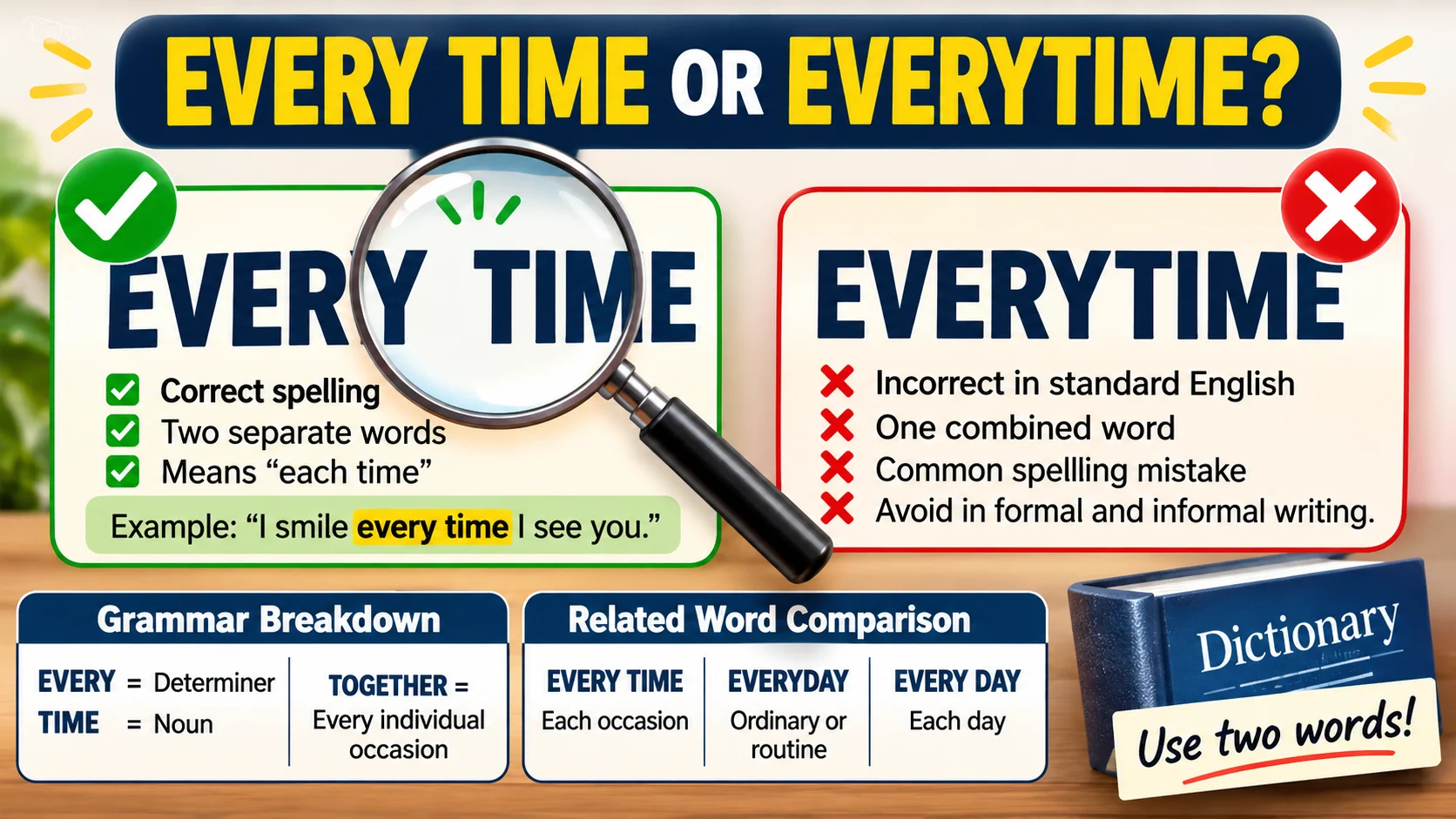
Every time is the correct spelling in standard English because it consists of two separate words. It means “each time” or “whenever something happens.” In contrast, everytime is a common spelling mistake and is not accepted as a standard English word. For example, write “I smile every time I see you,” not “I smile everytime I see you.”
Have you ever wondered whether to write every time or everytime in a text message, email, school assignment, or professional document? Although both versions may look familiar, only one is correct in standard English. The correct spelling is every time, written as two separate words.
This common grammar question often confuses English learners and even native speakers because many familiar expressions combine words into a single word. However, the phrase “every time” follows a different spelling rule. It contains the determiner “every” and the noun “time,” which work together to describe something that happens on each occasion.
Moreover, understanding this distinction can help you avoid unnecessary spelling mistakes in everyday communication. Whether you are writing a casual message, preparing an academic paper, or creating professional content, using the correct form makes your writing clearer.
In this guide, you’ll learn the meaning of every time, discover why everytime is incorrect, explore practical sentence examples, and understand how the phrase differs from similar expressions. By the end, you’ll know exactly when and how to use it.
Every Time vs. Everytime
| Meaning | Context | Primary Platforms | Example | Tone |
|---|---|---|---|---|
| Every time | Each occasion | Everyday writing | I laugh every time. | Neutral |
| Everytime | Nonstandard spelling | Informal messages and common mistakes | I laugh everytime. | Incorrect in standard English |
| Each time | Every individual occasion | Formal and informal writing | Each time we meet, we talk. | Neutral |
| Whenever | At any time that something happens | Conversations and writing | Call me whenever you need help. | Conversational |
What Does Every Time Mean?
Every time means each time something happens or on every occasion when a particular event takes place. People use this phrase to describe repeated actions, experiences, habits, and situations.
It helps explain that something happens consistently whenever a specific condition or event occurs.
For example:
- “I drink coffee every time I visit this cafe.”
- “She smiles every time she sees her dog.”
- “Every time it rains, the streets become slippery.”
- “He makes the same mistake every time.”
In each sentence, the phrase describes something that happens on every relevant occasion.
Additionally, every time can refer to repeated experiences that occur regularly or predictably. It does not always mean something happens continuously. Instead, it focuses on separate occasions when an action or event takes place.
For example, someone might say:
“I think about my childhood every time I hear that song.”
This means the song reminds the speaker of childhood whenever they hear it.
Therefore, every time is a useful expression for describing repetition, frequency, and recurring situations.
Is Everytime One Word?
No. Everytime is not a standard English word. The correct spelling is always “every time” when expressing the meaning of each occasion.
Although people sometimes combine the words in informal writing, this does not make the single-word spelling grammatically standard.
English contains many compound words, such as:
- Everyone
- Everything
- Everywhere
- Everyday
- Sometimes
Because these words appear frequently, writers may assume that everytime follows the same pattern. However, that assumption is incorrect.
The phrase every time has a different grammatical structure. It consists of two words that work together as a phrase rather than a single compound word.
Consider these examples:
Correct: I remember you every time I visit this place.
Incorrect: I remember you everytime I visit this place.
Similarly:
Correct: She calls me every time she needs advice.
Incorrect: She calls me everytime she needs advice.
Consequently, whenever you want to express “each time,” keep every and time separate.
Why Is Every Time Two Words?
The spelling becomes easier to understand when you examine the grammatical function of each word.
The Meaning of Every
“Every” is a determiner that refers to all individual members of a group or a series of occasions.
For example:
- Every student received a certificate.
- Every morning starts with a new opportunity.
- Every person deserves respect.
- Every opportunity matters.
In these examples, every describes a noun and emphasizes each individual member or occasion.
The Meaning of Time
“Time” is a noun that can refer to a particular moment, period, occasion, or experience.
For example:
- I had a wonderful time.
- This is the right time to leave.
- We met for the first time.
- She arrived on time.
When every and time appear together, they form the phrase every time, referring to each individual occasion.
How They Work Together
The word every modifies the noun time. Together, they express repetition across separate occasions.
For example:
“Every time I visit my grandmother, she prepares my favorite meal.”
Here, every describes each occasion, while time identifies the individual visit.
Therefore, the two words should remain separate because they perform different grammatical functions.
Every Time vs. Everytime: Key Differences
The main difference is that every time is the correct two-word phrase, whereas everytime is a nonstandard spelling.
| Feature | Every Time | Everytime |
|---|---|---|
| Spelling | Two words | One word |
| Grammar | Standard English | Nonstandard |
| Meaning | Each time | Intended to mean each time |
| Dictionary usage | Recognized phrase | Not accepted as the standard spelling |
| Formal writing | Correct | Incorrect |
| Academic writing | Recommended | Avoid |
| Professional emails | Appropriate | Avoid |
| Text messages | Appropriate | Common typo |
The important point is that both spellings may communicate the same intended meaning to a reader. However, only every time follows standard English spelling conventions.
For this reason, always choose the two-word version in essays, articles, business communications, and everyday writing.
When to Use Every Time
Use every time when you want to describe an action, event, or experience that occurs on each relevant occasion.
The phrase works naturally in several situations.
To Describe Repeated Actions
You can use every time when someone performs the same action repeatedly.
Examples:
- My brother forgets his keys every time he leaves home.
- She checks her phone every time it makes a sound.
- He washes his hands every time he comes home.
- I remember that conversation every time I see him.
These examples show how the phrase connects an action with repeated occasions.
To Describe Habits
Every time can also describe regular habits or behaviors.
Examples:
- My father drinks tea every time he reads the newspaper.
- She listens to music every time she exercises.
- I call my mother every time I travel.
- He checks the weather every time he plans a trip.
Moreover, the phrase can emphasize how consistently someone follows a particular habit.
To Describe Emotional Reactions
People often use every time when discussing feelings or reactions that occur repeatedly.
Examples:
- I smile every time I hear your voice.
- She gets nervous every time she speaks in public.
- He laughs every time someone tells that joke.
- I feel happy every time I visit my hometown.
In these sentences, the phrase highlights a recurring emotional response.
To Describe Repeated Events
You can also use every time to describe situations that happen whenever a particular event occurs.
Examples:
- Every time the bell rings, students leave the classroom.
- Every time it snows, the roads become difficult to drive on.
- Every time the team scores, the crowd celebrates.
- Every time we meet, we discuss our future plans.
Thus, every time is useful for connecting recurring events and their outcomes.
Every Time in Different Types of Writing
The phrase works in almost every type of English communication.
Everyday Conversations
People commonly use every time when talking about habits, experiences, and repeated situations.
Examples:
- “You make me laugh every time.”
- “I forget something every time I travel.”
- “He arrives late every time.”
- “We have fun every time we meet.”
Text Messages and Social Media
Every time is also common in online conversations, captions, comments, and posts.
Examples:
- “This song gets better every time I hear it.”
- “I miss these moments every time I look at old pictures.”
- “Every time I see this video, I laugh.”
- “You surprise me every time!”
Although informal messages sometimes contain the incorrect spelling everytime, using two words remains the better choice.
Academic Writing
Students can use every time when discussing repeated observations, examples, or events.
Examples:
- Every time the experiment was repeated, the results remained consistent.
- The researcher recorded the temperature every time a measurement was taken.
- Every time the sample was tested, the same pattern appeared.
However, academic writers should ensure that the phrase fits the sentence and does not create unnecessary repetition.
Professional Writing
In business communication, every time can describe recurring processes, customer experiences, and workplace activities.
Examples:
- Please save the document every time you make significant changes.
- Every time a customer submits a request, our system generates a confirmation.
- The software should automatically update every time new information becomes available.
Therefore, the phrase is perfectly suitable for professional and formal writing.
Every Time vs. Everyday: What Is the Difference?
One of the most common spelling confusions involves every time and everyday.
Although these expressions look similar, they have different grammatical functions and meanings.
Every time means each time or on every occasion.
Everyday is an adjective that describes something ordinary, routine, or commonly experienced.
Examples of Every Time
- I call my sister every time I need advice.
- Every time we travel, we take photographs.
- He smiles every time he sees his friends.
Examples of Everyday
- These are my everyday shoes.
- She enjoys everyday activities.
- Good communication is an important part of everyday life.
The easiest way to remember the distinction is to examine the sentence.
If you mean “each time,” use every time. If you mean “ordinary” or “regular,” use everyday.
Can Everyday Replace Every Time?
No. The two expressions are not interchangeable.
Consider these examples:
Correct: I see him every time I visit the office.
Incorrect: I see him everyday I visit the office.
Similarly:
Correct: This is my everyday routine.
Incorrect: This is my every time routine.
As a result, understanding their grammatical roles will help you select the correct expression.
Every Time vs. Each Time
Every time and each time have almost identical meanings. Both refer to every individual occasion when something happens.
However, each time can place slightly more emphasis on individual occasions.
Examples:
Every time: She smiles every time she sees her children.
Each time: She smiles each time she sees her children.
Both sentences are grammatically correct.
Here are additional examples:
| Every Time | Each Time |
|---|---|
| I learn something new every time I read. | I learn something new each time I read. |
| He calls every time he needs help. | He calls each time he needs help. |
| Every time we meet, we talk. | Each time we meet, we talk. |
In everyday American English, every time is particularly natural and widely used.
Every Time vs. Whenever
Whenever is another expression that can sometimes replace every time.
Both can describe repeated events, but they do not always have exactly the same meaning.
Every time emphasizes each individual occasion.
Whenever can mean every time that something happens or at any time that a condition is met.
Examples:
- Every time I hear that song, I remember my childhood.
- Whenever I hear that song, I remember my childhood.
Both sentences communicate a similar idea.
However, consider these examples:
- Call me whenever you need help.
- Call me every time you need help.
The first sentence gives someone flexibility to call at any suitable time. The second emphasizes calling on every occasion when help is needed.
Therefore, choose the expression that best communicates your intended meaning.
Synonyms for Every Time
Several expressions can replace every time, depending on the context.
| Synonym | Meaning | Example |
|---|---|---|
| Each time | On every occasion | Each time we meet, we talk. |
| Whenever | At any time that something happens | Whenever I travel, I take pictures. |
| On every occasion | Every individual instance | She performs well on every occasion. |
| Without exception | Always, with no exceptions | He arrives early without exception. |
| Consistently | In a regular or dependable way | She consistently delivers excellent work. |
| Always | At all times or on every relevant occasion | He always remembers my birthday. |
| Every single time | Emphasizes every individual occasion | You make me laugh every single time. |
However, these expressions are not perfect replacements in every sentence. Their meanings and grammatical structures can differ slightly.
Common Mistakes When Using Every Time
Even experienced writers sometimes make mistakes with this phrase. Fortunately, most errors are easy to correct.
Writing Everytime as One Word
This is the most common mistake.
Incorrect: I think about you everytime I hear this song.
Correct: I think about you every time I hear this song.
Remember that the standard phrase always uses two words.
Confusing Every Time With Everyday
These expressions have different meanings.
Incorrect: I go jogging everyday it rains.
Correct: I go jogging every time it rains.
Meanwhile, everyday is correct when describing something ordinary.
Correct: I wear these shoes for everyday activities.
Using Every Times Instead of Every Time
The phrase normally uses the singular noun time after every.
Incorrect: She calls me every times she needs help.
Correct: She calls me every time she needs help.
Although every refers to all individual occasions, the noun following it remains singular.
Adding Unnecessary Words
Some writers create awkward sentences by adding extra words that do not improve the meaning.
Awkward: Every single each time I see him, I smile.
Better: Every time I see him, I smile.
Keep the expression simple and natural.
Using Every Time When Always Is More Natural
Sometimes, always communicates the intended meaning more smoothly.
Less natural: He is late every time.
Alternative: He is always late.
Both can be correct, but the best choice depends on the context and emphasis.
Advantages and Disadvantages of Using Every Time
Like other common expressions, every time has strengths and limitations depending on how you use it.
Advantages
- Clear meaning: It communicates repetition and recurring events.
- Easy to understand: Most English speakers recognize the expression.
- Flexible usage: It works in conversations, emails, articles, and academic writing.
- Natural expression: It sounds appropriate in everyday American English.
- Useful for storytelling: It helps describe recurring experiences and habits.
- Grammatically straightforward: Its two-word structure is easy to remember.
Disadvantages
- Possible repetition: Using it too frequently can make writing sound repetitive.
- Potential ambiguity: In some sentences, the reader may need additional context to understand which occasions are included.
- Common spelling confusion: Writers sometimes mistakenly combine the words.
- Limited precision: In technical writing, expressions such as “for each occurrence” may communicate a more specific meaning.
Nevertheless, these limitations are easy to manage by varying your vocabulary and choosing expressions that fit the context.
Real-Life Examples of Every Time in Sentences
The following examples demonstrate how to use every time naturally in different situations.
Everyday Life Examples
- I forget my umbrella every time it rains.
- She makes coffee every time she wakes up.
- My dog gets excited every time someone knocks.
- He checks his wallet every time he leaves home.
- We take pictures every time we visit the beach.
- I learn something new every time we talk.
- My brother borrows my charger every time his phone battery dies.
- She laughs every time she watches that movie.
Romantic and Emotional Examples
- I fall in love with your smile every time I see you.
- You make my day better every time we talk.
- I remember our first meeting every time I visit that restaurant.
- My heart skips a beat every time you call.
- Every time I hear your name, I smile.
- I miss you every time I see our old pictures.
School and Education Examples
- Every time I practice English, my confidence improves.
- The teacher explains the lesson every time students ask questions.
- I understand mathematics better every time I solve a problem.
- Every time we take a test, I learn something new.
- She reviews her notes every time she prepares for an exam.
Workplace Examples
- Every time we receive an order, we update the inventory.
- He checks the report every time he finishes a project.
- The manager reviews the results every time the team completes a task.
- Please restart the computer every time the software stops responding.
- Our system sends an alert every time an error occurs.
Social Media Examples
- This video makes me laugh every time.
- I love this song every time I hear it.
- Every time I open Instagram, I see something interesting.
- This trend gets funnier every time I watch it.
- You look amazing every time you post a picture.
Funny Examples
- My cat ignores me every time I call its name.
- I open the refrigerator every time I feel bored.
- My phone battery dies every time I need directions.
- I forget why I entered a room every time I get there.
- My alarm becomes my enemy every time Monday arrives.
How to Remember the Correct Spelling
If you frequently confuse every time and everytime, try these simple memory tricks.
Use the Each Time Replacement Test
Replace every time with each time.
If your sentence still makes sense, you are probably using the correct phrase.
For example:
“I smile every time I see her.”
Replacement:
“I smile each time I see her.”
Both sentences work naturally.
Remember the Two-Word Rule
Think of every and time as two separate grammatical units.
Every describes the noun, while time identifies the occasion.
Therefore, keep both words separate.
Compare It With Everyday
Remember this simple distinction:
- Every time = Each occasion.
- Everyday = Ordinary or routine.
This comparison makes the spelling difference easier to recognize.
Read Your Sentence Aloud
Reading your writing aloud can help you identify awkward expressions.
For example, “I visit my parents everytime I travel” may sound perfectly understandable. However, recognizing the correct written form requires remembering that the expression contains two words.
Practice With Short Sentences
The more you use the correct spelling, the easier it becomes.
Try writing sentences such as:
- I smile every time.
- She calls every time.
- We learn every time.
- He wins every time.
Regular practice helps build good spelling habits.
Grammar Rules to Remember
Keep these simple grammar points in mind whenever you use the phrase.
- Write every time as two separate words.
- Use the singular noun time after every.
- Use the phrase to describe each relevant occasion.
- Do not confuse every time with everyday.
- Use a comma when the phrase begins a sentence and is followed by an introductory dependent clause.
For example:
“Every time I visit my hometown, I feel happy.”
Here, the introductory clause is followed by a comma.
However:
“I feel happy every time I visit my hometown.”
No comma is normally needed because the every time clause comes at the end of the sentence.
Exercises: Test Your Knowledge
Now that you understand the difference, test your knowledge with these simple exercises.
Fill in the Blanks
Choose the correct spelling to complete each sentence.
- I smile ______ I see my best friend.
- She drinks coffee ______ she visits the cafe.
- He makes the same mistake ______.
- ______ it rains, the roads become slippery.
- My dog barks ______ someone knocks on the door.
- I learn something new ______ I read a book.
- We take photographs ______ we travel.
- She calls her mother ______ she needs advice.
Choose the Correct Option
Which sentence is correct?
A. I remember you everytime I hear this song.
B. I remember you every time I hear this song.
Which spelling is standard?
A. Everytime
B. Every time
Which sentence uses everyday correctly?
A. I exercise everyday I wake up.
B. I wear comfortable clothes for everyday activities.
Which expression means each occasion?
A. Everytime
B. Every time
Correct the Mistakes
Rewrite these sentences using the correct spelling and grammar.
- I see him everytime I visit the park.
- She smiles everytime she talks to her mother.
- Everytime we meet, we have fun.
- He forgets his password everytime.
- I learn something new everytime I practice.
Exercise Answers
Fill in the blanks:
- Every time
- Every time
- Every time
- Every time
- Every time
- Every time
- Every time
- Every time
Choose the correct option:
- B. I remember you every time I hear this song.
- B. Every time.
- B. I wear comfortable clothes for everyday activities.
- B. Every time.
Correct the mistakes:
- I see him every time I visit the park.
- She smiles every time she talks to her mother.
- Every time we meet, we have fun.
- He forgets his password every time.
- I learn something new every time I practice.
If you answered all the questions correctly, you understand the basic spelling and usage rules.
Related Comparisons: Commonly Confused English Words
English contains many expressions that look similar but have different spellings or meanings. Understanding these differences can improve your writing.
| Word or Phrase | Correct Usage | Example |
|---|---|---|
| Every time vs. Everytime | Every time is correct. | I smile every time. |
| Everyday vs. Every day | Everyday is an adjective; every day means daily. | I exercise every day. |
| Sometime vs. Some time | Sometime means at an unspecified time; some time means a period of time. | Visit me sometime. |
| Anytime vs. Any time | Anytime is an adverb; any time is used in certain expressions and when emphasizing an amount of time. | Call me anytime. |
| Anyone vs. Any one | Anyone means any person; any one emphasizes an individual member of a group. | Anyone can participate. |
| Everyone vs. Every one | Everyone means all people; every one emphasizes each individual member. | Every one of the books is useful. |
| Alright vs. All right | All right is the traditional standard form. | Everything is all right. |
| A lot vs. Alot | A lot is correct; alot is nonstandard. | I learned a lot today. |
These comparisons are especially useful for students and writers because similar-looking expressions can follow very different spelling rules.
Frequently Asked Questions
Is it every time or everytime?
Every time is correct in standard English. It consists of two separate words and means each time or on every occasion. Everytime is a nonstandard spelling and should be avoided in formal and informal writing.
Is everytime one word?
No. Everytime is not an accepted standard spelling. The correct expression is every time, with a space between every and time.
Why do people write everytime?
People often write everytime because they associate it with single-word expressions such as everyone, everything, and everywhere. However, every time follows a different grammatical structure and remains two words.
What does every time mean?
Every time means each occasion when something happens. For example, “I smile every time I see you” means that the speaker smiles on each occasion when they see that person.
Is every time grammatically correct?
Yes. Every time is grammatically correct and widely used in American English. It works in casual conversations, academic writing, professional emails, and everyday communication.
Is every time formal or informal?
Every time works in both formal and informal situations. You can use it in a friendly text message, a school essay, a business email, or a professional article.
Is every time the same as each time?
Yes, they generally have the same meaning. Both expressions refer to every individual occasion when something happens. However, each time can place slightly more emphasis on individual instances.
Can I use every time at the beginning of a sentence?
Yes. You can start a sentence with every time when introducing a recurring situation.
Example: “Every time I visit my grandparents, they prepare my favorite meal.”
Do you need a comma after every time?
It depends on the sentence structure. When an introductory every time clause comes before the main clause, use a comma.
Example: “Every time I travel, I take pictures.”
However, a comma is generally unnecessary when the phrase appears at the end.
Example: “I take pictures every time I travel.”
Is every time one word in British English?
No. The standard spelling is every time in both American and British English. The phrase remains two words regardless of the variety of English.
What is another word for every time?
Common alternatives include each time, whenever, on every occasion, and every single time. However, choose a replacement based on the sentence because these expressions can have slightly different meanings.
Can I say every single time?
Yes. Every single time is grammatically correct and adds emphasis to the idea that something happens on each occasion.
Example: “You make me laugh every single time.”
Is every time an adverb?
Every time is a two-word phrase that often functions as an adverbial expression of frequency or time. It explains when or how regularly an action happens.
What is the difference between every time and all the time?
Every time refers to each individual occasion when something happens. All the time usually means continuously, constantly, or very frequently.
For example:
- I smile every time I see you.
- You are on my mind all the time.
Can I use every time in an email?
Absolutely. Every time is appropriate in professional emails and business communication.
Example: “Please save your work every time you update the document.”
Key Takeaways: Every Time or Everytime
Here are the most important points to remember:
- Every time is the correct standard spelling.
- Everytime is a common but nonstandard spelling mistake.
- Every time means each time or on every occasion.
- The phrase contains the determiner every and the noun time.
- Use every time in academic, professional, and everyday writing.
- Do not confuse every time with everyday.
- Each time and whenever can sometimes replace every time.
- Always use two words when expressing the meaning of each occasion.
Conclusion
When deciding between every time or everytime, remember that the correct spelling is always every time in standard English. The phrase consists of two separate words and means each time or on every occasion when something happens.
Although everytime appears in casual online writing and common spelling mistakes, it is not considered a standard English word. Therefore, you should avoid combining the two words, especially in school assignments, professional emails, articles, and other written communication.
Additionally, understanding the difference between every time and everyday can help you avoid another frequent grammar mistake. Use every time when describing repeated occasions, and choose everyday when describing something ordinary or routine.
Ultimately, the rule is simple: Every time is two words, and everytime is incorrect in standard English. Remember this distinction, practice using the phrase in sentences, and your writing will become clearer and more accurate.