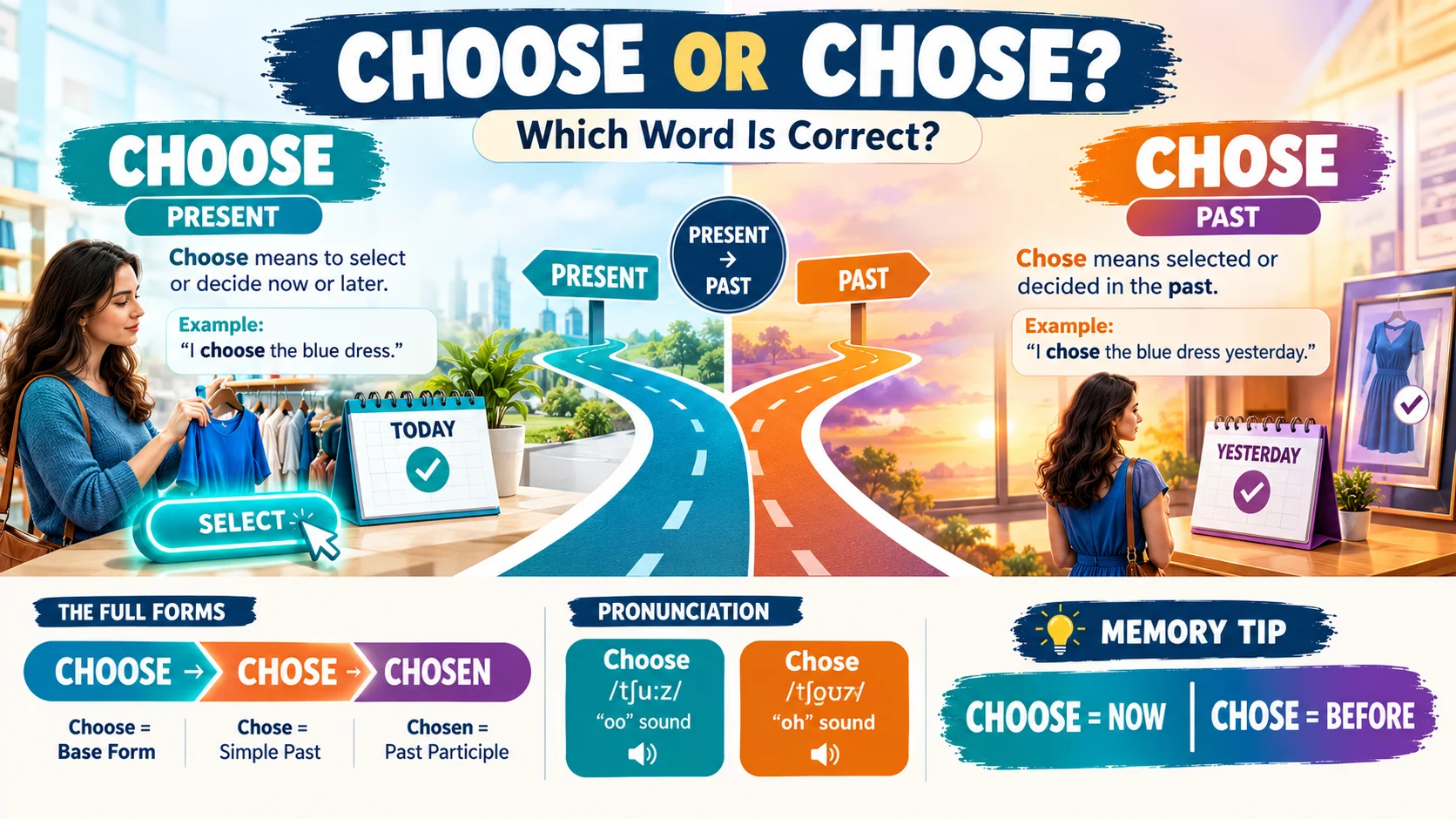
Choose and chose are both correct English words, but they have different meanings and uses. Choose is the present-tense form of the verb, meaning to select or make a decision, while chose is its simple past-tense form. For example, “I choose the blue dress” describes a present choice, whereas “I chose the blue dress yesterday” describes a completed decision.
Have you ever stopped while writing a sentence and wondered whether to use choose or chose? These two words look and sound similar, but they represent different points in time. Although both are forms of the same verb, using the wrong one can change the meaning of your sentence and create a grammar mistake.
The main difference is simple: choose describes a present decision or a choice that someone is about to make, while chose describes a decision made in the past. For example, you might say, “I choose to study English every day” when discussing a current habit. However, “I chose to study English last year” refers to a decision you already made.
Understanding this difference can improve your writing, conversations, emails, and everyday communication. Moreover, learning their verb forms and pronunciation will help you remember which word belongs in each situation.
In this guide, you’ll discover the meanings of both words, their grammar rules, pronunciation differences, real-life examples, common mistakes, and simple exercises to help you use them confidently.
Choose vs. Chose
| Meaning | Context | Primary Platforms | Example | Tone |
|---|---|---|---|---|
| Choose: To select or decide | Present or future decisions | Writing, speech, education | “I choose this option.” | Neutral |
| Chose: Selected or decided | Completed past decisions | Writing, speech, storytelling | “I chose this option yesterday.” | Neutral |
What Does Choose Mean?
Choose is a verb that means to select something, make a decision, or decide between two or more possibilities. It is the present-tense form of the verb and can also be used when discussing future decisions.
People use this word when selecting an item, expressing a preference, making a personal decision, or deciding what action to take.
For example:
- “I choose the chocolate cake.”
- “You can choose any seat you like.”
- “We choose to work together.”
- “She wants to choose her own career.”
- “They will choose a new team captain tomorrow.”
In each example, the word describes a selection or decision rather than a completed action in the past.
Furthermore, choose can express personal freedom and responsibility. For instance, “You can choose your own path” suggests that someone has the freedom to make their own decisions.
Choose as a Present-Tense Verb
The word choose is the base form of the verb. It appears in the simple present tense with subjects such as I, you, we, and they.
However, when using he, she, or it in the simple present tense, the verb changes to chooses.
Examples:
- “I choose healthy food.”
- “They choose their favorite movies.”
- “We choose the best available option.”
- “She chooses a different route.”
- “He chooses his words carefully.”
Notice that the verb takes an additional -s with third-person singular subjects.
Choose for Future Decisions
Although choose is a present-tense base form, it can also appear in sentences about future choices.
For example:
- “I will choose a college next month.”
- “She is going to choose her wedding dress tomorrow.”
- “We need to choose a destination before Friday.”
In these sentences, the decision has not happened yet. Therefore, the word describes an upcoming selection.
What Does Chose Mean?
Chose is the simple past-tense form of choose. It means that someone selected something or made a decision at an earlier time.
Use this word when discussing a completed action or describing a decision that already happened.
For example:
- “I chose the blue shirt yesterday.”
- “She chose medicine as her career.”
- “They chose a beautiful location for the wedding.”
- “We chose the cheaper option.”
- “He chose to stay at home last night.”
In each sentence, the selection or decision happened in the past.
Additionally, chose frequently appears in stories, personal experiences, news reports, and conversations about previous decisions.
Chose as a Past-Tense Verb
Unlike choose, the word chose does not change according to the subject in the simple past tense.
You can use it with I, you, he, she, it, we, and they.
Examples:
- “I chose the red one.”
- “You chose the right answer.”
- “He chose a different career.”
- “She chose to leave early.”
- “We chose the winning design.”
- “They chose a new leader.”
Therefore, you do not need to add an -s or another ending to chose when changing the subject.
Choose or Chose: What Is the Main Difference?
The most important difference between these words is their tense.
Choose refers to a present or upcoming selection, whereas chose describes a selection that happened in the past.
Consider these examples:
| Choose | Chose |
|---|---|
| I choose this book. | I chose this book yesterday. |
| We choose our team. | We chose our team last week. |
| She will choose a dress. | She chose a dress yesterday. |
| They choose their favorite songs. | They chose their favorite songs. |
| You can choose a seat. | You chose the wrong seat. |
Both words describe the same basic action. Nevertheless, the time of that action determines which form you should use.
Easy Way to Remember the Difference
Use this simple memory trick:
- Choose = Now or later.
- Chose = Before or in the past.
For example, imagine ordering food at a restaurant.
If you are still deciding, say:
“I choose the chicken sandwich.”
However, if you ordered it yesterday, say:
“I chose the chicken sandwich yesterday.”
The time clue makes the correct word much easier to identify.
Choose, Chose, and Chosen: Understanding All Three Forms
Many English learners confuse these three words because they belong to the same verb family. However, each form has a different grammatical purpose.
| Verb Form | Word | Usage | Example |
|---|---|---|---|
| Base form | Choose | Present, infinitive, or after modal verbs | I choose carefully. |
| Simple past | Chose | Completed past action | I chose carefully. |
| Past participle | Chosen | Used with helping verbs | I have chosen carefully. |
Choose
Use choose for present decisions, infinitives, and after modal verbs.
Example: “I want to choose a better option.”
Chose
Use chose for completed past actions.
Example: “I chose a better option yesterday.”
Chosen
Use chosen as the past participle, usually with helping verbs such as have, has, or had.
Examples:
- “I have chosen my favorite design.”
- “She has chosen a new school.”
- “They had chosen their seats before we arrived.”
Remember that chosen is not interchangeable with chose.
For instance, “I have chose a dress” is incorrect. The correct sentence is “I have chosen a dress.”
Pronunciation: Choose vs. Chose
Although these words have similar spellings, their vowel sounds are different.
Choose: Pronounced /tʃuːz/, rhyming with “news” and “shoes.”
Chose: Pronounced /tʃoʊz/, rhyming with “rose” and “those.”
The main difference is the vowel sound:
- Choose has a long “oo” sound.
- Chose has a long “oh” sound.
Both words begin with the same “ch” sound and end with the same “z” sound.
Learning this pronunciation difference can help you recognize the words in spoken English as well as written communication.
How to Use Choose in a Sentence
The word choose works in several grammatical structures. Understanding these patterns will help you use it naturally.
Choose + Noun
Use this structure when someone selects a person, object, place, or option.
Examples:
- “Please choose a color.”
- “I choose this restaurant.”
- “You can choose your favorite book.”
- “They choose their own clothes.”
Choose to + Verb
Use this structure when someone decides to perform an action.
Examples:
- “I choose to learn something new.”
- “She chooses to remain positive.”
- “We choose to support our friends.”
- “They choose to travel together.”
Choose Between + Options
Use choose between when selecting from two or more possibilities.
Examples:
- “I cannot choose between coffee and tea.”
- “She must choose between two job offers.”
- “We need to choose between these designs.”
Choose From + Options
Use choose from when selecting something from an available group.
Examples:
- “You can choose from five different colors.”
- “Customers may choose from several meal options.”
- “Students can choose from different courses.”
Choose + Object + To Be
Use this pattern when selecting someone or something for a particular role or position.
Examples:
- “They chose him to be the captain.”
- “The committee will choose her to lead the project.”
How to Use Chose in a Sentence
The word chose follows similar sentence patterns, but it refers to completed decisions.
Chose + Noun
Examples:
- “I chose the black jacket.”
- “She chose a beautiful wedding dress.”
- “We chose the second option.”
- “They chose a different restaurant.”
Chose to + Verb
Examples:
- “He chose to study abroad.”
- “I chose to remain silent.”
- “She chose to accept the offer.”
- “They chose to work together.”
Chose Between + Options
Examples:
- “We chose between two different plans.”
- “She chose between the blue and green dresses.”
- “I chose between two job opportunities.”
Chose From + Options
Examples:
- “He chose a gift from the collection.”
- “They chose from several available apartments.”
- “We chose from the final list of candidates.”
In all these examples, the decision took place before the moment of speaking.
Real-Life Examples of Choose or Chose
Here are practical examples showing how these words work in everyday situations.
Everyday Conversations
Choose:
- “You can choose whatever you want.”
- “I choose to spend my weekend at home.”
- “Let’s choose a movie for tonight.”
Chose:
- “I chose that movie last weekend.”
- “She chose the restaurant for dinner.”
- “We chose to walk instead of driving.”
Education and School
Choose:
- “Students can choose their favorite subjects.”
- “I need to choose a topic for my assignment.”
- “You should choose the correct answer.”
Chose:
- “She chose biology as her major.”
- “We chose the wrong answer on the test.”
- “He chose to attend a different university.”
Workplace and Business
Choose:
- “Companies choose employees based on their qualifications.”
- “We need to choose a marketing strategy.”
- “You can choose your preferred working hours.”
Chose:
- “The manager chose a new team leader.”
- “Our company chose a different supplier.”
- “They chose to launch the product in June.”
Relationships and Personal Life
Choose:
- “I choose to spend time with people who support me.”
- “You should choose a partner who respects you.”
- “We choose how we respond to difficult situations.”
Chose:
- “She chose to forgive him.”
- “I chose to follow my dreams.”
- “They chose to move to another city.”
Social Media Captions
Both words can also appear in social media captions.
Choose captions:
- “Choose happiness every day.”
- “Choose yourself first.”
- “Choose growth over comfort.”
- “Choose kindness whenever possible.”
Chose captions:
- “I chose peace over drama.”
- “I chose my own path.”
- “I chose happiness, and I have no regrets.”
- “She chose courage over fear.”
Common Mistakes When Using Choose or Chose
Even experienced English speakers sometimes mix up these forms. However, a few simple rules can prevent most errors.
Using Chose for a Present Decision
Incorrect: “I chose this one because I like it.”
Correct: “I choose this one because I like it.”
Explanation: If you are describing a current decision, use choose. However, if the selection happened earlier, chose is appropriate.
Using Choose for a Completed Past Action
Incorrect: “She choose the red dress yesterday.”
Correct: “She chose the red dress yesterday.”
Explanation: The word “yesterday” identifies a past action, so the simple past form is necessary.
Confusing Chose With Chosen
Incorrect: “I have chose my favorite book.”
Correct: “I have chosen my favorite book.”
Explanation: The present perfect tense requires the past participle chosen, not the simple past form chose.
Adding an Unnecessary -S to Chose
Incorrect: “He choses the best option yesterday.”
Correct: “He chose the best option yesterday.”
Explanation: The simple past form remains chose for every subject.
Using Choose After Did
Incorrect: “Did you chose this color?”
Correct: “Did you choose this color?”
Explanation: After the auxiliary verb did, use the base form of the main verb. Therefore, choose is correct.
Choose or Chose: Comparison With Other Verb Forms
Understanding related grammar patterns makes it easier to avoid mistakes.
| Sentence | Correct Form | Reason |
|---|---|---|
| I ___ a new phone every year. | Choose | Present habit |
| She ___ a new phone yesterday. | Chose | Past action |
| We have ___ our destination. | Chosen | Present perfect |
| He will ___ a different option. | Choose | After will |
| They had ___ the winner. | Chosen | Past perfect |
| Did you ___ this one? | Choose | After did |
Choose vs. Chooses
Choose is the base form, while chooses is the third-person singular present form.
- “I choose my clothes.”
- “She chooses her clothes.”
Chose vs. Had Chosen
Chose is the simple past form, while had chosen is the past perfect construction.
- “I chose a seat.”
- “I had chosen a seat before the show started.”
The past perfect form emphasizes that one action happened before another past action.
Choose vs. Will Choose
Both forms can describe future decisions, but they have different grammatical structures.
- “I choose the blue option.” (Present decision)
- “I will choose the blue option tomorrow.” (Future decision)
Why Choose and Chose Matter in English Grammar
Using the correct verb tense helps readers understand when an action happens. Although the difference between these two words seems small, it can change the timeline of a sentence.
For example, consider these statements:
“I choose to study medicine.”
“I chose to study medicine.”
The first sentence describes a current decision or preference. In contrast, the second tells readers that the decision happened in the past.
Correct verb usage offers several benefits:
- Clear communication: Readers understand when a decision happened.
- Better grammar: Your sentences follow standard English tense rules.
- Professional writing: Correct verb forms improve emails, applications, and reports.
- Stronger storytelling: You can describe past and present decisions accurately.
- Better speaking skills: Understanding tense helps you communicate naturally.
Therefore, learning this small grammar difference can make a meaningful improvement in everyday English.
Tips to Remember When to Use Choose or Chose
You do not need complicated grammar rules to remember these words. Instead, use the following tips.
Think about time: If the decision happens now or later, use choose. If it already happened, use chose.
Look for time clues: Words such as yesterday, last week, and previously often indicate the past.
Remember the verb family: Choose, chose, chosen.
Practice with examples: Write a few sentences about decisions you make today and decisions you made yesterday.
Check helping verbs: After did, will, can, and should, use the base form choose. After have, has, and had, use chosen.
With regular practice, the difference will become easier to recognize.
Choose or Chose: Related Word Comparisons
English contains many verbs with different present and past forms. Learning these pairs can strengthen your grammar skills.
| Present Form | Past Form | Example |
|---|---|---|
| Choose | Chose | I choose today; I chose yesterday. |
| Lose | Lost | I lose sometimes; I lost yesterday. |
| Write | Wrote | I write daily; I wrote yesterday. |
| Speak | Spoke | I speak English; I spoke English. |
| Drive | Drove | I drive carefully; I drove carefully. |
| Break | Broke | I break the rules; I broke a rule. |
| Freeze | Froze | Water can freeze; the water froze. |
| Take | Took | I take notes; I took notes. |
These verbs do not follow the usual -ed pattern in the past tense. Therefore, memorizing their forms is especially useful.
Practice Exercises: Choose or Chose
Test your understanding with these fill-in-the-blank questions. Select the correct form of the verb based on the context.
Fill in the Blanks
- I always ______ healthy meals.
- She ______ a beautiful dress yesterday.
- We need to ______ a new team captain.
- They ______ to move to California last year.
- He will ______ his favorite subject tomorrow.
- Did you ______ this restaurant?
- My parents ______ this house in 2018.
- You can ______ any book from the shelf.
- I ______ to stay home last night.
- She wants to ______ a different career.
Choose the Correct Sentence
Which sentence is correct?
A. I chose this option every day.
B. I choose this option every day.
Which sentence is correct?
A. She choose a new dress yesterday.
B. She chose a new dress yesterday.
Which sentence is correct?
A. Did he choose the blue car?
B. Did he chose the blue car?
Which sentence is correct?
A. They have chosen their destination.
B. They have chose their destination.
Exercise Answers and Explanations
Fill in the blanks:
- Choose — Describes a regular habit.
- Chose — The word “yesterday” indicates the past.
- Choose — Follows the phrase “need to.”
- Chose — Describes a completed past decision.
- Choose — Follows the future auxiliary “will.”
- Choose — The auxiliary “did” requires the base form.
- Chose — The year 2018 identifies a past event.
- Choose — Describes a selection someone can make.
- Chose — Describes a completed past decision.
- Choose — Follows the infinitive marker “to.”
Choose the correct sentence:
- B — “I choose this option every day.” The sentence describes a habit.
- B — “She chose a new dress yesterday.” The action happened in the past.
- A — “Did he choose the blue car?” Use the base form after “did.”
- A — “They have chosen their destination.” The present perfect requires the past participle.
Frequently Asked Questions
Is it choose or chose?
Both words are correct, but they have different grammatical uses. Choose is the present-tense form, while chose is the simple past-tense form. Use choose for current or upcoming decisions and chose for completed past decisions.
Is chose the past tense of choose?
Yes. Chose is the simple past-tense form of choose. For example, “I choose a book today” becomes “I chose a book yesterday.”
What is the past participle of choose?
The past participle of choose is chosen. It is used with helping verbs such as have, has, and had. For example, “I have chosen my favorite option.”
Is it I choose or I chose?
Both are correct, depending on the time of the action. Say “I choose” when describing a present decision or habit. However, use “I chose” when talking about a decision you made in the past.
Is it choose or chose in a sentence about yesterday?
Use chose because yesterday refers to a completed past action. For example, “I chose the blue shirt yesterday.”
Is it choose or chose after did?
Use choose after did because the auxiliary verb already indicates the past tense. For example, “Did you choose this book?” is correct.
Is it have choose, have chose, or have chosen?
The correct expression is have chosen. The present perfect tense requires the past participle of the verb. Therefore, “I have chosen my favorite color” is grammatically correct.
Is it will choose or will chose?
The correct form is will choose. After the modal verb will, always use the base form of the main verb. For example, “She will choose a new car next month.”
What is the difference between choose, chose, and chosen?
Choose is the base form, chose is the simple past form, and chosen is the past participle. For example, “I choose today,” “I chose yesterday,” and “I have chosen already.”
Is choose a regular or irregular verb?
Choose is an irregular verb because its past-tense form does not follow the standard -ed pattern. Its three principal forms are choose, chose, and chosen.
How do you pronounce choose and chose?
Choose is pronounced /tʃuːz/, with a long “oo” sound. Meanwhile, chose is pronounced /tʃoʊz/, with a long “oh” sound.
Can choose refer to a future decision?
Yes. The base form choose appears in future constructions such as “I will choose a college next year.” It can also follow phrases such as “going to” and “planning to.”
Key Takeaways: Choose or Chose
Here are the most important points to remember:
- Choose is the base form of the verb and describes present or upcoming decisions.
- Chose is the simple past-tense form and describes completed decisions.
- Chosen is the past participle used with have, has, and had.
- Use choose after helping verbs such as did, will, can, and should.
- The pronunciation of choose has an “oo” sound, while chose has an “oh” sound.
- Time expressions such as yesterday, last year, and earlier can help identify when to use chose.
Conclusion
Understanding choose or chose becomes easy when you remember one simple rule: choose refers to a present or upcoming decision, while chose describes a decision made in the past. Both words are correct, but they cannot always replace each other because their verb tenses are different.
Additionally, remember the third form, chosen, which works with helping verbs such as have, has, and had. By practicing these forms in everyday conversations, school assignments, professional emails, and social media posts, you can avoid common grammar mistakes.
Ultimately, the best way to remember the difference is to connect each word with time: choose for now or later, chose for the past, and chosen for perfect tenses.