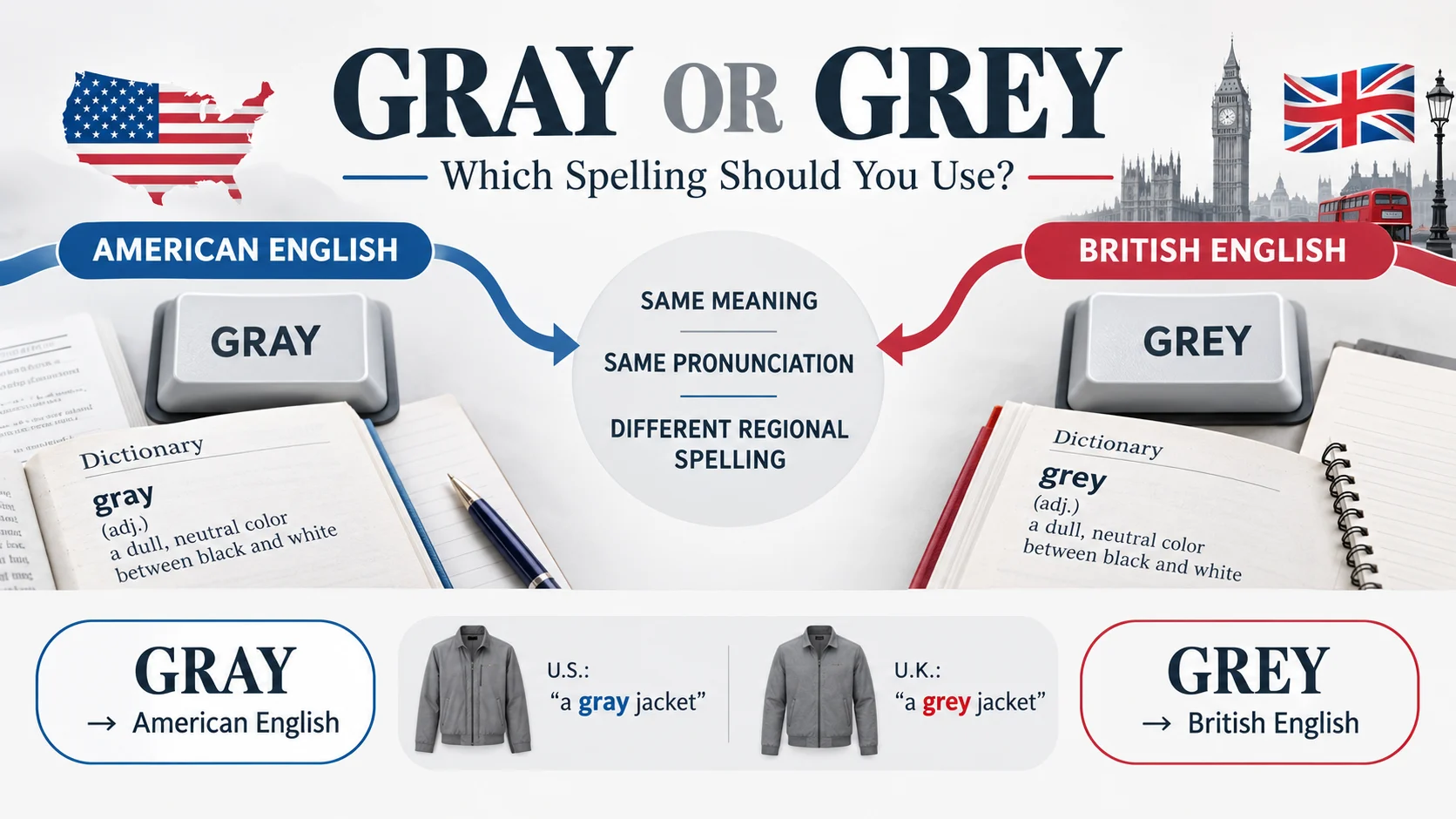
Gray or grey are two spellings of the same word. Both are correct, but the preferred spelling depends mainly on the variety of English you are using. Gray is the standard spelling in American English, while grey is more common in British English. Both forms describe the same color between black and white, and both can also work in related expressions and as a verb or noun.
For example, an American writer would normally write, “The gray sky looked cloudy.” A British writer would usually write, “The grey sky looked cloudy.”
Therefore, neither spelling is inherently wrong. The key is to match your spelling to your audience and remain consistent throughout your writing.
Gray or Grey?
Gray is the preferred spelling in American English, while grey is the preferred spelling in British English. Both words have the same meaning and pronunciation, so the main difference is regional spelling.
| Spelling | Main Usage | Example |
|---|---|---|
| Gray | American English | She wore a gray jacket. |
| Grey | British English | She wore a grey jacket. |
| Gray | U.S. names and usage | Gray is common in American writing. |
| Grey | UK and Commonwealth usage | Grey is common in British writing. |
So, if you’re writing for a U.S. audience, choose gray. If you’re writing primarily for a British audience, choose grey.
What Does Gray or Grey Mean?
Gray and grey refer to a color that falls between black and white.
The word can describe objects, clothing, hair, skies, animals, buildings, and many other things.
For example:
- The house has a gray roof.
- His hair is turning grey.
- Dark gray clouds covered the sky.
- She bought a grey sweater.
Although the spelling changes, the basic meaning does not.
Gray or Grey as an Adjective
Most commonly, the word functions as an adjective.
It describes something that has a gray or grey color.
Examples:
- He bought a gray car.
- The cat has grey fur.
- The walls are gray.
- She wore a grey dress.
Gray or Grey as a Noun
The word can also function as a noun when referring to the color itself.
Examples:
- Gray is one of my favorite colors.
- The artist used several shades of grey.
- She painted the room in a soft gray.
Gray or Grey as a Verb
In some contexts, gray or grey can also function as a verb.
It can describe something becoming gray or grey, especially hair.
For example:
- His hair began to gray.
- Her hair started to grey with age.
Again, the regional spelling determines which form you normally use.
Gray vs Grey: The Main Difference
The simplest distinction is geographic.
American English generally uses “gray.”
British English generally uses “grey.”
This difference is similar to other spelling variations between American and British English.
For example:
| American English | British English |
|---|---|
| gray | grey |
| color | colour |
| favorite | favourite |
| center | centre |
| realize | realise |
Therefore, gray vs grey is primarily a spelling difference rather than a difference in meaning.
Why Does American English Use Gray?
American English generally standardized gray as the preferred spelling.
Over time, American English developed several spelling conventions that differ from British English. Noah Webster played an important role in standardizing American spelling in the 19th century.
As a result, gray became the dominant American form.
Today, American dictionaries and publications normally use gray.
For a U.S.-focused website, therefore, gray is usually the safer choice.
Why Does British English Use Grey?
British English generally favors grey.
The spelling has a long history in English and remains common throughout the United Kingdom.
Moreover, grey is also widely used in other English-speaking regions influenced by British English conventions.
Therefore, if you’re writing for readers in Britain, grey will usually look more natural.
Is Gray or Grey Correct?
Both are correct.
Neither spelling is a misspelling when it is used appropriately for the intended variety of English.
If you’re writing American English, use gray.
If you’re writing British English, use grey.
The most important rule is consistency.
For instance, an American article should generally use:
The gray walls matched the gray sofa.
A British article would normally use:
The grey walls matched the grey sofa.
Mixing the two forms isn’t usually a serious grammar error, but consistent spelling makes your writing look more polished.
Gray or Grey in American English
If your audience is primarily in the United States, gray should be your default.
American publications, schools, businesses, and websites generally use gray.
American English Examples
- The gray sky made the afternoon feel gloomy.
- He bought a gray suit for the interview.
- Her hair is beginning to gray.
- The designer selected a soft gray for the walls.
- A gray wolf crossed the trail.
For American SEO content, using gray is also the natural choice when the article is written specifically for U.S. readers.
Gray or Grey in British English
British English generally prefers grey.
Therefore, writers targeting audiences in the United Kingdom should normally use grey throughout their content.
British English Examples
- The grey sky covered the city.
- He wore a grey suit.
- Her hair began to grey.
- The room had grey walls.
- A grey wolf appeared in the distance.
The meaning remains exactly the same.
Only the preferred spelling changes.
Gray or Grey in Canada, Australia, and Other English Varieties
The situation becomes slightly less simple outside the United States and United Kingdom.
Many English-speaking countries traditionally follow British spelling conventions. Consequently, grey is widely used in places such as Australia.
Canadian English can be more flexible because it contains influences from both British and American English.
Therefore, the safest approach is to follow the style guide used by your organization, publication, school, or client.
If no specific style guide exists, choose one spelling and use it consistently.
How Do You Pronounce Gray and Grey?
Gray and grey are pronounced the same way.
They are homophones in standard English, meaning they have the same pronunciation even though their spellings differ.
Both are generally pronounced like:
/ɡreɪ/
That is the same vowel sound found in words such as day, say, and way.
So, you do not need to change your pronunciation when switching from gray to grey.
Gray or Grey: Example Sentences
Seeing both spellings in context makes the distinction easier.
Examples With Gray
- The gray clouds covered the mountains.
- He bought a gray hoodie.
- The building has a modern gray exterior.
- Her hair is starting to gray.
- The artist used several shades of gray.
- A gray cat slept on the porch.
- The road disappeared beneath the gray sky.
- He chose a dark gray color for his office.
Examples With Grey
- The grey clouds covered the hills.
- She wore a grey sweater.
- The building has a grey stone exterior.
- His hair began to grey.
- The artist mixed several shades of grey.
- A grey cat sat near the window.
- The city looked quiet beneath the grey sky.
- They painted the bedroom grey.
Notice that the meaning remains unchanged.
Only the spelling changes according to the variety of English.
Gray vs Grey in Formal Writing
Both forms are acceptable in formal writing.
However, the correct choice depends on your audience.
For American Writing
Use gray in:
- Essays
- Business reports
- Websites
- Academic writing
- News articles
- Marketing content
- Professional emails
For British Writing
Use grey in the same types of writing when following British English conventions.
The important point is not to switch between the two without a reason.
Gray or Grey in Creative Writing
Creative writers can use either spelling.
Your choice should depend on the setting, narrator, audience, and preferred style.
For example, an American novel would naturally use:
The old man stared at the gray ocean.
A British novel might use:
The old man stared at the grey sea.
If a story intentionally reflects a particular regional voice, matching that variety can make the writing feel more authentic.
Special Cases and Proper Names
One important exception is proper names.
Sometimes a person’s name, place name, organization, or product uses one specific spelling.
In that situation, you should preserve the official spelling.
For example, if someone’s surname is Gray, don’t change it to Grey simply because you’re writing for a British audience.
Likewise, if an organization officially uses Grey in its name, keep Grey.
Proper names are not ordinary spelling choices.
Gray and Grey in Names
Both spellings appear in surnames.
Common examples include:
- Gray
- Grey
These names may have different historical origins, but you should never change someone’s surname to match your preferred English spelling.
Gray vs Grey: Which One Should You Use?
Use a simple rule.
Choose Gray When:
- You’re writing American English.
- Your audience is primarily in the United States.
- Your website follows U.S. spelling.
- Your publication uses American style.
- You’re writing for American schools or businesses.
Choose Grey When:
- You’re writing British English.
- Your audience is primarily in the United Kingdom.
- Your publication follows British spelling.
- You’re writing for a British institution.
- Your style guide specifies British English.
What If Your Audience Is International?
If your audience includes readers from many English-speaking countries, either spelling can work.
However, consistency becomes even more important.
For a website targeting U.S. search traffic, gray is generally the better default.
For a British-focused website, use grey.
Common Mistakes With Gray and Grey
Although this is a simple spelling difference, writers still make a few common mistakes.
Mistake 1: Thinking One Spelling Is Wrong
Both forms are correct.
The difference is mainly regional.
Mistake 2: Mixing Both Forms
Using gray in one paragraph and grey in another can make your writing look inconsistent.
Instead, choose the spelling that matches your audience.
Mistake 3: Changing Proper Names
Don’t change Gray to Grey or Grey to Gray when it is part of someone’s official name.
Mistake 4: Assuming Pronunciation Changes
The pronunciation is essentially the same.
The spelling changes, not the normal pronunciation.
Mistake 5: Choosing Based on Personal Preference Alone
If you’re writing professionally, audience matters more than personal preference.
A U.S. publication may expect gray, while a British publication may expect grey.
Gray or Grey: A Simple Memory Trick
Here’s an easy way to remember the difference:
Gray = America
Think of the A in gray as a reminder of America.
Grey = Britain
Think of grey as the traditional British spelling.
This isn’t a linguistic rule, of course. It’s simply a useful memory trick.
Gray or Grey Compared
| Feature | Gray | Grey |
|---|---|---|
| Meaning | Same | Same |
| Pronunciation | Same | Same |
| American English | Preferred | Less common |
| British English | Less common | Preferred |
| Part of speech | Adjective, noun, verb | Adjective, noun, verb |
| Refers to color | Yes | Yes |
| Correct spelling | Yes | Yes |
Related Words and Expressions
The word gray/grey appears in many expressions.
Some common examples include:
Gray Area
A gray area is a situation that is unclear or doesn’t fit neatly into a simple category.
Example:
The legal situation remains a gray area.
In British English, you’ll often see:
The legal situation remains a grey area.
Gray Matter
Gray matter refers to a type of tissue in the brain and spinal cord.
Example:
The study examined changes in gray matter.
Gray Hair
Gray hair describes hair that has lost some of its natural color.
Example:
His gray hair gave him a distinguished appearance.
British English commonly uses grey hair.
Gray Wolf
The animal is commonly called a gray wolf in American English.
British English generally uses grey wolf.
Words Similar to Gray or Grey
Some words describe colors that are related to gray or grey, but they aren’t exact synonyms.
Silver
Silver is a metallic color that is often lighter and more reflective than gray.
Example:
She drove a silver car.
Ashen
Ashen describes a pale grayish appearance, often associated with someone’s face.
Example:
His face looked ashen after the frightening experience.
Charcoal
Charcoal describes a very dark gray.
Example:
She chose a charcoal suit.
Slate
Slate can describe a dark bluish-gray color.
Example:
The designer selected slate for the kitchen cabinets.
Smoky
Smoky can describe a soft gray color resembling smoke.
Example:
The room had a smoky gray appearance.
These words can be useful when you want to describe a more specific shade.
Gray or Grey in Different Contexts
The choice becomes especially easy when you think about your audience.
In American Blogging
Use gray.
This guide explains how to choose the perfect gray paint.
In British Blogging
Use grey.
This guide explains how to choose the perfect grey paint.
In Academic Writing
Follow your institution’s style guide.
In Business Writing
Follow the spelling conventions of your company and target market.
In SEO Content
Use the spelling that matches your target audience and search intent.
For U.S.-focused content, gray is generally the natural primary form.
How to Choose Between Gray and Grey
You don’t need a complicated rule.
Simply ask these questions:
Who is reading this?
If your readers are mainly American, choose gray.
Which spelling does your style guide use?
Follow the guide if one exists.
Am I writing a proper name?
If so, preserve the official spelling.
Have I already chosen one form?
Stay consistent throughout the document.
Does the publication target a specific country?
Match its English variety.
As a result, the decision becomes straightforward in most situations.
Quick Gray or Grey Cheat Sheet
American English: Gray
British English: Grey
Meaning: The same
Pronunciation: The same
Color: The same
American spelling: Gray
British spelling: Grey
Can both be correct? Yes
Should you mix them? Usually no
Should proper names be changed? No
FAQs About Gray or Grey
Is gray or grey correct?
Both are correct. Gray is the standard American spelling, while grey is the standard British spelling.
Is gray American or British?
Gray is primarily American. American English generally uses gray, while British English generally prefers grey.
Is grey American or British?
Grey is primarily British. British English commonly uses grey, although the spelling is also used in other English varieties.
Do gray and grey mean the same thing?
Yes. They refer to the same color and generally have the same meanings when used as adjectives, nouns, or verbs.
Are gray and grey pronounced the same?
Yes. Both are normally pronounced /ɡreɪ/.
Should I use gray or grey in the United States?
Use gray. It is the standard spelling in American English.
Should I use gray or grey in the UK?
Use grey. It is the standard spelling in British English.
Which spelling is better for a U.S. website?
Gray is usually better. If your website targets American readers, using American spelling throughout creates a consistent style.
Can I use both gray and grey in the same article?
You generally should not. Choose one spelling based on your target variety of English and use it consistently, except when preserving a proper name or official title.
Conclusion
Gray and grey are both correct spellings of the same word. The main difference is regional: gray is preferred in American English, while grey is preferred in British English.
Therefore, the best choice depends on your audience. If you’re writing for the United States, use gray. If you’re writing for the United Kingdom, use grey.
Most importantly, stay consistent. Once you choose the spelling that matches your audience and style guide, use it throughout your writing.