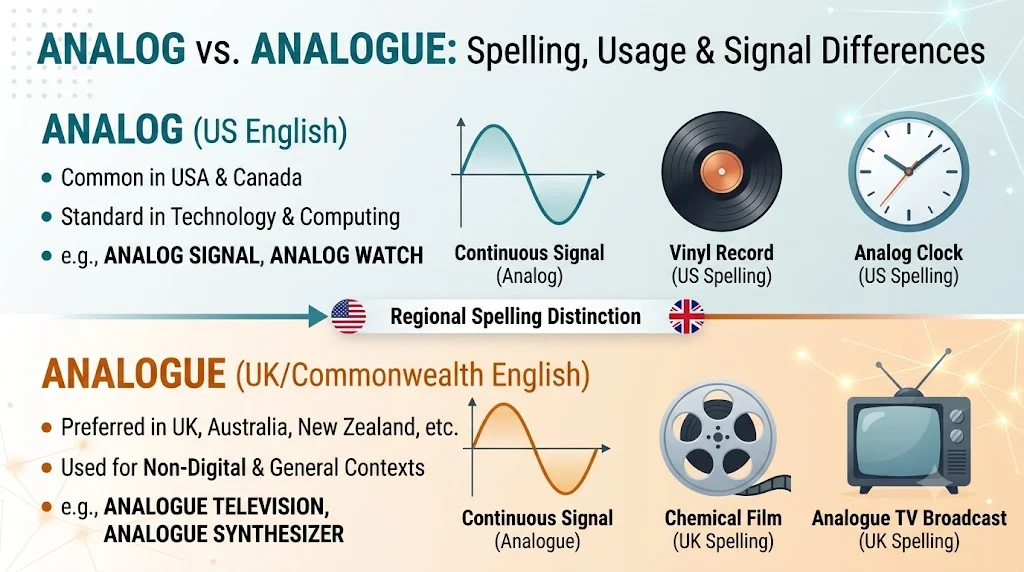
The word analog is the preferred American English spelling, commonly used in technical contexts like signals, electronics, and clocks. The spelling analogue is the preferred British, Canadian, and Australian English form, often referring to a person or thing that is comparable to another. Both spellings share the same root meaning of similarity, proportionality, or continuous variation.
Choosing between analog or analogue can confuse writers, students, and technical professionals. Language conventions vary depending on where you live and what topic you are discussing.
In everyday writing, spelling choices often depend on geographic location. American publications favor the shorter spelling, while British publications prefer the traditional ending. However, technology has introduced subtle nuances to these rules. Engineers often use the shorter spelling even in regions that traditionally prefer British English.
Understanding the distinction between these two forms helps you communicate clearly and professionally. Misusing regional spellings can make your writing look careless to global readers or technical auditors.
This comprehensive guide breaks down the origins, regional rules, technical applications, and grammatical functions of both spellings. By the end of this article, you will know exactly when to use each term in your documents, technical specs, or everyday writing.
- American English primarily uses analog for all contexts, including electronics, software, and grammar.
- British English prefers analogue for general writing, though analog is widely accepted in digital electronics.
- In technical contexts, an analog signal varies continuously, whereas a digital signal uses discrete binary values (0 and 1).
- Non-technical uses of the word refer to a counterpart, comparison, or equivalent idea in another system.
- Consistency within a single document is the most critical rule for professional publishing and SEO performance.
Definition and Origins
Etymology and Historical Roots
The words trace their origin back to the ancient Greek word analogos, which means proportionate or corresponding. The term combines ana (meaning according to) and logos (meaning ratio or proportion).
French writers adopted the Greek term as analogue, which entered the English language during the seventeenth century. Over time, writers used the word as both a noun and an adjective to describe things that shared a clear structural similarity.
During the twentieth century, language reformers in the United States simplified many words ending in -gue. Words like catalog, dialog, and analog dropped their silent trailing letters. This change coincided with the rise of modern computing and electrical engineering, which popularized the simplified American spelling worldwide.
What Does the Term Mean Today?
In modern language, the term functions as both an adjective and a noun across two primary domains:
- Technical Domain: Describing physical quantities or signals that vary continuously over a smooth range rather than in discrete steps.
- General Domain: Referring to something that corresponds to, or is comparable with, another thing in a different context.
Analog or Analogue: Regional Differences
Understanding geography helps you choose the correct spelling for your audience. Although the core meaning remains identical, regional style guides strictly enforce their preferred forms.
American English Usage
In the United States, analog is the universal standard. American dictionaries list analogue as a variant spelling, but style guides discourage its use. Whether you are discussing a clock face, a synthesizer, or a pharmaceutical counterpart, stick to the shorter form.
British and Commonwealth Usage
In the United Kingdom, Canada, Australia, and New Zealand, analogue is the standard spelling in general literature, journalism, and formal prose. British publications like The Guardian or The Economist consistently print analogue.
However, global engineering standards have created an exception. Because early computing and microchip documentation originated in the United States, many international engineers use analog when describing electrical circuits, signal converters, and microprocessors regardless of region.
Technical vs Non-Technical Contexts
To avoid confusion, examine how the word functions across different fields. The table below outlines common applications and preferred spellings across industries.
| Field / Context | Meaning | US Preference | UK/Commonwealth Preference |
| Electronics & Signals | Continuous physical measurements (voltage, sound) | Analog | Analog or Analogue |
| Computing & Hardware | Non-digital machinery or processing systems | Analog | Analogue |
| Chemistry & Biology | A chemical compound similar in structure to another | Analog | Analogue |
| General Literature | A comparable object, person, or concept | Analog | Analogue |
| Horology (Clocks) | Time displays using moving hands over a dial | Analog | Analogue |
Signal Processing and Electronics
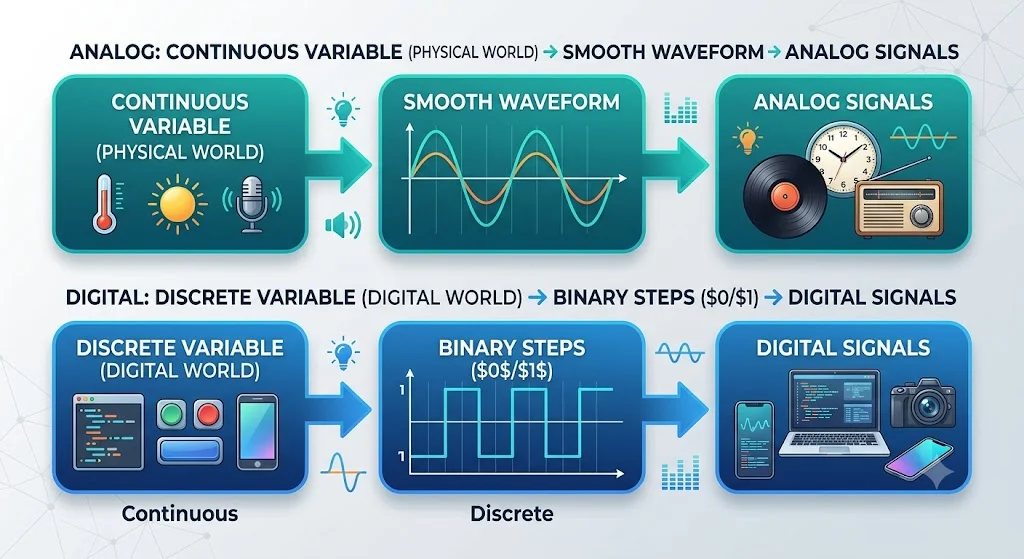
In electrical engineering, continuous waveforms represent real-world physical values. For instance, sound waves, temperature readings, and light levels exist as continuous variations.
An analog signal mirrors these continuous physical variations directly. Consequently, devices like microphones convert acoustic sound waves into continuous voltage fluctuations.
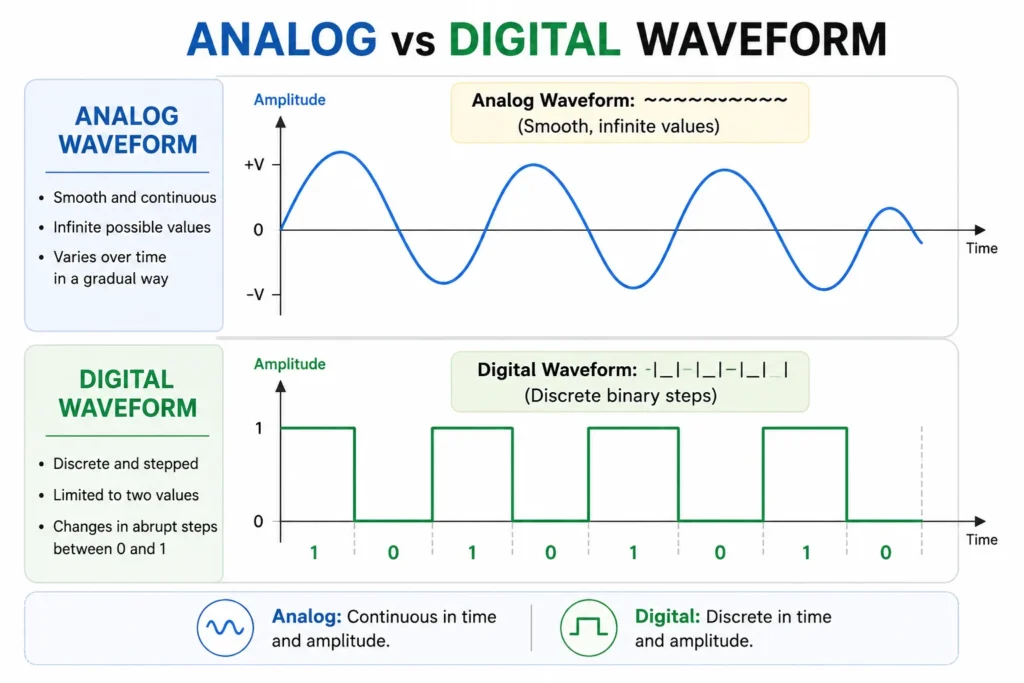
In contrast, digital systems sample these continuous waveforms at set intervals, converting them into binary code consisting of ones and zeros.
Chemistry and Pharmacology
In chemistry, an analogue (or chemical analog) is a compound that shares a similar structural layout with another compound, yet differs in a specific component, such as a single element or functional group.
For instance, synthetic insulin functions as a therapeutic analogue to natural human insulin. Scientists engineer these structural counterparts to improve absorption rates or minimize unwanted side effects in medical treatments.
Advantages and Disadvantages of Analog Systems
Comparing physical continuous systems with modern digital alternatives helps clarify why this terminology matters in engineering and product design.
Advantages
- Smooth Representation: Continuous signals capture natural physical phenomena without sample quantization errors or mathematical approximation.
- Low Latency: Simple physical circuits process incoming signals directly without requiring digital conversion algorithms or buffering delays.
- Warmth and Fidelity: Audio enthusiasts often prefer vinyl records and tape systems because they retain subtle harmonic overtones lost in compression.
- Intuitive Design: Mechanical systems, such as traditional dial pressure gauges, allow operators to observe rapid changes instantly without reading digital screens.
Disadvantages
- Noise Sensitivity: External electromagnetic interference easily degrades continuous signals, causing permanent distortion or unwanted background hiss.
- Storage Limitations: Physical media degrade over time due to mechanical wear, heat exposure, and repeated playback usage.
- Component Degradation: Thermal variations alter component resistance, causing physical equipment to drift out of calibration over prolonged operation.
- Complex Scaling: Multiplexing and transmitting high volumes of continuous data over long distances requires complex and costly cabling infrastructure.
Real-World Examples
To master the use of analog or analogue, examine how writers apply these terms across various industries.
Examples in Technology and Audio
“The studio recorded the band’s new album on continuous analog tape to achieve a rich, vintage sound tone.”
“Modern smartphones utilize analog-to-digital converters to translate voice vibrations into transmitted binary data.”
“Although digital displays are common, many pilots prefer traditional analogue instruments for quick visual scanning during flight operations.”
Examples in General Writing and Literature
“The film industry of the nineteenth century lacks a direct modern analogue, as modern digital streaming operates on entirely different financial models.”
“Historians often consider the Roman Senate an ancient analogue to modern legislative assemblies.”
“Her literary style serves as a striking analogue to the atmospheric paintings of the late romantic era.”
Common Mistakes and How to Avoid Them
Even experienced writers occasionally struggle with regional spelling rules and technical context shifts. Below are common mistakes and simple strategies to fix them.
Mixing Regional Conventions
Mixing American and British spellings within the same document creates inconsistent prose and harms editorial quality.
- Incorrect: The engineer installed an analog signal converter, but the analogue display failed to read the incoming current.
- Correct (US): The engineer installed an analog signal converter, but the analog display failed to read the incoming current.
- Correct (UK): The engineer installed an analogue signal converter, but the analogue display failed to read the incoming current.
Misinterpreting Digital for Analog
Occasionally, people confuse non-digital mechanical systems with purely manual operations.
- Incorrect: Writing a letter by hand with a pencil is an analog computing process.
- Correction: Writing by hand is a manual activity, not an analog signal or process. Reserve the keyword for continuous physical representations or system counterparts.
Overusing the Term as a Trend Phrase
Marketing materials often use the term loosely to mean outdated or old-fashioned.
- Imprecise: Our business uses an analog decision-making strategy during client meetings.
- Improved: Our business uses a traditional or non-digital decision-making strategy during client meetings.
Detailed Comparisons: Related Concepts
Understanding how these terms relate to broader technical concepts prevents misuse in specialized technical documents.
Analog vs Digital
The fundamental difference between these two systems lies in how they measure, process, and store information.
| Feature | Analog System | Digital System |
| Signal Structure | Continuous wave | Discrete binary steps ($0$ and $1$) |
| Data Capacity | Limited by physical bandwidth | High capacity through data compression |
| Noise Impact | High (causes continuous distortion) | Low (error correction fixes lost data) |
| Storage Medium | Magnetic tape, vinyl, paper charts | Hard drives, solid-state drives, cloud storage |
| Accuracy | High real-time fidelity, prone to drift | Precise numerical accuracy, prone to sampling loss |
Analog vs Anisotropy vs Homologue
Technical writers often confuse related terminology across different disciplines:
- Analog / Analogue: Refers to continuous signal processing or comparable structures in different systems.
- Homologue: Used in biology and chemistry to denote structures sharing a common evolutionary or chemical ancestor.
- Anisotropy: Describes physical properties that change depending on the direction of measurement (such as wood grain strength).
Practical Exercises with Answers
Test your understanding of regional variations, technical definitions, and correct word choice with these quick practice sentences.
Exercise 1: Choose the Correct Form for American English
Select the appropriate form (analog or analogue) based on standard American English guidelines.
- The watch features a classic dial with physical hands rather than a digital screen.
- Synthetic chemists synthesized a novel structural to combat bacterial resistance.
- High-definition media cables transmit data much faster than legacy connections.
Answers for Exercise 1
- analog (Standard American spelling for physical clock displays).
- analog (Standard American spelling for chemical equivalents).
- analog (Standard American spelling for legacy signals).
Exercise 2: Identify and Correct Regional Misalignments
Rewrite these sentences to maintain consistent British English conventions throughout.
- Our UK firm produces an analog synthesizer alongside modern digital software accessories.
- The historical analog to this economic crisis occurred during the late nineteenth century.
- She prefers reading an analog book over using an electronic reader.
Answers for Exercise 2
- Our UK firm produces an analogue synthesizer alongside modern digital software accessories.
- The historical analogue to this economic crisis occurred during the late nineteenth century.
- She prefers reading a printed (or physical) book over using an electronic reader. (Note: Calling a physical book “analogue” is imprecise marketing jargon; replacing it improves clarity).
Frequently Asked Questions
Is analog or analogue correct in modern English?
Both spellings are correct. Analog is standard in American English, while analogue is standard in British, Canadian, and Australian English.
Which spelling should I use for audio equipment?
Use analog if your audience is in the United States or if you are writing technical manuals for global markets. Use analogue if you are publishing in British English regions.
What is an analog signal in simple terms?
An analog signal is a continuous electric wave that varies smoothly over time, directly mirroring physical sounds, light, or temperature readings.
Why do engineers prefer the shorter spelling?
Many international engineering standards use analog because early computing standards, patents, and technical documentation originated in the United States.
What does the word mean outside of electronics?
Outside electronics, the word refers to something that is comparable or equivalent to another thing in a different situation or era.
Is vinyl music continuous or digital?
Vinyl records store sound as physical, continuous grooves, making them a classic example of an analog audio format.
What is a chemical analogue?
A chemical analogue is a compound whose structure closely resembles another compound, but differs in a specific atom, functional group, or side chain.
How do I use the term in SEO content writing?
Choose one regional spelling based on your target audience, apply it consistently across headings, and include natural long-tail variations like continuous signal or digital comparison.
Can I use both spellings in the same article?
No, mixing both spellings within a single document creates inconsistency. Stick strictly to American or British conventions throughout your text.
What is the opposite of an analog device?
The direct opposite of an analog device is a digital device, which processes information using discrete numerical digits ($0$ and $1$).
Conclusion
Choosing between analog or analogue ultimately comes down to target audience, regional conventions, and industry standards. While both forms share the same historical roots and core definitions, regional style guides strictly separate their usage.
For American audiences and global engineering documents, stick consistently to analog. For general publications in the United Kingdom, Canada, and Australia, choose analogue.
By applying these simple rules, maintaining consistency, and avoiding common jargon traps, you will elevate the clarity, accuracy, and professional impact of your writing across all technical and non-technical projects.

Jack Murphy is a language writer with a passion for word meanings, synonyms, and effective communication. He creates informative and easy to understand content to help readers enhance their vocabulary and language skills.








5 thoughts on “Analog or Analogue| Difference, Spelling Rules and Examples”