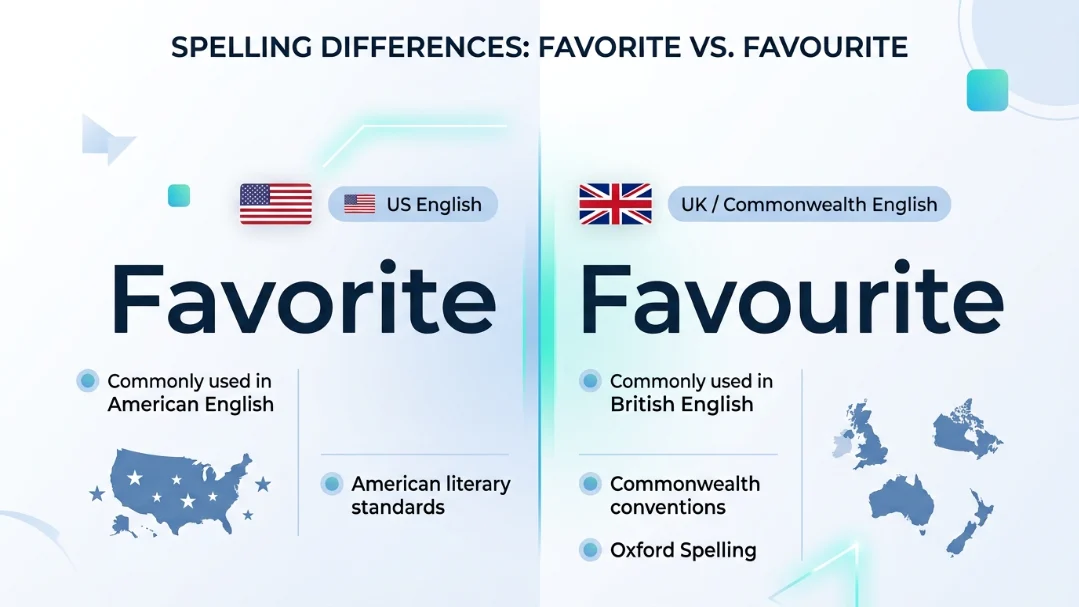
Favorite or favourite represents the exact same word, with the only difference being regional spelling standards. You should use favorite in the United States, while favourite remains the standard spelling in the United Kingdom, Canada, Australia, and other Commonwealth nations. Ultimately, neither spelling is incorrect; your choice depends entirely on your target audience and geographical location.
Choosing between favorite or favourite confuses many writers every single day. People often wonder if one version is wrong or if they mean different things. In reality, both words mean the exact same thing. They describe something you like more than all other things.
The confusion comes entirely from geography. Writers in the United States spell it without the letter “u. Meanwhile, people in the United Kingdom, Australia, and Canada keep the “u” in the word. Because we use the internet to talk to people all over the world, we see both spellings constantly. This mixing makes it hard to know which word to type.
Learning the difference helps you write better for your specific readers. Furthermore, using the right spelling makes your work look professional. This article explains everything you need to know about these two words. You will learn the history behind them, see real examples, and practice choosing the right one. Ultimately, you will never feel confused by this spelling rule again.
Understanding the difference between favorite or favourite requires looking at regional standards. Both terms function exactly the same way in a sentence. Therefore, you only need to match your spelling to your audience.
Writers in the United States follow a simplified spelling system. Conversely, writers in Commonwealth countries follow older British traditions. If you write for an international audience, you must pick one style and stay consistent. Mixing both styles in a single document looks messy and unprofessional.
Below, you will find a quick comparison of the two words.
| Feature | Favorite | Favourite |
| Primary Region | United States | UK, Canada, Australia |
| Meaning | Preferred above others | Preferred above others |
| Part of Speech | Noun, Adjective, Verb | Noun, Adjective, Verb |
| Historical Root | Noah Webster reforms | Old French / Middle English |
| Technology Standard | Dominant in coding | Rarely used in programming |
Definition and Explanation

To master these words, you must understand how they work in everyday language. Both terms come from the Italian word “favorito” and the Old French word “favorit.” Over time, the English language adopted the concept to describe things people love most.
Regardless of the spelling you choose, the word operates in three different ways. You can use it as a noun, an adjective, or a verb. Consequently, understanding its grammatical role helps you construct better sentences.
Using the Word as a Noun
When acting as a noun, the word represents a person or thing that you prefer over all others. Furthermore, it can describe a competitor who is most likely to win a contest.
For instance, if you love chocolate ice cream the most, chocolate is your favorite. Similarly, in a horse race, the fastest horse becomes the crowd favourite.
Using the Word as an Adjective
As an adjective, the word modifies a noun to show preference. Therefore, you place it directly before the object you are describing.
Instead of saying “the movie I like most,” you simply say “my favorite movie.” This usage makes sentences much shorter and more direct. Additionally, it adds emotional weight to your statement.
Using the Word as a Verb
While less common, people also use the term as a verb in modern times. This usage grew rapidly with the rise of social media and digital technology.
When you click a star icon on a website, you “favorite” that item. As a result, the platform saves the item for you to view later. Interestingly, digital platforms almost universally use the American spelling for this action.
Regional and Global Usage
Geography dictates whether you should use favorite or favourite. Because the British Empire spread its language across the globe, different nations adopted different spelling standards. Today, we divide these standards into two primary categories: American English and British English.
United States Spelling Standards
In the United States, writers drop the “u” completely. This rule applies to school papers, business documents, and everyday text messages.
American schools teach students to write “favorite” from a very young age. Consequently, most Americans view the spelling with a “u” as foreign or outdated. If you apply for a job in New York or publish an article for a US-based magazine, you must use the American version.
United Kingdom and Commonwealth Standards
The United Kingdom retains the traditional spelling. Therefore, writers in England, Scotland, Wales, and Northern Ireland always write “favourite.”
Furthermore, this standard extends to other Commonwealth nations. Countries that follow British spelling rules include:
- Australia
- New Zealand
- South Africa
- India
- Ireland
If you submit a university essay in Sydney or London, you must include the “u.” Leaving it out will result in a spelling error mark from your professor.
The Canadian Exception
Canada presents a unique situation. Geographically, Canada sits right next to the United States. Historically, however, Canada belongs to the British Commonwealth. As a result, Canadian English blends both American and British rules.
Despite this blending, Canadians strongly prefer “favourite.” Major Canadian style guides, such as the Canadian Press Stylebook, mandate the inclusion of the “u.” Therefore, treat Canadian audiences just like British audiences for this specific word.
The History Behind the Spelling Split
You might wonder why we have two spellings for the same word. The answer lies in the history of the printing press and American independence. Before the 1800s, English spelling lacked strict rules. Writers spelled words however they sounded.
The Influence of Samuel Johnson
In 1755, an English writer named Samuel Johnson published A Dictionary of the English Language. He wanted to standardize how British people wrote. Johnson favored spellings that showed the history of the word. Because many English words came through French, he kept the French “ou” endings.
Consequently, words like colour, honour, and favourite became the official standard in Great Britain. His dictionary cemented these spellings across the British Empire.
Noah Webster and American Independence
Across the ocean, the newly independent United States wanted its own identity. A man named Noah Webster believed American English should look different from British English. Furthermore, he thought traditional spelling was too complicated.
In 1828, Webster published An American Dictionary of the English Language. He purposefully removed silent letters to make words easier to read and write. Therefore, he stripped the “u” from many words. His dictionary changed the American educational system forever, solidifying the spelling “favorite.”
Advantages and Disadvantages
Choosing between favorite or favourite might seem trivial, but it carries real consequences in professional writing. Each spelling offers specific benefits and drawbacks depending on your industry.
Advantages of the American Spelling
Using the American version provides several distinct benefits in the modern world.
- Global Tech Standard: Almost all programming languages and software applications default to American English.
- Character Limits: Dropping the “u” saves one character. While small, this matters in coding and tight design spaces.
- Wider Recognition: Due to American pop culture and movies, non-native speakers recognize the American spelling very easily.
Disadvantages of the American Spelling
However, the American spelling is not perfect for every situation.
- Alienates Commonwealth Readers: British and Australian readers might view the American spelling as an error if used in a local publication.
- Fails Local Academic Standards: Submitting American spellings in a UK university will hurt your grades.
Advantages of the British Spelling
The British spelling holds its own unique benefits for writers.
- Cultural Authenticity: Using the traditional spelling shows respect for local audiences in the UK, Canada, and Australia.
- Formal Tone: Many international readers associate British spelling with high academic and literary standards.
Disadvantages of the British Spelling
Conversely, the traditional spelling presents a few hurdles.
- Inconsistent Tech Use: If you try to use “favourite” in web development or software code, it usually causes syntax errors.
- Confusion for ESL Learners: People learning English as a second language often find the extra “u” confusing because it does not change the pronunciation.
Real-World Examples
Seeing words in context helps cement them in your memory. Below, you will find examples of how to use these words correctly based on regional audiences.
Examples for American Audiences
When writing for readers in the United States, always drop the “u”.
- My absolute favorite color is deep blue.
- We went to our favorite restaurant for our anniversary.
- The teacher asked the students to list their favorite books.
- That horse is the clear favorite to win the Kentucky Derby.
- Do not forget to favorite this post so you can find it later.
Examples for British and Commonwealth Audiences
When addressing readers in the UK, Australia, or Canada, include the “u”.
- My absolute favourite colour is deep blue.
- We went to our favourite restaurant for our anniversary.
- The teacher asked the students to list their favourite books.
- That horse is the clear favourite to win the Grand National.
- She cooked my favourite meal for my birthday.
Notice how in the first British example, the word “colour” also changes to match the British standard. Consistency across the entire sentence is crucial.
Related Concepts and Comparisons
The debate between favorite or favourite represents a much larger pattern in the English language. Noah Webster changed many words ending in “-our” when he created his American dictionary. Consequently, if you learn the rule for one word, you can apply it to dozens of others.
Below is a comparison table showing other words that follow this exact same rule.
| American English (-or) | British English (-our) | Meaning / Context |
| Color | Colour | The visual property of objects. |
| Flavor | Flavour | The distinctive taste of a food or drink. |
| Honor | Honour | High respect or great esteem. |
| Humor | Humour | The quality of being amusing or comic. |
| Labor | Labour | Work, especially hard physical work. |
| Neighbor | Neighbour | A person living near or next door. |
| Rumor | Rumour | A currently circulating story or report. |
Whenever you write a document, you must choose one column from this table and stick to it. Mixing American and British standards creates a jarring reading experience. For example, writing “My favourite color” pairs a British spelling with an American one. Instead, you should write “My favourite colour” or “My favorite color.”
Impact on Digital Marketing
If you work in digital marketing, the favorite or favourite debate directly impacts Search Engine Optimization. You might wonder which spelling will bring more traffic to your website.
How Google Handles Spelling Variations
Fortunately, modern search engines are incredibly smart. Google recognizes that these two words mean the exact same thing. Therefore, if a user searches for “favourite recipes,” Google will also show them pages optimized for “favorite recipes.” The search engine seamlessly bridges the gap between regional dialects.
Choosing a Strategy for Your Website
Despite Google’s intelligence, you still need a deliberate strategy for your website’s content.
- Target the Local Audience: If your business only sells products in London, use the British spelling.
- Target the Largest Demographic: If you run a global blog, look at your Google Analytics. If 70% of your readers live in the US, use the American spelling.
- Use Hreflang Tags: If you have a massive international website, you can create two different pages. Use HTML hreflang tags to serve the American spelling to US visitors and the British spelling to UK visitors.
Coding and Technology Standards
Technology heavily favors American English. Because much of the early internet and programming languages were developed in the United States, American spelling became the default syntax.
HTML and CSS
If you build websites, you already know that CSS requires American spelling. For example, you must type color: red; to change text color. If you type colour: red;, the code will break.
Similarly, when dealing with website bookmarks or icon classes, developers use the word “favorite.” Popular icon libraries, such as FontAwesome, use classes like fa-favorite. Using the British spelling in code will almost always result in an error.
Database Management
When creating database tables, developers should stick to American spellings. Naming a column Favorite_Foods rather than Favourite_Foods prevents confusion when international developers work on the same project later. Standardizing on American English for backend code is a widely accepted industry best practice.
Common Mistakes
Even experienced writers make mistakes when dealing with regional dialects. Reviewing these common errors will help you polish your writing.
Mistake 1: Mixing Dialects
The most frequent mistake involves mixing British and American English in the same paragraph.
- Incorrect: My favourite part of the holiday was seeing the beautiful colors of the sunset.
- Correction: My favorite part of the holiday was seeing the beautiful colors of the sunset. (Or use favourite/colours together).
Mistake 2: Overcorrecting in Proper Nouns
You should never change the spelling of a proper noun, even if it violates your regional rules. Titles of books, movies, and brand names must retain their original spelling.
- Example: If an American reviews a British movie called “The King’s Favourite,” they must spell it with the “u” because it is a title.
Mistake 3: Changing Quotations
When you quote someone directly, you must keep their original spelling. Do not alter a text just to match your style guide. If an Australian author writes “favourite,” leave the “u” intact when quoting their book in an American essay.
How to Check Your Documents
Maintaining consistency requires diligent proofreading. Fortunately, you can use several tools to ensure you selected the right word.
Firstly, always check the language settings in your word processor. Microsoft Word and Google Docs allow you to set your document language to English (US) or English (UK). If you select English (UK), the software will highlight the American spelling as an error, and vice versa.
Secondly, use grammar checking tools like Grammarly. These tools allow you to set your preferred dialect in your user profile. Consequently, they will monitor your writing and flag any inconsistencies automatically.
Finally, read your document specifically looking for “-our” and “-or” endings. Doing a quick “Ctrl+F” search for the letter “u” inside common target words can save you from an embarrassing publishing mistake.
Exercises with Answers
Practicing with real sentences builds your confidence. Try these exercises to test your knowledge of the favorite or favourite rule.
Exercise 1: Choose the Correct Regional Spelling
Read the target audience for each sentence and select the correct spelling.
- (Target: London, UK) Summer is my absolute [favorite / favourite] season.
- (Target: Chicago, USA) We watched his [favorite / favourite] television show.
- (Target: Toronto, Canada) What is your [favorite / favourite] type of music?
- (Target: Sydney, Australia) She wore her [favorite / favourite] dress to the party.
- (Target: Dallas, USA) He is the [favorite / favourite] to win the election.
Exercise 2: Spot the Inconsistency
Identify the word that does not match the dialect established by the first bold word in the sentence.
- Because she loves the colour green, it is her favorite shade to wear.
- My favourite neighbor brought us a pie yesterday.
- The rumor about the teacher’s favourite student spread quickly.
Answers to Exercise 1
- Favourite (The UK uses the traditional spelling with the “u”).
- Favorite (The USA uses the simplified spelling without the “u”).
- Favourite (Canada follows the British spelling standard for this word).
- Favourite (Australia follows the British Commonwealth spelling rules).
- Favorite (The USA uses the simplified spelling).
Answers to Exercise 2
- The inconsistent word is favorite. Because the sentence uses the British “colour,” it must use the British “favourite.”
- The inconsistent word is neighbor. Because the sentence uses the British “favourite,” it must use the British “neighbour.”
- The inconsistent word is favourite. Because the sentence uses the American “rumor,” it must use the American “favorite.”
Frequently Asked Questions
Is favorite spelled with a U?
You only spell it with a “u” (favourite) if you are writing for an audience in the United Kingdom, Canada, Australia, or another Commonwealth country. If you are writing in the United States, you spell it without the “u” (favorite).
Which spelling is correct in Canada?
Canadians use the British spelling standard for this word. Therefore, “favourite” is the correct spelling in Canada.
Can I use both spellings interchangeably?
You should never mix both spellings in the same document. While both words mean the same thing, mixing them looks unprofessional and sloppy. Pick the one that matches your audience and stick with it.
Why does American English drop the U?
American English drops the “u” because of Noah Webster. In the early 1800s, he reformed American spelling to make it simpler and more distinct from British English.
Does Microsoft Word highlight favourite as a mistake?
It depends on your language settings. If your document is set to English (US), it will mark “favourite” as wrong. If it is set to English (UK), it will accept it as correct.
Which spelling should I use for international business?
For global business, American English is generally the safest default, especially in technology and finance. However, if your clients are primarily in Europe or the Commonwealth, use the British spelling.
Is favourite a noun or an adjective?
It functions as both. In the phrase “my favourite book,” it acts as an adjective. In the phrase “she is the teacher’s favourite,” it acts as a noun.
Do Australians say favorite or favourite?
Australians follow British spelling rules. Consequently, they spell it “favourite” with the “u”.
Should I change the spelling if it is in a title?
No. You must always preserve the original spelling of proper nouns, book titles, movie titles, and brand names, regardless of your local regional rules.
Conclusion
The debate between favorite or favourite is incredibly common, yet perfectly simple to resolve. Ultimately, both words represent the exact same concept and function identically within a sentence. Your only task is deciding which audience you are speaking to.
If you write for readers in the United States, you must drop the “u” and use the American standard. Conversely, if you write for audiences in the United Kingdom, Canada, Australia, or other Commonwealth nations, you must include the “u”.
Maintaining consistency remains your most important goal. Mixing dialects within a single piece of writing confuses readers and diminishes your professional credibility. Always check your word processor’s language settings before you begin typing. By understanding the history and rules behind these two spellings, you can confidently choose the right word for any situation.

Harry Edwards is a language writer specializing in word meanings, synonyms, and language usage. He creates clear, accurate, and engaging content to help readers improve their vocabulary and communication skills.










3 thoughts on “Favorite or Favourite| Rules, Regional Usage and Examples”