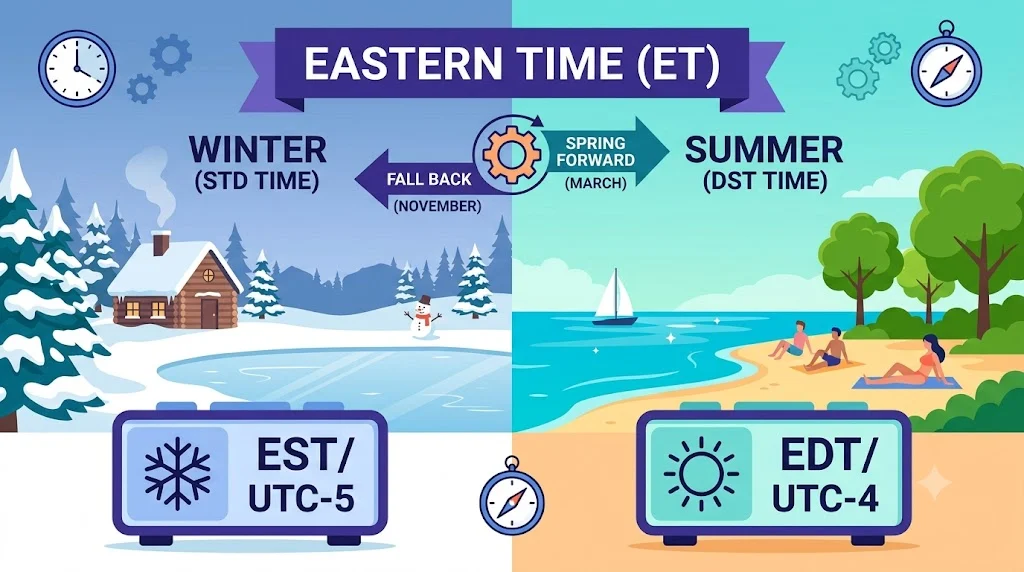
EST or ET refers to the distinction between Eastern Standard Time (EST) and Eastern Time (ET) in the United States and Canada. EST specifically denotes the fixed UTC-5 time offset used during autumn and winter months, while ET serves as an umbrella term that automatically encompasses both Eastern Standard Time (EST) and Eastern Daylight Time (EDT, UTC-4). Understanding when to use EST or ET prevents scheduling errors during seasonal daylight saving time shifts.
Scheduling global calls or setting meeting invitations often leads to confusion between EST or ET. Choosing the wrong acronym seems like a minor mistake. However, writing EST in the middle of summer can cause participants to miss calls by an entire hour. People frequently use these two abbreviations as if they mean the exact same thing.
Time zone abbreviations carry strict geographic and legal definitions. Eastern Standard Time represents a fixed UTC offset. Conversely, Eastern Time is an overarching time zone designation that adjusts for daylight saving time automatically. Misusing these abbreviations disrupts business operations, travel arrangements, and digital calendar synchronization.
This guide breaks down everything you need to know about EST or ET. You will discover how regional daylight saving laws alter these time designations. Furthermore, you will explore real-world scheduling scenarios, international conversions, and practical exercises. Following these rules ensures your professional communication remains clear and accurate throughout the entire calendar year.
Understanding the core distinction between EST or ET requires looking at how standard time and daylight saving time interact. The summary below highlights the fundamental differences between these designations.
- EST is a specific offset: EST stands strictly for Eastern Standard Time, which operates at UTC-5.
- ET is a general time zone: ET stands for Eastern Time, which shifts seasonally between EST (UTC-5) and EDT (UTC-4).
- Summer usage requires care: Writing EST during summer is technically inaccurate because the region operates on EDT (UTC-4).
- ET prevents confusion: Using ET in schedules allows participants to follow whatever local time offset currently applies in the Eastern region.
- Automated systems prefer ET: Calendar invites and global scheduling tools usually list ET to account for automatic daylight adjustments.
| Feature | Eastern Standard Time (EST) | Eastern Time (ET) |
| Type of Term | Specific time offset | Broad regional time zone |
| UTC Offset | UTC-5 | UTC-5 (Winter) or UTC-4 (Summer) |
| Active Months | November to March | All year round |
| Daylight Saving Adjustment | Fixed; does not adjust | Adjusts automatically |
| Recommended Usage | Specific winter scheduling | General year-round scheduling |
Definition and Fundamental Explanation
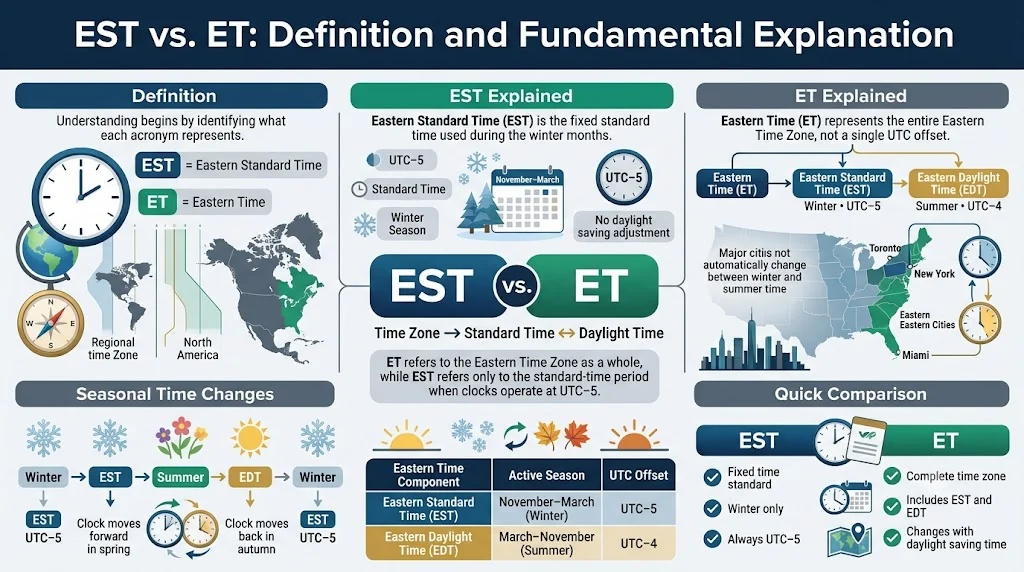
To master time zone accuracy, you must understand what each letter in these abbreviations represents. The acronym EST stands exclusively for Eastern Standard Time. Standard time represents the original, non-adjusted time baseline for the region. Because standard time remains fixed, EST always corresponds to Coordinated Universal Time minus five hours (UTC-5).
The acronym ET stands for Eastern Time. Rather than defining a static numerical offset, ET designates the geographical zone along the eastern coast of North America. Consequently, Eastern Time acts as a container that holds two distinct operational states throughout the year: Eastern Standard Time (EST) during the winter and Eastern Daylight Time (EDT) during the summer.
Because Eastern Time switches between offsets, using ET signals the current active clock time in cities like New York, Toronto, or Miami. When the clock shifts forward in spring, Eastern Time moves from UTC-5 to UTC-4. When the clock turns back in autumn, Eastern Time returns to UTC-5.
| Eastern Time Component | Active Season | UTC Offset |
| Eastern Standard Time (EST) | November to March (Winter) | UTC-5 |
| Eastern Daylight Time (EDT) | March to November (Summer) | UTC-4 |
Advantages and Disadvantages of Each Term
Using specific or general time zone terms offers distinct benefits depending on your audience and context. Analyzing these pros and cons clarifies when to choose EST or ET in daily writing.
Eastern Standard Time (EST) Advantages
Specifying EST provides precise mathematical clarity for technical logs and aviation records. Furthermore, using EST communicates an absolute UTC-5 offset that never changes regardless of the date.
Eastern Standard Time (EST) Disadvantages
Writing EST during summer creates ambiguity because local clocks operate on EDT (UTC-4). Additionally, international team members who calculate offsets literally may arrive one hour late for meetings.
Eastern Time (ET) Advantages
Using ET covers both standard and daylight saving periods naturally. Consequently, you avoid calculating whether a future meeting date falls inside or outside daylight saving time.
Eastern Time (ET) Disadvantages
Some automated software platforms require explicit numerical offsets rather than broad regional indicators like ET. Therefore, technical systems may demand exact UTC notation instead.
Seasonal Clock Changes and Daylight Saving Time
Daylight Saving Time (DST) directly impacts whether a region is using EST or EDT. In North America, the clock transition follows a predictable schedule established by federal regulations.
Springing forward occurs on the second Sunday in March. At 2:00 AM, local clocks shift forward to 3:00 AM. As a result, the Eastern region stops using EST (UTC-5) and begins using EDT (UTC-4). The entire territory remains on EDT through the spring, summer, and early autumn months.
Falling back happens on the first Sunday in November. At 2:00 AM, local clocks move back to 1:00 AM. Consequently, the region ends EDT and resumes EST (UTC-5) for the winter season.
| Season Transition | Date of Change | Clock Adjustment | Active Time Designation |
| Spring Transition | 2nd Sunday in March | Jump forward 1 hour (+1) | Enters EDT (UTC-4) |
| Autumn Transition | 1st Sunday in November | Fall back 1 hour (-1) | Returns to EST (UTC-5) |
Because of these mandatory shifts, using EST in July is technically incorrect. The region is actively observing EDT during July. Writing ET resolves this issue entirely because ET naturally covers EDT during summer months.
Regional and Global Usage Patterns
Different geographic areas within the Eastern time zone handle these abbreviations with varying levels of formality. Moreover, global team members interpret time designations based on their local customs.
North American Usage
In the United States and Canada, business professionals frequently write ET in email signatures and meeting invites. Because both countries observe identical daylight saving transitions, local workers adapt to time shifts seamlessly. However, regions like Jamaica and certain parts of Panama remain on EST year-round because they do not observe daylight saving time.
European and Asian Perspective
International partners rely heavily on exact numerical offsets. When a European counterpart sees EST, they calculate UTC-5. If you write EST in June when your local area is using UTC-4, European colleagues will add or subtract hours incorrectly. Using ET along with a city reference (e.g., “10:00 AM ET / New York time”) provides international readers with crucial context.
Real-World Examples and Scenarios
Examining concrete workplace scenarios demonstrates how choosing EST or ET affects real-life communications.
Scenario A: Winter Business Meeting (December)
You are scheduling a client presentation for December 15 at 2:00 PM in New York.
- Incorrect: 2:00 PM EDT (EDT is active only in spring/summer).
- Correct: 2:00 PM EST or 2:00 PM ET.
- Explanation: Since December falls during standard time, EST and ET are both accurate.
Scenario B: Summer Webinar (July)
You are hosting a global webinar on July 20 at 11:00 AM in Toronto.
- Incorrect: 11:00 AM EST (The region is on UTC-4, not UTC-5).
- Correct: 11:00 AM EDT or 11:00 AM ET.
- Explanation: Writing EST during July introduces a one-hour error. Using ET guarantees accuracy regardless of seasonal shifts.
Scenario C: Scheduling Across Months (October to November)
You are setting up a recurring weekly training session that begins on October 25 and runs through November 15.
- Best Choice: “Thursdays at 3:00 PM ET.”
- Explanation: Because the clock shift occurs in early November, using ET keeps the invite valid across the transition without requiring mid-series adjustments.
Common Mistakes and Corrections
People regularly make predictable errors when writing time zones. Correcting these habits improves professional communication instantly.
Mistake 1: Using EST as a Year-Round Catchall
Many individuals write EST on every invitation regardless of the month.
- Wrong: “Join our live product launch on July 10 at 4:00 PM EST.”
- Right: “Join our live product launch on July 10 at 4:00 PM ET (or EDT).”
Mistake 2: Mixing Up Standard and Daylight Acronyms
Writers sometimes combine standard and daylight terms into contradictory phrases.
- Wrong: “Eastern Standard Daylight Time (ESDT).”
- Right: Use either “Eastern Standard Time (EST)” or “Eastern Daylight Time (EDT).”
Mistake 3: Omitting the Time Zone Entirely
Sending times without any geographic reference forces recipients to guess your location.
- Wrong: “The meeting is at 3:00 PM.”
- Right: “The meeting is at 3:00 PM ET.”
Comparison of North American Time Zones
Understanding Eastern Time becomes easier when comparing it to adjacent North American time zones. The table below illustrates how standard and daylight variations function across the continent.
| Time Zone | Abbreviation (Standard) | Standard Offset | Abbreviation (Daylight) | Daylight Offset | Major Cities Included |
| Eastern | EST | UTC-5 | EDT | UTC-4 | New York, Toronto, Miami |
| Central | CST | UTC-6 | CDT | UTC-5 | Chicago, Dallas, Winnipeg |
| Mountain | MST | UTC-7 | MDT | UTC-6 | Denver, Calgary, Phoenix* |
| Pacific | PST | UTC-8 | PDT | UTC-7 | Los Angeles, Vancouver, Seattle |
*Note: Most of Arizona remains on MST year-round and does not observe daylight saving time.
Advanced Time Zone Concepts and Automation
Modern digital systems handle time zone calculations differently than human writers. Software applications store timestamps in Universal Coordinated Time (UTC) rather than localized strings like EST or ET.
When you create a calendar event in modern applications, the system converts your selected local time into a UTC timestamp. Subsequently, when a colleague opens that invitation in London or Tokyo, the application translates the UTC timestamp into their local time zone automatically.
| Scheduling Step | Action / Translation | Time Format Example |
| 1. User Entry | Sender schedules local time in Eastern Zone | “2:00 PM ET” on July 10 |
| 2. System Processing | Software translates time to UTC baseline | 18:00 UTC (Universal Time) |
| 3. Recipient View | Calendar converts UTC to viewer’s local clock | 7:00 PM BST (London) |
However, text-based communications like plain text emails or PDFs lack automatic translation features. Therefore, human readers must calculate offsets manually. Writing ET explicitly signals to readers that they should check their current local offset relative to Eastern North America.
Related Concepts and Time Zone Comparisons
Understanding EST or ET requires comparing these terms to other primary global time markers.
Coordinated Universal Time (UTC)
UTC serves as the primary time standard by which the world regulates clocks. Neither EST nor ET alters UTC. Instead, local time zones express their offsets as additions or subtractions from UTC.
Greenwich Mean Time (GMT)
GMT represents the historical time zone baseline centered on Greenwich, London. Although GMT shares the same current time as UTC during winter, UTC remains the official scientific standard for computing offsets.
Central Time (CT) and Pacific Time (PT)
Just like ET, terms such as CT (Central Time) and PT (Pacific Time) function as general umbrella indicators for their respective geographical regions. Using CT or PT avoids specific seasonal mistakes within those zones as well.
Practical Exercises with Answers
Test your understanding of EST or ET by completing these practical exercises. Review your choices against the detailed answers provided below.
Exercise 1: Identify the Correct Term
Choose the most accurate term (EST, EDT, or ET) for each scenario listed below:
- A conference scheduled in New York City on January 15.
- A live stream broadcasting from Toronto on August 22.
- A recurring monthly meeting that runs continuously from January through December.
- An international contract specifying a static UTC-5 execution deadline.
Exercise 2: Correct the Errors
Rewrite these sentences to ensure professional accuracy:
- “Our team will host a summer workshop on June 14 at 2:00 PM EST.”
- “Please submit your reports by 5:00 PM Eastern Standard Daylight Time.”
- “The call is set for November 20 at 10:00 AM EDT.”
Answers and Explanations
Exercise 1 Answers
- EST or ET: January falls within standard time, making EST or ET equally correct.
- EDT or ET: August falls within daylight saving time, so EDT or ET must be used.
- ET: Using ET accommodates both seasonal transitions automatically without requiring text edits.
- EST: Contracts requiring a fixed UTC-5 offset must state EST explicitly.
Exercise 2 Answers
- “Our team will host a summer workshop on June 14 at 2:00 PM ET (or EDT).” (Correction: June operates on daylight time, not standard time).
- “Please submit your reports by 5:00 PM ET.” (Correction: Removed redundant non-existent term).
- “The call is set for November 20 at 10:00 AM EST (or ET).” (Correction: November operates on standard time, not daylight time).
Frequently Asked Questions
What is the primary difference between EST or ET?
EST refers strictly to Eastern Standard Time (UTC-5), which is used during winter. ET stands for Eastern Time, an umbrella term that includes both EST in winter and EDT (UTC-4) in summer.
Is it wrong to write EST during the summer?
Yes, writing EST during summer is technically inaccurate because Eastern North America operates on Eastern Daylight Time (EDT, UTC-4) from March to November.
What does ET stand for in time zones?
ET stands for Eastern Time. It covers the geographic area along the east coast of North America and shifts seasonally between standard and daylight saving time.
Which abbreviation should I use in email signatures?
Using ET is recommended for email signatures because it remains accurate all year long without requiring seasonal adjustments.
What UTC offset corresponds to EST?
EST corresponds strictly to UTC-5. During daylight saving time, the offset shifts to UTC-4, which is designated as EDT.
Does Eastern Time change automatically in digital calendars?
Yes, modern calendar applications adjust for daylight saving changes automatically when you select Eastern Time (ET) as your primary zone.
Why do some Caribbean countries stay on EST all year?
Certain nations, such as Jamaica, do not observe daylight saving time. Consequently, they remain on UTC-5 (EST) throughout the entire year.
How do I write Eastern Time in formal business documents?
Write ET for general references, or explicitly state EST/EDT depending on the specific date of the event. Alternatively, include the UTC offset for total clarity.
What is the relationship between EDT and ET?
EDT (Eastern Daylight Time) represents the summer phase of Eastern Time (ET). ET encompasses both EDT during summer and EST during winter.
Should I include city references when scheduling internationally?
Yes, adding a major city reference such as “10:00 AM ET (New York Time)” eliminates ambiguity for international participants calculating offsets manually.
Conclusion
Understanding the distinction between EST or ET is essential for accurate scheduling and professional communication. EST represents a fixed time offset of UTC-5 that applies exclusively during the winter months. In contrast, ET serves as an overarching time zone designation that encompasses both Eastern Standard Time (EST) and Eastern Daylight Time (EDT) throughout the year.
Misusing these terms during seasonal shifts creates unnecessary confusion and leads to missed meetings. Using EST during the summer months introduces a one-hour offset error for colleagues calculating times manually. Choosing ET avoids this issue completely by adapting to whichever seasonal clock setting currently applies in North America.
To maintain professional standards, default to ET for recurring schedules, email signatures, and year-round business communications. Reserve EST specifically for winter dates or technical documentation requiring a fixed UTC-5 offset. Following these practical guidelines ensures your schedules remain clear, professional, and accurate every month of the year.

Jack Murphy is a language writer with a passion for word meanings, synonyms, and effective communication. He creates informative and easy to understand content to help readers enhance their vocabulary and language skills.









3 thoughts on “EST or ET| Differences, Time Zones and Formatting Guide”