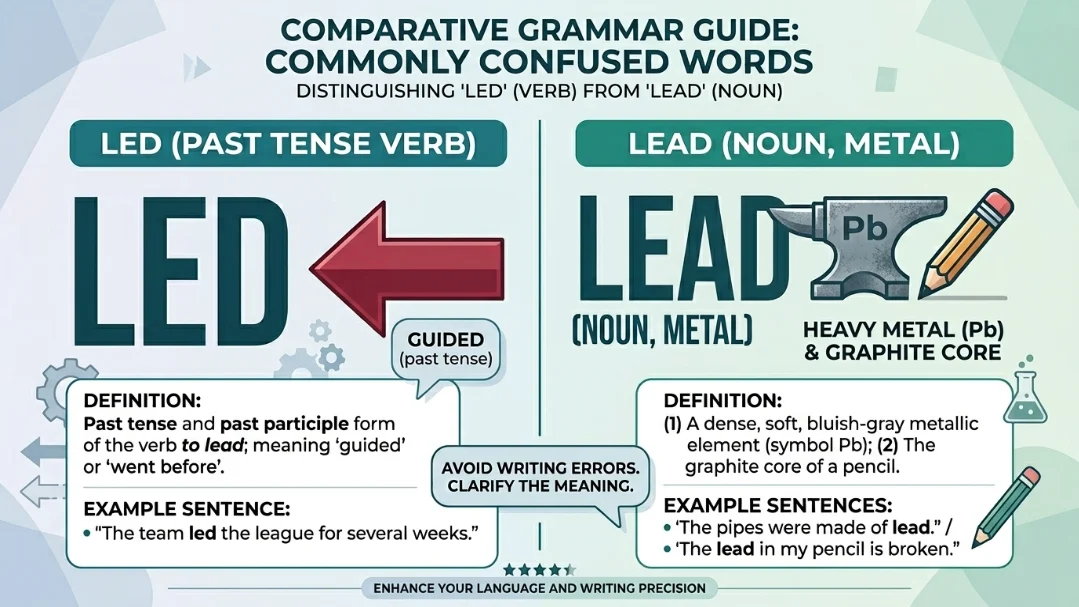
The word led is exclusively the past tense and past participle form of the verb “to lead,” meaning to guide or direct. In contrast, lead can function as a noun for a heavy metallic element, a present-tense verb meaning to guide, or a noun meaning the front position. Therefore, if you are writing about a past event where someone guided a group, the correct spelling is always led.
Choosing between led or lead remains one of the most frequent grammar traps for writers, students, and professionals alike. Because these words sound identical in certain contexts, spell checkers often overlook the error entirely. Consequently, a small slip can quickly undermine the professionalism of your emails, essays, or reports. Understanding this distinction is vital because it directly impacts the clarity and credibility of your written communication.
The primary confusion stems from the heavy metal substance. We pronounce the metallic noun exactly like the past tense verb, yet we spell them differently. Meanwhile, the present tense verb looks identical to the metallic noun but sounds entirely distinct. This overlapping web of homophones and homographs naturally creates confusion for anyone trying to master English grammar.
Fortunately, you can easily conquer this linguistic hurdle by learning a few core rules. This comprehensive guide will break down the definitions, pronunciation tricks, and structural rules behind both terms. By exploring real-world examples, comparative tables, and practical exercises, you will permanently eliminate this common mistake from your writing vocabulary.
Key Takeaway and Summary
If you only remember one rule from this article, let it be this core grammatical fact: led is the past tense of the verb “to lead.” The word lead wears many hats, but it never serves as the past tense form of a guiding action.
To keep them straight, look at this quick summary of their behaviors:
- Use led when the action of guiding, directing, or influencing occurred in the past.
- Use lead as a present-tense action to show guidance happening right now or in the future.
- Use lead as a noun when referring to the heavy metal material, a graphite pencil core, or a primary position in a race.
Definition and Explanation of Led
To master these terms, we must examine their individual definitions and grammatical classifications. Let us begin with the less complex of the two words.
The Past Tense Verb
The word led serves a single, dedicated purpose in the English language. It functions as the past tense and past participle form of the verb “to lead.” Whenever an individual, an idea, or a path provided direction in a time before the present, this spelling is the mandatory choice.
Historically, this word evolved to maintain a distinct spelling that reflects its short vowel sound. Because it stands alone as a past-tense marker, it never functions as a noun or an adjective. Whenever you can substitute the phrase “guided” or “directed” into a past-tense sentence, the spelling must be l-e-d.
Grammatical Functions of Led
Within sentences, this word acts cleanly as an action that has already concluded. It links subjects to their historical destinations or outcomes seamlessly.
Subject + Led + Object / Prepositional Phrase
For instance, a captain led the team to victory last season. In this scenario, the action wrapped up in the past, making the three-letter spelling structurally correct.
Definition and Explanation of Lead
Unlike its past-tense counterpart, the word lead is a homograph, which means it has multiple meanings and pronunciations wrapped into one spelling. It shifts its identity based entirely on its surrounding context.
The Present Tense Verb
When pronounced with a long “ee” sound, lead functions as a present, future, or habitual verb. It describes the act of guiding, conducting, directing, or commanding a group or process.
You use this form when an action is ongoing, universal, or scheduled for a later date. For example, managers lead their teams through daily operations. Here, the action represents a recurring, present-day responsibility.
The Heavy Metal Noun
When pronounced with a short “e” sound, lead transforms into a noun representing the chemical element with the atomic number 82. This dense, malleable metal appears frequently in historical contexts, industrial manufacturing, and plumbing discussions.
Note: The protective material found in X-ray aprons and old pipes is spelled "lead," even though it sounds identical to "led."
The Pencil Graphite Noun
Additionally, we use this same spelling to describe the writing core of a pencil. Although modern pencils actually utilize non-toxic graphite mixed with clay, the historical name remains deeply embedded in our daily vocabulary. Therefore, when your pencil point snaps, you state that you need more lead.
The Position of Leadership or Advantage
Finally, this word can designate a frontrunner position or a primary clue in an investigation. A runner can hold the lead in a marathon, just as a detective can follow a promising lead to solve a complex mystery. In these instances, the word functions as a noun but retains the long “ee” pronunciation.
Pronunciation Differences
The overlapping sounds of these words cause the vast majority of spelling errors. Mastering the pronunciation patterns will immediately clear up your writing choices.
The Long E Sound
When you mean to guide in the present tense, or when you refer to a winning position, use the long “ee” sound. It rhymes perfectly with words like bead, read (present tense), seed, and feed. Whenever your voice creates this long, stretching vowel sound, the correct spelling is always lead.
The Short E Sound
Conversely, the short “e” sound rhymes with words like bed, red, fed, and shed. This phonetic neighborhood is where the spelling trap springs open.
Both the past tense of the guiding verb and the heavy metallic noun share this identical short vowel sound. To separate them in your mind, remember that the metal retains the four-letter spelling, while the past-tense action drops down to three letters.
Visual Comparison Table
To help you visualize these differences at a single glance, this table organizes the pronunciations, parts of speech, and core meanings side by side.
| Led | Verb (Past Tense) | Short “e” (Rhymes with red) | Guided or directed in the past |
| Lead | Verb (Present Tense) | Long “ee” (Rhymes with bead) | Guiding or directing right now |
| Lead | Noun (Metal) | Short “e” (Rhymes with red) | Dense, heavy metallic element |
| Lead | Noun (Graphite) | Short “e” (Rhymes with red) | The writing material inside a pencil |
| Lead | Noun (Front Position) | Long “ee” (Rhymes with bead) | First place or a helpful clue |
Advantages and Disadvantages of Usage Forms
Understanding the specific roles of led or lead allows writers to unlock distinct stylistic advantages while avoiding critical errors. Each form carries unique implications for document clarity.
Using the Past Tense Form
- Advantages: This spelling provides absolute, unambiguous clarity to your reader. Because it only possesses one definition, anyone reading your work knows instantly that you are describing a completed historical action. It eliminates reading drag and speeds up comprehension.
- Disadvantages: It offers zero grammatical flexibility. If you accidentally apply it to a present-tense scenario or a physical substance, the sentence collapses into nonsense.
Using the Multi-Meaning Form
- Advantages: This spelling offers incredible versatility across multiple industries. It serves technical manufacturing texts, sports journalism, and management handbooks with equal effectiveness.
- Disadvantages: It introduces a high risk of phonetic confusion. Because the reader must rely on contextual clues to determine the correct pronunciation and meaning, poorly constructed sentences can force readers to stop and re-read the line.
Real-World Examples
Analyzing these words inside complete sentences will help solidify your understanding of their contextual behavior.
Sentences Using Led
- The seasoned tour guide led the anxious hikers through the dark canyon safely.
- Historical evidence demonstrates that the economic crisis led to major policy overhauls.
- She led the research department for over a decade before retiring last spring.
- An unexpected mechanical failure led the pilots to request an emergency landing.
Sentences Using Lead as a Verb
- Effective executives must lead their organizations with transparency and empathy.
- We believe this innovative strategy will lead our business to higher profitability next year.
- Signs posted along the main highway lead travelers directly to the historical museum.
- Does this narrow dirt pathway lead back to the main campground?
Sentences Using Lead as a Noun
- Construction crews wore specialized masks to safely remove old lead paint from the school.
- The local detective caught a lucky break when a new witness provided a critical lead.
- Our star athlete sprinted ahead during the final lap to take the lead in the race.
- Please check if your mechanical pencil has enough lead before the exam begins.
Comprehensive Industry Comparison
To illustrate how these terms manifest in daily technical work, let us review how different professional sectors deploy led or lead within their specialized fields.
The Corporate and Management Sector
In business writing, leadership communication demands absolute precision. Executives use the present tense when outlining forward-looking visions or corporate strategies.
“We must lead the market in sustainability initiatives throughout the upcoming fiscal year.”
Conversely, quarterly reports looking back at performance must switch to the past tense exclusively.
“The marketing director led a successful campaign that increased sales by twenty percent.”
The Industrial and Engineering Sector
Engineers and environmental safety officers frequently encounter the metallic noun during structural assessments. They must monitor old infrastructure for chemical contamination risks.
“The safety inspector confirmed that the old water pipes contained dangerous levels of lead.”
If the team successfully resolves the issue, the project manager will document the action using the past tense.
“The engineering team led the remediation project and successfully replaced the entire plumbing system.”
Regional and Global Usage Trends
While English spellings often diverge sharply between American and British dialects, the rules governing led or lead remain remarkably consistent worldwide.
Global Standardization
Unlike variations like color versus colour, both major branches of global English agree entirely on these definitions. Writers in London, Sydney, New York, and Toronto all utilize the three-letter spelling for the past tense of the guiding verb.
The Misconception of Regional Variations
Occasionally, writers mistakenly believe that using the four-letter spelling for the past tense is an acceptable British or Australian variant. This assumption is completely false.
Across all global publication standards, using the four-letter spelling for a past-tense action is classified as an outright spelling error. The uniformity of this rule means that mastering it will protect your writing across international borders.
Common Mistakes and Corrections
Examining common blunders is an excellent way to prevent your own writing from slipping up. Review these typical errors to see how easily they can be corrected.
The Read and Lead Analogy Trap
The single biggest cause of this spelling error is an incorrect grammatical analogy involving the verb “to read.” Look at how that specific word behaves:
- Present Tense: I read the book every day. (Pronounced with a long “ee” sound).
- Past Tense: I read the book yesterday. (Pronounced with a short “e” sound).
Because “read” keeps its exact same spelling in the past tense while changing its pronunciation, writers assume that “lead” behaves the identical way. They write, “She lead the meeting yesterday,” believing they are following a valid pattern.
Incorrect Analogy:
Read (Present) -> Read (Past)
Lead (Present) -> Lead (Past) <--- This is an error! The past tense must be written as "led."
To break this bad habit, you must treat the verb of guidance as a completely separate entity that demands a total spelling transformation in the past tense.
Incorrect Sentences and Explanations
- Incorrect: The project manager lead the daily briefing yesterday morning.
- Correction: The project manager led the daily briefing yesterday morning.
- Explanation: Because the briefing occurred in the past, the sentence requires the past-tense verb spelling.
- Incorrect: Consuming water from contaminated led pipes poses severe health risks.
- Correction: Consuming water from contaminated lead pipes poses severe health risks.
- Explanation: The sentence refers to the physical metallic chemical element, which mandates the four-letter noun spelling.
- Incorrect: These continuous mistakes will led to project delays.
- Correction: These continuous mistakes will lead to project delays.
- Explanation: The helper word “will” signals a future action, which requires the base present-tense verb form.
Exercises with Answers
Put your newly acquired knowledge to the test with these practical exercises. Complete the sentences by choosing the correct option, then review the answers below to check your work.
Fill-in-the-Blank Questions
- Yesterday, the general safely __________ (led / lead) his troops across the treacherous river.
- Exposure to heavy metals like __________ (led / lead) can cause severe neurological damage in young children.
- If you want to succeed in this competitive market, you must __________ (led / lead) by example.
- She realized her mechanical pencil was completely out of __________ (led / lead) right before the test started.
- The clues eventually __________ (led / lead) the researchers to a groundbreaking scientific discovery.
- Who will __________ (led / lead) the upcoming seminar while the director is away on vacation?
- Our local team held a commanding __________ (led / lead) during the first half of the championship game.
- The path that we followed last weekend __________ (led / lead) us straight to a beautiful hidden waterfall.
- Engineers often use __________ (led / lead) lining to shield sensitive electronic equipment from radiation.
- His poor financial decisions ultimately __________ (led / lead) to the bankruptcy of the family business.
Answer Key and Explanations
- led — The word “yesterday” clearly indicates a past action, requiring the past-tense verb form.
- lead — This context refers directly to the toxic metallic element, which requires the noun spelling.
- lead — The phrase “must lead” indicates a present or future obligation, requiring the base verb form.
- lead — This sentence refers to the physical writing material inside a pencil, which uses the noun form.
- led — The word “eventually” points to an action that already concluded in the past, requiring the past-tense spelling.
- lead — The helper phrase “will lead” signals a future action, which demands the present-tense verb spelling.
- lead — The phrase refers to holding the primary position in a game, which requires the long-vowel noun form.
- led — The phrase “last weekend” places the action firmly in the past, requiring the past-tense verb.
- lead — This refers to the dense physical metal used for protective shielding, requiring the noun form.
- led — The word “ultimately” describes a historical outcome that has already materialized, requiring the past-tense verb.
Related Concepts and Comparisons
To deepen your mastery of led or lead, it helps to look at adjacent grammatical concepts, acronyms, and homophones that populate the same linguistic space.
The LED Electronic Acronym
Writers occasionally confuse the past-tense verb with the capitalized acronym LED, which stands for Light-Emitting Diode. This term refers to a highly efficient semiconductor light source used in modern light bulbs, television screens, and digital displays.
Acronym Breakdown:
L = Light
E = Emitting
D = Diode
When you write about technology or home lighting, always capitalize all three letters to show that you are using an acronym. For example, you might write that you replaced your old incandescent bulbs with energy-saving LED models. This formatting prevents readers from confusing your light fixtures with past-tense actions.
Homophones and Homographs
Understanding the broader linguistic category of these words can help demystify their behavior. The relationship between these terms involves two distinct concepts:
- Homophones: Words that sound identical but possess completely different spellings and meanings. The past-tense verb led and the metallic noun lead are perfect homophones.
- Homographs: Words that share an identical spelling but differ in meaning, origin, and sometimes pronunciation. The present-tense verb lead (to guide) and the noun lead (the heavy metal) are classic homographs.
By recognizing that these words sit at the intersection of both categories, you can see why they create a perfect storm for spelling errors.
Frequently Asked Questions
Is it past tense led or lead?
The correct past tense of the verb to lead is always spelled led. Writing the four-letter version for a past action is an error across all standard English dialects.
What is the chemical definition of lead?
In chemistry, lead is a heavy, soft, malleable bluish-white metallic element. It possesses the atomic number 82 and the chemical symbol Pb, which stems from its Latin name, plumbum.
Why do people spell the past tense of lead as lead?
People make this error because they follow the pattern of the verb to read. Since read is spelled the same way in both present and past tense, writers assume lead behaves identically, which is incorrect.
How do you spell the material inside a pencil?
The material inside a pencil is spelled lead, even though it actually consists of non-toxic graphite and clay rather than the actual chemical metal.
Is led short for something else?
The lowercase word led is not short for anything; it is a full, standard past-tense verb. However, the capitalized acronym LED stands for Light-Emitting Diode.
Can lead be used as an adjective?
Yes, lead can function as an adjective when it describes a primary or foremost position, such as a lead singer in a rock band or a lead researcher on a medical project.
What is a simple trick to remember the difference?
Think of the color red. Both red and led are spelled with three letters and share a short “e” sound. If you guided a group in the past, you led them, rhyming with red.
Is leaded paint spelled with an a?
Yes, because toxic old-fashioned paint contains the heavy chemical metal, it retains the four-letter base spelling and is written as leaded paint.
Can you use led in future tense sentences?
No, you cannot use led for future actions. Future actions require the helper word “will” followed by the present tense form, as seen in the phrase “she will lead the project.”
What does it mean to follow a lead?
In journalism or criminal investigations, following a lead means pursuing a valuable piece of information, a clue, or a potential source that might uncover the truth.
Conclusion
Mastering the difference between led or lead is a major milestone in developing clear, professional writing habits. Although their overlapping pronunciations and spellings create natural confusion, the underlying grammatical rules are remarkably straightforward.
Always remember that led serves exclusively as the past tense of the guiding verb, while lead handles present-tense actions, physical metals, and primary positions.
By keeping the three-letter rhyme with the color red in mind, you can instantly verify your past-tense sentences before publishing your work. Consistently applying these distinctions will elevate the polish of your prose, protect your professional credibility, and ensure that your readers focus entirely on your ideas rather than your typos.
We highly recommend bookmarking this guide or reviewing the summary table whenever you tackle your next major writing project.