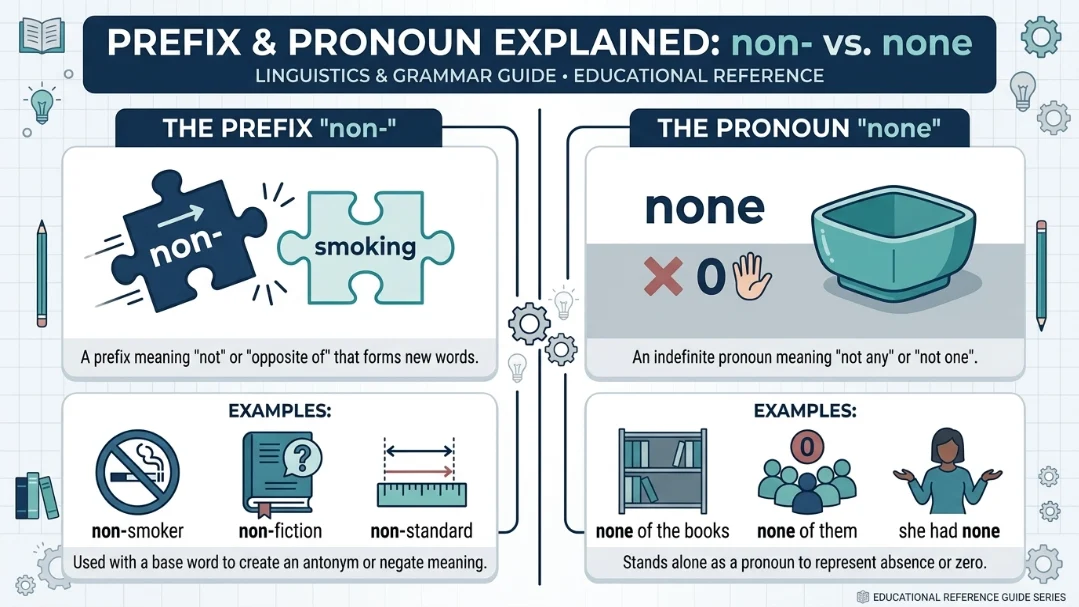
The main difference between non and none lies in their grammatical function. The term non- acts as a prefix meaning “not” or “the opposite of” and must attach directly to a noun, adjective, or adverb. Conversely, none functions as a standalone pronoun meaning “not any” or “no one,” replacing a noun entirely within a sentence.
Choosing between non or none can puzzle even experienced writers during the drafting process. Because both words convey a sense of negation or absence, people frequently mix them up in everyday sentences. This common linguistic confusion complicates professional communication, business reporting, and academic publication. Therefore, mastering the distinction between these two linguistic terms remains vital for clear writing.
Understanding how to deploy each word correctly will immediately elevate the quality of your prose. While one element requires a companion word to make sense, the other operates independently as a subject or object. This structural divide alters how sentences function and how readers interpret your message. Consequently, analyzing their specific rules ensures your communication remains polished, authoritative, and completely professional.
This comprehensive guide will examine everything you need to know about non or none. We will break down definitions, structural patterns, and real-world industrial scenarios. Furthermore, interactive exercises and clear answers will help lock in your understanding. Let us begin by reviewing the fundamental core principles of these essential vocabulary components.
If you need a rapid structural reference, remembering their distinct grammatical identities will solve most issues. The element non- cannot stand alone because it relies entirely on a base word. On the other hand, none serves as a complete pronoun that takes the place of a missing noun phrase.
| Grammatical Part | Prefix (Bound Morpheme) | Pronoun (Standalone) |
| Core Definition | Not; opposite of; lacking | Not any; zero amount; no one |
| Hyphen Use | Frequently used with hyphens | Never used with hyphens |
| Sentence Position | Attached to the front of a word | Functions as a subject or object |
| Independence | Cannot exist as a separate word | Exists independently in sentences |
Definition and Explanation of Non
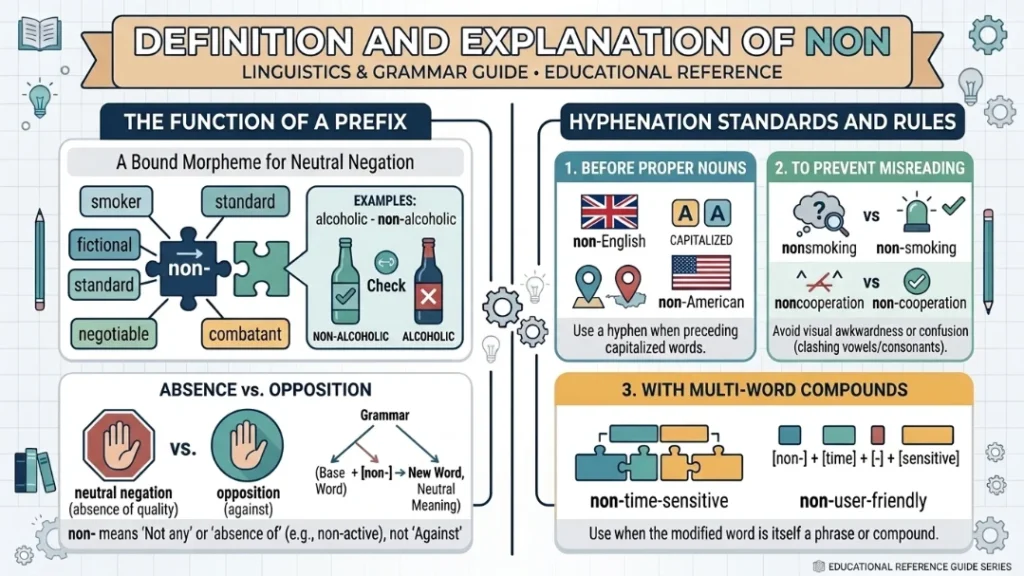
To grasp the mechanics of non, you must analyze how prefixes alter the DNA of standard words. Grammatically, this element constitutes a bound morpheme, meaning it only creates meaning when attached to an existing base term.
The Function of a Prefix
When you add this prefix to a word, you instantly invert its definition. It creates a neutral negative statement, indicating the complete absence of a quality rather than an active opposition. For example, something that is non-alcoholic simply contains zero alcohol, which differs from something actively fighting against alcohol.
Hyphenation Standards and Rules
Writers frequently debate whether to include a hyphen when utilizing this prefix. While modern style guides prefer closed compounds, certain conditions require a hyphen for clarity.
- Before Proper Nouns: You must always insert a hyphen if the base word begins with a capital letter, such as non-English or non-American.
- To Prevent Misreading: If omitting the hyphen creates an awkward visual layout or a confusing word blend, keep the hyphen intact.
- With Multi-word Compounds: When modifying an entire phrase, the hyphen helps maintain structural unity, as seen in non-time-sensitive data.
Ultimately, this prefix serves as an efficient modifier that strips away specific attributes from nouns and adjectives.
Definition and Explanation of None
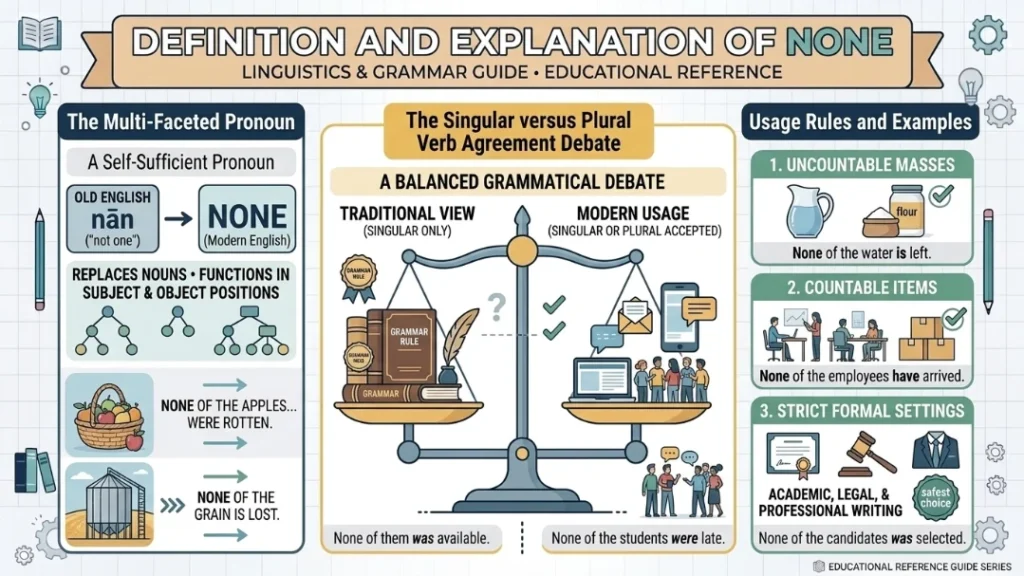
Shifting our focus to none reveals a completely self-sufficient component of speech. As a pronoun, this word tracks its history back to the Old English term nān, which literally translated to “not one.”
The Multi-Faceted Pronoun
Because this word replaces nouns, it routinely answers questions concerning quantity or availability. It functions perfectly well when responding to inquiries about both countable items and uncountable masses. Furthermore, it easily occupies the subject position at the start of a sentence or the object position at the end.
The Singular versus Plural Verb Agreement Debate
One of the most complex issues surrounding this pronoun involves verb agreement. Because the word implies “not one,” traditional grammarians argue that it must always take a singular verb. However, modern usage accepts both singular and plural verbs depending on the context of the prepositional phrase.
- Uncountable Masses: If the pronoun refers to a mass noun, you must use a singular verb. For instance, you should write, “None of the water is left.”
- Countable Items: When the pronoun references a plural countable noun, a plural verb often sounds more natural in casual settings. An example includes, “None of the employees have arrived.”
- Strict Formal Settings: In high-level academic or legal writing, sticking to the singular verb remains the safest approach to maintain absolute traditional correctness.
Advantages and Disadvantages of Each Form
Selecting the ideal linguistic tool impacts how efficiently your audience processes structural information. Let us examine the specific benefits and drawbacks associated with using non or none.
Advantages of the Prefix Non
Utilizing this prefix allows you to streamline your sentences by removing unnecessary words. Instead of writing “a system that does not profit,” you can elegantly write “a non-profit system.” This consolidation creates compact, punchy sentences that improve readability. Additionally, it helps form standardized industry terminology that professionals recognize instantly.
Disadvantages of the Prefix Non
Overusing this prefix can lead to dry, robotic prose that lacks emotional nuance. If you stack too many prefixed words together, your text becomes dense and difficult to read. Furthermore, misapplying hyphens can distract readers, slowing their reading speed and harming user experience metrics on digital platforms.
Advantages of the Pronoun None
Deploying this pronoun gives you a direct, powerful method for stating total absence. It eliminates ambiguity regarding amounts by confirming a value of absolute zero. Because it can handle both singular and plural contexts, it offers immense structural flexibility across various types of descriptive sentences.
Disadvantages of the Pronoun None
The primary drawback stems from the verb agreement confusion it introduces for writers. Spending too much time debating whether to use a singular or plural verb can slow down your editing process. Moreover, placing it incorrectly within a complex sentence can create vague references, leaving readers unsure of which noun you are replacing.
Real-World Examples in Professional Sectors
To fully understand these words, we should examine how they perform in distinct corporate environments. These scenarios highlight the practical value of maintaining proper grammar standards.
Technology and Data Management
In software engineering, technical teams manage system states and data structures.
“The administrator verified that none of the database backups contained corrupted files during the audit.”
In this technical instance, the pronoun stands in for the plural countable noun “backups.”
“Developers prefer using non-blocking input-output operations to maximize the performance of web servers.”
Here, the prefix transforms the action word “blocking” into a specific structural adjective.
Corporate Legal Compliance
Legal departments write binding agreements that require absolute linguistic precision.
“The contract explicitly states that none of the signees can disclose proprietary information to outside entities.”
The pronoun ensures that every individual member faces the exact same restriction.
“Both corporations signed a binding non-disclosure agreement prior to discussing the potential corporate merger.”
The prefixed adjective clarifies the precise nature of the confidentiality document.
Financial Reporting and Analytics
Financial analysts track assets, revenue streams, and investment portfolios using precise terminology.
“The quarterly review confirmed that none of the venture capital had been allocated to risky assets.”
The pronoun smoothly modifies the mass noun “capital,” requiring the singular helping verb “had been.”
“The accounting team separated regular revenue from non-operating income to clarify the core performance metrics.”
This prefix creates a clear category distinction that guides strategic corporate planning.
Regional and Global Usage Patterns
While the core rules of grammar remain stable, minor variations appear when we look at international English standards. Understanding these shifts helps you write effectively for global audiences.
The Evolution of Hyphenation Trends
American English and British English handle hyphenation differently when dealing with prefixes. American style guides, such as the Chicago Manual of Style, encourage writers to remove hyphens whenever possible. Consequently, words like “nonprofit” or “nonessential” appear as single, solid words in American publications.
Conversely, British publications, following style guides like Oxford, retain hyphens far more frequently. You will routinely see “non-profit” and “non-essential” across media outlets in the United Kingdom. Despite these stylistic variations regarding punctuation, the foundational definition of the prefix remains identical globally.
Cross-Cultural Interpretation of Negation
For international audiences speaking English as a second language, the word none can occasionally trigger double-negation errors. Because some languages use two negative words for emphasis, learners might pair it with a negative verb. Writers must avoid these confusing patterns to keep global documentation accessible and clear.
Common Mistakes and How to Avoid Them
Errors involving non or none generally stem from structural confusion rather than vocabulary issues. Recognizing these structural missteps will save you time during editing.
The Standalone Prefix Error
A frequent mistake involves trying to use the prefix as an independent word within a sentence. Because it lacks independent meaning, it cannot sit by itself without a base word.
- Incorrect: The results of the laboratory experiment were completely non.
- Correct: The results of the laboratory experiment were completely non-conclusive.
The Missing Preposition Mistake
When using the pronoun to modify a specific noun phrase, writers sometimes omit the necessary preposition “of.” Without this connector, the sentence structure collapses.
- Incorrect: None the strategies succeeded during the market downturn.
- Correct: None of the strategies succeeded during the market downturn.
The Double Negative Trap
Pairing either of these negative terms with an additional negative word like “not” or “never” creates a logical contradiction. The two negatives cancel each other out, reversing your intended meaning.
- Incorrect: We did not find none of the missing office keys.
- Correct: We found none of the missing office keys.
Interactive Exercises for Practice
Test your understanding of these grammatical elements by choosing the correct word to fill the blanks in the sentences below.
- The factory implemented a strictly __________-hazardous manufacturing process last month. (non / none)
- __________ of the applicants met the rigorous technical requirements for the engineering role. (Non / None)
- The customer service representative requested a __________-refundable deposit for the venue booking. (non / none)
- When the system crashed, __________ of the active user sessions were saved to the hard drive. (non / none)
- The research team focused their study on __________-verbal communication patterns in primates. (non / none)
Answers to Exercises
Review the correct answers below to evaluate your performance and identify areas that may need additional study.
- non (It acts as a prefix modifying the adjective “hazardous”)
- None (It serves as a standalone pronoun replacing the subject noun phrase)
- non (It functions as an attached prefix creating the compound adjective “non-refundable”)
- none (It operates as a pronoun indicating zero quantity of the sessions)
- non (It attaches to the adjective “verbal” to indicate the absence of speech)
If you answered all five questions correctly, you understand the core structural boundaries that separate these two vocabulary words.
Related Concepts and Comparisons
To fully master negation in English, it helps to compare our focus words with other similar prefixes and pronouns. This section explores how these terms stack up against common alternatives.
Non- vs. Un- vs. In-
English features several negative prefixes, each carrying unique semantic shades. The prefix non- remains strictly objective and denotes a simple absence. In contrast, un- often implies an active reversal or an opposite state, as seen in “unhappy.” The prefix in- (or “im-“) typically denotes an inherent inability, such as “impossible.”
None vs. Nothing vs. No One
These pronouns differ based on the specific types of nouns they replace. While none can represent both people and physical objects, nothing applies exclusively to inanimate things or concepts. Similarly, no one focuses entirely on human beings.
| Non- | Prefix | Objective absence | Non-toxic |
| Un- | Prefix | Opposite condition | Unkind |
| None | Pronoun | Zero items or mass | None survived |
| Nothing | Pronoun | Zero inanimate things | Nothing changed |
Frequently Asked Questions
Can non be used as a standalone noun in casual speech?
No, it cannot function as a standalone noun in standard grammar. It must always attach to a base word as a prefix to form a complete concept.
Is it ever correct to write none of the less?
No, that is an incorrect spelling of the transition phrase “nonetheless.” You must write it as a single word without spaces to function as an adverb meaning “nevertheless.
How do I determine if none should take a singular or plural verb?
Look closely at the noun following the preposition “of.” If the noun is uncountable, choose a singular verb. If the noun is plural and countable, you can use a plural verb.
Should I use a hyphen after non when writing for an American company?
American style guides generally recommend dropping the hyphen for standard words like “nonprofit.” However, you must retain the hyphen if the base word starts with a capital letter.
What is the difference between non-cooperation and no cooperation?
The term non-cooperation acts as a formal noun describing a specific stance or movement. Conversely, “no cooperation” is a standard phrase indicating a total absence of assistance.
Can none refer to a single person?
Yes, historically it meant “not one person.” In modern contexts, it regularly describes both singular individuals and larger groups depending on the sentence layout.
Why does my word processor flag non profit as an error?
Your word processor flags it because it lacks structural unity. You must either connect them with a hyphen or merge them into a single word to make it correct.
Is none considered a negative adverb?
No, it primarily functions as a pronoun. However, it can occasionally serve as an adverb to modify adjectives, as seen in the phrase “none the wiser.”
Conclusion
Understanding when to use non or none is a straightforward way to polish your writing. The element non- works as a helpful prefix that modifies nouns and adjectives to show an objective absence. On the other hand, none operates independently as a pronoun to represent a value of absolute zero.
By keeping these structural roles clear, you can avoid common errors like double negatives and awkward sentence layouts. These corrections make your business reports, emails, and web articles much easier to read. Always check your work for these specific terms during your final proofread to ensure your text remains accurate and clear.