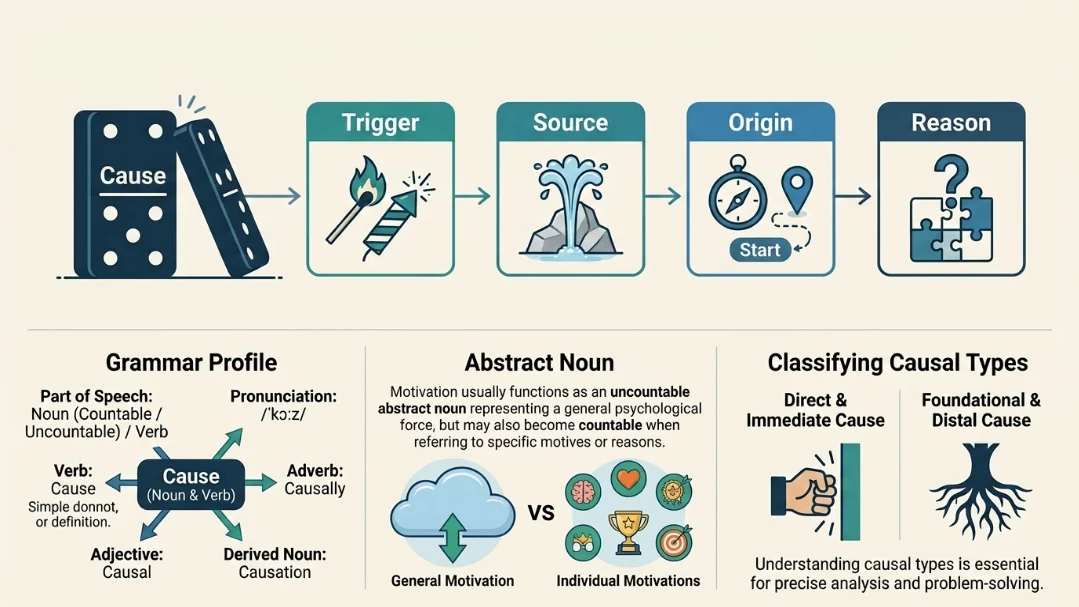
Finding the right synonyms for cause depends entirely on whether you are describing the origin of an event, a political movement, or the act of making something happen. As a noun, “cause” refers to the reason behind an outcome or a principle people support. As a verb, it means to bring about a specific result.
Swapping out “cause” for a more precise word improves your writing, sharpens your meaning, and prevents awkward repetition. This guide breaks down the best synonyms for cause across different contexts, complete with definitions, example sentences, and practical selection rules.
Best Synonyms for Cause
The table below offers a fast overview of the most accurate replacements for “cause” based on part of speech and common usage.
| Context | Best Synonym | Secondary Options | Formality Level |
| Noun: Origin of an event | Reason | Origin, source, root, basis | Neutral |
| Noun: Social or ideal goal | Principle | Movement, crusade, campaign | Neutral to High |
| Verb: To make happen | Produce | Trigger, generate, induce | Neutral |
| Verb: To force an outcome | Compel | Prompt, provoke, instigate | High |
What Does Cause Mean?
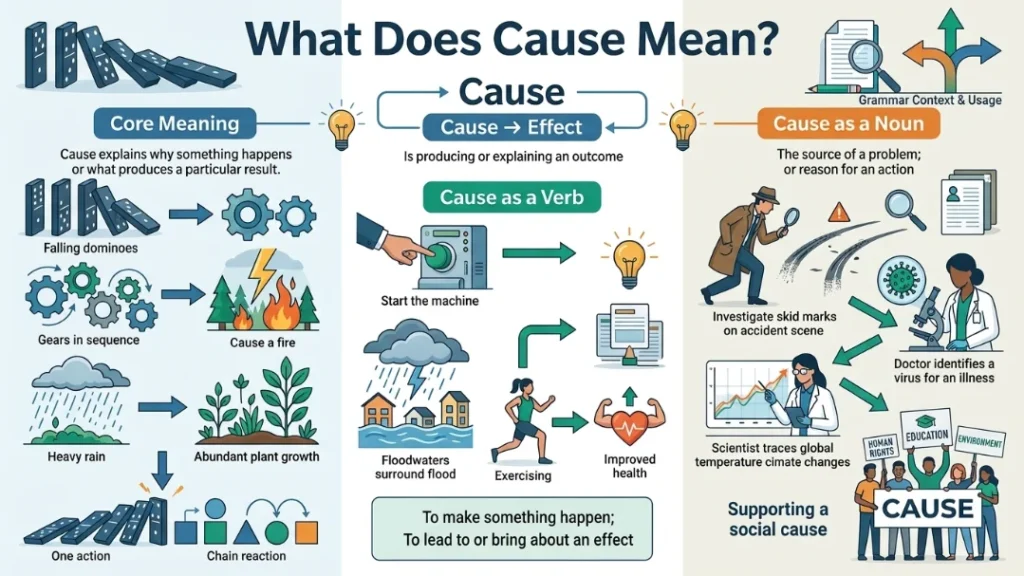
Understanding the core meaning of “cause” makes picking an accurate alternative much easier. The word functions primarily as both a noun and a verb, with subtle shifts in meaning depending on sentence structure.
Core Meaning as a Noun
As a noun, “cause” generally means a person, thing, or event that brings about a condition or result. It answers the question why something occurred.
- Example: Investigators searched for the cause of the power outage.
Additionally, “cause” refers to a belief, principle, or social movement that a group supports or fights for.
- Example: The charity raises money for a worthy cause.
Core Meaning as a Verb
As a verb, “cause” means to make something happen, bring something into existence, or compel an action.
- Example: Heavy rain can cause dangerous flash floods.
Core Meaning and Grammar of Cause
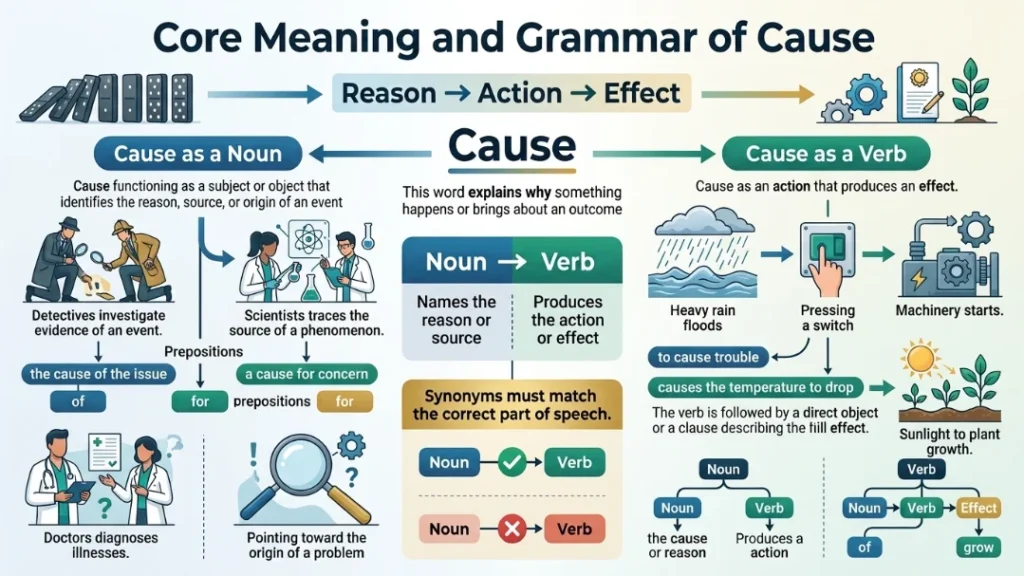
To use cause synonyms correctly, you must align the replacement word with the correct part of speech. Substituting a noun synonym into a verb position creates grammatical errors.
- Noun Form: Functioning as a subject or object, “cause” pairs with prepositions like of or for (e.g., “the cause of the issue” or “a cause for concern”).
- Verb Form: Functioning as an action, “cause” takes a direct object or works within a clause (e.g., “to cause trouble” or “causes the temperature to drop”).
Best Synonyms for Cause in Context
Context dictates which alternative fits best. Using “trigger” instead of “source” completely changes the speed and intensity of the action you describe.Here is the table version:
| Meaning / Context | Nuance | Associated Synonyms |
| Root / Source | Deep, fundamental origin | Root, Source, Foundation, Origin |
| Trigger / Catalyst | Immediate spark driving action | Trigger, Catalyst, Incentive, Agent |
| Reason / Rationale | Logical explanation or justification | Reason, Rationale, Grounds, Motive |
| Movement / Belief | Shared social or political goal | Movement, Belief, Crusade, Principle |
Common Synonyms for Cause
These everyday words work well in standard writing, emails, and conversational settings without sounding overly academic or casual.
1. Reason (Noun)
A fact, condition, or motive that explains why something happens or why someone acts.
- Tone: Neutral
- Example: She explained the reason for her sudden departure.
2. Source (Noun)
The starting point or place where something originates.
- Tone: Neutral
- Example: The broken pipe was the main source of the leak.
3. Lead to (Verb Phrase)
To result in a specific action, state, or situation over time.
- Tone: Neutral
- Example: Poor planning can lead to unexpected delays.
4. Produce (Verb)
To make, yield, or bring a specific outcome into existence.
- Tone: Neutral
- Example: The new marketing strategy produced excellent results.
Formal Synonyms for Cause
Academic, legal, and professional environments often require elevated vocabulary. These formal synonyms for cause convey authority and precision.
1. Origin (Noun)
The fundamental beginning or point where something comes into being.
- Tone: Formal / Academic
- Example: Historians continue to study the origins of the conflict.
2. Catalyst (Noun)
A person, event, or thing that precipitates a change or event rapidly.
- Tone: Formal / Technical
- Example: The economic policy acted as a catalyst for industrial growth.
3. Precipitate (Verb)
To make something happen suddenly, unexpectedly, or prematurely.
- Tone: High Formal
- Example: The sudden rise in interest rates precipitated a decline in housing sales.
4. Instigate (Verb)
To initiate or provoke a specific action or event, often used in negative or legal contexts.
- Tone: Formal
- Example: Audit reports showed that rogue actors instigated the security breach.
Informal Synonyms for Cause
In casual conversation, storytelling, or creative writing, formal terms feel stiff. These informal options sound natural and conversational.
1. Spark (Verb)
To ignite or set off an immediate reaction or debate.
- Tone: Informal / Expressive
- Example: Her casual comment sparked a huge debate among the team.
2. Bring on (Verb Phrase)
To cause something, often an illness, stress, or a physical reaction, to start.
- Tone: Casual
- Example: Eating late at night usually brings on heartburn.
3. Root (Noun)
The basic, underlying, or primary origin of a problem.
- Tone: Conversational / Metaphorical
- Example: Miscommunication was at the root of the entire misunderstanding.
Strong Synonyms for Cause
When you need to emphasize force, urgency, or direct responsibility, use these high-intensity alternatives.
1. Trigger (Verb / Noun)
To set off an immediate, automatic, or violent chain reaction.
- Intensity: High
- Example: A single loud noise triggered the avalanche on the slope.
2. Compel (Verb)
To force or drive an outcome with strong pressure or authority.
- Intensity: High
- Example: Harsh weather conditions compelled the captain to change course.
3. Drive (Verb)
To push, motivate, or force a system or person toward a specific result.
- Intensity: High
- Example: Customer demand drives innovation in the technology sector.
Mild Synonyms for Cause
Sometimes an outcome is not forced, but rather gently influenced or encouraged. These mild synonyms describe subtle causality.
1. Prompt (Verb)
To move or encourage someone toward an action without harsh force.
- Intensity: Low to Moderate
- Example: The safety alert prompted managers to review their office guidelines.
2. Contribute to (Verb Phrase)
To be one of several factors that help bring about a result.
- Intensity: Low
- Example: High stress levels can contribute to poor sleep quality.
3. Influence (Verb)
To affect or shape the development or behavior of something indirect.
- Intensity: Low
- Example: Peer feedback heavily influenced the design team’s final decision.
Popular Synonyms for Cause by Usage Context
Matching your word choice to your specific topic ensures clarity and authority.
Business & Economics
- Drive: Market forces drive price increases.
- Generate: The campaign generated substantial new revenue.
- Factor: Rising transport costs remain a key factor in inflation.
Science & Medicine
- Induce: The medication induces sleep within twenty minutes.
- Etiology: Medical researchers investigated the etiology of the rare disease.
- Agent: Bacteria serve as the primary infectious agent in this condition.
Law & Public Policy
- Grounds: The lawyer argued that there were sufficient grounds for an appeal.
- Proximate Cause: The court determined the proximate cause of the collision.
- Instigate: The defendant was accused of instigating the public disturbance.
Another Word for Cause in Sentence Examples
Seeing how words operate inside actual sentences makes switching between options effortless.
Noun Examples
- Original: What was the cause of the engine failure?
- Alternative 1: What was the origin of the engine failure?
- Alternative 2: What was the source of the engine failure?
Verb Examples
- Original: The sudden announcement caused panic in the market.
- Alternative 1: The sudden announcement triggered panic in the market.
- Alternative 2: The sudden announcement precipitated panic in the market.
Comparing Key Synonyms for Cause
Many writers confuse words like “reason,” “source,” and “catalyst.” While all three relate to cause, their specific meanings differ significantly.Here is the clean, standard Markdown table version ready to copy into your document:
| Word | Primary Focus | Typical Speed/Force |
| Cause | Direct agent producing an outcome | General / Direct |
| Reason | Explanation or justification for a belief | Logical / Intellectual |
| Source | Initial starting point or root | Passive / Foundational |
| Catalyst | Acceleration of an event or reaction | Sudden / High energy |
- Use Reason when explaining why a conscious decision or natural logic exists.
- Use Source when tracing something back to its physical or temporal starting point.
- Use Catalyst when an element speeds up a reaction without being the main component.
Words Similar to Cause
Some terms share a close semantic relationship with “cause” but do not mean the exact same thing. Using these requires caution to avoid shifting your sentence’s meaning.
Important Distinction: These words describe related elements of causation, such as motives, conditions, or secondary factors, rather than the primary direct cause itself.
- Motive: The internal psychological drive behind an action (e.g., greed, fear). Not the physical cause itself.
- Occasion: The specific time or favorable opportunity that allows an event to happen.
- Pretext: A false reason given to hide the real cause or motivation.
- Foundation: The underlying framework supporting an idea or structure.
Antonyms and Opposites of Cause
To fully understand “cause,” it helps to look at its direct opposites. While cause represents the starting force, these words represent what comes after.
Noun Antonyms
- Effect: A change that is a direct result or consequence of an action.
- Result: The final outcome produced by a cause or series of events.
- Consequence: A result or effect, typically one that is unwelcome or unpleasant.
- Outgrowth: A natural development or product growing out of a primary source.
Verb Antonyms
- Prevent: To stop something from happening or arising.
- Halt: To bring an ongoing process or action to an immediate stop.
- Suppress: To forcibly put an end to an action or development before it starts.
How to Choose the Right Synonym for Cause
Selecting the ideal replacement comes down to assessing four core attributes of your sentence:
Step 1: Check Part of Speech ──► Noun or Verb?
Step 2: Determine Intensity   ──► Mild (influence) or Strong (trigger)?
Step 3: Evaluate Formality    ──► Casual (spark) or Academic (precipitate)?
Step 4: Verify Prepositions   ──► Does "source of" or "lead to" fit grammatically?
- Identify the Part of Speech: Ensure your substitute matches whether “cause” is acting as a noun or verb in your sentence.
- Determine Intensity: Decide if the action is mild (influenced, prompted) or forceful (compelled, triggered).
- Consider Tone: Match the vocabulary to your audience. Academic papers suit terms like “etiology” or “precipitate,” while blog posts benefit from “spark” or “lead to.”
- Check Prepositions: Remember that replacing “cause” often changes surrounding prepositions. For instance, you say “cause of the problem,” but “reason for the problem.”
Common Mistakes When Using Synonyms for Cause
- Confusing Reason with Cause: “Reason” usually implies rationalization, logic, or human motive, whereas “cause” refers to direct physical or circumstantial links.
- Wrong Preposition Usage: Writing “the source for the issue” instead of “the source of the issue” creates awkward phrasing.
- Overusing Medical or Legal Jargon: Words like “etiology” or “proximate cause” belong in specialized fields. Using them in everyday business communications makes text feel unnecessarily dense.
- Ignoring Sentence Speed: Replacing “caused” with “triggered” implies a fast, explosive reaction. If the process took years, “triggered” creates an inaccurate picture.
Quick Reference Synonym List for Cause
Here is a quick lookup list categorized by usage type:
- Everyday Nouns: Reason, source, root, basis.
- Everyday Verbs: Lead to, produce, make, bring about.
- Formal Nouns: Origin, agent, catalyst, foundation.
- Formal Verbs: Precipitate, instigate, induce, compel.
- Casual Terms: Spark, bring on, setup.
- Strong Action Verbs: Trigger, drive, force, dictate.
- Social/Ideological Nouns: Principle, movement, campaign, crusade.
FAQs
What is the best synonym for cause?
The best general synonym for cause as a noun is reason or source. As a verb, the most reliable alternative is bring about or produce.
What is another word for cause in a formal essay?
In formal or academic writing, good alternatives include origin, catalyst, precipitate, or instigate, depending on whether you need a noun or a verb.
What is a formal synonym for cause?
As a noun, origin or etiology serves well in formal contexts. As a verb, precipitate or induce offers strong formal alternatives.
What is an informal synonym for cause?
Informal verbs include spark or bring on. Informal noun phrases include the root of or the bottom of.
What is a stronger word for cause?
Stronger alternatives include trigger, compel, force, or precipitate, all of which convey direct power and rapid results.
What is a milder word for cause?
Milder terms include prompt, influence, contribute to, or encourage, indicating an indirect or gentle effect.
What words are similar to cause?
Words like motive, pretext, occasion, and basis are closely related to cause, though they refer to specific aspects like intention or opportunity.
What is the opposite of cause?
The direct opposite of “cause” as a noun is effect, result, or consequence. The opposite of “cause” as a verb is prevent, halt, or stop.
How do I choose the right synonym for cause?
Determine whether you need a noun or verb, select the appropriate formality level, choose the desired intensity (mild vs. strong), and ensure your surrounding prepositions match the new word.
Conclusion
Mastering synonyms for cause empowers you to write with greater clarity, precision, and tone control. Whether you choose a formal noun like “catalyst,” a strong verb like “trigger,” or a simple everyday term like “source,” picking the precise word ensures your true meaning comes through clearly every time.