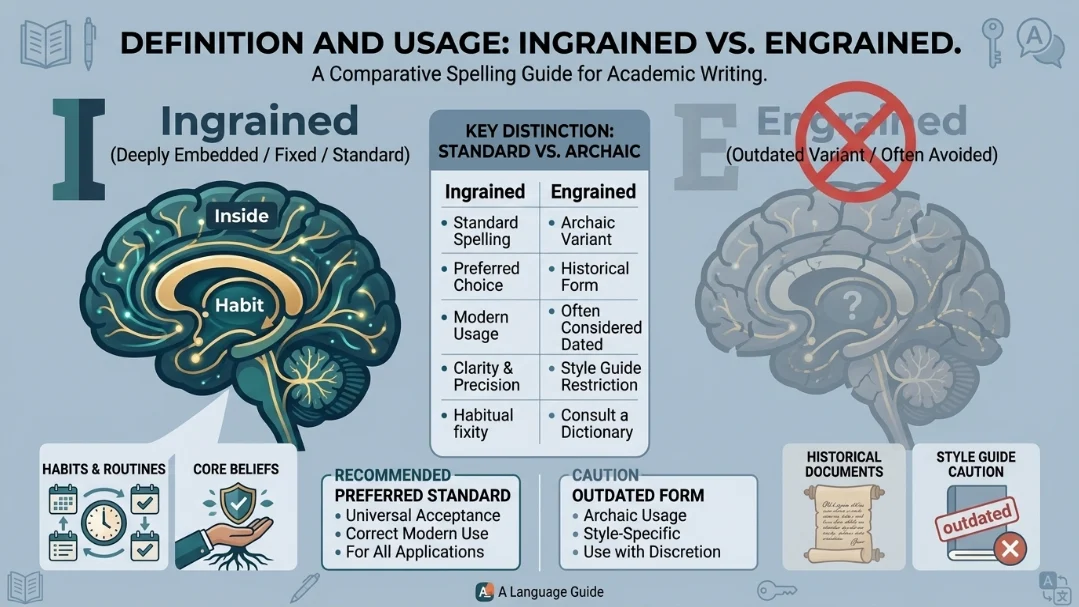
The words ingrained and engrained are both acceptable spellings of the same adjective, which means deeply fixed, firmly established, or thoroughly worked into a surface. However, ingrained is the vastly preferred and much more common spelling in both American and British English. While engrained is a recognized variant, dictionaries often list it as a secondary alternative.
Language learners and experienced writers alike frequently stumble over spelling variants that differ by only a single letter. Consequently, deciding between ingrained or engrained can cause unnecessary hesitation during the drafting process. This specific confusion stems from historical shifts in prefix usage within the English language, where the prefixes “in-” and “en-” often competed for dominance.
Because both forms appear in print from time to time, you might wonder if they carry distinct nuances or if one has become entirely obsolete. Understanding the root of this linguistic overlap helps clarify why one form has pulled so far ahead of the other. Therefore, exploring their shared origin and subtle divergence will give you total confidence in your word choice. Furthermore, mastering these small orthographic details directly enhances the professionalism and polish of your prose.
If you are looking for a quick, definitive answer to the ingrained or engrained dilemma, the choice is straightforward. You should almost always choose ingrained with an “i” for all standard, professional, and academic writing.
- Ingrained is the dominant spelling worldwide, capturing over 95% of modern textual usage.
- Engrained is an older variant that remains technically correct but is increasingly rare.
- Both words share the exact same definition, parts of speech, and pronunciation.
- The choice between them does not alter the meaning or tone of your sentence.
Definition and Etymology of the Word
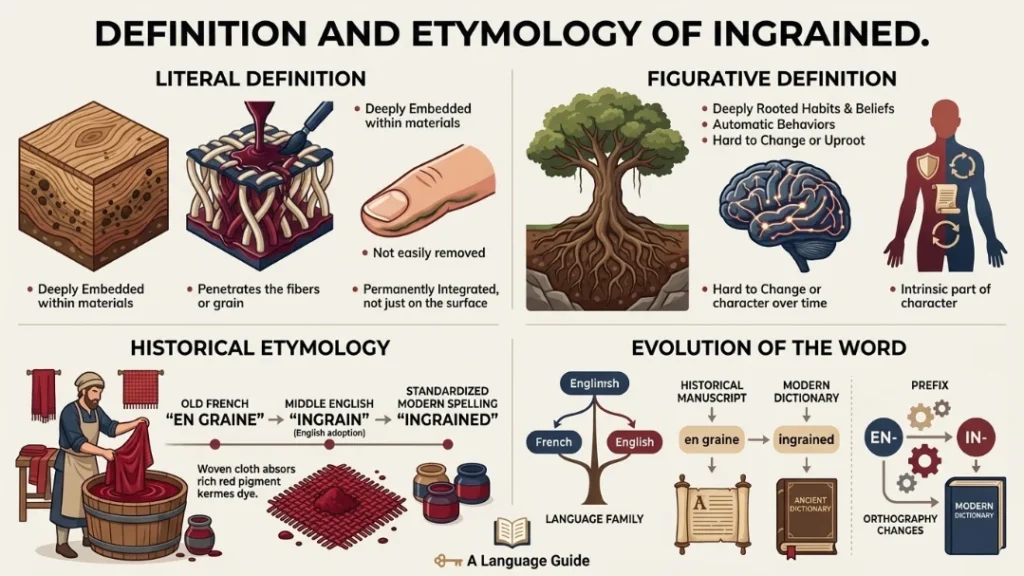
To truly grasp why this word is spelled the way it is today, we must look at its literal and figurative definitions. Additionally, tracing its linguistic family tree reveals a fascinating history of industrial and agricultural practices.
Literal Definition
As an adjective, the term describes something deeply embedded within the fiber, grain, or substance of an object. For instance, think of dirt that has worked its way deep into the pores of a wooden table or under a mechanic’s fingernails. In these physical contexts, the substance cannot simply be wiped away because it has integrated with the host material.
Figurative Definition
In everyday conversation and psychological contexts, the word describes habits, beliefs, prejudices, or attitudes that are firmly fixed. These traits are so deeply rooted in a person’s mind or culture that they feel entirely natural and become exceptionally difficult to change. For example, a childhood habit of saying “please” and “thank you” becomes an automatic response in adulthood.
Historical Etymology
The word traces its roots back to the Old French phrase en graine, which relates to the process of dyeing cloth. Specifically, it referred to dyeing fabric using a scarlet powder derived from dried insects, known as “kermes” or “grain.” This dye was so potent that it saturated the very core of the fabric fibers, making the color permanent and unwashable.
During the Middle Ages, English speakers adopted the phrase into Middle English as ingrain. Over the subsequent centuries, the spelling shifted between prefixes. Eventually, the “in-” prefix became the standardized standard for the adjective form, while the “en-” variant slowly receded into the background of English orthography.
Grammatical Analysis and Word Forms
Understanding how to position this term within a sentence ensures grammatical accuracy. The table below outlines the primary forms of the word based on standard American and British English conventions.
| Word Form | Ingrained Spelling (Preferred) | Engrained Spelling (Variant) |
| Adjective | Ingrained | Engrained |
| Verb (Base Form) | Ingrain | Engrain |
| Verb (Past Tense) | Ingrained | Engrained |
| Noun Form | Ingrainedness | Engrainedness |
| Adverb Form | Ingrainedly | Engrainedly |
Comparative Analysis of the Prefixes In and En
The core of the confusion between ingrained or engrained lies in how the prefixes “in-” and “en-” function in the English language. Although they often look and sound similar, they historically entered the language through different paths.
The Latinate Prefix In
The prefix “in-” typically comes directly from Latin. It generally means “inside,” “into,” or “within” when used to indicate location or insertion. In the case of this specific vocabulary word, “in-” perfectly matches the concept of something being driven deep into the grain of a material or a mind.
The French Variant En
Conversely, the prefix “en-” usually arrived in English via Old French, which had adapted it from Latin. It carries a causative meaning, often translated as “to put into,” “to confine in,” or “to cause to be.” We see this prefix active in modern words like encase, enfold, and entrap.
Why the Convergence Happened
Because these two prefixes overlap so significantly in meaning, English writers historically used them interchangeably for many words. Over time, however, public usage usually filters out one variant to make the language more efficient. While words like enquire and inquire still battle for regional dominance, the word ingrained won a decisive victory over its sibling centuries ago.
Regional and Global Usage Trends
Linguistic patterns often vary based on geography, but the story of ingrained or engrained is surprisingly consistent across the globe. Unlike differences like color versus colour, this spelling choice unites major English-speaking regions.
Usage in United States and Canada
In North America, editors, publishers, and major dictionaries overwhelmingly mandate the use of ingrained. If you submit an essay or an article containing the spelling engrained to an American publication, an automated spell-checker or a human proofreader will almost certainly flag it as an error.
Usage in the United Kingdom and the Commonwealth
British, Australian, and New Zealand English users mirror the American preference. Even though British English is traditionally more receptive to French-influenced “en-” spellings, major UK publications like The Guardian and The Economist consistently print ingrained.
Modern Global Usage Share:
[==================================================] 96% Ingrained
[==] 4% Engrained
Real-World Examples in Contemporary Media
Examining how reputable publications use this vocabulary word clarifies its placement in professional contexts. Here are several simulated examples that reflect real-world journalistic standards.
- Political Journalism: The commentators argued that partisan loyalties have become too deeply ingrained in the electorate to allow for meaningful compromise.
- Scientific Research: Neurologists discovered that repetitive behaviors create ingrained pathways in the brain, making habits difficult to break.
- Business and Finance: The corporate culture possessed an ingrained resistance to remote work, which ultimately hindered their recruitment efforts.
- Environmental Reporting: Decades of fossil fuel reliance created ingrained systemic challenges that slowed the transition to green energy.
Advantages and Disadvantages of Each Spelling
While both words are technically definitions of the same concept, choosing one over the other carries distinct practical consequences for your writing.
Using the Ingrained Spelling
- Advantage: It ensures immediate readability because your audience will recognize the word instantly without distraction.
- Advantage: It clears all automated spell-check parameters, saving you time during edit cycles.
- Disadvantage: It lacks historical novelty if you are purposefully trying to mimic archaic 17th-century texts.
Using the Engrained Spelling
- Advantage: It can provide a rustic, old-fashioned, or highly stylized aesthetic in creative fiction or historical roleplay.
- Disadvantage: It frequently distracts modern readers, causing them to question your spelling accuracy rather than focus on your message.
- Disadvantage: It violates the strict style guides of most academic institutions, corporate environments, and newsrooms.
Structural Breakdown: How to Use the Word Effectively
To integrate ingrained into your writing seamlessly, you must understand its common collocations and structural pairings. Below is a detailed breakdown of how the word interacts with other parts of speech.
Common Noun Pairings
The adjective ingrained routinely pairs with nouns that represent abstract mental structures, cultural norms, or stubborn physical traits.
- Ingrained habits: Routines performed without conscious thought, like checking your phone upon waking.
- Ingrained beliefs: Core ideologies or religious convictions that shape a person’s entire worldview.
- Ingrained prejudices: Unconscious biases that influence how a person judges others.
- Ingrained dirt: Physical grime that has penetrated deep into a surface and resists cleaning.
Prepositional Pairings
When you need to extend a sentence beyond the adjective, you must use the correct preposition to maintain a natural flow.
- Ingrained in: This is the most common construction (“The tradition is ingrained in our family history”).
- Ingrained into: Use this when emphasizing the process of embedding something (“The training was ingrained into the recruits during boot camp”).
Analogies and Metaphors for Conceptual Clarity
If you are struggling to explain the concept of an ingrained trait to a student or a colleague, visual analogies can break down the idea beautifully.
The Pathway in the Woods Analogy
Imagine a pristine, dense forest with no walking trails. If a person walks through the brush once, they leave almost no trace. However, if hundreds of people walk along the exact same line every day for years, a deep, clear dirt path forms. The plants stop growing there, and the earth packs down firmly. That path is now ingrained into the landscape, just like a habit is carved into human neural pathways through constant repetition.
The Sponge and Ink Analogy
Consider a block of dry wood. If you spill thick paint on it, the color sits on top and can be scraped away with a tool. Now, imagine dropping thin water-based ink onto a porous sponge. The sponge sucks the ink deep into its interior matrix. Because the ink is now part of the inner structure, you cannot remove it without destroying the sponge itself. This represents a truly ingrained characteristic.
Synonyms for Ingrained
When you want to avoid repeating ingrained, several close alternatives can help vary your vocabulary. However, each synonym introduces a slightly different shade of meaning.
Inherent
- Meaning: Existing in something as a permanent, essential, or characteristic attribute from birth or creation.
- Nuance Difference: While ingrained implies a habit or trait developed and fixed over time, inherent implies that the trait was present from the very beginning.
- Example: There is an inherent risk in skydiving, no matter how many safety checks you perform.
Deep-seated
- Meaning: Firmly established at a profound level; difficult to change or remove.
- Nuance Difference: This synonym perfectly matches the psychological weight of ingrained, but it is used almost exclusively for abstract concepts like emotions, fears, or traditions.
- Example: Her fear of flying was deep-seated, originating from a turbulent flight during her childhood.
Inveterate
- Meaning: Having a particular habit, activity, or interest that is long-established and unlikely to change.
- Nuance Difference: Writers use inveterate almost exclusively to modify nouns that represent people or their personal behaviors, often with a slightly negative tone.
- Example: As an inveterate gambler, he found it impossible to walk past a casino without stepping inside.
Entrenched
- Meaning: Firmly established and difficult or unlikely to change; safely guarded.
- Nuance Difference: Entrenched carries a defensive or combative connotation, reminiscent of military trenches. It describes political positions, corporate power structures, or systems that actively resist outside forces.
- Example: The bureaucracy was so entrenched that changing a single form required months of administrative approval.
Antonyms of Ingrained
To define a concept fully, it is equally helpful to explore its opposites. These antonyms describe things that are temporary, shallow, or easily altered.
Superficial
- Meaning: Existing or occurring at or on the surface; shallow and not deep.
- Example: The storm caused only superficial damage to the exterior siding of the suburban home.
Transient
- Meaning: Lasting only for a short time; impermanent or fleeting.
- Example: The joy of winning the regional lottery proved transient, vanishing as bills began to pile up.
Extraneous
- Meaning: Irrelevant or unrelated to the subject; coming from the outside.
- Example: Please remove all extraneous details from your report so the board can focus on core data.
Malleable
- Meaning: Easily influenced, trained, shaped, or altered.
- Example: The minds of young children are highly malleable, absorbing everything they see and hear.
Common Mistakes and How to Correct Them
Even native speakers occasionally misuse ingrained or misapply its structural rules. Reviewing these standard errors will help safeguard your writing from clumsy phrasing.
Mistake 1: The Double Prefix Confusion
Some writers accidentally create non-existent words by blending different linguistic elements together. For example, you might see the word emgrained or ingraineded in rough drafts.
- Incorrect: The old traditions were emgrained in the village culture.
- Correct: The old traditions were ingrained in the village culture.
Mistake 2: Mixing Up Ingrained with Ingrown
Because both words begin with the same letters, hurried writers sometimes swap them. However, ingrown refers specifically to hair or nails that have grown abnormally into the flesh.
- Incorrect: He had an ingrown habit of biting his nails when he felt anxious.
- Correct: He had an ingrained habit of biting his nails when he felt anxious.
Mistake 3: Forcing a Passive Construction With the Verb Form
While ingrain can function as a verb, trying to use it in an active, progressive sense often sounds incredibly stiff.
- Awkward: The teacher is currently ingraining the rules of grammar into the class.
- Better: The teacher is helping students develop ingrained grammar habits through daily practice.
Helpful Memorization Tricks
If you find yourself pausing before typing this word, use these quick mental shortcuts to select the correct letter instantly.
Mnemonic Device:
I = Inside = Ingrained
E = External = (Avoid for this word)
Think of the I in Ingrained as standing for Inside, Internal, or Grain. Since the definition refers to something hidden deep inside a structure or internalized in a mind, the letter I serves as your logical anchor. Conversely, associate the letter E with External or Exit, which represents the exact opposite of what this vocabulary word actually means.
Practice Exercises to Master the Vocabulary
Put your knowledge to the test by completing the following sentences. Choose the optimal spelling or synonym based on the context and rules discussed above.
Part 1: Fill in the Blank
- Years of rigorous military training had ________ a sense of absolute discipline into the soldier’s daily routine.
- The auto mechanic washed his hands twice, but the ________ grease remained trapped under his cuticles.
- Sociologists study how cultural myths become so deeply ________ in a community that they dictate modern laws.
- Although ________ is technically listed in older dictionaries, my university professor marked it wrong on my term paper.
- Her bias against modern art was completely ________, steming from her grandfather’s traditional views on painting.
Part 2: True or False
- True or False: Choosing the spelling engrained instead of ingrained will alter the fundamental definition of your sentence.
- True or False: In British English, engrained is used for physical objects, while ingrained is reserved for mental concepts.
- True or False: The word ingrained can function as both a past-tense verb and an adjective.
- True or False: Superficial is an accurate synonym for a belief that is deeply ingrained.
- True or False: Automated spell-checkers in modern word processors prefer ingrained over engrained.
Answer Key and Detailed Explanations
Review your work to ensure you understand the core mechanics of the words.
- ingrained (or ingrained into). This choice describes a deeply fixed habit developed via repetitive military drills.
- ingrained. This represents the literal definition of dirt or grease physically penetrating a textured surface.
- ingrained. This highlights abstract cultural concepts that have integrated seamlessly into a societal collective consciousness.
- engrained. This sentence demonstrates how authority figures view the rare variant spelling in academic environments.
- ingrained. This accurately depicts an emotional and mental attitude that has become fixed over a long period.
- False. Both spellings mean the exact same thing; the difference is purely orthographic, not semantic.
- False. Both regions prefer ingrained for both physical and mental applications without differentiation.
- True. It functions primarily as an adjective, but it also serves as the past-tense form of the verb ingrain.
- False. Superficial means shallow and on the surface, making it an antonym, not a synonym.
- True. Modern systems flag the “en-” variant to encourage standard contemporary usage.
Frequently Asked Questions
Is engrained a real word?
Yes, engrained is a legitimate, recognized word listed in major dictionaries. It is an older variant spelling of ingrained, meaning they share identical definitions and origins. However, because it is so rare in modern publishing, many readers and automated editing programs view it as a misspelling.
Which spelling should I use for a business report?
You should exclusively use ingrained with an “i” for corporate reports, legal documents, and formal business letters. This choice aligns with modern global publishing standards and ensures that your readers focus on your insights rather than your orthographic quirks.
Why does my computer underline engrained in red?
Your computer underlines engrained because most digital dictionaries prioritize standard contemporary usage to minimize text errors. Since the “en-” variant appears in less than five percent of modern literature, spell-check parameters automatically flag it to help you maintain standard usage.
Can ingrained be used to describe physical objects?
Yes, you can absolutely use ingrained to describe physical surfaces. It originally described textile dyes that thoroughly saturated fabric fibers. Today, it frequently describes stubborn dirt, grease, or stains that have worked deep into wood, stone, skin, or cloth.
What is the difference between ingrained and entrenched?
While both words describe things that are firmly fixed, entrenched carries a much stronger connotation of active defense and resistance to outside pressure. We typically say a political ideology or corporate bureaucracy is entrenched when it deliberately fights against modification or reform.
Is ingrained a positive or a negative word?
The word itself is completely neutral and takes its emotional tone from the noun it modifies. For instance, having an ingrained sense of honesty is highly positive. Conversely, possessing an ingrained habit of procrastination represents a clear negative trait.
How do you pronounce ingrained?
The word is pronounced as /ɪnˈɡreɪnd/ or “in-GRAYND.” Both spelling variations are pronounced in the exact same manner, meaning the initial vowel sound remains identical regardless of whether it is written with an “i” or an “e.”
Can I use the word ingrain as a standalone verb?
Yes, you can use ingrain as a verb, which means to firmly impress an idea, habit, or stain onto a mind or surface. However, modern speakers generally prefer using it in its past-participle adjective form rather than as an active, progressive verb.
What part of speech is ingrained?
In almost all contemporary contexts, ingrained functions as an adjective that directly modifies a noun. It describes the state of a habit, belief, or physical substance that has become deeply embedded within something else.
Are there any style guides that recommend engrained?
No major contemporary style guides, including the Associated Press, Chicago Manual of Style, or Oxford University Press, recommend using the engrained spelling. They universally favor ingrained to maintain consistency across modern publishing networks.
Conclusion
Navigating the subtle complexities of English spelling variants does not need to hinder your creative or professional momentum. When faced with the choice between ingrained or engrained, remember that public usage has already settled the score. While both forms are historically valid definitions of the same core concept, ingrained is the undeniable standard for modern communication across the globe.
By consistently selecting the “in-” spelling, you safeguard your prose from awkward automated red lines and protect your readers from unnecessary distraction. Use this word to describe those stubborn physical stains, deep psychological habits, or ancient cultural traditions that define our world. Ultimately, choosing standard vocabulary forms shows attention to detail and a commitment to clear communication. Implement this advice in your upcoming writing projects to elevate the authority and accessibility of your voice.