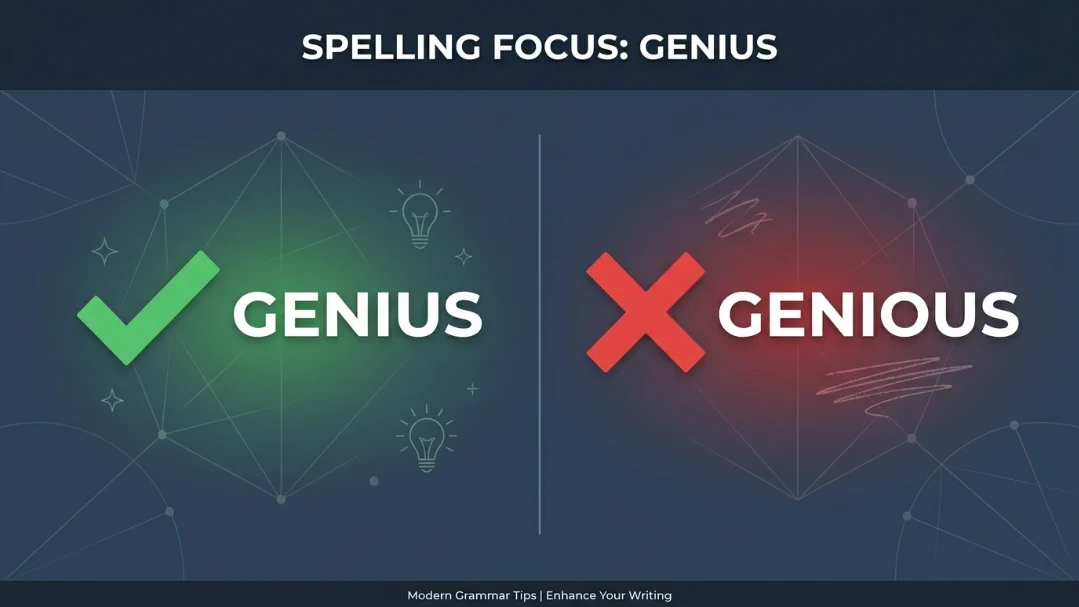
The correct spelling is genius. The form genious is an incorrect spelling and does not exist in standard English dictionaries. Therefore, you should always use genius when referring to exceptional intellectual ability or a person who possesses it.
Language often presents us with spelling dilemmas that can cause hesitation during writing. A particularly frequent point of confusion occurs when people choose between genious or genius. Because many English adjectives end in the letters o-u-s, it feels entirely natural to apply that pattern to this specific word. For example, words like ingenious or pious legitimate contain that vowel sequence.
Consequently, writers frequently type the incorrect variant by mistake. This extensive guide will examine why this spelling error occurs so frequently. Furthermore, we will analyze the historical roots of the word and establish clear rules to ensure you never make this mistake again. Understanding the distinction is vital for maintaining professional credibility in your writing. By mastering the core principles behind this word, you can elevate your communication and express your ideas with absolute confidence. Let us dive deep into the mechanics of this essential English noun.
Key Takeaway and Summary
If you are looking for a quick resolution to this linguistic puzzle, the answer is completely definitive. The word genius is the only correct spelling recognized in modern English. Conversely, the form genious is a spelling error that should be systematically avoided in all contexts.
| Status | Correct and valid | Incorrect and invalid |
| Part of Speech | Noun and Adjective | None |
| Dictionary Entry | Present in all major dictionaries | Absent from dictionaries |
| Acceptability | Universally accepted | Universally rejected |
Definition and Explanation
To fully grasp why the word is structured this way, we must look at its definition and grammatical functions. The term genius primarily operates as a noun. It refers to an exceptional natural capacity of intellect, high standard of creativity, or a person who displays such transcendent abilities.
[Latin: Genius] ──> [Old French: Genie] ──> [Modern English: Genius]
Historically, the word travels to us from ancient Rome. In Roman mythology, a genius was a guardian spirit assigned to a person at birth. This spirit was believed to govern their fortune and shape their character. Over the centuries, the meaning shifted away from external spirits. Instead, it came to represent an individual’s internal, exceptional mental power.
In modern times, the word can also function as an adjective in casual speech. When you say someone made a genius move, you are using it modifying another noun. However, despite this adjectival use, it refuses to take the traditional o-u-s suffix that characterizes words like glorious or famous. It firmly retains its original u-s ending in every scenario.
Advantages and Disadvantages of Proper Spelling
Using the correct spelling provides numerous benefits for your professional image. On the other hand, relying on phonetic errors carries distinct disadvantages.
Advantages of Using Genius
- Professional Credibility: Writing the word correctly demonstrates that you possess a strong command of English orthography.
- Clear Communication: Your readers can focus entirely on your message rather than being distracted by obvious typos.
- SEO Optimization: Search engines prioritize content that utilizes accurate spelling, which improves your overall visibility.
Disadvantages of Using Genious
- Loss of Authority: Readers may question your expertise if they spot basic spelling mistakes in your text.
- Academic Penalties: Professors and examiners routinely deduct points for using non-existent words.
- Algorithmic Penalties: Automated grading systems and search algorithms flags misspelled words, which lowers your score or ranking.
Real-World Examples
Analyzing how this word looks in actual sentences helps solidify the correct usage in your mind. Because context determines how we perceive language, seeing these examples reinforces correct habits.
Correct Examples
- Albert Einstein is universally recognized as a scientific genius.
- She had a genius idea for saving the company millions of dollars.
- The artistic genius of Leonardo da Vinci is visible in the Mona Lisa.
- To solve this complex puzzle, you do not need to be a genius.
Incorrect Examples
- Incorrect: The tech company is looking for a software genious.
- Incorrect: His genious plan completely fooled the entire opposition.
- Incorrect: She displayed her genious at a very early age.
Regional and Global Usage
Language sometimes varies across different geographical zones, but this word remains completely uniform globally. Whether you are writing in British English, American English, Canadian English, or Australian English, the standard never changes.
Global English Standards:
├── United States: Genius (Correct)  |  Genious (Incorrect)
├── United Kingdom: Genius (Correct) |  Genious (Incorrect)
├── Canada: Genius (Correct)         |  Genious (Incorrect)
└── Australia: Genius (Correct)      |  Genious (Incorrect)
Data from global publications indicates that the incorrect variant occasionally appears in casual internet forums. However, it is entirely absent from edited print media, academic journals, and news broadcasts. Therefore, regardless of your target audience, you must strictly adhere to the standard spelling.
Common Mistakes and Why They Happen
The persistence of the incorrect spelling stems primarily from a phenomenon known as phonetic analogy. Writers often lean on the sounds of familiar words when they are unsure of a specific spelling.
Because the word ingenious sounds remarkably similar to genius, people easily confuse their structures. The word ingenious means clever or inventive, and it genuinely ends in i-o-u-s. Due to this acoustic similarity, the mind accidentally applies the ending of ingenious to genius.
Ingenious ──> Ends in -ious (Correct)
Genius    ──> Ends in -us   (Correct)
Genious   ──> Confused Mix  (Incorrect)
Another factor is the presence of other common adjectives. Words such as vicious, delicious, and conscious create a strong mental pattern. Breaking this pattern requires conscious effort and a solid understanding of the word’s unique origin.
Synonyms for Genius
When you want to vary your vocabulary, you can use several excellent alternative terms. Depending on your specific context, these options can make your prose more engaging.
Synonyms for the Noun Form
- Prodigy: A person, especially a young child, endowed with exceptional qualities or abilities.
- Intellectual: A person possessing a highly developed intellect.
- Virtuoso: A person highly skilled in music or another artistic pursuit.
- Maestro: A distinguished musician or master of any artistic field.
Synonyms for the Adjective Form
- Brilliant: Exceptionally clever or talented.
- Inspired: Demonstrating exceptional quality or extraordinary creativity.
- Astute: Having or showing an ability to accurately assess situations.
- Masterful: Performing a task with consummate skill.
Exercises with Answers
Practicing with real sentences will lock this spelling rule into your long-term memory. Try to identify the correct word choice in the following exercises.
Exercise Questions
- The young chess player was hailed as a child (genius / genious) by the grandmasters.
- Steve Jobs was known for his marketing (genius / genious).
- Designing that bridge was a piece of (genius / genious) engineering.
- Do you think that mathematical ability requires a person to be a (genius / genious)?
- The novel was praised for its sheer narrative (genius / genious).
Answers and Explanations
- genius — Because genious is not a real word, the standard spelling must be used.
- genius — This noun correctly describes the marketing brilliance possessed by the individual.
- genius — Here, the word acts as an adjective, but it still retains its standard spelling.
- genius — The sentence refers to an intellectual person, requiring the correct noun form.
- genius — Absolute creative quality is being described, which demands the u-s ending.
Related Concepts and Comparisons
To fully solidify your grasp of this topic, it is helpful to compare genius with words that share similar roots or sounds. This comparative analysis helps prevent cognitive slip-ups during drafting.
Genius vs. Ingenious
While these two words sound almost identical, they serve different functions. Genius is primarily a noun representing supreme talent. Conversely, ingenious is strictly an adjective meaning clever, resourceful, or inventive. Notice that ingenious retains the o-u-s ending because it follows the traditional Latin adjectival path through French.
Genius vs. Ingenuity
If you need the noun form of ingenious, you should use ingenuity. This word refers to the quality of being clever, original, and inventive. It is easy to see how these overlapping definitions cause confusion, but keeping them separate will refine your writing style.
FAQs
Is genious a word in any English dictionary?
No, the form genious is not recognized by any reputable English dictionary. It is classified strictly as a spelling error.
Why do so many people spell genius with an ‘o’?
Many people include the ‘o’ because they confuse it with the adjective ingenious, which sounds similar and ends in ious.
Can genius be used as an adjective?
Yes, the word frequently functions as an adjective in modern English to describe highly clever ideas or actions.
What are some common synonyms for genius?
Excellent options include prodigy, mastermind, virtuoso, and brilliant, depending on your context.
How do you spell the plural of genius?
The plural form can be spelled either as geniuses or, in specific scientific or traditional contexts, as genii.
Is there a difference between American and British spelling for this word?
No, both American and British English utilize the exact same spelling, which is genius.
Is a child prodigy the same as a genius?
While a prodigy shows advanced skills at an early age, a genius represents a broader category of exceptional intellectual or creative power.
How can I remember the correct spelling easily?
Remember that a genius always welcomes us, which reminds you that the word ends simply in u-s.
Conclusion
Mastering the nuances of English spelling can feel challenging, but resolving the debate between genious or genius is straightforward. The word genius stands as the only legitimate spelling in modern communication. By eliminating the incorrect spelling from your active vocabulary, you protect your academic reputation and enhance your professional credibility.
Whenever you are tempted to insert an extra ‘o’ into the word, remind yourself of its ancient Latin roots. Consider using alternative vocabulary options like prodigy or brilliant if you wish to avoid repeating the word too often in your essays. Consistently applying these rules ensures your prose remains polished, persuasive, and entirely free of distracting errors.