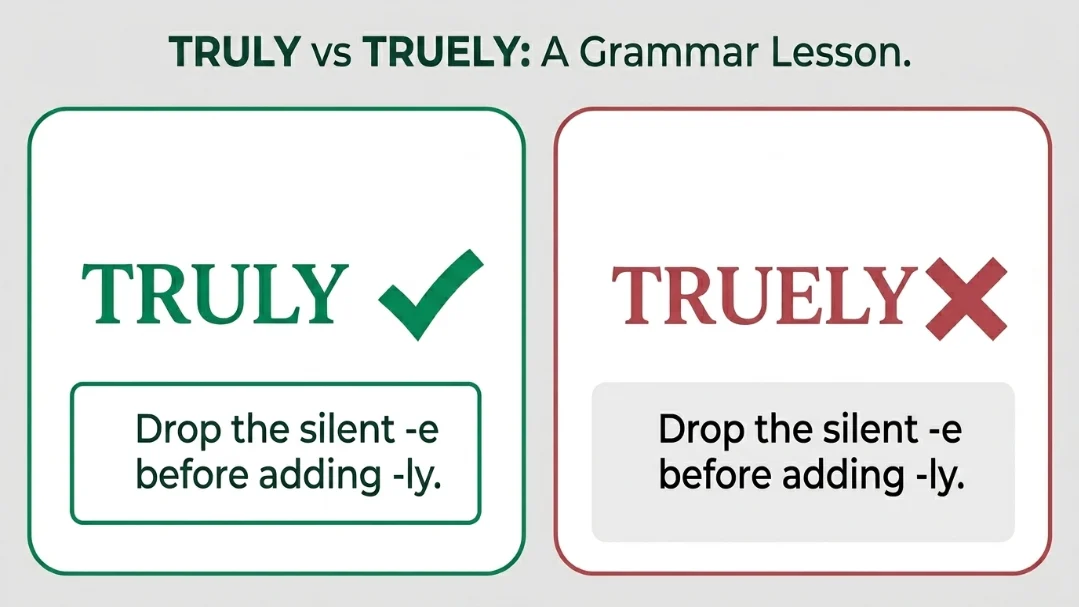
The correct spelling is truly. The form “truely” is a common spelling mistake and is considered incorrect in all forms of English. You should always use truly when writing letters, essays, or professional documents.
Spelling mistakes can quiet your message and lower your professional credibility. One of the most frequent errors in English writing involves the choice between truly or truely. Many people feel confused by this word because they want to preserve the root word “true” when adding a suffix.
When you write, your primary goal is clarity. A simple spelling error can distract your audience from your main point. Consequently, understanding the foundational rules of English spelling helps you build trust with your readers. This article explores why the spelling of truly confuses so many writers. Furthermore, it provides the clear guidelines you need to ensure you never make this mistake again.
Whether you are composing an important business email, an academic essay, or a simple text message, accurate spelling matters. By mastering this specific rule, you will improve your writing style and communicate with total confidence. Let us dive into the core mechanics of this word to understand how it functions in daily communication.
The debate between truly or truely has a single, definitive answer. The only correct spelling recognized by dictionaries globally is truly.
Here is a quick overview of the essential facts regarding this word:
| Aspect | Correct Details |
| Correct Spelling | Truly |
| Incorrect Spelling | Truely |
| Part of Speech | Adverb |
| Root Word | True |
| Suffix Applied | -ly |
| Primary Rule | Drop the silent “-e” before adding “-ly” |
Definition and Explanation
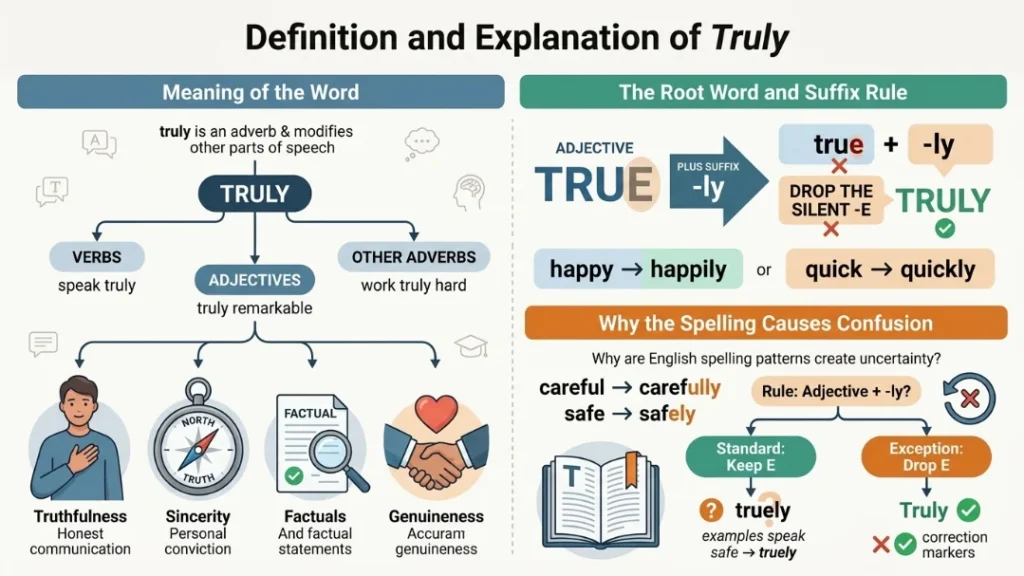
To understand why we spell this word without an “e”, we must look at its grammatical definition and linguistic roots. Truly functions as an adverb in the English language. This means it modifies verbs, adjectives, or other adverbs.
Meaning of the Word
The adverb truly means in a truthful, sincere, or accurate manner. Writers use it to emphasize the absolute truth of a statement. It can also mean genuinely or without fraud. For example, if you love a sport, you might say you are truly passionate about it.
The Root Word and the Suffix Rule
The confusion stems from the base word true. Normally, the English language follows specific patterns when turning adjectives into adverbs. The standard method involves adding the suffix -ly to the end of an adjective. For instance, the adjective sad transforms cleanly into sadly.
However, words ending in a silent “-e” sometimes require you to drop that final vowel. While many words like completely keep the letter “e”, a small group of words drops it entirely. The word true belongs to this exception group. Therefore, when you add -ly to true, the letter e disappears, resulting in truly.
Advantages of Using the Correct Spelling
Using the correct spelling provides several distinct advantages for writers, students, and professionals alike. Writing accurately affects how people perceive your intelligence and attention to detail.
Increased Professional Credibility
In the corporate world, written communication represents your personal brand. If you send a cover letter containing the non-word “truely”, a hiring manager might reject your application instantly. Conversely, clean writing shows that you value precision and high standards.
Better Academic Performance
Grading rubrics in schools and universities penalize spelling errors heavily. Automated grading systems and professors notice when you write truely instead of truly. Using the correct form protects your grades and ensures your arguments remain the central focus of your work.
Enhanced Search Engine Optimization
For digital content creators, spelling accuracy affects search engine rankings. Search engines aim to show high-quality, authoritative content to users. While algorithms understand common typos, maintaining correct spelling signals that your website provides reliable information.
Disadvantages of Spelling Errors
Mistakes in spelling have negative consequences that go beyond simple red underlines on a screen. Understanding these drawbacks can motivate you to proofread your work more carefully.
Loss of Reader Trust
When readers encounter typos like truely, they begin to question the validity of the surrounding information. If a writer cannot master basic vocabulary, the audience might assume the research or data is also flawed.
Distraction from Content
A spelling mistake acts as a visual speed bump. Instead of focusing on your brilliant ideas, the reader stops to look at the error. This interruption breaks the natural flow of your narrative.
Negative Impact on Automated Screening
Many companies use automated Applicant Tracking Systems (ATS) to screen resumes. These systems look for specific keywords. If you misspell a word in your profile or summary, the software may fail to recognize your qualifications.
Real-World Examples
Seeing the word used correctly in sentences helps cement the proper spelling in your mind. The following examples demonstrate how to apply truly in various contexts.
Examples in Professional Writing
- We are truly grateful for your continued partnership during this fiscal quarter.
- The board of directors believes this merger offers a truly unique opportunity for growth.
- She is a truly exceptional leader who inspires her team daily.
Examples in Creative and Casual Writing
- After hiking for five hours, the view from the summit was truly breathtaking.
- I truly believe that kindness can change the world.
- The novel provides a truly authentic look at life in the nineteenth century.
Regional and Global Usage
English spelling sometimes varies depending on geography. For instance, British English uses colour, while American English uses color. However, the word truly does not follow this regional division.
American English
In the United States, truly is the only accepted form. Mainstream dictionaries like Merriam-Webster list truely as an obsolete or incorrect variant.
British and Commonwealth English
Writers in the United Kingdom, Canada, Australia, and New Zealand also utilize truly exclusively. Oxford and Cambridge dictionaries explicitly state that truely is an error. Therefore, no matter where your target audience lives, you must omit the letter “e”.
Common Mistakes and How to Avoid Them
People make the mistake of writing truely because human brains love patterns. We see words like definitely, politely, and safely, and we assume true follows the exact same path.
Why the Error Happens
The mind visualizes the adjective true first. Then, it attempts to glue -ly onto the end without changing the base structure. Because your brain focuses on the meaning of honesty, it resists deleting the crucial “e”.
Strategies for Remembering the Rule
To prevent this mistake, you can use a few simple mental tricks.
- The Vowel Collision Rule: Think of the “e” and the “y” as two powerful vowels fighting for space. The “y” wins the fight, pushing the “e” completely out of the word.
- The Alphabetical Drop: Remind yourself that “e” comes early in the alphabet, so it gets dropped first when building this adverb.
- Look at the Adjective ‘Duly’: The word due behaves exactly like true. When it becomes an adverb, it turns into duly, dropping the “e”. Remembering this pair can reinforce the pattern.
Comparison Table of Similar Suffix Transformations
To clarify why truly behaves the way it does, it helps to compare it to other adjectives that end in “e”. Some words keep the vowel, while others reject it.
| Base Adjective | Suffix Added | Correct Adverb | Does it Keep the “E”? |
| True | -ly | Truly | No |
| Due | -ly | Duly | No |
| Whole | -ly | Wholly | No (drops ‘e’, adds ‘l’) |
| Safe | -ly | Safely | Yes |
| Polite | -ly | Politely | Yes |
| Rare | -ly | Rarely | Yes |
| Absolute | -ly | Absolutely | Yes |
As you can see, most words keep the letter “e”. This reality explains why so many people accidentally write truely. The incorrect version mimics the dominant rule rather than the exception.
Exercises with Answers
Practice is the most effective way to turn new knowledge into a permanent habit. Complete the following exercises to test your understanding of the keyword truly or truely.
Part 1: Fill in the Blank
Choose the correct spelling to complete each sentence.
- The artisan crafted a __________ remarkable piece of jewelry. (truly / truely)
- I am __________ sorry for the delay in answering your email. (truly / truely)
- Do you __________ believe that we will finish the project on time? (truly / truely)
- His actions showed that he was a __________ noble friend. (truly / truely)
- The magic show was __________ magnificent. (truly / truely)
Part 2: Error Detection
Identify whether the sentence is correct or incorrect. If it is incorrect, rewrite the sentence with the proper spelling.
- “Yours truely, Jonathan Vance,” was written at the bottom of the letter.
- She was truly inspired by the keynote speaker at the conference.
- It is truely an honor to accept this prestigious award tonight.
- We need a truly independent audit of our financial records.
- The children were truely excited to visit the amusement park.
Answers and Explanations
- truly — This is the correct adverbial spelling.
- truly — Never include the “e” when modifying an adjective like sorry.
- truly — The verb believe is modified correctly here by dropping the “e”.
- truly — Standard spelling rules apply globally here.
- truly — The incorrect variant “truely” must be avoided.
- Incorrect — It should be: “Yours truly, Jonathan Vance,” was written at the bottom of the letter. (Note: “Yours truly” is a classic letter sign-off that always drops the “e”).
- Correct — The sentence uses the perfect spelling with no errors.
- Incorrect — It should be: It is truly an honor to accept this prestigious award tonight.
- Correct — This sentence correctly modifies the adjective independent.
- Incorrect — It should be: The children were truly excited to visit the amusement park.
Related Concepts and Comparisons
To deepen your mastery of English orthography, let us look at some related words and concepts that cause similar headaches for writers.
Sincerely vs. Truly
In correspondence, writers often debate between using sincerely or truly. Both serve as polite sign-offs for professional letters. However, notice the structural difference: sincere ends in an “e”, and it keeps that “e” when turning into sincerely. In contrast, true sheds its “e” entirely.
Awfully and Duly
The words awful and due also change shape when moving into adverb status. Awful drops its final “e” if we trace it back to archaic roots, turning into awfully. Similarly, due drops the vowel to become duly. When you study these patterns, you realize that vowels often shift to make words easier to pronounce or print.
The Influence of Autocorrect Technology
Modern text editors and smartphone keyboards generally fix the truely mistake instantly. Nevertheless, relying entirely on technology can be dangerous. If you are writing on a physical whiteboard, typing in a code editor, or completing a handwritten exam, your personal knowledge is your only safety net.
FAQs
Is truely a word in any dictionary?
No, truely is not recognized as a valid word in any reputable contemporary English dictionary. It is classified strictly as a misspelling of the adverb truly.
Why do so many people type truely instead of truly?
People type the incorrect version because they want to preserve the root word true. Since most English adverbs keep the final “e” of the adjective, writers assume this word follows the general trend.
How do you sign off a letter using truly?
You should write “Yours truly” followed by a comma. Make sure to capitalize only the first word in the sign-off and always omit the “e” in truly.
Is truly an adjective or an adverb?
Truly is an adverb. It modifies verbs, adjectives, or other adverbs to express sincerity, truth, or emphasis. The adjective form is simply true.
Does British English allow the spelling truely?
No, British English does not allow that spelling. Both British and American English authorities agree that truly is the only correct form.
What is a good synonym for truly?
Excellent synonyms include genuinely, sincerely, honestly, really, and actually. These words can help you avoid repeating truly too often in a single piece of text.
Are there other words that drop the letter e before adding ly?
Yes, words like due become duly, and whole becomes wholly. These exceptions are few, making them vital to memorize.
Can using truely hurt my business?
Yes, using misspelled words in marketing materials, contracts, or customer emails can harm your professional reputation. It suggests a lack of attention to detail.
How can I permanently fix this spelling habit?
You can fix this habit by using mnemonic devices, completing grammar exercises, and consciously proofreading your writing specifically for this error.
Conclusion
Mastering the distinction between truly or truely is a small step that yields huge benefits for your writing. The English language features many confusing rules, but this specific puzzle has a clear resolution. You must always drop the “e” and write truly.
By paying close attention to these small details, you protect your professional reputation and ensure your audience understands your message clearly. Typos distort your voice and diminish the impact of your ideas. Therefore, practicing correct spelling habits builds a solid foundation for all your future communications.
Whenever you find yourself writing a formal letter or preparing an assignment, take an extra moment to check your adverbs. Remember that the letter “y” drives out the “e” in this specific instance. Dedicate yourself to clean, precise language, and your readers will appreciate your commitment to quality.