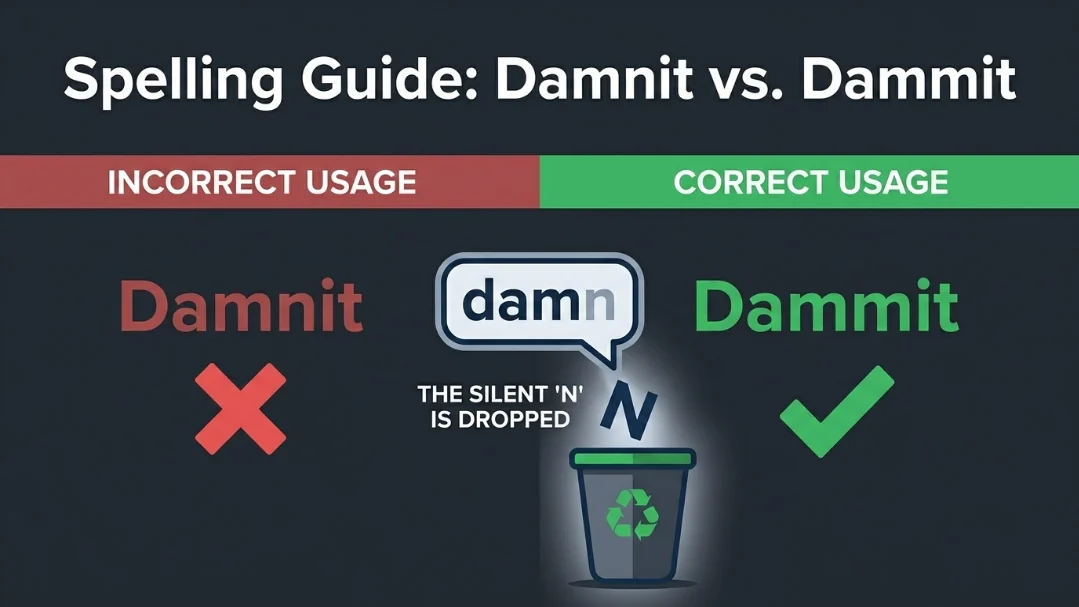
The correct spelling of this popular interjection is dammit, which is widely accepted by standard dictionaries like Merriam-Webster and Oxford. While damnit logical combines the root words “damn” and “it,” standard English usage treats it as a misspelling because the phonetic evolution dropped the silent “n” entirely. Therefore, you should always use dammit for formal writing, publication, and editing purposes.
Language possesses a fascinating ability to evolve based on how people speak rather than how they write. Consequently, daily speech often creates a disconnect between the phonetic sound of a word and its traditional etymological spelling. One of the most common examples of this linguistic tug-of-war appears when people try to type out an expression of frustration: damnit or dammit.
While individuals use this exclamation daily across the globe, a sharp divide exists regarding its correct representation on the written page. Writers frequently find themselves pausing mid-sentence, wondering whether they should preserve the silent letter of the original root word or embrace the phonetic spelling.
Understanding the correct choice matters because subtle spelling errors can quietly undermine the authority of your writing. Whether you are drafting a realistic dialogue sequence for a novel, writing a casual blog post, or editing a script, choosing the wrong variant can distract your readers. This comprehensive guide will analyze the mechanics behind damnit or dammit, explore their historical origins, and provide clear rules to ensure your writing remains polished, professional, and grammatically accurate.
Key Takeaway & Summary
If you are looking for a quick, definitive answer to the damnit or dammit debate, the solution is straightforward. You should use dammit in almost every writing scenario because it is the only form recognized by major dictionaries.
To help you visualize the core differences between these two spellings, review the summary table below.
| Dictionary Status | Officially recognized and approved | Listed strictly as a common misspelling |
| Phonetic Accuracy | High (matches actual spoken English) | Low (retains a confusing, silent letter) |
| Etymological Loyalty | Low (drops the original spelling of “damn”) | High (attempts to preserve the root word) |
| Acceptability in Publishing | Standard for fiction, scripts, and journalism | Generally rejected by professional copyeditors |
Definition and Explanation
To understand why dammit became the dominant spelling, we must look at how compound words develop. An interjection functions as a sudden exclamation that expresses an emotion like anger, surprise, or disappointment.
Originally, this specific interjection began as two distinct words: the verb damn and the pronoun it. When speakers utter these words during moments of irritation, they naturally slurred the two terms together into a single, continuous sound.
[Original Verb: damn] + [Pronoun: it]
       │
       ▼ (Natural Spoken Slur)
[Phonetic Assimilation: dam-it]
       │
       ▼ (Standardized Spelling)
[Accepted Interjection: dammit]
During this process of phonetic assimilation, the silent “n” in damn created a structural problem for written English. If a writer kept the “n” and wrote damnit, the spelling implied a pronunciation like “dam-nit” or “dam-night.
To resolve this issue and preserve the short “a” sound, early modern writers doubled the “m” and dropped the “n” entirely. As a result, dammit became an independent word with its own spelling, completely detached from the formal grammar rules governing the original verb.
Advantages and Disadvantages of Each Spelling
Analyzing the pros and cons of both variants reveals why the phonetic version ultimately triumphed in modern lexicography.
The Case for Dammit
Using the standard spelling offers several clear benefits for writers:
- Universal Recognition: Every major style guide and dictionary accepts this form as correct.
- Reading Flow: It reflects exactly what the reader hears in their mind, which prevents visual stuttering during a sentence.
- Typographical Balance: The double “m” creates a balanced visual weight on the page.
However, the primary disadvantage of this spelling is that it completely obscures the linguistic history of the word. Purists sometimes argue that dropping the “n” makes the word look uneducated, even though dictionaries disagree with this assessment.
The Case for Damnit
The single advantage of writing damnit is its strict adherence to etymological logic. Because the phrase explicitly means “may God damn it,” keeping the “n” honors the ancestral verb.
Unfortunately, the disadvantages far outweigh this single benefit:
- Red Flags for Editors: Automated spellcheckers and professional proofreaders will instantly flag it as an error.
- Phonetic Confusion: It introduces an awkward visual cue that does not align with spoken English.
- Lack of Authority: Using it can make a publication look unpolished or poorly researched.
Real-World Examples
To see how these spellings function in practice, let us examine their usage across different mediums. Dialogue writing in fiction relies heavily on exclamations to convey authentic human emotion.
“Oh, dammit, I left the keys inside the vault!” yelled the protagonist as the security doors slammed shut.
In this fictional context, the standard spelling effectively communicates urgency without drawing attention to the mechanics of the language.
Conversely, look at how the alternative spelling disrupts a sentence:
Incorrect: The mechanic looked under the hood, sighed, and muttered, “Damnit, the alternator is completely fried.”
When a reader encounters the phrase written this way, their brain often pauses to process the silent “n” cluster. Consequently, the dramatic tension of the scene loses its immediate impact.
In journalism and non-fiction, the term appears rarely due to its profane nature. However, when printing direct quotes, reputable newspapers like The New York Times consistently print dammit to maintain standard typographic uniformity.
Regional and Global Usage
English is a global language, which means spelling conventions often split across geographic lines. Interestingly, the preference for dammit remains remarkably consistent across different English-speaking nations, though subtle regional nuances still exist.
North American English
In the United States and Canada, dammit reigns supreme in printed literature, digital media, and subtitles. American dictionaries were among the first to formalize phonetic spellings for colloquial speech during the twentieth century. Despite this official stance, the variant damnit remains surprisingly common in casual text messages, internet forums, and social media posts within North America.
British and Commonwealth English
The United Kingdom, Australia, and New Zealand demonstrate an even stronger institutional preference for dammit. British literature has a long history of integrating stylized expletives into theatrical scripts and comedic novels.
While British writers occasionally use traditional alternative phrases like “dash it,” they universally prefer dammit over damnit when they want a stronger emphasis.
Common Mistakes and Corrections
The persistence of the incorrect spelling usually stems from a few predictable cognitive habits. Understanding these mental traps can help you eliminate them from your own writing.
Trap 1: The Root Word Fallacy
Writers often think, “I know how to spell damn, so I must simply add it to the end.” This logic ignores the fact that compounds often alter their root spellings to accommodate pronunciation changes.
- Incorrect: I need to finish this report tonight, damnit.
- Correct: I need to finish this report tonight, dammit.
Trap 2: Misinterpreting Autocorrect
Many digital devices learn from user behavior rather than official dictionaries. If you type the wrong version multiple times, your phone might save it as a preferred word, which reinforces the bad habit.
- Incorrect: Well, damnit, that is not what we planned.
- Correct: Well, dammit, that is not what we planned.
Exercises with Answers
Practicing with real sentences will reinforce your ability to spot correct and incorrect usage instantly. Identify the correct spelling in the following scenarios.
Exercise Set
- “________! I missed the train by thirty seconds,” shouted Marcus. (damnit / dammit)
- Sarah knew she shouldn’t swear, but a quiet “________” escaped her lips anyway. (damnit / dammit)
- The editor told the novelist to replace every instance of “________” in the manuscript. (damnit / dammit)
- If you keep saying “________,” people might think you lose your temper too easily. (damnit / dammit)
- The script supervisor noted that the actor clearly pronounced the word as “________” instead of “darn it.” (damnit / dammit)
Answer Key
- Dammit (This serves as an introductory interjection, requiring the standard dictionary form).
- dammit (Even when whispered or quiet, the phonetic spelling remains correct).
- damnit (The editor would want the incorrect form removed and replaced with the proper spelling).
- dammit (Standard usage applies here to maintain clean prose).
- dammit (Phonetic alignment requires the double “m” configuration).
Related Concepts and Comparisons
To broaden your command of conversational English, it helps to compare damnit or dammit to other linguistic mutations and euphemisms.
Phonetic Consonantal Assimilation
The transformation of “damn it” into dammit is not an isolated quirk of English history. It is a recognized linguistic process called assimilation, where neighboring sounds drive spelling changes over time.
Consider how the phrase “gimme” emerged from “give me,” or how “wanna” developed from “want to.” In each case, the written language adapted to reflect the real-world efficiency of human speech.
Minced Oaths
Because the word root carries religious weight, speakers throughout history have created “minced oaths”—intentional misspellings or mispronunciations designed to soften an offensive term.
The table below contrasts our focus keyword with common mild alternatives.
| Dammit | Darn it | Casual, family-friendly frustration |
| Dammit | Dang it | Regional, polite annoyance |
| Dammit | Confound it | Archaic, formal, or theatrical irritation |
| Dammit | Blimey | British slang expressing surprise |
FAQs
Is damnit a real word in the English language?
No, it is not an officially recognized word in standard English dictionaries. While people use it frequently in casual digital communication, lexicographers categorize it purely as a common spelling error.
Why does Microsoft Word flag damnit but accept dammit?
Microsoft Word relies on authoritative lexical databases to populate its spellcheck system. Because dictionaries recognize only the double-m variant, the software automatically flags the version with the silent “n” as a typo.
Can I use dammit in a formal business email?
You should generally avoid using this word in professional business emails entirely. Even though it has a correct spelling, the term remains a mild profanity that can offend clients or supervisors.
When did dammit first appear in printed literature?
Textual records show that phonetic spellings of the exclamation began surfacing regularly in the late nineteenth and early twentieth centuries. Playwrights and novelists popularized the form to capture authentic urban dialects.
Is the word dammit considered a swear word?
Yes, society classifies it as a mild expletive or profane interjection. It is less offensive than many vulgar terms, but it remains inappropriate for formal, academic, or professional environments.
What is the difference between dammit and goddammit?
Both terms function as expressions of anger, but the latter includes an explicit religious invocation. The compound rules remain identical, meaning you should always spell the longer version with a double “m” and no “n.
How do you pronounce the spelling damnit?
Most people who write it still pronounce it exactly like “dam-it.” However, if a reader strictly follows the phonetic rules of written English, the presence of the “n” encourages an incorrect “dam-nit” pronunciation.
Are there any style guides that allow the spelling damnit?
No mainstream journalistic or literary style guides authorize this variant. The Associated Press Stylebook, The Chicago Manual of Style, and the MLA Style Manual all require standard dictionary spellings.
Why do so many people still spell it damnit?
This error persists because the human brain values logical consistency. Because people know the base verb is spelled damn, they mistakenly assume that adding a suffix shouldn’t alter that foundational structure.
Should I capitalize dammit in a sentence?
You only need to capitalize the word if it appears at the very beginning of a sentence or stands alone as an independent exclamation. If it occurs in the middle of a sentence, keep it lowercase.
Conclusion
Navigating the nuances of English spelling can frequently feel like a minefield, especially when dealing with words born from spoken slang. The ongoing confusion surrounding damnit or dammit highlights a natural tension between logical historical roots and modern phonetic efficiency.
While etymological logic points toward retaining the silent “n,” linguistic consensus has firmly decided otherwise. Dictionaries, publishing houses, and automated spellcheckers universally validate dammit as the only correct, professional form.
When you write creative dialogue or informal prose, choosing the standard spelling ensures that your text remains clean, authoritative, and readable. Avoiding the incorrect variant prevents unnecessary disruptions to the narrative flow and preserves your professional credibility.
As a final recommendation, take a moment to update your personal digital dictionaries and autocorrect shortcuts on your devices. By actively enforcing this standard in your everyday communication, you will build a solid habit that naturally elevates the accuracy of your written work.