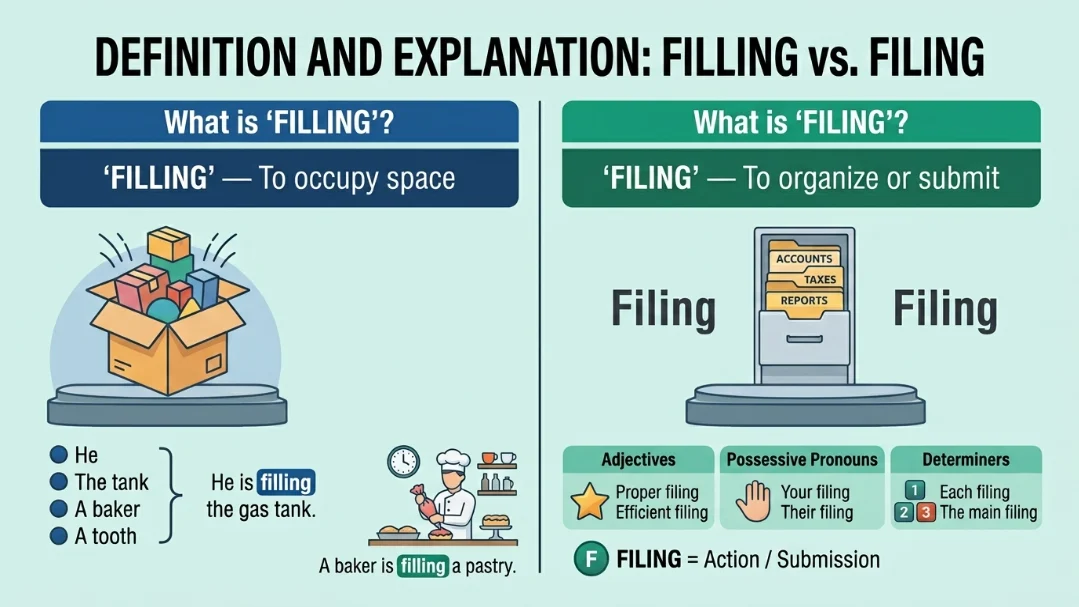
The core difference between filling and filing depends on the number of consonants and the vowel sound. Specifically, filling contains a double “l” with a short “i” sound and means to occupy an empty space, such as packing a box or treating a tooth cavity. In contrast, filing features a single “l” with a long “i” sound and refers to organizing records, submitting legal documents, or smoothing a rough surface.
Choosing between filling or filing represents a frequent challenge for professionals, students, and non-native English speakers alike. Although a single letter separates these two terms, misusing them completely alters the meaning of a sentence. For instance, telling your team that you are filling a report means something entirely different from saying you are filing a report. Consequently, confusing these terms can lead to significant misunderstandings in corporate communications, legal contexts, and medical settings.
This detailed, long-form guide provides a comprehensive breakdown of the linguistic boundaries between filling or filing. We will examine their distinct roots, explore practical everyday applications, and outline strategies to avoid common typos. Additionally, you will find targeted exercises to test your mastery. Understanding these distinctions will boost your writing confidence and ensure your professional communications remain clear, accurate, and impactful.
If you need a rapid method to distinguish between filling or filing, focus directly on the internal mechanics of the words. The word with two “l” letters packs things tightly together, while the word with one “l” organizes items sequentially.
Visual Comparison Table
The following matrix provides a quick reference point for identifying the differences between these two commonly confused terms at a glance.
| Consonant Count | Double L (ll) | Single L (l) |
| Vowel Pronunciation | Short “i” sound as in “sit” | Long “i” sound as in “bite” |
| Primary Meaning | Making something full or rich | Submitting documents or smoothing edges |
| Common Noun Context | Dental restorations, pie stuffings | IRS tax submissions, cabinet systems |
| Primary Verb Root | To fill | To file |
Definition and Explanation
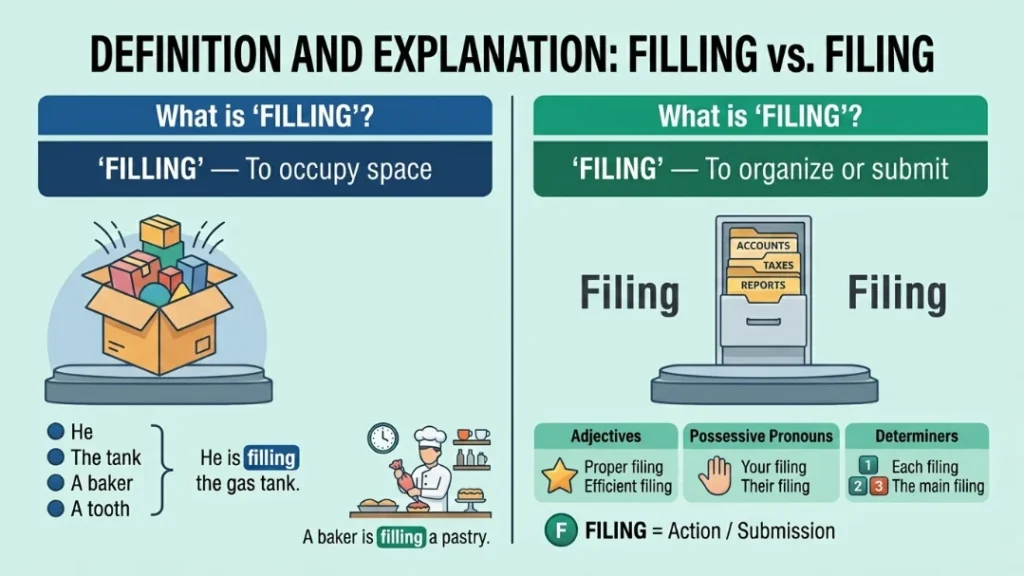
To master these terms completely, we must analyze their distinct grammatical properties and etymological functions. Both words can serve as verbs or nouns depending on the specific sentence structure.
Detailed Analysis of Filling
The word filling stems directly from the Old English verb fyllan, which means to occupy a void space. When acting as a participle or gerund, it represents the physical or abstract action of making something complete or crowded. For example, a worker might spend an afternoon filling orders in a large fulfillment warehouse.
When functioning as a noun, filling denotes the actual material used to occupy an empty space. In dental medicine, a dentist places a composite resin filling into a tooth to halt decay. In culinary environments, a baker whips up a sweet fruit filling to place inside a pastry crust. Therefore, the term always connects back to the core concept of occupancy and containment.
Detailed Analysis of Filing
Conversely, the word filing emerges from the Old French term filer, which originally referred to stringing documents together on a wire or thread. In modern usage, it functions as a participle or gerund indicating the systematic arrangement of information or the submission of legal notices. For instance, accountants spend the spring season filing tax returns for corporate clients.
Additionally, filing acts as a noun describing the methodical archiving of data. It can also describe a manufacturing byproduct. When an engineer uses a metal file to smooth a rough component, tiny particles called metal filings fall away. Hence, this term always links back to the structural concepts of order, legal registration, or abrasive reduction.
Advantages and Disadvantages in Communication
Utilizing the exact term when writing produces clear organizational benefits. Meanwhile, allowing errors to slip through can damage professional reputation.
Advantages of Precise Usage
- Enhanced Structural Clarity: Colleagues understand immediately whether you are actively packing an asset or registering an administrative document.
- Optimized Search Performance: Search engine spiders index well-crafted, grammatically flawless industry articles with higher authority scores.
- Flawless Automated Sorting: Corporate database systems process records far more accurately when text metadata matches the correct operational action.
Disadvantages of Careless Mistakes
- Severe Operational Delays: A warehouse crew might mistakenly attempt the physical loading of cargo because an email read filling instead of filing.
- Diminished Academic Trust: Evaluators frequently downgrade research reports when authors continually confuse foundational linguistic terms.
- Altered Legal Outcomes: Misspelling key actions in legal briefs can generate confusion during formal courtroom proceedings.
Real-World Examples
To better observe how these words operate, let us examine their functionality within several primary industries.
Corporate Administration
- Correct Use of Filling: The procurement team is currently filling the vacant storage shelves with fresh office supplies.
- Correct Use of Filing: The administrative assistant finished filing the client contracts in alphabetical order before leaving.
Financial Services
- Correct Use of Filling: The investment banker spent hours filling out the detailed financial questionnaire for the underwriters.
- Correct Use of Filing: The accounting firm managed the electronic filing of federal tax documentation ahead of the deadline.
Industrial Manufacturing
- Correct Use of Filling: Technicians are filling the large automated vats with liquid chemical formulas.
- Correct Use of Filing: The machinist wore safety goggles to protect his eyes from the flying iron filing debris.
Regional and Global Usage
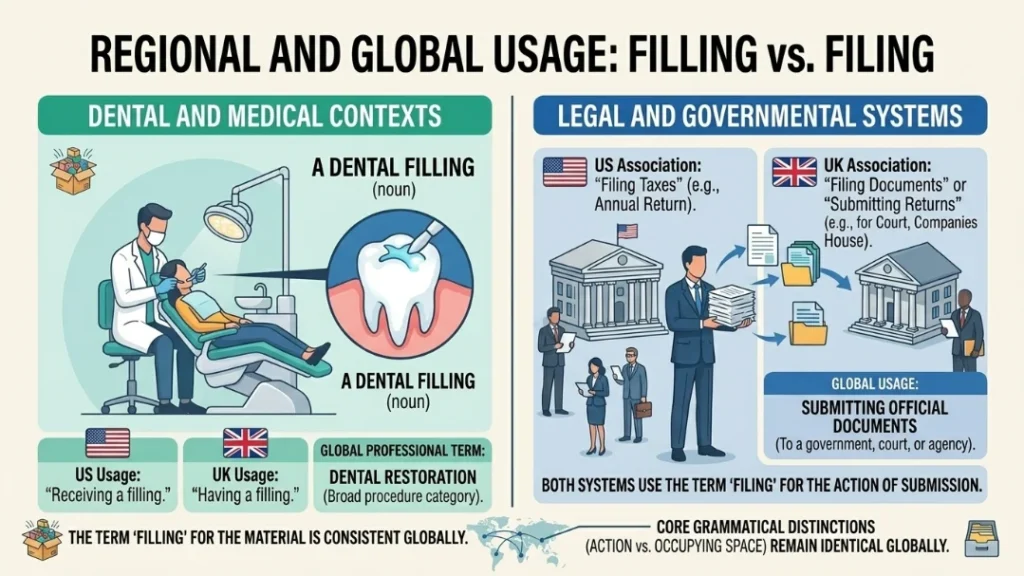
While the core definitions of filling or filing remain completely uniform across the globe, distinct industry preferences exist. These preferences vary by country and region.
Dental and Medical Contexts
In North American medical systems, practitioners use the noun filling to describe the restorative material placed in a tooth cavity. British dental professionals use identical terminology, though they may also refer to the broader procedure as a restoration. Globally, the term remains stable because anatomy requires an actual space to be occupied by a dense substance.
Legal and Governmental Systems
In the United States, citizens associate filing heavily with the Internal Revenue Service (IRS). Conversely, UK residents often discuss submitting documents to Companies House or HMRC rather than using the generic word filing quite as frequently. Despite these small regional preferences, the underlying grammatical mechanics remain identical across all English-speaking territories.
Common Mistakes
Many individuals struggle with filling or filing because their brains move faster than their fingers on a keyboard. Reviewing these structural errors will protect your work from common pitfalls.
The Double Consonant Typo
Writers frequently insert a double “l” when they intend to describe document management. This typo creates an awkward sentence that confuses readers.
- Incorrect: The paralegal spent the morning filling the lawsuits at the courthouse.
- Correct: The paralegal spent the morning filing the lawsuits at the courthouse.
Why it matters: Courts do not fill lawsuits with material; instead, they receive and record documents sequentially.
The Single Consonant Drop
Conversely, people often drop the second “l” when they want to describe the process of completing a form or adding liquid to a container.
- Incorrect: Please assist me in filing this bucket with water from the well.
- Correct: Please assist me in filling this bucket with water from the well.
Why it matters: A bucket holds volume, which means it requires the action of filling rather than the action of organization.
Confusion in Professional Titles
Office managers sometimes mislabel job descriptions due to spelling confusion. This error can attract candidates with the wrong skill sets.
- Incorrect: We are seeking a temporary clerk to assist with medical filling duties.
- Correct: We are seeking a temporary clerk to assist with medical filing duties.
Why it matters: A medical filing clerk manages charts, whereas a filling clerk might work in a pharmaceutical packaging plant.
Phonetic Breakthroughs and Memory Tricks
If you find yourself hesitating before typing filling or filing, you can use simple acoustic and structural memory tricks to make the right choice.
The Vowel Duration Anchor
Listen closely to how you say the words aloud. The word filling uses a short, sharp vowel sound that mirrors the words ill, chill, and spill. If liquid can spill, you are filling.
On the other hand, filing features a long, drawn-out vowel sound that mimics mile, pile, and style. If you are organizing a massive pile of paperwork, you are filing.
The Structural Analogy
Think about the letters themselves. The double “ll” in filling looks exactly like two parallel pillars blocking an open space. Those pillars take up physical room, which matches the idea of occupying a void.
The single “l” in filing looks like a single thin folder line standing upright inside an office cabinet. This visual connection links the spelling directly to organization.
Advanced Conceptual Deep Dives
To truly master these terms, advanced writers must look beyond basic dictionary definitions. Let us examine how these words act as metaphors and specialized jargon.
Abstract and Psychological Applications
The word filling frequently appears in discussions about human emotion and psychology. For example, people talk about filling an emotional void after experiencing a major life transition. In this context, the word signifies a deep search for meaning, connection, or satisfaction to replace an internal feeling of emptiness.
[Vacant Space / Emotional Void] ---> (Action of Filling) ---> [Complete State / Satisfaction]
Conversely, the word filing operates as a psychological metaphor for cognitive processing. Our brains routinely organize memories, skills, and sensory data into mental filing cabinets. This internal structure allows us to retrieve important information quickly when we encounter familiar situations.
[Incoming Sensory Information] ---> (Action of Filing) ---> [Systematic Cognitive Storage]
Digital and Computing Frameworks
In computer science and digital administration, both terms take on precise technical meanings. System engineers discuss filling database tables with user records to run stress tests. This action tests the limits of storage capacity and data architecture.
+-------------------------------------------------------------+
|                     DATABASE ARCHITECTURE                   |
+-------------------------------------------------------------+
| [Record 001] -> Filling Table Space -> [Occupied Storage]    |
| [Log.txt]    -> Filing Data Stream  -> [Indexed Directory]   |
+-------------------------------------------------------------+
| System Action: Filling expands volume; Filing maps order.    |
+-------------------------------------------------------------+
Meanwhile, network administrators manage digital filing structures to keep server directories organized. This ensures that users can locate files without running into broken path errors.
Related Concepts and Comparisons
To strengthen your understanding, let us compare filling or filing with other words that rely on double-consonant adjustments.
The Short Vowel versus Long Vowel Matrix
The English language contains many word pairs where a single consonant change completely alters the pronunciation and definition. Studying these patterns makes it much easier to remember the rules for filling or filing.
| Filling | Occupying a void space | Filing | Organizing or smoothing |
| Hopping | Leaping on one foot | Hoping | Wishing for an outcome |
| Tapping | Striking a surface gently | Taping | Binding with adhesive strips |
| Matting | Tangling fibers together | Mating | Pairing for reproduction |
Synonyms and Structural Alternatives
If you want to avoid using filling or filing repeatedly in a long document, you can use these precise alternatives to keep your writing fresh.
- Synonyms for Filling (Verb Context): Packing, loading, replenishing, stuffing, occupying, congesting.
- Synonyms for Filling (Noun Context): Content, stuffing, mixture, padding, lining, restorative material.
- Synonyms for Filing (Verb Context): Archiving, categorizing, cataloging, logging, registering, smoothing.
- Synonyms for Filing (Noun Context): Documentation, dossier submission, record-keeping, scrapings.
Exercises with Answers
Practicing with realistic sentences helps cement these spelling rules in your memory. Try to fill in the blanks in the sentences below using either filling or filing.
Practice Scenarios
- The shipping clerk is currently __________ the large wooden crates with protective foam peanuts.
- The legal secretary completed the electronic __________ of the appellate court brief at noon.
- A dental assistant noted that the patient required a composite __________ on tooth number fourteen.
- While __________ down the sharp metal edges of the frame, the technician noticed a microscopic crack.
- The Human Resources department is actively __________ the open positions for corporate accountants.
- The administrative team spends every Friday afternoon __________ invoices into the archive system.
- We must finish __________ the fuel tanks before the transport vehicles depart for the border.
- The state agency charges a nominal fifty-dollar fee for __________ an annual business registration.
- After hours of careful __________ with a diamond tool, the jeweler polished the edge of the silver ring.
- The chef demonstrated the delicate process of __________ the homemade ravioli with ricotta cheese.
Answers and Detailed Explanations
- filling (The sentence describes the physical action of packing an empty container with protective material.)
- filing (This context refers to the official legal submission of documentation to a court registry system.)
- filling (The noun form here specifies the restorative material used by dental professionals to treat a cavity.)
- filing (This example illustrates the abrasive action of using a hand tool to grind down and smooth a rough metal edge.)
- filling (The corporate phrase refers to occupying vacant job slots with qualified new employees.)
- filing (The task involves organizing paperwork into a structured storage archive for easy retrieval.)
- filling (This action involves adding liquid fuel to empty tanks until they reach maximum storage capacity.)
- filing (The financial phrase refers to submitting official paperwork and paying a processing fee to a government office.)
- filing (The phrase refers to using a precision hand tool to smooth, abrade, and shape a piece of fine jewelry.)
- filling (The culinary process describes adding delicious ingredients inside a pocket of fresh pasta dough.)
FAQs
What is the main difference between filling or filing?
The primary difference lies in the spelling, pronunciation, and meaning. Specifically, filling features a double “l,” uses a short vowel sound, and means occupying an empty space. In contrast, filing uses a single “l,” features a long vowel sound, and means organizing records or smoothing a surface.
Can you use the word filling when talking about taxes?
No, you should not use filling when discussing tax submissions. The correct phrase is filing taxes, which refers to the act of submitting your official forms to a revenue agency like the IRS.
What does it mean when a dentist recommends a filling?
When a dentist recommends a filling, they are referring to a restorative procedure. The dentist cleans away decay and uses a material like composite resin to occupy the empty space left behind.
Is it correct to say filling a lawsuit or filing a lawsuit?
The correct legal phrase is always filing a lawsuit. This term describes the formal act of submitting legal complaints and documentation to a court clerk to initiate a case.
Why does filling have a short vowel sound while filing has a long vowel sound?
In English orthography, a double consonant like the “ll” in filling shorts the preceding vowel. A single consonant followed by a vowel suffix like the “l” in filing allows the primary vowel to maintain its long sound.
What are metal filings?
Metal filings are tiny, powdery fragments of metal shaved off during manufacturing. They are created when a worker rubs a hard tool against a metal component to smooth its rough edges.
How do I know whether to write filling out a form or filing out a form?
The correct phrase is filling out a form. This expression means you are adding information to the blank spaces on a document until it is complete.
Can a single document require both filling and filing?
Yes, a document often requires both actions in sequence. You begin by filling out the blank spaces on the application, and then you complete the process by filing the document with the proper department.
Is filing considered a present-tense or past-tense word?
The word filing functions as a present participle or a gerund. To describe the action of organization in the past, you must use the past-tense verb filed.
Conclusion
Understanding the differences between filling or filing prevents confusion and keeps your writing sharp. While a single consonant change seems small, it fundamentally alters how a reader interprets your message. By paying attention to these spelling details, you ensure that your professional documents, emails, and reports read clearly and accurately.
To keep these rules straight, focus on what you are trying to accomplish in your sentence. Use filling with a double “l” when your goal is to occupy an empty space, pack a container, or treat a cavity. Choose filing with a single “l” when you need to submit formal documents, organize records, or smooth down a rough surface. Following these simple guidelines will improve your communication style and protect your professional credibility.