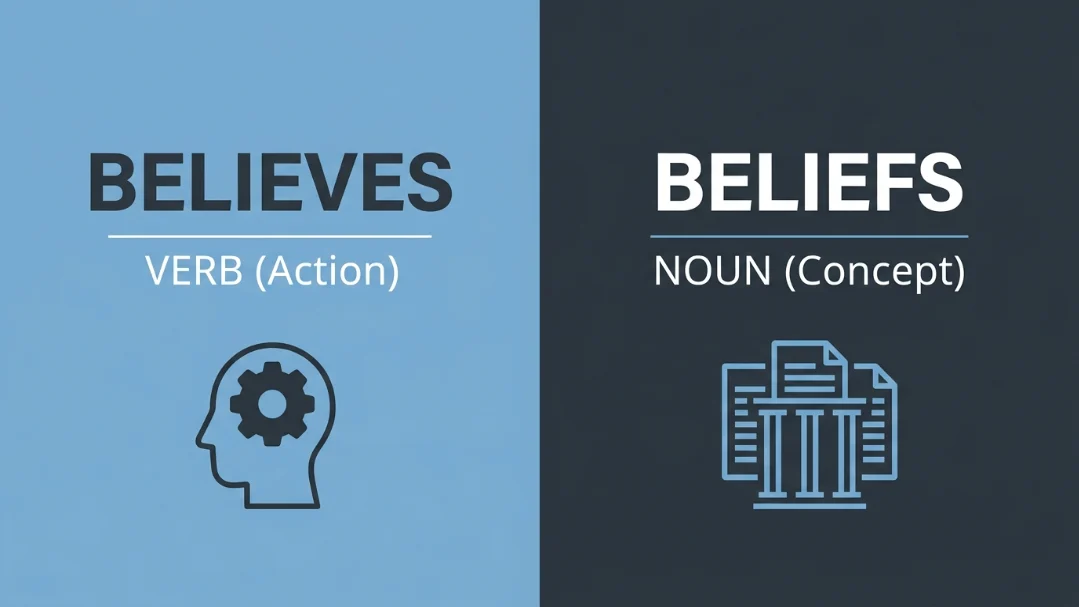
The primary difference between believes or beliefs rests entirely on their parts of speech. “Believes” functions as the third-person singular form of the verb “believe,” which describes the active process of accepting something as true. In contrast, “beliefs” serves as a plural noun that refers to the actual ideas, convictions, or tenets that a person holds held to be true.
Language serves as the ultimate bridge for human connection, yet small spelling variations frequently cause major confusion. A primary example of this linguistic friction appears when writers must choose between believes or beliefs. While these two terms share an identical core meaning rooted in trust and acceptance, they perform entirely different grammatical roles within a sentence. Using the wrong form can instantly disrupt the flow of your writing, confuse your audience, and lower the perceived professionalism of your content.
Understanding the boundary between a verb and a noun remains essential for anyone who creates written content. Whether you compose an academic essay, write a corporate email, or optimize a digital article for search engine optimization, linguistic precision matters. Choosing correctly between believes or beliefs ensures your message remains crystal clear.
This comprehensive guide breaks down the core definitions, provides visual comparison data, and offers real world scenarios. By exploring these foundational structures, you will learn to spot errors instantly and apply the correct term naturally. Let us dive deep into the mechanics of these essential words to elevate your writing clarity today.
If you require a quick mental shortcut to keep these terms distinct, focus on the action versus the object. Use “believes” when a specific subject acts out their faith, trust, or confidence in an idea. Choose “beliefs” when you describe the collection of principles, doctrines, or values that exist as things.
The following summary table offers an immediate snapshot of the core distinctions between the two terms:
| Part of Speech | Third-person singular verb | Plural noun |
| Core Function | Expresses an action or mental state | Names a set of ideas or convictions |
| Typical Context | Paired with singular subjects like he, she, or it | Accompanied by adjectives or possessives |
| LSI Synonyms | Accepts, trusts, maintains, considers | Convictions, tenets, values, principles |
| Singular Form | Believe (base verb form) | Belief (singular noun form) |
Definition and Explanation
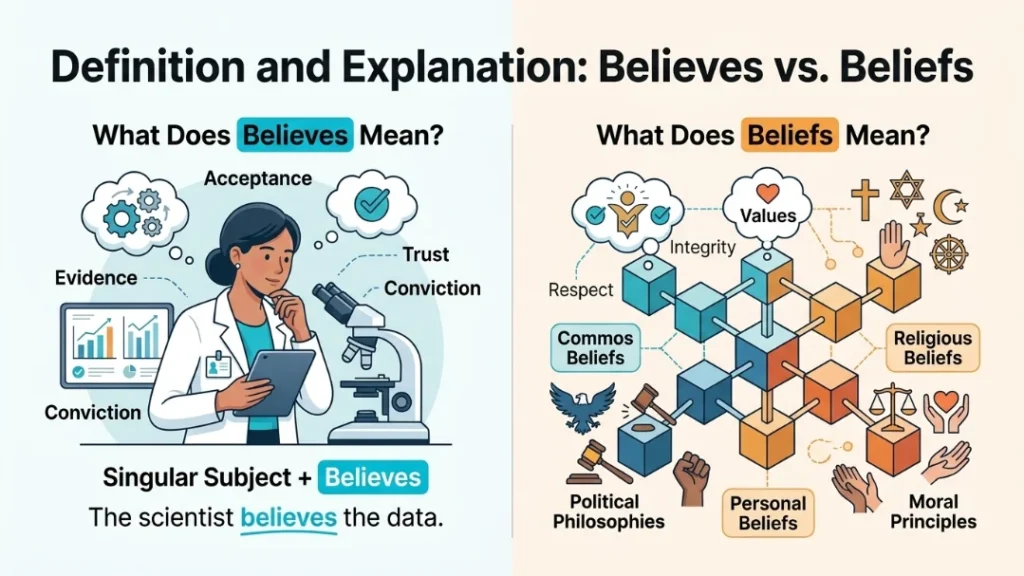
To master believes or beliefs, we must examine the architectural roots of each word within English sentences. Linguistic clarity begins with a precise understanding of how these words transform from abstract concepts into functional communication tools.
What Does Believes Mean
The term “believes” represents the present tense, third-person singular form of the verb “believe.” It originates from Middle English roots that signify holding an opinion, trusting a person, or accepting a statement as factual truth. Whenever an individual, an organization, or a singular entity holds confidence in something, that entity actively believes.
Because it operates as a verb, “believes” requires a singular subject to drive the action forward. For instance, in the phrase “the scientist believes the data,” the word “believes” bridges the subject with the underlying truth. It denotes a continuous state of mental acceptance or intellectual certainty regarding a concept.
What Does Beliefs Mean
The term “beliefs” functions exclusively as a plural noun, representing the actual ideas, thoughts, and philosophies that people maintain. It names the tangible or intangible tenets that shape human culture, guide political systems, and define personal morality. While the verb describes the psychological action, the noun represents the psychological product.
Because “beliefs” acts as a plural noun, it frequently pairs with modifiers, articles, or possessive pronouns. Phrases like “core beliefs,” “religious beliefs,” or “their personal beliefs” demonstrate how this word groups multiple ideas together. It categorizes the architectural building blocks of an individual’s worldview.
Advantages and Disadvantages of Precise Usage
Maintaining a strict separation between believes or beliefs yields profound benefits for writers, readers, and digital creators. Conversely, neglecting this grammatical boundary introduces several distinct vulnerabilities into your text.
Advantages of Correct Grammar
Using the correct grammatical form directly enhances your professional authority across all media platforms. When a reader encounters flawless syntax, their trust in your core message increases exponentially. Clear sentence structures prevent cognitive friction, allowing your audience to absorb complex arguments without stopping to decipher typos.
From a digital publishing standpoint, search engines prioritize high quality, grammatically accurate text. Clean writing improves user engagement metrics, such as time on page and reduced bounce rates. Consequently, proper usage indirectly boosts your search engine optimization rankings by signaling editorial excellence to algorithmic crawlers.
Disadvantages of Grammatical Errors
Misusing believes or beliefs instantly detracts from the analytical weight of your commentary. Casual readers may view grammatical errors as a sign of intellectual carelessness or rushed editing. In high stakes environments, such as legal briefs, corporate proposals, or medical documentation, a single error can compromise your professional reputation.
Furthermore, grammatical confusion muddles the underlying logic of your sentences. Mixing up nouns and verbs disrupts the syntactic rhythm, forcing the reader to re-read sentences multiple times to understand the context. This extra effort drives users away from your content, ultimately damaging your brand loyalty.
Real World Examples
Contextualizing these terms through practical scenarios helps solidify the differences between believes or beliefs. Observing how these words interact with adjacent parts of speech clarifies their distinct roles in everyday language.
Examples of Believes in Action
- The lead developer believes that upgrading to a solid state drive will resolve our database latency issues.
- History shows that when a society believes in equal opportunity, economic innovation thrives across all sectors.
- She firmly believes that regular physical exercise improves cognitive function and reduces workplace stress levels.
- Our legal team believes the revised contract protects our intellectual property rights more effectively than the original draft.
Examples of Beliefs in Action
- Sociologists study how ancient cultural beliefs influenced the architectural designs of early Mediterranean civilizations.
- We must respect the diverse religious beliefs of every employee to maintain an inclusive, collaborative corporate environment.
- Political analysts argue that deep seated philosophical beliefs often dictate voter behavior more than immediate economic incentives.
- Her core beliefs regarding environmental sustainability inspired her to launch a local zero waste recycling initiative.
Regional and Global Usage
Linguistic patterns can shift across global borders, but the grammatical rules separating believes or beliefs remain uniform worldwide. Whether you write in British English, American English, or Australian English, the fundamental mechanics do not alter.
Western Linguistic Consistency
In both American and British literary traditions, the division between third-person singular verbs and plural nouns remains absolute. Standard editorial guides, including the Chicago Manual of Style and the Oxford Style Guide, enforce identical parameters for these expressions. No regional dialects swap these terms in formal communication.
However, stylistic preferences surrounding the types of beliefs discussed can vary between cultures. For example, American corporate literature frequently emphasizes “corporate core beliefs” when discussing mission statements. Meanwhile, British organizational text may lean toward terms like “corporate values” or “guiding principles” to convey identical ideas.
Global English Contexts
For non-native English speakers learning standard international business communication, mastering this word pair represents a critical milestone. Because many languages use a single root word for both actions and concepts, blending these terms occurs frequently. International publishing standards demand rigorous adherence to these distinctions to ensure seamless cross border collaboration.
Common Mistakes and Corrections
Even seasoned professionals occasionally falter when typing quickly, leading to frequent errors involving believes or beliefs. Identifying these frequent pitfalls allows you to implement proactive editing strategies.
Mixing Subject-Verb Agreement
A widespread error occurs when writers pair the plural noun “beliefs” with a singular verb, or vice versa. This mistake breaks the structural integrity of the sentence, creating immediate confusion for the reader.
- Incorrect: The team’s core believes guide their daily operations and long term strategic goals.
- Correct: The team’s core beliefs guide their daily operations and long term strategic goals.
Confusing the Plural Verb with the Plural Noun
Writers sometimes use the verb form when they intend to describe a collection of thoughts held by a community. This error typically happens because both words end with an “s” sound, causing auditory confusion during drafting.
- Incorrect: Traditional believes regarding agriculture dictated that planting should always align with lunar cycles.
- Correct: Traditional beliefs regarding agriculture dictated that planting should always align with lunar cycles.
Incorrectly Dropping the “s” from the Verb
When writing about a singular entity, individuals occasionally substitute the base verb form for the third-person singular form.
- Incorrect: The chief executive officer believe that market expansion will stabilize our quarterly revenue.
- Correct: The chief executive officer believes that market expansion will stabilize our quarterly revenue.
Exercises with Answers
Practicing with targeted sentence completion tasks reinforces the mental pathways required for error-free writing. Complete the following ten exercises by selecting the correct option between believes or beliefs.
Sentence Completion Tasks
- The lead researcher __________ that the new partition table format will prevent sudden data loss during a system boot.
- Many ancient civilizations structured their communities around deeply held spiritual __________.
- Every individual on our engineering team holds unique __________ regarding the future of decentralized computing networks.
- Management firmly __________ that migrating our legacy infrastructure to a modern cloud server will lower operational costs.
- When a culture collectively __________ a rumor, correcting that misinformation becomes a monumental social challenge.
- The human resources department updated the handbook to protect the diverse personal __________ of our global workforce.
- He __________ that installing a modern unified extensible firmware interface will optimize the computer’s startup sequence.
- Philosophers spend lifetimes analyzing how foundational __________ shape human political systems over centuries.
- Our legal counsel __________ that the defendant acted in accordance with established industry standards.
- Environmental scientists argue that public __________ regarding climate change do not always align with empirical data.
Answer Key and Explanations
- believes | Explanation: The sentence requires a third-person singular verb to match the singular subject “lead researcher.”
- beliefs | Explanation: The modifier “deeply held spiritual” signals that a plural noun is necessary to fill the object position.
- beliefs | Explanation: The word “unique” acts as an adjective modifying a plural noun, describing the actual concepts held by the team.
- believes | Explanation: The singular noun “management” requires the third-person singular verb form to complete the action.
- believes | Explanation: The singular noun “culture” acts as the subject performing the mental action of acceptance, requiring the verb form.
- beliefs | Explanation: The possessive phrase “personal beliefs” correctly labels the collection of thoughts belonging to the workforce.
- believes | Explanation: The pronoun “he” serves as a singular subject, which directly demands a third-person singular verb.
- beliefs | Explanation: The adjective “foundational” modifies the plural noun that represents the abstract principles under analysis.
- believes | Explanation: The singular subject “legal counsel” needs the active verb form to express their professional opinion.
- beliefs | Explanation: The word functions as a plural noun acting as the subject of the subordinate clause, modified by the adjective “public.”
Related Concepts and Comparisons
To deepen our understanding of believes or beliefs, we must examine adjacent linguistic concepts. Exploring related words illuminates the broader ecosystem of language mechanics and prevents secondary errors.
Believe vs. Belief
The relationship between the singular forms mirrors the relationship between the plural forms exactly. “Believe” represents the base verb form used for plural subjects, such as “they believe” or “we believe.” Meanwhile, “belief” serves as the singular noun that describes a solitary conviction or specific tenet.
Convictions, Values, and Tenets
When building out content, using synonyms strategically prevents your text from sounding repetitive. While “beliefs” represents a broad category, more specific words can add nuance to your commentary. Consider the following distinctions:
- Convictions: These represent deeply rooted beliefs that an individual holds with absolute certainty, rarely changing even under immense social pressure.
- Values: This term describes the moral principles that guide an individual’s behavior and dictate their choices in life.
- Tenets: These signify the formal, documented doctrines or principles held true by a specific group, organization, or religion.
The table below contrasts these related concepts against standard usage patterns:
| Beliefs | General descriptions of ideas | Neutral | Personal beliefs |
| Convictions | Strong, unshakeable stances | Intense | Moral convictions |
| Values | Behavioral standards | Ethical | Corporate values |
| Tenets | Official group doctrines | Formal | Legal tenets |
FAQs
Here are answers to some frequently asked questions about these terms:
Is it correct to say someone’s believes?
No, it is incorrect to use that phrasing. The word “someone’s” indicates possession, which means it must always precede a noun rather than a verb. Therefore, you must write “someone’s beliefs” to refer to the ideas that a person possesses.
How do you use believes in a professional sentence?
To use this verb professionally, pair it with a singular subject to describe an analytical stance or strategic confidence. For example, you can write, “The chief financial officer believes that our current investment strategy will yield high dividends.”
Can beliefs be used as a verb in any context?
No, it cannot function as a action word under any circumstances. It serves exclusively as a plural noun in standard English grammar. If you require a plural action word, you must drop the “s” and use the base verb “believe.”
What is the singular form of the noun beliefs?
The singular form of this noun is “belief.” You should use the singular form when you discuss a solitary idea, trust, or conviction held by an individual, such as “a deep belief in justice.”
Why do people frequently confuse believes or beliefs?
People confuse these terms because they sound incredibly similar when spoken aloud in conversation. Additionally, because both words terminate with an “s,” writers mistakenly assume they represent interchangeable plural variations of the same root word.
How can I remember the difference between believes or beliefs quickly?
Remember that the word “believes” contains a “v,” which stands for verb. Conversely, the word “beliefs” contains an “f,” which can remind you of foundational facts or faith, which are things (nouns).
Is beliefs considered an abstract noun or a concrete noun?
It is classified as an abstract noun. Because you cannot physically touch, see, or measure an individual’s convictions with your physical senses, the word represents an intellectual concept rather than a physical object.
Does the choice between believes or beliefs affect SEO optimization?
Yes, search engines scan your text for semantic accuracy and grammatical authority. Misusing these terms creates a poor reading experience, which can negatively impact user metrics and subtly lower your search visibility over time.
Can a corporate mission statement include both terms?
Yes, a mission statement can incorporate both words if they occupy correct grammatical positions. For instance: “Our founder believes in transparency, and these core beliefs drive our commitment to ethical client services across the globe.”
Conclusion
Mastering the distinction between believes or beliefs remains a fundamental requirement for executing high quality communication. By understanding that “believes” operates as a third-person singular verb and “beliefs” functions as a plural noun, you eliminate structural errors from your writing portfolio. This precision removes cognitive barriers for your audience, allowing your ideas to stand at the forefront of your work.
As digital landscapes continue to expand, editorial excellence serves as a powerful differentiator for brands and individual creators alike. Implementing systematic proofreading workflows ensures your copy maintains the professional authority your audience expects. Avoid relying solely on automated grammar software; instead, develop an intuitive understanding of subject-verb agreement and parts of speech.
We highly recommend maintaining a personalized style guide that highlights tricky word pairs to reference during your drafting process. Consistently applying these linguistic standards will elevate the clarity of your articles, emails, and academic submissions. Commit to precision today, and watch your written communication achieve greater influence and reach across all platforms.