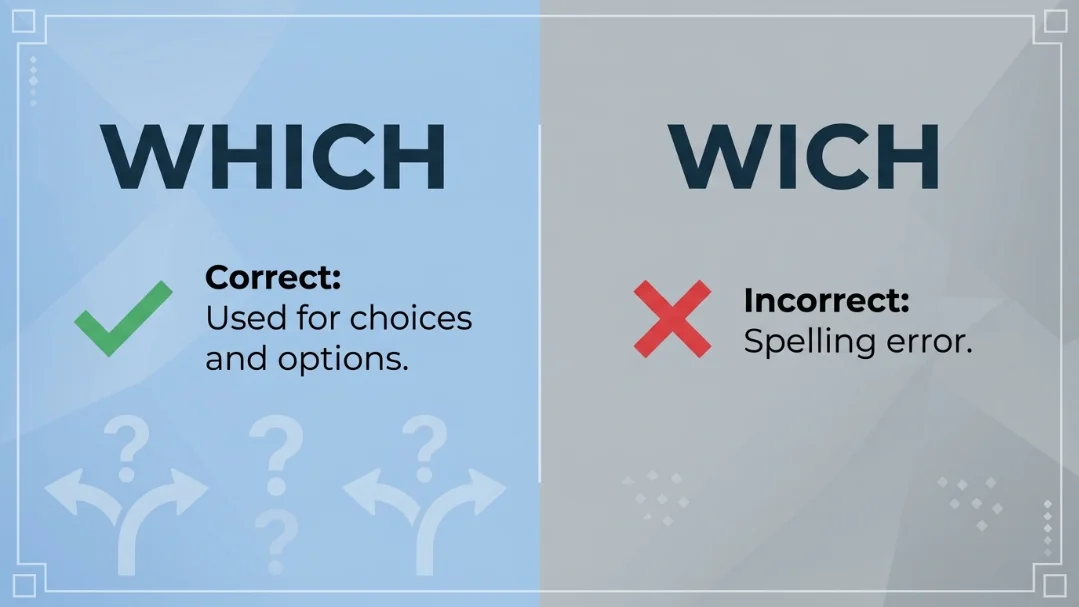
The correct spelling is which, a relative pronoun and determiner used to introduce choices or add information to a sentence. The spelling wich is an incorrect variant that does not exist as a standalone word in standard English, though it appears as a suffix in historical place names like Norwich or Greenwich. Always use which when asking a question or clarifying a specific item from a group.
Have you ever paused while typing and wondered, “Is it wich or which?” You’re not alone. This is one of the most frequently searched English spelling questions because the two words sound identical, yet only one is correct. A single missing letter can make your writing appear less polished, whether you’re sending an important email, submitting an assignment, or posting online.
If you’ve searched for wich or which, which or wich, which vs wich, or even wich vs which, this guide provides the clear, evidence-based answer. We’ve reviewed standard English dictionaries, grammar references, and real-world usage to explain not only the correct spelling but also why this mistake happens and how to avoid it permanently.
Many people accidentally type wich because they are writing quickly or are unsure about the spelling of which. Others wonder about the wich meaning or search how to spell wich, assuming it may be an alternative spelling. In reality, modern English recognizes which as the correct word in almost every context, while wich is generally a misspelling except in a few rare historical or proper-name uses.
In this comprehensive guide, you’ll learn the difference between wich or which, see wich or which examples, understand the grammar behind the correct spelling, and discover simple memory tricks that help you choose the right word every time. By the end, you’ll write with greater confidence and never second-guess wich o which again.
Key Takeaway & Summary
If you are looking for a rapid solution to your spelling dilemma, the answer is straightforward. The word which is a legitimate English word. The word wich is a misspelling.
- Which is the term you need for questions, options, and descriptions.
- Wich is an invalid word on its own and will trigger spellcheckers.
Think of the letter H in which as a helpful signpost. Just like the words who, what, where, when, and why, the word which belongs to the family of question words. Every single member of this family requires the letter H. If you notice that you have left the H out, your spelling is incomplete.
Definition and Deep Explanation
To understand why which is so important, it helps to look at its grammatical functions. It is not just a filler word; it performs heavy lifting in the structure of English sentences. It primarily serves as an interrogative pronoun, a relative pronoun, or a determiner.
Interrogative Pronoun and Determiner
When you use which as an interrogative tool, you are asking someone to make a choice from a specific, limited set of alternatives. It narrows down the possibilities.
- As a pronoun: Which is your favorite color?
- As a determiner: Which path should we take to reach the summit?
In both cases, the word signals that a selection must be made from an implied or stated group of options.
Relative Pronoun
When acting as a relative pronoun, which introduces a clause that provides extra information about a non-human noun. It connects thoughts together so your writing flows smoothly.
- The report, which took three weeks to complete, was finally submitted today.
- The company bought a new software package, which will automate our billing.
The Etymology of Which
The word traces its roots back to Old English, where it appeared as hwilc. Over centuries, the spelling shifted, but the Germanic root always maintained a guttural or aspirated sound that eventually stabilized into the modern wh spelling.
The Strange Case of Wich
While wich is incorrect as a standalone word, it does have a historical footprint. In old English, wic referred to a village, dwelling, or a trading settlement, particularly one associated with salt production.
Today, this historical word only survives as a suffix embedded within proper nouns and geographical locations. You can spot it in famous locations across the globe:
- Ipswich
- Sandwich
- Greenwich
- Norwich
Unless you are writing a specific geographical name, the letters W-I-C-H should never stand alone in your prose.
Advantages and Disadvantages of Correct Usage
Using correct grammar and spelling yields profound benefits in your personal and professional life. Conversely, falling into lazy habits carries distinct disadvantages.
Advantages of Correct Spelling
- Professional Authority: Clean text signals attention to detail. Clients, managers, and instructors judge your competence based on your written output.
- Clarity of Communication: When you spell words correctly, you remove friction for the reader. They absorb your ideas immediately without stalling on errors.
- Search Engine Optimization: For digital content creators, using correct words ensures search engines index your pages accurately. Algorithms prioritize high-quality, grammatically precise content.
- Avoidance of Automated Flagging: Modern applicant tracking systems and grading software automatically downgrade documents that contain repetitive typos.
Disadvantages of Making Spelling Errors
- Loss of Trust: A reader might assume that if you are careless with basic spelling, you may also be careless with important facts, numbers, or financial data.
- Distraction: Typographical errors pull the reader out of the narrative or argument, breaking the psychological flow of your piece.
- Communication Breakdown: In complex technical documents, a misspelled word can confuse readers who may wonder if wich refers to an obscure technical acronym or a specialized tool.
Comprehensive Comparison between Which and Similar Terms
To further clarify how which functions, we can compare it to other homophones and close matches that frequently appear in English writing. The table below outlines these distinctions clearly.
| Which | Pronoun / Determiner | Used to specify or choose an item | Which book did you buy? |
| Wich | Noun Suffix | Historical term for a village or salt works | He moved to Norwich last year. |
| Witch | Noun | A person who practices magic or sorcery | The witch stirred the bubbling potion. |
| Sandwich | Noun | Two slices of bread with a filling | She ate a turkey sandwich for lunch. |
Real-World Examples and Scenarios
Context is the best teacher. Let us look at how these terms function across various environments, from corporate boardrooms to casual settings.
Business and Corporate Communication
In professional emails, clarity prevents costly mistakes. Notice how the word coordinates options:
“We have received two competing bids for the construction project. Which vendor do you believe offers the best long-term value for our infrastructure needs?”
If an employee wrote wich in this context, the executive reviewing the message might view the employee as unpolished or rushed.
Academic and Scientific Writing
In research papers, which serves to add non-restrictive detail to experiments and data points:
“The team utilized a specialized spectrometer, which allowed them to analyze the chemical composition of the soil samples with absolute precision.”
Here, the word safely introduces a clause that expands on the utility of the spectrometer without disrupting the primary statement.
Everyday Casual Conversations
In daily text messages or casual emails, the word helps organize social activities:
“I am standing in the theater lobby right now. Which movie tickets did you end up booking for tonight’s show?”
Regional and Global Usage Trends
The confusion between which or wich is not restricted to a specific country. It is a global phenomenon driven by the phonetic nature of modern languages.
The Phonetics of the Wh Sound
In historical English dialects, the letters wh were pronounced with a distinct breathy whistle, technically known as a voiceless labial-velar fricative. If you listen to older Scottish dialects or certain regional accents in the American South, you can still hear a subtle difference between the pronunciation of wine and whine.
However, in the vast majority of modern English dialects around the world, a linguistic shift called the wine-whine merger has occurred. This means that wh and w are pronounced exactly the same way. Because which sounds identical to a hypothetical word spelled wich, the brain naturally defaults to the shortest phonetic spelling when a writer is tired or distracted.
Digital and Mobile Typing Trends
The rise of mobile communication has accelerated spelling errors globally. Predictive text and autocorrect systems usually catch the omission of the letter H, but if a user accidentally saves wich into their smartphone dictionary, the device will stop correcting it. This results in an influx of informal public posts, tweets, and comments featuring the incorrect spelling.
Common Mistakes and How to Correct Them
Understanding the mistake is the first step toward eradication. Let us review the most frequent errors writers make and look at immediate fixes.
1: Leaving out the H in questions
- Incorrect: Wich team won the championship match yesterday?
- Correct: Which team won the championship match yesterday?
2: Confusing a magic practitioner with an option
- Incorrect: I need to find out witch road leads back to the main highway.
- Correct: I need to find out which road leads back to the main highway.
- 3: Misspelling geographical suffix terms
- Incorrect: The historic town of Greenwhich is beautiful in the autumn.
- Correct: The historic town of Greenwich is beautiful in the autumn.
The Memory Trick
To permanently fix this error in your mind, remember this simple mental phrase:
“Choose which whale to watch.”
The act of choosing requires the word that starts with wh. Since whales live in the water, matching the wh of choice to the wh of the whale gives you a clear visual anchor.
Exercises with Answers
Put your knowledge to the test. Read the following sentences and decide whether the sentence requires which, witch, or if it features a correct geographical suffix.
Practice Questions
- Could you please tell me ________ laptop belongs to the design department?
- The old storybooks tell tales of a wicked ________ who lived deep within the dark forest.
- Our company’s European headquarters is located in the vibrant city of Nor________.
- The strategy document, ________ was updated by the management team last night, outlines our quarterly goals.
- I cannot decide ________ flavor of ice cream I want to order.
- She made a delicious ham and cheese ________ for her afternoon picnic.
- ________ assignment should I focus on completing first?
- The printer ________ is sitting on the second floor is currently out of ink.
Answer Key and Explanations
- Which | Explanation: This sentence asks for a choice between specific options, requiring the interrogative pronoun.
- Witch | Explanation: The sentence refers to a mythical figure who casts spells, which requires the spelling with a T.
- wich | Explanation: This is part of a British place name (Norwich), where it functions as a historical suffix.
- which | Explanation: This serves as a relative pronoun introducing extra information about the strategy document.
- which | Explanation: The speaker is selecting from a group of flavors, which demands the standard spelling.
- sandwich | Explanation: The sentence refers to food, combining the root word with the correct suffix.
- Which | Explanation: This is a direct question asking for a selection among multiple assignments.
- which | Explanation: This relative pronoun links the specific printer to the description of its location.
Advanced Grammar: Restrictive vs. Non-Restrictive Clauses
For advanced writers, understanding which requires looking at its relationship with the word that. This is one of the most fiercely debated topics in style guides across the English-speaking world. The choice between these words depends entirely on whether your clause is restrictive or non-restrictive.
Non-Restrictive Clauses (Using Which)
A non-restrictive clause adds bonus information to a sentence. If you remove this clause entirely, the core meaning of the sentence remains completely unchanged. In American English, non-restrictive clauses must be set off by commas, and they must use which.
- Our office building, which was painted blue last summer, houses forty different businesses.
- If you remove the detail about the blue paint, the reader still knows exactly what the sentence is about: Our office building houses forty different businesses. The paint color is simply a nice extra detail.
Restrictive Clauses (Using That)
A restrictive clause contains vital information that identifies the specific noun you are talking about. If you delete a restrictive clause, the sentence loses its primary meaning or becomes confusingly vague. These clauses do not use commas, and they typically employ that in American English.
- The office building that was painted blue houses forty different businesses, while the red building houses only ten.
- In this scenario, the paint color is not bonus information. It is the exact characteristic used to distinguish one specific building from the other. Leaving it out destroys the logic of the comparison.
By mastering this subtle distinction, you will ensure your writing meets the highest academic and journalistic standards.
FAQs
Is wich ever a correct spelling in standard English?
No, wich is never a correct standalone word in modern standard English. It is an outdated linguistic term that only exists today when it is attached to the end of specific place names or food items, such as Ipswich or sandwich.
Why do people write wich instead of which?
People write wich because modern English pronunciation treats wh and w identically. Because the letter H is completely silent when you say the word aloud, writers often leave it out during fast typing sessions.
What is a simple trick to remember the spelling of which?
Remember that which is part of the question word family. Just like who, what, where, when, and why, the word which must always start with the letters wh.
Is there a difference between which and witch?
Yes, they are completely different words. Which is a tool used to outline choices or add descriptive details. A witch is a noun that describes a folklore character who possesses magical powers and rides a broomstick.
Can I start a complete sentence with the word which?
Yes, you can start a sentence with which when you are formulating a direct question, such as: “Which path leads to the main office?” However, starting a descriptive sentence with it in formal writing can accidentally create an ungrammatical sentence fragment if you are not careful.
How does autocorrect handle the word wich?
Most modern smartphone and computer autocorrect engines will recognize wich as a typo and instantly convert it to which. However, if you accidentally hit accept on the error, your device may memorize the mistake.
Is it correct to use which when talking about humans?
No, you should generally avoid using which to refer to people. Instead, use who or whom. For example, write “The manager who hired me is away,” instead of “The manager which hired me is away.”
What is the historical meaning of the suffix wich?
The historical suffix wich originates from old Germanic and English words that indicated a coastal village, a harbor, or an area containing saltwater springs used for harvesting salt.
Does British English use wich differently than American English?
No, both British English and American English follow identical rules regarding this word. Both language systems reject wich as an independent word and mandate which for all grammatical functions.
How do you spell the food item made with bread: sandwich or sandwhich?
The correct spelling is sandwich. Even though the word which is inside our minds, the food item uses the historical suffix structure, meaning it does not contain the extra letter H near the end.
Conclusion
Mastering the distinction between which or wich is a small but vital step in developing an impeccable writing style. Grammatical precision forms the bedrock of professional communication. When you eliminate simple, repetitive typos from your writing, your essays, business emails, and creative projects shine with true authority.
Always keep in mind that wich has no place in standard writing outside of traditional geographical names and terms like sandwich. For every choice, every question, and every descriptive clause, the correct choice is always which.
Take the time to proofread your work slowly. Pay special attention to words that contain silent letters, as they are the primary cause of written errors. If you find yourself doubting your work, remember the question family rule: if it helps you choose, it needs the wh. By applying the lessons, memory tricks, and rules outlined in this ultimate guide, you can confidently eliminate this spelling error from your vocabulary forever.

Harry Edwards is a language writer specializing in word meanings, synonyms, and language usage. He creates clear, accurate, and engaging content to help readers improve their vocabulary and communication skills.
5 thoughts on “Which or Wich|The Ultimate Guide to Ending the Spelling Confusion”