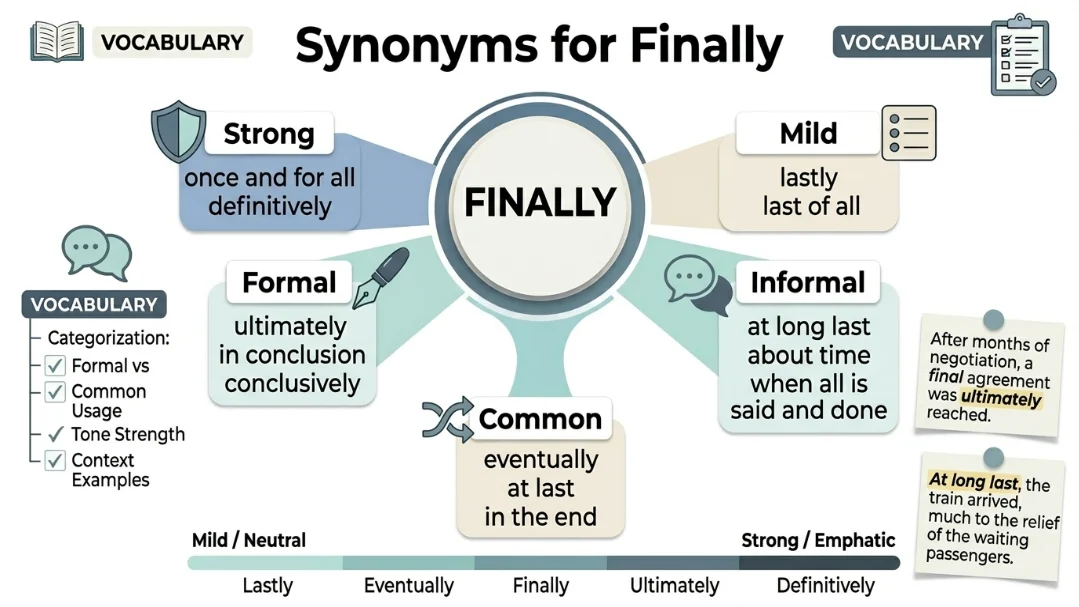
If you need synonyms for finally, you have more options than you might think — and the differences between them matter. The best alternatives include ultimately, eventually, at last, in the end, lastly, and at long last. But each one carries a different feeling. Some signal that a sequence has ended. Others express relief, inevitability, or conclusion. The right choice depends on what you want your sentence to do and how you want it to sound.
Best Synonyms for Finally
The best synonyms for finally are ultimately, eventually, at last, in the end, lastly, and at long last. The right choice depends on tone, context, and what function the word serves in the sentence — whether it marks the end of a list, expresses relief after a long wait, or signals an inevitable conclusion.
What Does “Finally” Mean?
Finally is an adverb with two main uses.
1. Sequence or order: It marks the last item in a series or the last step in a process. “First, preheat the oven. Then add the batter. Finally, bake for thirty minutes.”
2. After a long wait or delay: It expresses that something has happened at last, often with a sense of relief or impatience. “After years of planning, they finally opened the restaurant.”
Part of speech: Adverb
Both uses are common in everyday writing and speech. The synonym you choose should match which of these two meanings you intend — because not every synonym works for both.
Core Meaning of “Finally”
The core idea behind finally is arrival at an end point — whether that end is the last step in a list, the conclusion of a long process, or the resolution of a long wait. There is often an emotional undercurrent: patience tested, effort rewarded, or persistence confirmed.
That emotional layer is what separates finally from a neutral transition word like then or next. When you write “They finally agreed,” the word carries weight — implying it took longer than expected or required more effort than it should have. That nuance is what you need to preserve when choosing a synonym.
Grammar and Usage Notes
Part of speech: Adverb
Common sentence positions:
- At the start: “Finally, the results came in.”
- Mid-sentence: “She finally heard back from the committee.”
- End of sentence: “The report was submitted, finally.”
Common collocations:
- finally arrived / finally finished / finally decided
- finally over / finally done / finally able to
- and finally… (in lists)
When finally sounds natural:
- Wrapping up a numbered or bulleted sequence
- Expressing relief that something long-awaited has happened
- Summarizing a conclusion or outcome
When a synonym works better:
- When you need a more formal tone (ultimately, conclusively)
- When you want to avoid repeating finally in the same paragraph
- When you want to remove the emotional weight (in the end, lastly)
- When the sequence focus needs to be clearer (last, lastly)
Best Synonyms for Finally
| Synonym | Meaning | Tone | Best Use Case | Example Sentence |
| Ultimately | In the end, after everything is considered | Formal, conclusive | Academic, professional, analytical writing | “Ultimately, the decision rested with the board.” |
| Eventually | At some point after a period of time | Neutral | General writing, predictions, storytelling | “She eventually found a solution that worked.” |
| At last | After a long wait; expressing relief | Warm, emotional | Personal writing, speech, storytelling | “At last, the long winter was over.” |
| In the end | When all is said and done; as a final result | Neutral to reflective | Conclusions, summaries, storytelling | “In the end, they chose the simpler route.” |
| Lastly | Used to introduce the final point in a list | Neutral, structural | Lists, instructions, presentations | “Lastly, remember to save your work.” |
| At long last | After an especially long or difficult wait | Emphatic, emotional | Speech, personal writing, celebrations | “At long last, the case was closed.” |
| Conclusively | In a way that settles something definitely | Formal, precise | Legal, academic, analytical writing | “The study conclusively proved the hypothesis.” |
| In conclusion | Used to introduce a final summary statement | Formal, structural | Essays, reports, presentations | “In conclusion, the data supports the theory.” |
| To conclude | Used to signal a closing point or summary | Formal | Academic essays, speeches, presentations | “To conclude, three key lessons stand out.” |
| After all | Taking everything into account; in the end | Conversational | Casual writing, reasoning, reflection | “After all, it was their choice to make.” |
Common Synonyms for Finally
These everyday alternatives work across most general writing and conversation without sounding stiff or out of place.
Eventually Means something happened after a period of time — not necessarily after a long struggle, just after some delay or progression. It lacks the emotional urgency of finally but is widely versatile. “He eventually came around to the idea.”
In the end A natural phrase that signals a conclusion or outcome. Works well in storytelling and reflective writing. Slightly softer than finally — it focuses on the result rather than the wait. “In the end, they made the right call.”
At last Carries warmth and relief. Close in feel to finally when expressing that something long-awaited has happened. Works well in both speech and personal writing. “At last, she had the answer she had been looking for.”
After all Conversational and reflective. Implies that despite doubts or delays, something turned out a certain way. Works well to express an outcome that confirms earlier expectations. “After all, hard work does pay off.”
Last Simple and direct when used as a transition. Less emphatic than finally — purely functional. “Last, add the garnish before serving.”
Formal Synonyms for Finally
These alternatives suit academic papers, legal writing, business reports, and formal presentations.
Ultimately Points to a final outcome or conclusion after a process of reasoning or events. Formal, precise, and widely accepted in professional writing. Best for: Essays, reports, business analysis “Ultimately, the merger proved beneficial for both companies.”
Conclusively Suggests that something has been settled or decided with finality. Strong and definitive — best when the conclusion is definitive, not tentative. Best for: Academic and legal writing “The evidence conclusively linked the compound to the reaction.”
In conclusion A standard signal phrase for closing arguments, essay summaries, or final remarks. Clearly marks the end of a structured piece. Best for: Academic essays, formal reports, speeches “In conclusion, further research is needed to confirm these findings.”
To conclude Similar to in conclusion but slightly more active in voice. Works well in speeches and formal essays. Best for: Speeches, academic writing “To conclude, the data supports three main arguments.”
As a final point More specific than finally — clearly signals the last item in a structured sequence. Best for: Presentations, formal lists, structured arguments “As a final point, the cost implications deserve careful attention.”
Informal Synonyms for Finally
Use these in casual conversation, personal writing, social media, or friendly messages.
At long last Slightly dramatic and expressive — best for celebrating something that took far longer than expected. Common in speech. “At long last, the weekend is here!”
About time Highly informal and often tinged with mild frustration. Implies something should have happened sooner. “It’s about time they fixed that road.”
In the end Works in casual contexts too. Natural and conversational without sounding lazy. “In the end, it all worked out fine.”
After all this time A slightly more elaborate casual phrase that emphasizes how long something took. “After all this time, they finally reconnected.”
When all is said and done A relaxed, conversational way to sum up. Slightly philosophical — good for wrapping up a thought. “When all is said and done, we did our best.”
Strong Synonyms for Finally
These carry more weight, emphasis, or emotional intensity. Use them when the moment deserves to feel significant.
At long last Emphasizes that the wait was especially long or difficult. More emotionally charged than at last. “At long last, justice had been served.”
Conclusively Delivers a strong sense of finality — nothing is left open. Works when you want to signal that a matter has been settled, not just concluded. “The investigation conclusively cleared her name.”
Once and for all Signals a decisive and permanent end. Very emphatic — implies the issue will not return. “They settled the dispute once and for all.”
Definitively Similar to conclusively but often used to describe findings, decisions, or identifications that leave no room for doubt. “The cause of the crash was definitively determined.”
Use strong synonyms when the outcome genuinely warrants them. “Once and for all” sounds powerful — but if the situation is minor, it will sound exaggerated.
Mild Synonyms for Finally
These softer alternatives work when you want to signal a conclusion without adding weight or drama.
Lastly Pure sequencing — no emotional charge at all. Ideal for lists, instructions, and presentations. “Lastly, we’d like to thank everyone who volunteered.”
Eventually Mild and neutral. Suggests an outcome arrived at its own pace, without urgency or frustration. “He eventually agreed with the assessment.”
In the end Quiet and reflective. The outcome is noted without emphasis. “In the end, it didn’t matter much either way.”
Last of all Slightly more formal than lastly but still gentle. Signals the final item in a sequence. “Last of all, check that all windows are locked.”
Mild synonyms work well in technical writing, instructions, and any context where adding emotional color would feel out of place.
Synonyms for Finally by Context
Everyday Conversation
In casual speech and personal writing, at last, in the end, at long last, and after all feel the most natural. “At last, the package arrived!” or “In the end, it was worth it” both land comfortably in informal settings.
Professional Writing
For business emails, reports, and presentations, ultimately, in conclusion, to conclude, and as a final point signal professionalism and structure. Avoid overly emotional phrases like at long last in formal business documents.
Academic Writing
Ultimately, conclusively, in conclusion, and to conclude are the most appropriate choices. These words signal logical closure rather than emotional relief, which suits academic tone.
Creative Writing
Finally, at last, at long last, and in the end all serve storytelling well — especially in moments of resolution or climax. The emotional charge of these words actually adds to narrative tension and release.
Lists and Instructions
Lastly, last, and last of all are the cleanest choices when you simply need to mark the final item. They carry no emotional weight and keep the focus on structure.
Speeches and Presentations
In conclusion, to conclude, ultimately, and finally itself all work well to signal that closing remarks are coming. In conclusion is the most recognized signal phrase in formal settings.
Another Word for “Finally” in a Sentence
Here are natural example sentences using different synonyms for finally:
- “Ultimately, the team agreed on a direction and moved forward.”
- “Eventually, the truth came to light.”
- “At last, the rain stopped and the sun came through.”
- “In the end, she decided to take the job offer.”
- “Lastly, I want to thank everyone who made this possible.”
- “At long last, the project they had worked on for three years was complete.”
- “Conclusively, the report showed that the approach had worked.”
- “In conclusion, the evidence supports all three of our initial claims.”
- “After all, the simplest solution is often the best one.”
- “Once and for all, let’s put this debate to rest.”
- “Definitively, no further testing is required.”
- “To conclude, the data points to one clear recommendation.”
- “When all is said and done, the team performed well under pressure.”
- “Last of all, double-check that the settings have been saved.”
- “About time — we’ve been waiting on that update for weeks.”
“Finally” Synonyms Compared
| Word | Function | Tone | Emotional Weight | Best For |
| Finally | Sequence or long wait | Neutral to warm | Moderate | General use |
| Ultimately | Conclusion or outcome | Formal | Low | Professional, academic |
| Eventually | Outcome after time | Neutral | Low | General writing |
| At last | Long-awaited moment | Warm, emotional | Moderate to high | Personal writing, speech |
| At long last | Very long wait | Emphatic, emotional | High | Celebrations, storytelling |
| Lastly | Last in a list | Neutral | None | Lists, instructions |
| In the end | Overall outcome | Reflective | Low to moderate | Storytelling, summaries |
| Conclusively | Definitive settlement | Formal, strong | Low | Academic, legal |
| Once and for all | Permanent resolution | Emphatic | High | Declarations, arguments |
| After all | Considered outcome | Conversational | Low | Casual reasoning |
Finally vs. Ultimately: Finally implies a wait or sequence has ended. Ultimately implies that after consideration or events, an outcome was reached — without necessarily implying delay or relief.
Eventually vs. Finally: Eventually is more neutral — it simply means “after some time.” Finally often implies impatience or relief that the wait is over. Use eventually when the delay is unremarkable; use finally when the delay matters emotionally.
At last vs. At long last: At last expresses relief. At long last emphasizes that the wait was particularly prolonged. The extra words add emphasis — use at long last only when that extra weight is earned.
Lastly vs. Finally (in lists): Both can close a list, but lastly is purely structural with no emotional color. Finally in a list can imply a climactic last point, while lastly is completely neutral.
Words Similar to “Finally”
These words belong to the same area of meaning as finally but work differently enough that they can’t always replace it directly.
Subsequently Means “after that” or “following that event.” It implies sequence but not necessarily the end of a sequence, and it carries no emotional weight. “The policy was reviewed and subsequently revised.” Not a direct synonym — use it only when you mean “after that,” not “at the end” or “after a long wait.
Thereafter Formal and somewhat dated. Means “from that point on” or “after that.” It doesn’t signal finality the way finally does. “The agreement was signed, and thereafter the two companies operated as one.”
Henceforth Means “from this point forward.” It signals a beginning after a turning point, not the end of a process. Don’t use it as a replacement for finally. “Henceforth, all submissions must be made online.”
As a result Points to consequence rather than sequence or finality. Related because outcomes and conclusions often overlap, but it’s about cause and effect — not about arriving at the end of something. “Funding was cut; as a result, the program was scaled back.”
In summary Signals a recap rather than a conclusion. Use it to condense what was said, not to wrap up an emotional or sequential arc. “In summary, three main issues were identified.”
Antonyms of “Finally”
| Antonym | Meaning | Example Sentence |
| Initially | At the beginning or first | “Initially, the plan seemed straightforward.” |
| First | Before anything else in a sequence | “First, gather all the materials you need.” |
| Originally | At the start; before changes occurred | “Originally, the deadline was set for March.” |
| At the outset | At the very beginning | “At the outset, everyone was optimistic.” |
| Preliminarily | At an early or introductory stage | “Preliminarily, the findings look promising.” |
How to Choose the Right Synonym for “Finally”
Decide which meaning of finally you need. Is it a sequence marker (last in a list) or an emotional signal (after a long wait)? That single decision narrows your options significantly.
Match the formality to the setting. Ultimately and conclusively belong in formal writing. At long last and about time belong in casual writing. Mixing registers confuses readers.
Consider the emotional temperature. At long last and once and for all run hot. Eventually and lastly run cold. Make sure the temperature fits the moment.
Check the sentence structure. Some phrases — in conclusion, to conclude — work best at the start of a closing paragraph, not mid-sentence. Eventually and ultimately can go almost anywhere.
Read the sentence out loud. Substitutions that look fine on paper sometimes sound clunky when spoken. Trust your ear.
Don’t over-signal. If your writing already makes clear that something is the last step, you may not need finally or any synonym at all. Sometimes the sequence is obvious and the word just adds noise.
Common Mistakes When Using Synonyms for “Finally”
Using in conclusion mid-sentence. This phrase is a paragraph opener, not a mid-sentence adverb. “We in conclusion decided to proceed” is not natural.
Treating ultimately and finally as always interchangeable. Ultimately focuses on outcome and reasoning. Finally focuses on sequence and wait. They often overlap, but not always.
Using at long last for minor things. Saying “At long last, my coffee is ready” sounds overdramatic. Reserve it for genuinely significant moments.
Confusing eventually with finally. Eventually says something happened after time passed — with no emotional charge. If the wait matters, finally carries that weight; eventually does not.
Using lastly to express relief. Lastly is structural, not emotional. “Lastly, the surgery was a success” sounds oddly clinical. Use finally or at last for emotional moments.
Stacking synonyms. “Finally, ultimately, in conclusion…” in the same passage signals weak structure. Pick one and commit to it.
Using conclusively loosely. It means something is settled with certainty. Don’t use it when the conclusion is still debatable or tentative.
Quick Synonym List for “Finally”
Common synonyms: eventually, at last, in the end, after all, last
Formal synonyms: ultimately, conclusively, in conclusion, to conclude, as a final point
Informal synonyms: at long last, about time, when all is said and done, after all this time
Strong synonyms: once and for all, definitively, at long last, conclusively
Mild synonyms: lastly, eventually, in the end, last of all
Related words (not always direct replacements): subsequently, thereafter, henceforth, as a result, in summary
FAQs
What is the best synonym for “finally”?
The best synonym depends on your context. For formal writing, ultimately or in conclusion works well. For personal or emotional writing, at last or at long last is often stronger. For lists and instructions, lastly is the cleanest choice.
What is another word for “finally”?
Common alternatives include eventually, ultimately, at last, in the end, lastly, and at long last. Each carries a slightly different tone and works best in specific contexts.
What is a formal synonym for “finally”?
The strongest formal synonyms are ultimately, conclusively, in conclusion, and to conclude. These are appropriate for academic papers, professional reports, and formal speeches.
What is an informal synonym for “finally”?
Casual alternatives include at long last, about time, in the end, when all is said and done, and after all this time. These work well in conversation, personal writing, and social media.
What is a stronger word for “finally”?
Once and for all, at long last, definitively, and conclusively are all more emphatic than finally. Use them when the moment is genuinely significant or when you want to signal permanence.
What is a milder word for “finally”?
Lastly, eventually, and in the end are softer alternatives. They signal closure without adding emotional weight, making them good choices for technical writing and instructions.
What is the difference between “finally” and “ultimately”?
Finally usually implies a sequence has ended or a long wait is over. Ultimately focuses on a conclusion reached after consideration or events — without necessarily implying delay or relief. “They finally agreed” carries impatience; “Ultimately, they agreed” carries reflection.
What is the opposite of “finally”?
The clearest antonyms are initially, first, originally, and at the outset — words that point to the beginning of something rather than its end.
How do I choose the right synonym for “finally”?
First, identify whether you need a sequence marker or an emotional signal. Then match the formality to your setting — formal, casual, or neutral. Finally, read the sentence out loud to make sure the substitution sounds natural.
Conclusion
Finally is one of those words that does two jobs at once: it marks the end of a sequence and carries an emotional signal about waiting and resolution. That double function is what makes choosing a synonym worth thinking about carefully.
For formal writing, ultimately and in conclusion keep the tone professional. For emotional moments, at last and at long last carry the feeling readers expect. For lists and instructions, lastly keeps things clean and structural. For strong, decisive moments, once and for all and conclusively add the weight the situation deserves.
The best synonym for finally is always the one that fits your meaning, matches your tone, and serves your reader. Use this guide to find it quickly — and make your writing sharper for the choice.