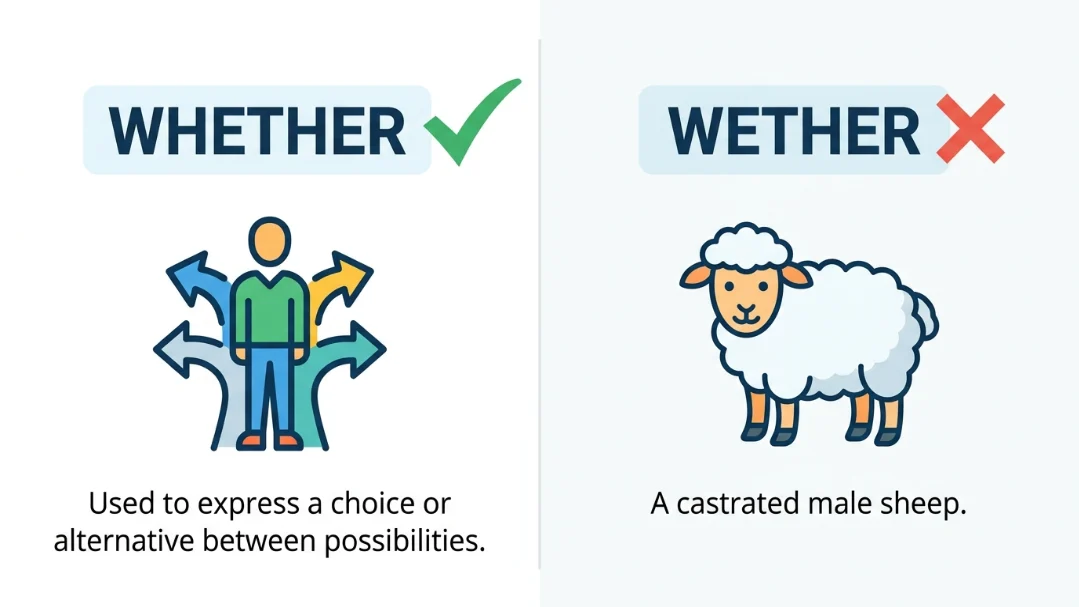
“Whether” is the correct English word used to introduce choices, conditions, or indirect questions (e.g., “I don’t know whether it will rain”). “Wether” is an entirely different word that refers to a castrated male sheep or goat. Confusing the two is a spelling error, not a grammar debate — only “whether” belongs in everyday writing.
Every writer, student, and professional has paused over a sentence and wondered: did I spell that right? Whether or wether — at first glance, these two words look almost identical. One small letter difference separates a common conjunction from an uncommon livestock term. Yet the confusion is surprisingly widespread, and it costs writers their credibility.
The word “whether” appears in millions of sentences every day. You use it to present options, ask indirect questions, and connect conditional ideas. It is one of the most useful conjunctions in the English language. “Wether,” on the other hand, rarely appears outside farming manuals and crossword puzzles.
So why do people confuse them? The answer is simple: they sound nearly identical when spoken aloud. Homophones and near-homophones trip up even experienced writers. Add the similarly spelled “weather” to the mix, and the confusion deepens.
This guide covers everything you need to know about whether or wether. You will learn their definitions, see real-world examples, understand their differences, and practice with exercises. By the end, you will never mix them up again.
Key Takeaway and Summary
Here is what you need to remember before reading further:
- Whether is a conjunction. It introduces conditions, choices, or indirect questions.
- Wether is a noun. It refers to a castrated male sheep or goat.
- Weather is yet another word. It describes atmospheric conditions.
- In almost every writing context, “whether” is the word you need.
- Mixing up these words is a spelling error, not a stylistic choice.
Keep these distinctions in mind as you move through the article.
Defining “Whether”: The Conjunction You Use Every Day
“Whether” functions as a subordinating conjunction in English grammar. It connects a main clause to a subordinate clause. More specifically, it introduces two possible conditions or outcomes.
Consider this example:
“She could not decide whether to stay or leave.”
Here, “whether” links the main idea (she could not decide) with two alternatives (to stay, to leave). This is the primary role of “whether” in a sentence.
Common Functions of “Whether”
Writers use “whether” in three main ways:
Presenting two alternatives:
“Tell me whether you want tea or coffee.”
To introduce an indirect question:
“He asked whether the meeting had started.”
To express a condition that applies in both cases:
“Whether you agree or not, the decision is final.”
Notice that in the third example, “whether” signals that the outcome stays the same regardless of the alternative. This is sometimes called the “whether or not” construction, and it is one of the most powerful uses of this conjunction.
“Whether” vs. “If”: A Related Distinction
Many writers also struggle with choosing between “whether” and “if.” While both can introduce indirect questions, they are not always interchangeable.
Use “whether” when:
- You present two alternatives: “Tell me whether you want to go or stay.”
- The clause follows a preposition: “The question of whether to invest is complex.”
- The clause functions as the subject: “Whether we succeed depends on effort.”
Use “if” when:
- You express a conditional: “Call me if you need help.”
- Replacing “if” with “whether” sounds awkward or changes the meaning.
Understanding this distinction helps you write more precisely. Furthermore, it shows that “whether” has a specific grammatical purpose that “if” cannot always fulfill.
Defining “Wether”: The Word You Probably Did Not Mean
“Wether” is a noun with a very specific meaning. It refers to a male sheep or goat that has been castrated. Farmers and shepherds use this term when managing livestock, because castrated males behave differently from intact rams or bucks.
The word traces back to Old English and Germanic roots. It is a genuine English word with a long history — but it belongs in agricultural contexts, not everyday writing.
When Would You Actually Use “Wether”?
You would use “wether” in contexts such as:
- Farming and livestock management
- Veterinary science
- Historical or medieval texts about animal husbandry
- Crossword puzzles and word trivia
- Academic writing about sheep breeds or pastoral economics
Outside these narrow fields, “wether” almost never appears in modern writing. Therefore, if you typed “wether” in a business email, academic essay, or news article, you almost certainly made a typo.
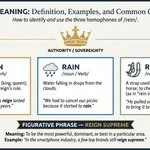
The Three Homophones: Whether, Wether, and Weather
One reason the whether or wether confusion persists is that a third word — “weather” — adds more noise to the mix. All three words sound similar, and spell-checkers do not always catch the error because all three are real words.
Here is a clear comparison:
| Word | Part of Speech | Meaning | Example Sentence |
|---|---|---|---|
| Whether | Conjunction | Introduces conditions or choices | “I don’t know whether to go.” |
| Wether | Noun | A castrated male sheep or goat | “The farmer sold two wethers at the market.” |
| Weather | Noun / Verb | Atmospheric conditions; to endure | “The weather today is cold.” / “She weathered the storm.” |
As you can see, these three words occupy completely different grammatical and semantic roles. Consequently, using the wrong one changes the meaning of a sentence entirely — or simply makes no sense.
A Memory Trick
Here is a simple way to remember the difference:
- W-H-E-T-H-E-R contains the word “HET,” which sounds like “het up” (anxious about making a choice). When you face a choice, use whether.
- W-E-T-H-E-R contains “WET,” which reminds you of the outdoors — where sheep live.
- W-E-A-T-H-E-R contains “EAT,” which reminds you of a picnic ruined by bad atmospheric conditions.
These silly mental anchors work. Many writers find that a single memorable trick eliminates a recurring error permanently.
Advantages of Using “Whether” Correctly
Using the right word always has advantages. Specifically, using “whether” correctly in your writing produces several benefits.
Advantages
Clarity: Sentences with “whether” communicate conditions and choices precisely. Readers understand immediately that two alternatives are on the table.
Credibility: Correct spelling signals that you pay attention to detail. In professional and academic settings, this builds trust with your audience.
Grammatical accuracy: “Whether” fulfills a specific grammatical function. Using it correctly produces sentences that follow established English grammar rules.
Versatility: “Whether” works in formal, informal, spoken, and written English. It adapts to almost any context where you need to express alternatives or conditions.
SEO and readability: In digital writing, clear and correct language improves readability scores. Search engines reward content that communicates clearly.
Disadvantages of Misusing “Wether”
On the other hand, writing “wether” when you mean “whether” creates real problems:
Loss of credibility: Readers notice spelling errors, especially those involving word substitution. A misused “wether” signals carelessness.
Confusion: Readers who know the word “wether” will be genuinely confused. Those who do not may simply disengage.
Unprofessional appearance: In formal documents, emails, or published articles, the error looks amateurish.
Spell-check blindness: Because “wether” is a real word, standard spell-checkers will not flag it. You must catch this error manually or with a grammar-aware tool.
Real-World Examples of “Whether” in Use
Seeing “whether” in context is the fastest way to solidify your understanding. Below are examples drawn from common real-world writing situations.
For Business Writing
“The manager had not yet decided whether to approve the budget increase.”
“Please confirm whether you will attend the Monday briefing.”
“The committee will evaluate whether the proposal meets all requirements.”
Academic Writing
“Researchers questioned whether the results could be replicated.”
“The study examined whether diet influences cognitive performance.”
“Students must consider whether their argument is supported by evidence.”
Everyday Conversation
“I wasn’t sure whether to call or text.”
“She asked whether the restaurant was still open.”
“He didn’t know whether the flight had been delayed.”
In Journalism
“Officials debated whether to extend the emergency declaration.”
“The report examined whether the policy had achieved its goals.”
Notice how naturally “whether” fits into all of these examples. Moreover, notice that none of them could use “wether” without becoming nonsensical.
Common Mistakes Writers Make with “Whether” and “Wether”
Understanding errors helps you avoid them. Here are the most frequent mistakes writers make — and how to fix them.
Mistake One: Typing “Wether” Instead of “Whether”
This is the most common error. It usually happens when typing quickly.
Incorrect: “I don’t know wether she will call back.” Correct: “I don’t know whether she will call back.”
Fix: Always proofread. Additionally, use a grammar-aware tool like Grammarly or the Hemingway Editor, which detects word substitution errors.
Mistake Two: Omitting “Or Not” When It Is Needed
Sometimes, “whether or not” is required for clarity. Omitting “or not” can make a sentence ambiguous.
Ambiguous: “Tell me whether you want to go.” Clearer: “Tell me whether or not you want to go.”
However, note that “or not” is redundant in many cases and can be omitted without loss of meaning. Use your judgment based on the context.
Mistake Three: Using “Whether” When “If” Is More Natural
Awkward: “Call me whether you need help.” Better: “Call me if you need help.”
In conditional sentences where no alternative is implied, “if” often reads more naturally. Therefore, not every situation calls for “whether.”
Mistake Four: Confusing “Weather” with “Whether”
Incorrect: “I couldn’t tell weather the news was good or bad.” Correct: “I couldn’t tell whether the news was good or bad.”
Fix: Remember that “weather” relates to climate and storms. If your sentence has nothing to do with the sky or storms, “weather” is wrong.
Mistake Five: Placing “Whether” After a Preposition Incorrectly
Incorrect: “It depends on whether or not.” Correct: “It depends on whether the plan succeeds.”
The clause after “whether” must be complete. “Whether or not” alone cannot follow a preposition — the full conditional clause must follow.
Regional and Global Usage of “Whether”
The word “whether” behaves consistently across all major varieties of English. Whether you write in American English, British English, Australian English, or Canadian English, the spelling and usage rules remain the same.
However, regional differences affect some related usage patterns:
American English
American English writers tend to drop “or not” more freely. For example:
“Let me know whether you’re coming.” (American style — “or not” dropped)
British English
British English writers sometimes retain “or not” more consistently for formality:
“Let me know whether or not you are coming.” (British formal style)
Global Academic and Professional Writing
In international academic writing, “whether” follows the same rules globally. Style guides such as APA, MLA, Chicago, and Oxford all treat “whether” identically. Therefore, you can apply the same rules regardless of which guide your institution or employer follows.
A Note on Non-Native English Writers
For writers whose first language is not English, the whether or wether confusion is especially understandable. The near-identical pronunciation makes the distinction difficult to internalize. However, the rule is simple: in almost every context, “whether” is correct. “Wether” belongs only in agricultural or specialized discussions about livestock.
“Whether or Not”: When to Include “Or Not”
The phrase “whether or not” comes up often, and many writers wonder whether the “or not” is necessary. The answer depends on the sentence structure.
When “Or Not” Is Required
Include “or not” when you want to emphasize that the outcome applies in both cases:
“Whether or not you agree, the policy will be implemented.”
Here, removing “or not” weakens the intended meaning. The sentence is specifically saying: it does not matter which side you take — the outcome is the same.
When “Or Not” Is Optional
In many sentences, “or not” is implied and can be omitted:
“She didn’t know whether (or not) to accept the offer.”
Both versions are grammatically correct. The version without “or not” is more concise, which is generally preferable in modern writing.
When “Or Not” Should Be Avoided
When “if” is used in place of “whether,” adding “or not” often sounds unnatural:
Awkward: “Call me if or not you need help.” Correct: “Call me if you need help.” or “Call me whether or not you need help.”
The lesson here is that “or not” pairs specifically with “whether,” not with “if.”
Exercises with Answers: Practice Using “Whether” Correctly
Practice is the best way to internalize grammar rules. Try each exercise before looking at the answer.
Exercise One: Fill in the Blank
Choose the correct word (whether / wether / weather) for each sentence.
- I could not decide _______ to accept the job offer.
- The farmer raised several _______ for the wool market.
- The _______ forecast predicts rain for the entire week.
- She asked _______ the train had already departed.
- The report examined _______ the new policy had reduced costs.
- The shepherd separated the _______ from the rams.
- Nobody knew _______ the package would arrive on time.
- The hikers checked the _______ before setting out.
Answers:
- whether
- wethers
- weather
- whether
- whether
- wethers
- whether
- weather
Exercise Two: Correct the Error
Each sentence contains an error. Rewrite it correctly.
- “We haven’t decided wether to expand the team.”
- “It depends on weather you finish the report today.”
- “The farmer sold three whether at the livestock auction.”
- “Tell me weather you prefer morning or evening meetings.”
Corrected Sentences:
- “We haven’t decided whether to expand the team.”
- “It depends on whether you finish the report today.”
- “The farmer sold three wethers at the livestock auction.”
- “Tell me whether you prefer morning or evening meetings.”
Exercise Three: Write Your Own Sentences
Write one original sentence for each of the following words:
- whether
- wether
- weather
There is no single correct answer here. However, your sentences should demonstrate that you understand the distinct meaning of each word.
Sample Answers:
- Whether: “The director must decide whether to delay the product launch.”
- Wether: “The veterinarian examined the wether for signs of infection.”
- Weather: “Cold weather can increase heating costs significantly.”
Related Concepts and Word Comparisons
Understanding “whether” more deeply requires exploring related grammar concepts. Several comparisons help clarify when and how to use this conjunction correctly.
Whether vs. If (Revisited)
As noted earlier, “whether” and “if” overlap but are not identical. Here is a quick reference table:
| Situation | Use “Whether” | Use “If” |
|---|---|---|
| Two alternatives presented | Yes | Sometimes |
| Clause follows a preposition | Yes | No |
| Clause is the subject of the verb | Yes | No |
| Simple conditional (“if this happens”) | No | Yes |
| Indirect yes/no question | Yes | Sometimes |
Whether vs. Although
Some writers confuse “whether” with “although” in certain sentence constructions. They are not interchangeable.
- Whether introduces alternatives or conditions.
- Although introduces a contrast or concession.
Whether: “Whether it rains or shines, the event continues.” Although: “Although it rained, the event continued.”
Both sentences are correct — but they have different meanings and structures.
Subordinating Conjunctions: A Broader Context
“Whether” belongs to the family of subordinating conjunctions. Other members of this family include “because,” “although,” “while,” “since,” “until,” and “unless.” All subordinating conjunctions connect a dependent clause to a main clause.
Understanding this family helps you see “whether” not as an isolated word to memorize but as part of a larger, logical grammar system.
Tools to Catch “Whether or Wether” Errors
Because spell-check will not flag “wether” as an error, you need better tools. Fortunately, several options help writers catch this specific category of mistake.
Grammarly: Grammarly’s context-aware engine detects word substitution errors, including misused homophones and near-homophones. It will flag “wether” when “whether” is clearly the intended word based on context.
ProWritingAid: This tool offers deep grammar analysis and includes a homophone detection feature. It is especially useful for long-form writers and editors.
Hemingway Editor: While it does not specifically catch “wether,” it promotes simpler writing habits that naturally reduce errors.
Manual proofreading: Reading your work aloud remains one of the most effective strategies. When you hear a sentence, errors often become audible in ways they are not when reading silently.
Peer review: A second set of eyes catches mistakes your own brain glosses over. Professional editors and writing partners add a valuable layer of quality control.
Frequently Asked Questions
Is “wether” ever the correct spelling in everyday writing?
Almost never. “Wether” refers specifically to a castrated male sheep or goat. Outside of farming, veterinary science, or agricultural history, you will almost certainly mean “whether” instead.
Can I use “whether” and “if” interchangeably?
Not always. “Whether” is preferred when you present two alternatives, when the clause follows a preposition, or when the clause serves as the subject of a sentence. “If” works better in simple conditional sentences. When in doubt, use “whether” — it is rarely wrong, while “if” sometimes is.
Does “whether” always need “or not” after it?
No. “Or not” is required only when you specifically want to emphasize that the outcome applies regardless of which alternative occurs. In many sentences, “or not” is implied and can be omitted for conciseness.
Why doesn’t spell-check catch “wether” when I mean “whether”?
Because “wether” is a real English word, spell-checkers that only check spelling (not context) will not flag it. You need a context-aware grammar tool like Grammarly, or you need to proofread manually.
What is the origin of the word “wether”?
“Wether” comes from Old English “weðer” and has Germanic roots. The word originally referred to a ram — specifically a castrated one. It has been in continuous use in English for over a thousand years, though today it appears mainly in specialized agricultural contexts.
Is “whether or wether” a common confusion?
Yes. Because the two words sound nearly identical in spoken English, the confusion is widespread. It appears frequently in typed drafts, especially when writers type quickly without pausing to proofread. Adding “weather” to the mix makes the confusion even more understandable.
Can “whether” start a sentence?
Yes. “Whether” can open a sentence when it introduces a subject clause. For example: “Whether the project succeeds depends on teamwork.” This construction is grammatically correct and often produces strong, direct sentences.
Is there a simple rule to remember when to use “whether”?
Yes. Use “whether” whenever you are expressing a choice between two options, asking an indirect yes/no question, or connecting a condition that applies in both cases. If your sentence involves atmospheric conditions, use “weather.” If your sentence discusses castrated male livestock, use “wether.” In any other situation, you almost certainly want “whether.”
Does “whether” work in both formal and informal writing?
Absolutely. “Whether” functions naturally in formal reports, academic essays, casual emails, spoken conversation, and everything in between. It is one of the most versatile and useful conjunctions in English.
What are some long-tail variations I should know about?
Writers searching for clarity on this topic often look for terms like: “whether or wether spelling,” “whether vs wether vs weather,” “when to use whether or not,” “difference between whether and if,” and “whether example sentences.” All of these point to the same core question: understanding how to spell and use “whether” correctly. This article addresses all of them.
Conclusion
The confusion between whether or wether is understandable — but it is easy to fix once you know the facts. In summary, “whether” is the conjunction you need in nearly every sentence involving choices, conditions, or indirect questions. “Wether” refers to a castrated male sheep or goat, and “weather” describes atmospheric conditions.
To write clearly and professionally, always pause before you use these words. Ask yourself: am I discussing livestock? If not, “wether” is wrong. Am I discussing atmospheric conditions? If not, “weather” is wrong. In virtually every other case, “whether” is the right choice.
Develop the habit of reading your work aloud. Use a grammar-aware tool such as Grammarly to catch word substitution errors that standard spell-check misses. Practice with exercises like the ones in this article. And remember the memory trick: “whether” involves a choice, and making a choice can make you “het up.”
With these strategies in place, the whether or wether confusion will no longer slow you down. Your writing will become sharper, more credible, and easier for readers to trust. That is always worth the effort.