The correct spelling is always. The word allways is a common spelling mistake and is not recognized in standard English. If you are writing emails, academic content, blog posts, business documents, or website content, you should always use always. Understanding the difference between allways or always helps improve writing accuracy, professionalism, and search visibility.
English spelling can be tricky, especially when words sound exactly like what we think they should look like. One common example is the confusion between allways or always. Many people accidentally add an extra “l” and write allways, believing it follows the same pattern as words like all right or all together.
The problem is simple: allways is incorrect, while always is the only accepted spelling in English.
This mistake appears everywhere, from student assignments and social media posts to professional emails and website content. While it may seem like a small error, incorrect spelling can affect credibility, communication, and even SEO performance if it appears repeatedly on a webpage.
In this guide, you’ll learn the correct spelling, meaning, usage, examples, common mistakes, grammar rules, and practical exercises. By the end, you’ll never be confused about allways or always again.
Allways or Always?
Which One Is Correct?
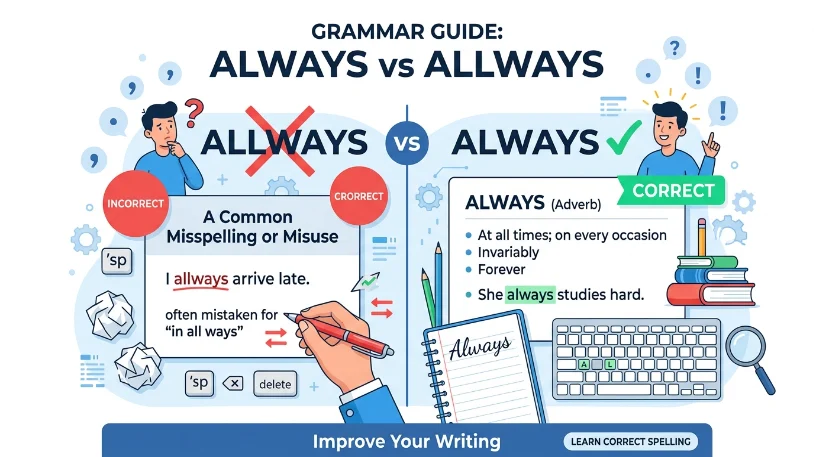
✅ Always = Correct
❌ Allways = Incorrect
- At all times
- On every occasion
- Consistently
- Without exception
Example Sentences
Correct:
- I always arrive on time.
- She always remembers birthdays.
- We always double-check our work.
Incorrect:
- I allways arrive on time.
- She allways remembers birthdays.
The spelling allways does not exist in standard English dictionaries.
What Does Always Mean?
Definition of Always
Always is an adverb that means:
At all times, continually, or every time.
It describes actions, habits, or situations that happen consistently.
Simple Examples
- The sun always rises in the east.
- My father always drinks coffee in the morning.
- Good writers always proofread their work.
In each sentence, the action happens regularly or without exception.
Why Do People Write Allways Instead of Always?
The Extra “L” Confusion
Many English learners assume the word should contain two Ls because it sounds like:
- All + ways
However, the word evolved historically as always, not allways.
Typing Errors
Fast typing often causes mistakes.
Examples:
- allways
- alwyas
- alwasy
- alaways
Spell-check tools usually catch these errors, but not everyone notices them before publishing.
Pronunciation Influence
In some accents, people pronounce always in a way that makes it sound like there should be an extra L.
This leads many learners to spell it incorrectly.
The History of the Word Always
Origins of Always
The word comes from Old English forms related to:
- all
- way
- ways
Over time, the language evolved and standardized the spelling as always.
Modern English dictionaries only recognize always.
Dictionary Acceptance
Major dictionaries list:
✅ Always
They do not list:
❌ Allways
Because it is considered a spelling mistake rather than an alternative spelling.
How Always Is Used in Everyday English
Always for Habits
Use always to describe regular actions.
Examples:
- I always brush my teeth before bed.
- She always studies before exams.
- They always eat dinner together.
Always for Facts
Examples:
- Water always flows downhill.
- The earth always orbits the sun.
Always for Promises
Examples:
- I will always support you.
- We will always remember this day.
Always for Emphasis
Examples:
- You always make me laugh.
- He always finds a solution.
Allways or Always in Grammar
Part of Speech
The word always is an adverb.
Adverbs modify:
- Verbs
- Adjectives
- Other adverbs
Position in a Sentence
Usually before the main verb:
- I always exercise.
After forms of “be”:
- She is always cheerful.
With auxiliary verbs:
- They have always been helpful.
Examples
| Correct Sentence | Usage |
|---|---|
| I always read before bed. | Habit |
| She is always polite. | Description |
| We have always lived here. | Time reference |
| He will always be my friend. | Promise |
Advantages of Using Correct Spelling
Better Professional Image
Correct spelling creates trust.
Examples:
- Business emails
- Job applications
- Reports
- Website content
Improved Communication
Readers understand your message immediately.
Stronger SEO Performance
Search engines value high-quality content.
Although Google understands spelling variations, pages filled with spelling mistakes may appear less trustworthy.
Better Academic Results
Teachers and professors often mark spelling errors.
Using always correctly helps maintain writing quality.
Disadvantages of Using Allways
Looks Unprofessional
A reader may question the writer’s attention to detail.
Creates Grammar Errors
The word is not accepted in English grammar.
Can Reduce Credibility
Frequent spelling mistakes make content appear poorly edited.
May Affect User Experience
Readers notice obvious errors, especially in educational and professional content.
Real World Examples of Always
In Emails
Correct:
I will always respond within 24 hours.
In Business Writing
Correct:
Our team always prioritizes customer satisfaction.
In Academic Writing
Correct:
Researchers should always verify their sources.
In Website Content
Correct:
We always provide accurate information.
Allways or Always in SEO Content
Why Correct Spelling Matters
Website owners often ask whether spelling affects rankings.
The answer is yes, indirectly.
Google focuses on:
- Quality
- Expertise
- Trustworthiness
- User experience
Content containing repeated spelling mistakes may reduce perceived quality.
User Trust Matters
Imagine reading:
We allways provide the best service.
Most visitors notice the mistake immediately.
Correct version:
We always provide the best service.
The second version looks more professional and trustworthy.
Content Quality Signals
Good spelling supports:
- Better readability
- Higher trust
- Improved engagement
These factors contribute to overall SEO performance.
Common Mistakes and Corrections
Mistake 1
Incorrect:
- I allways wake up early.
Correct:
- I always wake up early.
Mistake 2
Incorrect:
- She allways helps her friends.
Correct:
- She always helps her friends.
Mistake 3
Incorrect:
- We will allways remember this moment.
Correct:
- We will always remember this moment.
Mistake 4
Incorrect:
- They are allways late.
Correct:
- They are always late.
Related Comparisons
Always vs Forever
| Always | Forever |
|---|---|
| Means every time | Means endless duration |
| Can describe habits | Describes permanent continuation |
| Used frequently in daily speech | Often used for long-term situations |
Example:
- I always exercise.
- I will love you forever.
Always vs Usually
| Always | Usually |
|---|---|
| 100% frequency | Less than 100% |
| No exceptions | Some exceptions |
Example:
- I always wear a seatbelt.
- I usually drink tea in the morning.
Always vs Often
| Always | Often |
|---|---|
| Every time | Many times |
| Stronger frequency | Lower frequency |
Example:
- She always calls her mother.
- She often calls her mother.
Regional and Global Usage
American English
Uses always.
British English
Uses always.
Australian English
Uses always.
Canadian English
Uses always.
No major English-speaking country recognizes allways as a correct spelling.
This makes the answer universal:
Always is correct everywhere.
Exercises With Answers
Exercise 1
Choose the correct word:
I _____ check my work before submitting it.
A. allways
B. always
Answer: B. always
Exercise 2
Which sentence is correct?
A. She allways smiles.
B. She always smiles.
Answer: B. She always smiles.
Exercise 3
Fill in the blank:
We ______ arrive early for meetings.
Answer: always
Exercise 4
Find the mistake:
They are allways helpful.
Answer: allways → always
Exercise 5
True or False:
“Allways” is accepted in standard English.
Answer: False
Frequently Asked Questions
Is allways ever correct?
No. Allways is a spelling mistake. Always is the correct form.
Why do people write allways instead of always?
Usually because of typing errors, pronunciation influence, or misunderstanding the spelling.
Which spelling should I use in professional writing?
Always use always in business, academic, and professional writing.
Is allways recognized in dictionaries?
No. Standard dictionaries only recognize always.
Does Google know that allways means always?
Google often understands the intent, but correct spelling still improves content quality.
Can spelling mistakes hurt SEO?
Repeated spelling mistakes can reduce perceived quality and user trust.
How do I remember the correct spelling?
Remember that always contains one L and means “at all times.”
Is always an adverb?
Yes. Always is an adverb of frequency.
What is the opposite of always?
Words like “never,” “rarely,” or “sometimes” can be opposites depending on context.
Should students avoid using allways?
Absolutely. Students should always use the correct spelling to maintain writing quality.
Conclusion
When comparing allways or always, the answer is straightforward: always is the only correct spelling. The word means “at all times” or “every time” and is used daily in conversations, emails, academic writing, and professional communication.
Although allways is a common mistake, it is not accepted in modern English grammar or dictionaries. Using the correct spelling helps improve readability, credibility, and professionalism. It also contributes to higher-quality content, which is important for websites, businesses.
The easiest way to remember the rule is simple: always has one L, never two.
Whether you’re writing an email, a blog post, a school assignment, or website content, make it a habit to double-check your spelling. Small corrections like this can make a big difference in how readers and search engines view your work.
By remembering this one rule, you’ll always get it right.