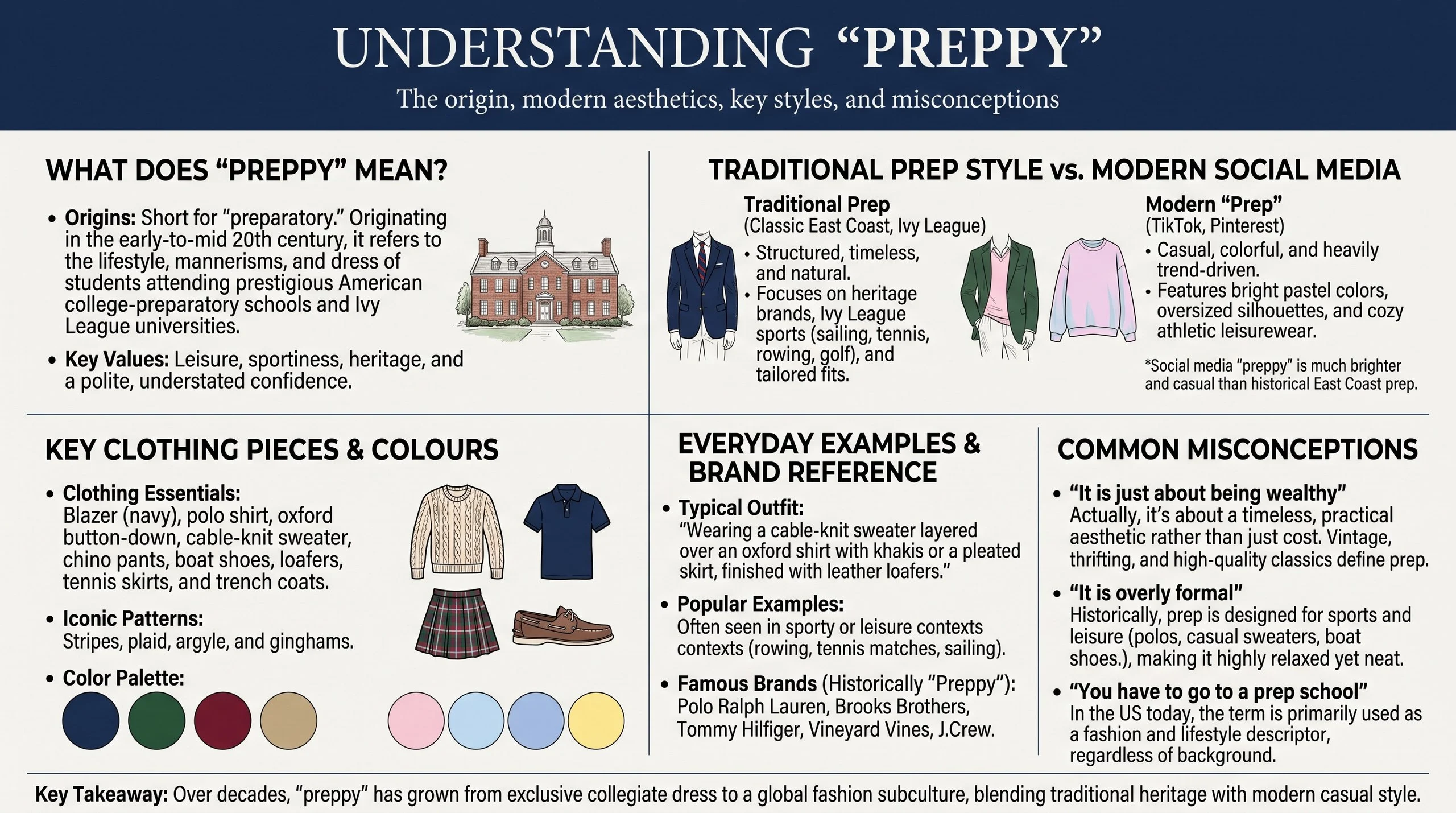
Preppy meaning refers to a polished, classic, and traditionally upper class inspired style associated with private preparatory schools. Today, it describes clothing, aesthetics, behavior, and online trends featuring neat outfits, classic colors, clean details, and an effortlessly put together appearance.
Preppy meaning has expanded far beyond its original connection to private preparatory schools in the United States. Today, people use the word to describe clothing, aesthetics, personalities, social media content, interiors, and even certain lifestyles.
Originally, the term was closely linked with students at elite college preparatory schools. Their wardrobes often included polo shirts, chinos, loafers, sweaters, blazers, pleated skirts, button down shirts, and other traditional pieces.
However, modern internet culture has changed the world considerably. On TikTok, Instagram, Pinterest, Snapchat, and everyday texting, preppy can describe anything that looks cheerful, polished, colorful, coordinated, or traditionally fashionable.
The modern version can also feel playful rather than serious. Someone might call a tennis skirt, ribbon hairstyle, pastel outfit, or matching accessories preppy even when the person wearing them has no connection to private school culture.
Therefore, understanding the term requires more than knowing a clothing definition. Context matters. Tone matters. Platform culture matters. Most importantly, the word can describe both a classic fashion tradition and a modern social media aesthetic.
Quick Answer Box
| Meaning | Context | Primary Platforms | Example | Tone |
| Polished, classic, traditionally school inspired style | Fashion, lifestyle, personality, aesthetics | TikTok, Instagram, Pinterest, Snapchat | “That outfit looks so preppy.” | Usually positive, playful, or complimentary |
What Does Preppy Meaning Mean?
The simplest definition is polished, traditional, neat, and often associated with American preparatory school fashion or culture.
The word comes from prep, a shortened form of preparatory. In the United States, preparatory schools traditionally prepared students for college. Over time, the clothing and social style associated with these schools became recognizable.
Classic preppy clothing often includes:
- Polo shirts
- Oxford button down shirts
- Chinos
- Khaki pants
- Pleated skirts
- Sweaters
- Cardigans
- Blazers
- Loafers
- Boat shoes
- Tennis inspired clothing
- Rugby shirts
- Argyle patterns
- Striped shirts
- Pearl accessories
However, preppy does not have one strict uniform.
Modern interpretations can be much brighter and more youthful. Pastel colors, bows, colorful sweaters, coordinated accessories, tennis skirts, and playful patterns can all appear in contemporary preppy outfits.
The Historical Connection
The traditional aesthetic developed around American preparatory school and college culture. It became especially recognizable through the clothing worn at prestigious schools and universities.
Later, fashion companies helped turn the look into a broader commercial style. Brands associated with classic American fashion popularized items such as polo shirts, chinos, sweaters, blazers, and boat shoes.
The look eventually became recognizable far beyond school campuses.
For example, a person could wear a navy sweater over a collared shirt with khaki trousers and loafers. That outfit would traditionally fit the preppy category.
Meanwhile, another person might wear a pastel cardigan, pleated skirt, white sneakers, and a ribbon. Online users may also call that outfit preppy.
Both can fit the modern definition.
Traditional Versus Modern Usage
Traditional usage focuses heavily on classic American clothing.
Modern usage is broader. It can describe an entire visual identity.
| Traditional Use | Modern Use |
| Private school fashion | Social media aesthetic |
| Classic clothing | Colorful coordinated outfits |
| Blazers and loafers | Skirts, bows, and accessories |
| Conservative colors | Pastels and bright colors |
| College inspired style | Youth focused fashion |
| Polished appearance | Cute and trendy appearance |
This difference explains why someone may encounter seemingly different definitions online.
Contextual Dynamics and Nuances of the Term
The meaning changes depending on who says it, where they say it, and what they are describing.
For example, calling someone’s outfit preppy can be a straightforward fashion observation. Calling someone’s entire personality preppy can imply something different.
Preppy as a Fashion Description
When used for clothing, the word usually suggests a neat, coordinated, classic appearance.
A person might wear a cable knit sweater, collared shirt, tailored trousers, and loafers. The overall combination creates a recognizable polished aesthetic.
The key idea is coordination.
The clothing does not necessarily need to be expensive. A thrifted cardigan and inexpensive loafers can create a similar visual effect when styled thoughtfully.
Preppy as an Aesthetic
Online, the word can describe an entire visual mood.
This may include:
- Pastel colors
- Tennis themes
- Ribbons
- Polished hairstyles
- Plaid patterns
- Stripes
- School inspired imagery
- Clean backgrounds
- Coordinated accessories
- Classic handbags
- Nautical elements
Therefore, the modern aesthetic can be more colorful and playful than the traditional version.
Preppy as a Personality Description
Calling someone preppy can also describe their presentation.
It may suggest that someone appears:
- Polished
- Social
- Confident
- Well dressed
- Traditional
- Energetic
- Fashion conscious
- Put together
However, the interpretation depends strongly on tone.
A friend saying, “You are so preppy today,” may simply be complimenting the outfit.
Someone using the word sarcastically may instead be commenting on perceived privilege or social status.
Is It Always a Compliment?
No.
Usually, the word is neutral or positive when discussing clothing.
However, it can become negative when someone uses it to stereotype another person as privileged, snobbish, superficial, or disconnected from ordinary life.
Context makes the difference.
For example:
“Your sweater looks really preppy.”
This sounds like a neutral or positive observation.
“He acts so preppy.”
This could be complimentary, neutral, or critical depending on the speaker’s tone.
Real Life Conversation Examples Using Preppy Meaning
The term appears naturally in everyday conversations, especially when friends discuss outfits, photos, shopping, or social media posts.
Example 1: Complimenting an Outfit
Maya: “I got this new cardigan yesterday.”
Jordan: “Wait, that is so preppy.”
Maya: “Right? I want to build the whole outfit around it.”
Here, the word describes the cardigan’s polished and classic appearance.
Example 2: Talking About a Social Media Aesthetic
Alex: “Why is my entire Pinterest board turning into this?”
Sam: “Because you are officially entering your preppy era.”
The phrase is playful. It does not necessarily refer to traditional prep school culture.
Example 3: Shopping With a Friend
Emma: “Which skirt should I get?”
Lily: “The pleated one. It looks more preppy with that sweater.”
Here, the term identifies a specific styling direction.
Example 4: Describing Someone’s Style
Noah: “How would you describe his style?”
Ryan: “Pretty preppy. Lots of polos, sweaters, and loafers.”
This is a straightforward description of someone’s wardrobe.
Example 5: Responding to a Photo
Ava: “Posted the new outfit.”
Chris: “Okay, preppy vibes.”
Ava: “That was exactly the goal.”
The phrase works as a short social media compliment.
Platform Specific Breakdown
Different platforms have helped broaden the modern interpretation of the word.
The basic idea remains recognizable. However, each platform adds its own cultural layer.
How It Is Used on Snapchat
Snapchat conversations tend to be casual and fast.
Users may use the word when reacting to a friend’s outfit, mirror selfie, shopping picture, or school related post.
Common Snapchat style messages include:
- “This is so preppy.”
- “Major preppy vibes.”
- “You look preppy today.”
- “Okay, I see the preppy era.”
- “That sweater is preppy.”
The language is usually informal.
Because Snapchat is heavily visual, the word often refers to what someone is wearing rather than a detailed lifestyle.
The Role of Preppy Meaning on TikTok
TikTok has played a major role in expanding the aesthetic.
Creators can build entire videos around outfit transformations, styling ideas, room designs, hairstyles, makeup, accessories, and lifestyle themes.
A TikTok creator might describe a look as preppy because it contains several recognizable visual signals.
For example:
- A pleated skirt
- A fitted sweater
- White sneakers
- A ribbon
- A tennis inspired outfit
- A colorful cardigan
- A structured handbag
However, TikTok usage can be highly flexible.
One creator may use the word for traditional East Coast inspired clothing. Another may use it for a colorful teenage fashion trend.
Consequently, the platform has helped turn the term into an aesthetic label rather than a strict historical category.
Instagram and Texting Dynamics
Instagram tends to emphasize visual presentation.
A creator might use the term in captions, hashtags, outfit descriptions, or comments.
Texting is even more flexible.
Friends may use short phrases such as:
- “That is so preppy.”
- “You look preppy.”
- “Preppy fit.”
- “Love the preppy vibe.”
- “This outfit is giving prep.”
The exact phrase is less important than the intention.
If the conversation is friendly, the word will usually sound complimentary.
Alternative Meanings and NLP Variations of the Phrase
Language rarely stays fixed.
The modern vocabulary surrounding this topic includes several related expressions.
Prep
Prep can refer to preparatory schools, preparation, or the broader style associated with traditional prep culture.
For example:
“Her outfit has a classic prep feel.”
Preppy
Preppy is the adjective most commonly used to describe the aesthetic.
For example:
“He wore a preppy sweater and loafers.”
Prep Style
This phrase usually points toward classic clothing and traditional American fashion.
Preppy Aesthetic
This expression is especially common online.
It usually refers to the visual identity surrounding clothing, colors, accessories, hairstyles, photography, and lifestyle imagery.
Classic American Style
This is a broader description.
It can overlap with preppy fashion but does not always carry the same school culture association.
Collegiate Style
Collegiate fashion can overlap with the aesthetic through sweaters, varsity clothing, polos, and school inspired pieces.
However, collegiate style may focus more directly on university sports and campus culture.
Clean and Polished Style
This expression captures part of the visual effect without necessarily implying prep culture.
It can be useful when describing an outfit without attaching a specific cultural label.
Misinterpretations: When Not to Use Preppy Meaning
Not every neat outfit is automatically preppy.
A minimalist black suit, for example, may look polished but not necessarily preppy.
Likewise, an athletic tracksuit may look coordinated without fitting the traditional category.
Do Not Treat the Term as a Strict Uniform
Modern fashion is fluid.
Someone can wear one preppy item without adopting the entire aesthetic.
A person wearing loafers does not automatically have a preppy wardrobe.
Similarly, a striped sweater does not define someone’s identity.
Avoid Assuming Wealth
One common mistake is treating the style as proof of someone’s financial background.
Clothing does not reliably tell you someone’s income, family history, education, or social class.
A person can create a preppy inspired outfit through thrift stores, secondhand clothing, affordable retailers, or items already in their closet.
Avoid Stereotyping Personality
Someone who dresses traditionally does not automatically have a particular personality.
Fashion communicates visual choices. It does not provide a complete picture of someone’s character.
Therefore, use the term as a style description unless the context clearly supports a broader interpretation.
How to Respond in Chat Comfortably
If someone tells you that your outfit looks preppy, you do not need a complicated response.
Your answer can match the relationship and tone.
Friendly Responses
“Thank you, that was the vibe I wanted.”
This works when you want to accept the compliment naturally.
“Haha, I was definitely going for that look.”
This keeps the conversation relaxed.
“I am slowly becoming a cardigan person.”
This adds personality without sounding overly serious.
Playful Responses
“My preppy era has officially begun.”
This works well with friends and social media conversations.
“The sweater made the decision for me.”
This turns a simple compliment into a joke.
“I guess the loafers gave me away.”
This is especially natural when shoes are part of the outfit.
Flirty Responses
“You noticed? I am impressed.”
This works when the conversation already has a playful tone.
“Maybe I dressed up hoping you would notice.”
Use this only when flirting already feels natural between you.
Professional Responses
In a workplace conversation, keep the response simple.
“Thank you. I was aiming for a polished look.”
This translates the casual label into professional language.
FAQs
What does preppy meaning refer to?
It refers to a polished style traditionally associated with American preparatory schools. Today, it can also describe colorful, coordinated, classic, or school inspired fashion and online aesthetics.
Is preppy a positive word?
Usually, yes. People commonly use it as a compliment when discussing clothing or appearance. However, tone can change the meaning, especially when someone uses the term to suggest privilege or social stereotypes.
Is preppy only about clothing?
No. Although clothing is the most common use, the term can also describe an aesthetic, lifestyle presentation, interior design, hairstyle, personality presentation, or social media theme.
What clothes are considered preppy?
Common examples include polo shirts, button down shirts, cardigans, blazers, sweaters, chinos, pleated skirts, loafers, boat shoes, striped shirts, argyle patterns, and tailored clothing.
Why is preppy popular on TikTok?
TikTok makes visual aesthetics easy to share and recreate. Outfit videos, transformations, styling tutorials, and lifestyle content can quickly turn a fashion category into a recognizable online trend.
Is preppy the same as old money?
No. The two aesthetics overlap, but they are not identical. Preppy style has strong connections to preparatory school and collegiate clothing, while old money is a broader online aesthetic focused on understated luxury and traditional wealth associated imagery.
Can affordable clothes look preppy?
Absolutely. The aesthetic depends heavily on styling, color coordination, silhouettes, patterns, and accessories. You do not need expensive clothing to create the look.
Can someone be preppy without attending a private school?
Yes. Modern usage usually describes an aesthetic rather than someone’s educational background. A person can enjoy the style without having any connection to preparatory schools.
Is preppy the same as classy?
Not exactly. Both can describe polished appearances, but classy is much broader. Preppy usually points toward a specific family of American inspired styles, patterns, clothing, and cultural references.
How can I describe a preppy outfit?
Mention the specific details that create the look. For example, you could say the outfit uses a cardigan, pleated skirt, loafers, stripes, pastel colors, or a collared shirt to create a polished preppy aesthetic.
Conclusion
The modern preppy meaning is much broader than its original connection to American preparatory schools. Traditionally, the word described a polished style shaped by private school and collegiate fashion. Today, it can describe everything from classic polos and loafers to colorful social media aesthetics featuring skirts, sweaters, ribbons, and coordinated accessories.
The biggest lesson is context. A person discussing fashion may use the word as a simple compliment. A TikTok creator may use it as an aesthetic label. A friend may use it playfully in a text.
Therefore, the safest interpretation depends on the situation.
Ultimately, the term has evolved because internet culture constantly reshapes familiar vocabulary. What once described a relatively specific social and fashion tradition can now function as a flexible label for polished, coordinated, youthful, and visually recognizable style.