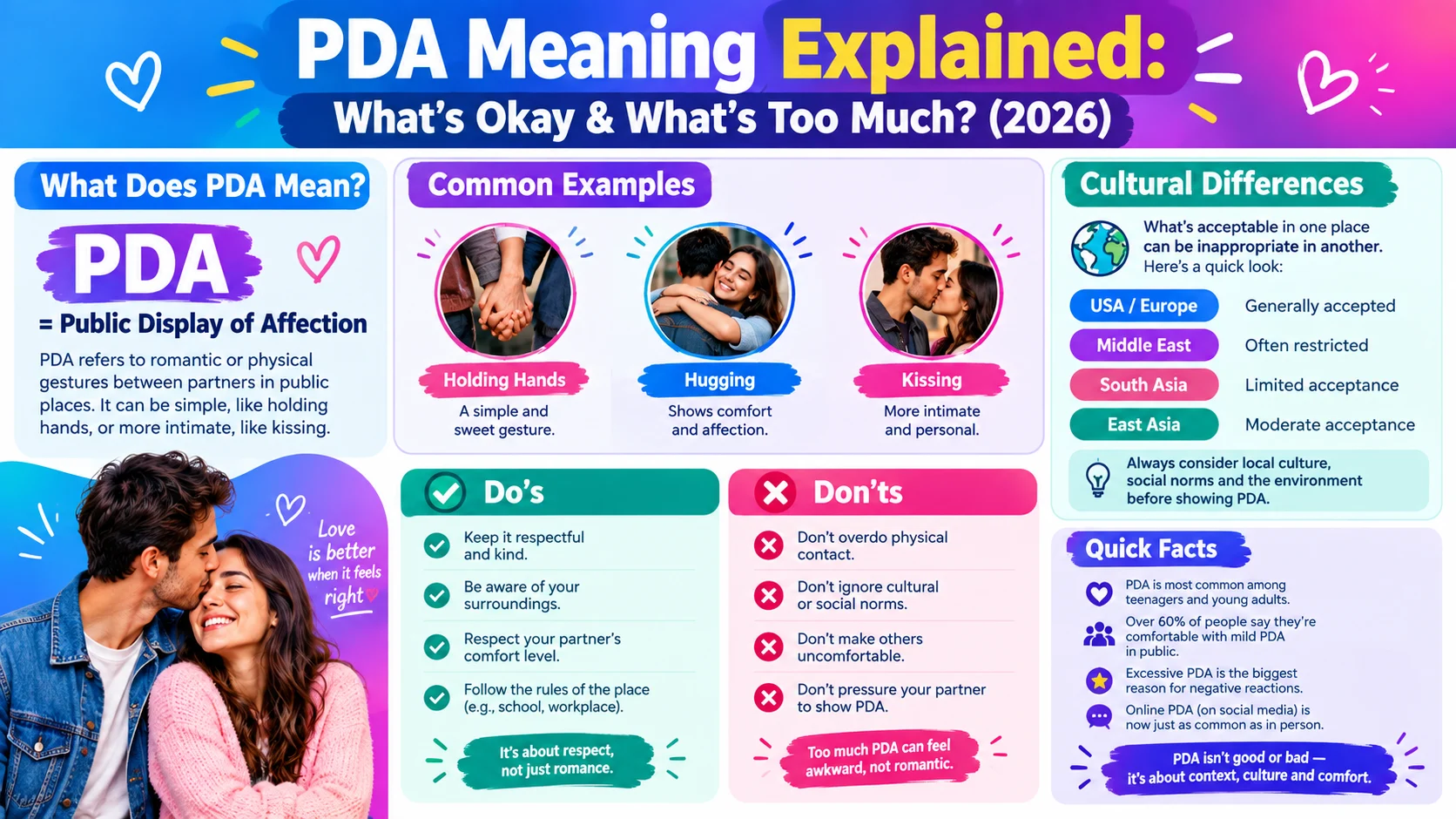
PDA meaning stands for Public Display of Affection, which refers to romantic or physical gestures like holding hands, hugging, or kissing in public places. It’s commonly used in relationships, social media, and texting. While mild PDA is widely accepted, excessive PDA can be seen as inappropriate depending on social norms, culture, and location.
Why Everyone Talks About PDA Today
You’ve seen it everywhere.
Couples holding hands in parks. A quick hug at the mall. Maybe even a kiss at the airport. Then someone says:
“That’s too much PDA.”
But what does that really mean?
The term PDA meaning has evolved beyond simple affection. Today, it connects to relationships, social norms, personal boundaries, and even online culture.
Some people see it as sweet. Others find it uncomfortable. And in some places, it’s not just frowned upon it’s restricted.
So let’s break it down properly. Clear. Real. No fluff.
What Does PDA Mean? (Simple Definition You’ll Actually Use)
The PDA full form is:
Public Display of Affection
It refers to any romantic or physical gesture between partners in a public setting.
Common Examples
- Holding hands
- Hugging
- Kissing
- Sitting close or cuddling
- Arm around the shoulder
Quick Example
You’re walking in a park. A couple is holding hands and laughing.
👉 That’s PDA.
PDA Meaning in Relationship Context
In relationships, PDA is more than just physical contact.
It reflects:
- Emotional connection
- Comfort level
- Relationship confidence
Why Couples Show PDA
- To express love openly
- To feel connected in public
- To signal relationship status
- To build intimacy
However, not everyone is comfortable with it.
Some prefer privacy. Others enjoy public affection.
👉 There’s no single “right” level. It depends on mutual comfort.
Types of PDA (From Subtle to Excessive)
Not all PDA is the same. There’s a spectrum.
Mild PDA (Widely Accepted)
- Holding hands
- Light hugs
- Quick peck on the cheek
Moderate PDA (Situational)
- Kissing briefly
- Sitting closely
- Arm around waist
Excessive PDA (Often Criticized)
- Prolonged kissing
- Intense physical contact
- Behavior that draws attention
Comparison Table: PDA Levels
| Type | Examples | Social Acceptance |
|---|---|---|
| Mild PDA | Holding hands, quick hug | Highly accepted |
| Moderate PDA | Short kiss, close sitting | Depends on place |
| Excessive PDA | Intense kissing | Often frowned upon |
PDA Meaning in Texting and Social Media
In digital conversations, PDA takes on a slightly different meaning.
PDA Meaning in Chat
- Refers to showing affection publicly (online or offline)
- Used casually in texting
Example Messages
- “They’re always doing PDA in public 😂”
- “No PDA please, keep it private”
PDA Meaning on Social Media Platforms
- Instagram → Posting couple photos, kisses, romantic captions
- TikTok → Couple videos showing affection
- Snapchat → Personal romantic snaps
👉 Online PDA is often called “digital PDA”
Real-Life Examples of PDA (Everyday Situations)
Let’s make it practical.
Common Scenarios
- A couple holding hands in a mall
- Hugging goodbye at the airport
- Sitting close at a café
- Posting kissing photos online
Quick Insight
Not all PDA is physical. Even romantic posts online count.
Is PDA Good or Bad? (Honest Answer)
It depends.
When PDA Is Positive
- Shows healthy affection
- Builds emotional connection
- Strengthens relationships
When PDA Becomes a Problem
- Makes others uncomfortable
- Crosses social boundaries
- Feels forced or performative
👉 Balance is everything.
Why People Show PDA (Psychology Behind It)
There’s more going on than you think.
Psychological Reasons
- Desire for connection
- Need for validation
- Emotional expression
- Social signaling
Interesting Insight
People in secure relationships often show natural, relaxed PDA, not exaggerated behavior.
PDA vs Privacy in Relationships
This is where many couples struggle.
Two Common Mindsets
Public Couples
- Comfortable showing affection
- Open about their relationship
Private Couples
- Prefer intimacy in private
- Avoid public attention
👉 Neither is wrong.
The key is agreement between partners.
Cultural Differences in PDA (Very Important)
What’s normal in one place can be inappropriate in another.
Examples Around the World
| Region | PDA Acceptance |
|---|---|
| USA/Europe | Generally accepted |
| Middle East | Often restricted |
| South Asia | Limited acceptance |
| East Asia | Moderate acceptance |
Key Takeaway
Always consider:
- Local culture
- Social norms
- Environment
PDA Rules in Public Places
Different locations have different expectations.
Where PDA Is Usually Acceptable
- Parks
- Beaches
- Public events
Where You Should Be Careful
- Schools
- Workplaces
- Religious places
- Formal events
PDA Etiquette: Do’s and Don’ts
Do’s
- Keep it respectful
- Read the environment
- Respect your partner’s comfort
Don’ts
- Overdo physical contact
- Ignore cultural norms
- Make others uncomfortable
What Is Considered Excessive PDA?
Excessive PDA goes beyond casual affection.
Signs of Too Much PDA
- Long, intense kissing
- Touching that feels inappropriate
- Drawing unnecessary attention
👉 If people are staring, it’s probably too much.
What Does “No PDA” Mean?
You might see this rule in:
- Schools
- Workplaces
- Events
Meaning
No public display of affection allowed
This helps maintain:
- Professional environment
- Respectful space
- Social comfort
PDA Meaning for Teens and Young Couples
Teenagers often explore PDA differently.
Key Considerations
- School rules
- Social pressure
- Emotional maturity
Advice
- Keep it respectful
- Follow rules
- Understand boundaries
PDA and Consent (Critical Topic)
PDA must always involve mutual consent.
Important Points
- Both partners must feel comfortable
- No pressure or force
- Respect personal space
👉 Consent matters even in small gestures.
PDA vs Intimacy (Not the Same Thing)
People often confuse these.
Difference
| PDA | Intimacy |
|---|---|
| Public expression | Private connection |
| Visible to others | Personal and deeper |
| External behavior | Emotional bond |
Alternate Meanings of PDA (Disambiguation)
PDA doesn’t always mean affection.
Other Meanings
- Personal Digital Assistant (old tech devices)
- Pathological Demand Avoidance (psychology term)
👉 However, in most cases, PDA means Public Display of Affection.
Common Misunderstandings About PDA
Let’s clear some myths.
Myth vs Reality
| Myth | Reality |
|---|---|
| PDA = inappropriate | Depends on context |
| PDA = attention-seeking | Not always |
| PDA = strong relationship | Not necessarily |
FAQs
What does PDA mean in a relationship?
PDA means Public Display of Affection, which includes actions like holding hands, hugging, or kissing your partner in public. In a relationship, it shows emotional connection, comfort, and affection, but the level varies from couple to couple.
What is considered PDA in public?
PDA includes any romantic or physical gesture done in public spaces, such as:
- Holding hands
- Hugging
- Kissing
- Sitting very close
- Putting an arm around your partner
👉 Even small gestures count as PDA.
Is PDA good or bad?
PDA isn’t good or bad on its own. It depends on:
- The environment
- The comfort level of both partners
- The social setting
👉 Mild PDA is usually fine. Excessive PDA can feel uncomfortable to others.
What does PDA mean in texting or chat?
In texting, PDA still means Public Display of Affection. People use it to describe couples showing affection in public or online.
Example:
“Stop the PDA 😂”
means someone thinks a couple is being too affectionate.
What does PDA mean on Instagram or TikTok?
On social media, PDA refers to:
- Posting romantic photos
- Sharing couple videos
- Publicly expressing love online
👉 This is often called digital PDA.
What is excessive PDA?
Excessive PDA includes:
- Long or intense kissing
- Overly physical behavior
- Actions that draw attention or make others uncomfortable
👉 If people around you feel awkward, it’s likely too much.
What does “no PDA” mean?
“No PDA” means no public display of affection allowed.
You’ll often see this in:
- Schools
- Workplaces
- Events
👉 It helps maintain a respectful environment.
Why do couples show PDA?
Couples show PDA for several reasons:
- To express love
- To feel connected
- To show relationship status
- To build emotional closeness
Is PDA appropriate for teenagers?
It depends on:
- School rules
- Cultural norms
- Maturity level
👉 Mild PDA like holding hands is usually acceptable, but boundaries matter.
Are there cultural differences in PDA?
Yes, a lot.
- Western countries → More accepting
- South Asia → More conservative
- Middle East → Often restricted
👉 Always consider local norms.
What are examples of PDA in daily life?
Common examples include:
- Holding hands while walking
- Hugging in public
- Kissing goodbye
- Sitting close together
Is PDA the same as intimacy?
No.
- PDA = Public expression of affection
- Intimacy = Deeper emotional or private connection
👉 PDA is visible. Intimacy is personal.
Can PDA be disrespectful?
Yes, if:
- It ignores cultural norms
- Makes others uncomfortable
- Happens in inappropriate places
👉 Respect is key.
How much PDA is acceptable?
There’s no fixed rule, but generally:
- ✔ Holding hands → Acceptable
- ✔ Light hug → Acceptable
- ⚠ Kissing → Depends on place
- ❌ Intense affection → Often inappropriate
What is anti-PDA or PDA dislike?
Some people prefer no PDA.
This could be due to:
- Personal comfort
- Cultural beliefs
- Personality traits
👉 Not everyone enjoys public affection and that’s okay.
Conclusion
PDA isn’t good or bad on its own.
It’s about:
- Context
- Respect
- Awareness
A simple hand hold can feel genuine.
Too much, and it feels forced.
So the real question isn’t:
“Is PDA okay?”
It’s:
“Is it appropriate here, right now?”
Answer that, and you’ll always get it right.