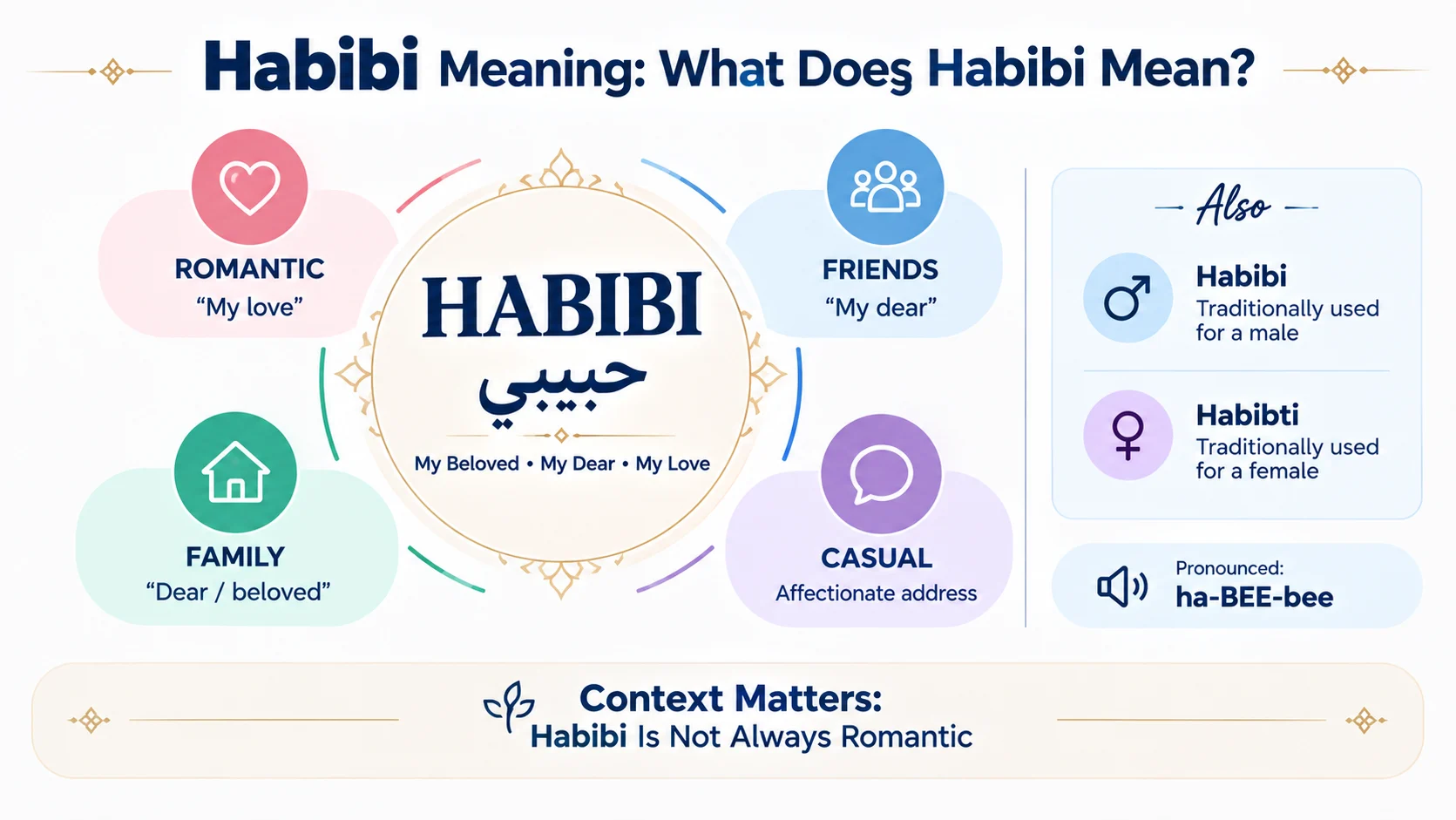
Habibi (حبيبي) is an Arabic term of endearment that literally means “my beloved” or “my dear.” People can use it romantically, but it can also express affection or friendliness between friends, family members, and other people, depending on the speaker, relationship, and context.
If you have heard someone say “habibi” in a song, text message, conversation, or social media post, you may wonder exactly what the word means. The habibi meaning is closely connected to affection and comes from Arabic. In English, it can be translated as “my beloved,” “my dear,” “my love,” or “darling,” depending on the context.
Although many people associate habibi with romantic relationships, the word does not always mean “boyfriend,” “girlfriend,” or romantic partner. Arabic speakers can use it in friendly, family, affectionate, playful, or casual situations as well.
The exact meaning depends on who says it, who receives it, and the situation. Tone also matters. A romantic message such as “Good night, habibi” can sound very different from a friend jokingly saying “Come on, habibi!”
This guide explains what habibi means, how to pronounce it, how the word works in Arabic, and what it can mean in texting and everyday conversation. You will also learn the difference between habibi and habibti, plus several common examples.
What Does Habibi Mean?
Habibi (حبيبي) is an Arabic term of affection that literally means “my beloved” or “my dear.”
Depending on the context, it can mean:
- My love
- My dear
- My beloved
- Darling
- Sweetheart
- Dear friend
A romantic partner might use habibi as an affectionate nickname. However, friends and family members can also use it without romantic meaning.
So, the simplest definition is:
Habibi = “my beloved” or “my dear,” used as a term of affection.
What Does Habibi Mean in Arabic?
In Arabic, حبيبي (ḥabībī) literally means “my beloved” or “my dear.”
The word comes from the Arabic root associated with love and affection.
The structure can be understood simply as:
habib = beloved / dear one
-i = my
Therefore:
habibi = my beloved / my dear
The exact pronunciation and everyday use can vary across Arabic-speaking regions and dialects. Still, the basic affectionate meaning remains widely recognizable.
Is Habibi a Romantic Word?
It can be romantic, but it is not exclusively romantic.
This is one of the most important things to understand about habibi.
A person may say habibi to a romantic partner:
“I miss you, habibi.”
In that situation, “my love” may be the most natural English interpretation.
However, a friend may also use the word affectionately:
“Come on, habibi, we’re going to be late.”
Here, the word may simply communicate warmth or familiarity.
Family members can also use affectionate Arabic terms with one another. Therefore, you should not automatically assume that someone is flirting just because they say habibi.
Habibi Meaning in English
There is no single English translation that works perfectly in every situation.
Common translations include:
| Arabic | Possible English meaning |
|---|---|
| Habibi | My beloved |
| Habibi | My dear |
| Habibi | My love |
| Habibi | Darling |
| Habibi | Sweetheart |
| Habibi | Dear friend |
The best translation depends on the relationship and tone.
For example, “my love” may fit a romantic conversation, while “my dear” may work better in a friendly or casual exchange.
Habibi Meaning in Texting
In texting, habibi usually expresses affection, warmth, closeness, or friendliness.
For example:
“Thank you, habibi ❤️”
Depending on the relationship, this could mean:
“Thank you, my dear.”
Another example:
“Goodnight habibi!”
Between romantic partners, it may mean:
“Goodnight, my love.”
Between close friends, it may simply express affection.
Texting also makes tone important because the same word can feel different depending on emojis, surrounding words, and the relationship between the people.
Habibi Meaning on Social Media
On platforms such as TikTok, Instagram, Snapchat, and other social media platforms, habibi often appears as an affectionate or playful expression.
People may use it:
- In captions
- In comments
- In memes
- In videos
- Between friends
- In romantic posts
- When discussing Arabic or Middle Eastern culture
- As a playful nickname
For example:
“Come here, habibi 😂”
The expression may sound affectionate without being romantic.
Similarly:
“Habibi, what are you doing?”
could simply mean:
“My dear, what are you doing?”
Context determines the tone.
Habibi Meaning From a Guy
If a guy calls you habibi, it does not automatically mean that he is romantically interested in you.
He could be:
- Flirting
- Showing affection
- Speaking casually
- Being friendly
- Using Arabic naturally
- Addressing a close friend
- Using the word playfully
If he is speaking romantically, other parts of the conversation usually make that clearer.
For example:
“I miss you so much, habibi.”
sounds more romantic than:
“Thanks, habibi!”
The relationship and surrounding conversation matter more than the single word.
Habibi Meaning From a Girl
A girl can also call someone habibi.
The meaning can still range from:
- My dear
- My love
- Darling
- Dear friend
- Affectionate nickname
The word itself does not automatically establish a romantic relationship.
However, when a woman is speaking directly to a male person, habibi is traditionally the masculine form of the term.
Habibi vs. Habibti
One of the most common questions about habibi involves habibti.
Both words express affection, but they differ in grammatical gender.
Habibi
حبيبي — ḥabībī
Traditionally used when addressing a male.
It can mean:
“My beloved,” “my dear,” or “my love.”
Habibti
حبيبتي — ḥabībtī
Traditionally used when addressing a female.
It can mean:
“My beloved,” “my dear,” or “my love.”
A simple way to remember the distinction is:
Habibi → male
Habibti → female
The exact usage can vary somewhat across dialects and communities, but this is the standard grammatical distinction learners commonly encounter.
Habibi vs. Habib
These words are related but do not function exactly the same way.
Habib can mean “beloved” or “dear one.”
Habibi means “my beloved” or “my dear.”
The ending -i conveys the idea of “my.”
Therefore:
Habib = beloved
Habibi = my beloved
Habibi vs. Habibti: Quick Comparison
| Word | Arabic | Common meaning | Traditionally addressed to |
|---|---|---|---|
| Habibi | حبيبي | My beloved / my dear | Male |
| Habibti | حبيبتي | My beloved / my dear | Female |
| Habib | حبيب | Beloved / dear | General noun or masculine form depending on context |
Can Friends Call Each Other Habibi?
Yes.
Friends can use habibi as an affectionate form of address.
For example:
“Where have you been, habibi?”
This can sound like:
“Where have you been, my friend?”
or:
“Where have you been, my dear?”
depending on the speakers.
In many conversations, affection does not automatically mean romantic affection.
That distinction is important when interpreting Arabic terms through English-language assumptions.
Can Family Members Say Habibi?
Yes.
Family members can use affectionate terms such as habibi when addressing one another.
For example, someone may use the word affectionately with a son, brother, father, or another male family member.
In that context, translating habibi as “my love” may sound overly romantic in English. “My dear” or “dear” may communicate the intended tone more naturally.
Habibi in Romantic Relationships
Romantic partners commonly use habibi as a term of affection.
Examples include:
“I love you, habibi.”
“Good morning, habibi.”
“I missed you, habibi.”
In these contexts, English translations such as “my love,” “darling,” or “sweetheart” may work well.
The word can function similarly to affectionate nicknames used in English.
Habibi as a Friendly Expression
In friendly conversation, habibi can communicate warmth without romance.
For example:
“Relax, habibi. Everything is fine.”
The speaker may simply be trying to comfort a friend.
Likewise:
“Thanks for helping me, habibi.”
could mean:
“Thanks, my dear.”
Therefore, the relationship and tone should guide your interpretation.
Habibi in Songs and Music
You may frequently hear habibi in Arabic songs and international music.
Artists may use the word to express:
- Romantic love
- Longing
- Affection
- Emotional attachment
- Devotion
- Desire
- Nostalgia
Because songs often use emotional language, habibi may frequently be translated as “my love” or “my beloved.”
Still, the exact meaning depends on the lyrics and context.
Habibi in Popular Culture
The word has become widely recognizable outside Arabic-speaking communities.
English speakers may encounter habibi through:
- Music
- Movies
- Television
- Social media
- Memes
- Travel
- Online conversations
- Arabic-language content
As a result, some people use habibi casually even when they do not speak Arabic.
However, learning the cultural context helps prevent misunderstandings.
Is Habibi Arabic Slang?
Habibi is an Arabic word and term of endearment, rather than simply internet slang.
People have used affectionate forms of the word in Arabic-speaking communities long before social media existed.
Online culture has helped spread the word to a wider international audience.
Therefore, calling habibi “internet slang” can miss its broader linguistic and cultural background.
Habibi Pronunciation
Habibi is commonly pronounced approximately:
ha-BEE-bee
The middle syllable receives the strongest emphasis in many English-language pronunciations.
A more precise transliteration is:
ḥabībī
The dots or special marks in transliteration represent Arabic sounds that English does not always reproduce exactly.
For everyday English conversation, ha-BEE-bee is a useful approximation.
How Do You Spell Habibi?
The most common English spelling is:
Habibi
You may also encounter:
- Habiby
- Habibee
- Habibi
- 7abibi in Arabizi
The spelling habibi is the standard Latin-script form most English speakers will recognize.
What Does 7abibi Mean?
In online Arabic writing, you may see:
7abibi
This is an example of Arabizi, a system that uses Latin letters and numbers to represent Arabic sounds.
The number 7 commonly represents the Arabic letter ح (ḥ).
Therefore:
7abibi ≈ habibi
Both refer to the same basic Arabic word.
Habibi in Arabizi
Arabizi is especially common in informal digital communication.
You may see forms such as:
- 7abibi
- 7abibti
- 7ob
- Other Arabic words written with Latin letters and numbers
The exact spelling can vary between people and communities.
Therefore, online spellings do not always follow one fixed system.
Examples of Habibi in Conversation
Romantic Example
“I can’t wait to see you, habibi.”
Meaning:
“I can’t wait to see you, my love.”
Friendly Example
“Come on, habibi. We’re already late.”
Meaning:
“Come on, my dear.”
Family Example
“Are you okay, habibi?”
Meaning:
“Are you okay, my dear?”
Playful Example
“Oh, habibi, what did you do?”
This can express affection, amusement, or playful frustration.
Supportive Example
“Don’t worry, habibi. It will be okay.”
Here, the word adds warmth and comfort.
Common Phrases With Habibi
Here are several expressions you may encounter:
“My Habibi”
This phrase means roughly:
“My beloved” or “my dear.”
English speakers sometimes use it as an affectionate nickname.
“Ya Habibi”
Ya habibi can be understood as an affectionate way of addressing someone.
Depending on context, it may translate as:
“Oh, my dear,” “my beloved,” or “my love.”
“Come on, Habibi”
This can be playful, affectionate, or encouraging.
The exact tone depends on the situation.
“Thank You, Habibi”
This usually expresses warmth or affection while thanking someone.
It does not automatically imply romance.
Is Calling Someone Habibi Flirting?
Not necessarily.
Habibi can be flirtatious when used between people with romantic interest. However, the word itself does not prove that someone is flirting.
Consider these two examples:
“I love you, habibi.”
This strongly suggests romantic affection in many contexts.
Compare that with:
“Thanks for picking me up, habibi!”
That could easily be friendly or familiar.
Therefore, context matters more than the word alone.
Does Habibi Mean “Love”?
Not exactly.
Habibi literally conveys the idea of “my beloved” or “my dear.”
The Arabic word for love as a noun is different.
So, while habibi is closely connected to love and affection, translating it simply as “love” can lose some of its grammatical meaning.
Is Habibi Used Only for Men?
The form habibi is traditionally used when addressing a male.
When addressing a female, habibti is the standard feminine form.
However, informal speech, dialects, communities, and cultural contexts can influence how people use affectionate expressions.
For language learners, the basic distinction remains useful:
Male → habibi
Female → habibti
Common Mistakes About Habibi
Mistake 1: Assuming It Always Means “Boyfriend”
It does not.
A romantic partner may be called habibi, but friends and family can also use the term.
Mistake 2: Assuming It Always Means “I Love You”
It does not directly mean “I love you.”
It is an affectionate term that can be translated as “my dear,” “my beloved,” or “my love.”
Mistake 3: Treating It as Only Internet Slang
The word has a long-standing place in Arabic language and culture. Social media simply helped spread it internationally.
Mistake 4: Using Habibi and Habibti Interchangeably
Traditionally, habibi addresses a male, while habibti addresses a female.
Mistake 5: Assuming Every Use Is Romantic
The relationship, setting, and tone determine the meaning.
Habibi Grammar and Usage
Habibi functions as a term of address or term of endearment.
In English sentences, it can appear at the beginning or end:
“Habibi, come here.”
“Thank you, habibi.”
“Goodnight, habibi.”
When English speakers borrow the word, they often use it as a nickname or affectionate form of address.
Habibi vs. “My Love”
These expressions can overlap, but they are not identical.
My love sounds strongly romantic in many English contexts.
Habibi can be romantic, but it can also be friendly or familial.
Therefore, translating habibi as “my love” works well in some situations but not all.
Habibi vs. “My Dear”
“My dear” can often capture the broader affectionate meaning of habibi.
For example:
“Thank you, habibi.”
could naturally become:
“Thank you, my dear.”
This translation works especially well when the relationship is friendly or familial rather than romantic.
Habibi vs. Darling
Darling is another possible English translation.
Both expressions can communicate affection and warmth.
However, habibi carries Arabic linguistic and cultural meaning that the English word darling does not fully reproduce.
Quick Reference: Habibi Meaning
| Question | Answer |
|---|---|
| What does habibi mean? | My beloved, my dear, or my love |
| What language is habibi? | Arabic |
| Arabic spelling | حبيبي |
| Is habibi romantic? | Sometimes, but not always |
| Can friends say habibi? | Yes |
| Can family members say habibi? | Yes |
| Male form | Habibi |
| Female form | Habibti |
| Common pronunciation | ha-BEE-bee |
| What does 7abibi mean? | A digital spelling of habibi using Arabizi |
| Is habibi slang? | It is primarily an Arabic term of endearment, not merely internet slang |
Frequently Asked Questions
What does habibi mean in English?
Habibi means “my beloved,” “my dear,” “my love,” or “darling,” depending on the context.
Is habibi Arabic?
Yes. Habibi (حبيبي) is an Arabic term of endearment.
What does habibi mean from a guy?
It can mean “my dear,” “my love,” “darling,” or another affectionate expression. The word alone does not prove romantic interest.
What does habibi mean from a girl?
A girl can also use habibi as an affectionate expression, especially when addressing a male. Depending on context, it can mean “my dear,” “my love,” or “darling.”
What is the female version of habibi?
The commonly used feminine form is habibti (حبيبتي).
Can you call a friend habibi?
Yes. Friends can use habibi to express affection, closeness, warmth, or familiarity.
Can parents call their children habibi?
Yes. Arabic-speaking family members may use affectionate terms such as habibi with children and other relatives.
Does habibi mean boyfriend?
No. Habibi does not literally mean boyfriend. It is an affectionate term that can be used for a romantic partner but also for friends and family.
Does habibi mean “my love”?
It can. In a romantic context, “my love” is often a natural English translation.
What is the difference between habibi and habibti?
Habibi is traditionally used when addressing a male, while habibti is traditionally used when addressing a female.
What does ya habibi mean?
Ya habibi is an affectionate form of address that can mean something like “my dear,” “my beloved,” or “my love,” depending on context.
How do you pronounce habibi?
A common English approximation is ha-BEE-bee.
Is habibi a bad word?
No. Habibi is generally an affectionate and positive term. Its exact tone depends on the context and relationship.
Can habibi be used sarcastically?
Yes. Like many terms of endearment, habibi can sometimes appear in playful, ironic, or sarcastic speech. Tone and context determine the intended meaning.
What does 7abibi mean?
7abibi is a digital spelling of habibi using Arabizi. The number 7 commonly represents the Arabic letter ح.
Conclusion
The habibi meaning is “my beloved,” “my dear,” or “my love.” It is an Arabic term of endearment that expresses affection, warmth, or closeness.
Although many people associate habibi with romantic relationships, the word does not automatically indicate romance. Friends, family members, and other close people can also use it. Therefore, the surrounding conversation and relationship matter when interpreting the word.
The masculine form is commonly written habibi, while habibti is the traditional feminine form. You may also see 7abibi online, which represents the same word through Arabizi spelling.
In short, habibi is more than a simple translation of “love.” It is a flexible Arabic expression of affection that can mean “my dear,” “my beloved,” “darling,” or “my love,” depending on the situation.

Charlotte Wilson is a language writer passionate about word meanings, synonyms, and clear communication. She creates accurate and engaging content to help readers expand their vocabulary and language skills.




1 thought on “Habibi Meaning| What Does Habibi Mean in Arabic and Texting? Definition, Uses, Pronunciation & Cultural Context 2026”