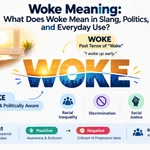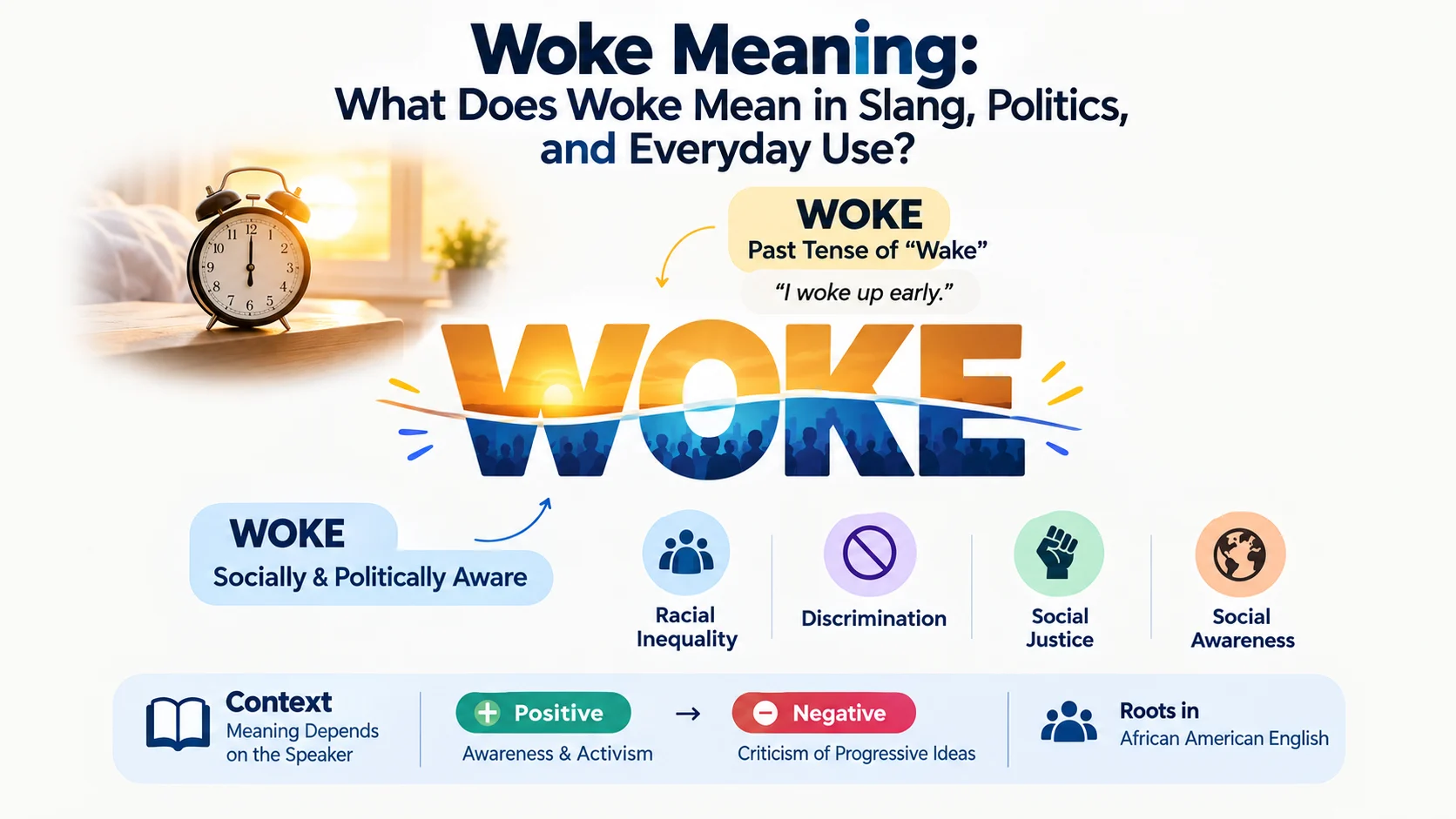
Woke originally means being alert or awake, but in modern slang it commonly means being aware of social and political issues, especially racism and inequality. The term originated in African American English and became widely associated with social justice activism. Today, people use “woke” both positively and negatively, so its meaning depends heavily on context.
The woke meaning has changed significantly over time. In ordinary English, woke is simply the past tense of wake. However, in slang and modern cultural discussions, the word can describe someone who is aware of social and political issues, particularly issues involving racism, discrimination, and inequality.
The modern slang use has roots in African American English, where “stay woke” developed as a way to encourage awareness of injustice and potential threats. The phrase later spread beyond Black American communities and became common in discussions about civil rights and social activism.
During the 2010s, social media helped make woke a much broader cultural term. People began using it to discuss subjects such as racial justice, gender, inequality, discrimination, and other social issues. At the same time, critics started using woke negatively to describe what they viewed as excessive political correctness or progressive activism.
As a result, the word can now carry very different meanings. This guide explains what woke means, where it came from, how people use it online, and why context matters when interpreting it.
What Does Woke Mean?
Woke has two important meanings.
Traditional meaning:
Woke is the past tense of wake.
“I woke up early.”
Modern slang meaning:
Woke describes being alert to or aware of social and political issues, especially racism, discrimination, and inequality.
“She is very woke about racial inequality.”
The slang meaning can be positive, neutral, or negative depending on who uses it and why.
What Is the Woke Definition?
The modern woke definition centers on social awareness.
Someone described as woke may be particularly aware of issues such as:
- Racism
- Discrimination
- Social inequality
- Gender-related issues
- Civil rights
- Economic inequality
- Systemic injustice
- Representation
However, the word does not have one universally accepted definition in modern political or cultural discussions.
One person may use woke as praise for someone who pays attention to injustice. Another person may use the same word critically to describe views they consider overly progressive.
Therefore, context plays a major role.
Where Did the Word Woke Come From?
The slang use of woke has roots in African American English.
The phrase “stay woke” became associated with maintaining awareness of racial injustice and social dangers. Although the expression existed before the modern social-media era, it gained wider public attention through discussions of racism and civil rights.
The word later spread into mainstream American culture.
Social media accelerated that process. As conversations about racial justice, police violence, discrimination, and inequality became more visible online, woke appeared frequently in posts, hashtags, articles, and public debates.
Consequently, a term that once had a relatively specific cultural context developed a much broader meaning.
What Does Woke Mean in Slang?
In slang, woke usually means socially aware.
For example:
“He’s pretty woke about environmental issues.”
Here, the speaker means that the person pays attention to social or ethical concerns.
Another example:
“She became more woke after learning about discrimination.”
In this case, woke suggests increased awareness of social problems.
However, not everyone uses the term positively.
For example:
“The movie feels too woke.”
Here, the speaker is criticizing the movie for what they perceive as excessive attention to progressive social ideas.
The same word can therefore express approval or criticism.
What Does Woke Mean in Text?
In texting, woke usually has the same slang meaning as it does on social media.
Someone might write:
“He’s really woke.”
Depending on the conversation, this could mean:
Positive:
“He is socially aware.”
Negative:
“He focuses too heavily on progressive political ideas.”
Another person might simply use woke in its literal sense:
“I woke up late today.”
In that sentence, woke is not slang. It is simply the past tense of wake.
What Does Woke Mean on Social Media?
Social media has played a major role in the modern use of woke.
You may see the word in conversations about:
- Racial justice
- Gender
- Politics
- Climate issues
- Diversity
- Representation
- Discrimination
- Social activism
- Popular culture
For example:
“The creator is known for making woke content.”
Depending on the speaker, this could be praise or criticism.
Similarly:
“People are tired of everything being called woke.”
This sentence clearly uses woke in a critical sense.
Therefore, readers should look at the surrounding words rather than assuming that the speaker intends one fixed definition.
What Does Woke Mean on TikTok?
On TikTok, woke often appears in discussions about culture, social issues, entertainment, and politics.
A creator may use the word positively:
“This is such a woke message.”
The creator may mean that the message raises awareness about an important social issue.
Another creator might use it negatively:
“Why is everything so woke now?”
Here, the speaker is criticizing what they perceive as excessive progressive messaging.
TikTok also uses the word humorously and ironically. Some users deliberately exaggerate the term for comedy.
What Does Woke Mean on Instagram?
On Instagram, woke can appear in captions, comments, memes, and discussions about social issues.
For example:
“Stay woke.”
This can mean:
Stay aware.
A meme might use “woke” differently, especially when mocking political arguments.
Therefore, the tone can range from serious activism to humor or criticism.
What Does Woke Mean on Reddit?
On Reddit, woke can have several meanings depending on the community.
In one discussion, users might use it to describe awareness of discrimination.
In another, people might use “woke” as a criticism of progressive politics or social messaging.
Some Reddit communities also use the word sarcastically.
As a result, the subreddit, topic, and surrounding comments can significantly affect its meaning.
What Does Woke Mean in Politics?
In political discussions, woke commonly refers to awareness of social inequalities and issues involving race, gender, discrimination, and related subjects.
However, the word has become contested political language.
Some people use woke positively to describe social awareness and support for equality. Others use it negatively as a broad criticism of progressive politics, cultural activism, or policies they oppose.
Because the term can function differently for different speakers, a political statement containing “woke” may require additional context to understand exactly what the speaker means.
It is often more precise to identify the specific policy, belief, or behavior being discussed rather than relying on the label alone.
Is Woke a Political Word?
It can be.
The word began as a broader expression of social awareness, particularly within African American communities. Today, however, woke frequently appears in political debates.
Its political meaning varies.
For some speakers, it represents awareness of injustice and support for social equality.
For others, it describes what they view as excessive progressivism, political correctness, or ideological activism.
Therefore, woke is not simply a neutral political category. Its meaning depends on the speaker and the context.
Is Woke a Positive or Negative Word?
It can be either.
Positive use
Someone may say:
“She’s very woke about racial inequality.”
The speaker is likely praising her awareness.
Negative use
Someone else may say:
“That company has become too woke.”
Here, the speaker is expressing criticism.
Neutral use
A writer might say:
“The campaign became part of the broader debate over woke politics.”
Here, the term may simply identify a subject of public discussion.
Because all three uses exist, you should not assume the speaker’s attitude from the word alone.
What Does “Stay Woke” Mean?
“Stay woke” means stay alert, aware, or informed, particularly about injustice or social problems.
The phrase became strongly associated with African American social and political discourse.
For example:
“Stay woke and pay attention to what is happening around you.”
The phrase can be serious and activist in tone.
Today, however, people also use it humorously or sarcastically online.
Woke vs. Aware
These words overlap, but woke has a more specific cultural history.
Aware is a broad everyday word.
“She is aware of the problem.”
Woke often carries a social or political meaning.
“She is woke about racial inequality.”
Therefore, aware works in many situations, while woke often signals awareness of social or political issues.
Woke vs. Progressive
Progressive usually describes political or social views that support reforms or changes associated with social equality and other causes.
Woke can refer to social awareness, but its meaning varies much more depending on the speaker.
Someone can hold progressive political views without using the word woke to describe themselves.
Likewise, someone may be called woke by another person even if they do not personally use that label.
These terms should not automatically be treated as exact synonyms.
Woke vs. Politically Correct
Politically correct generally refers to language or behavior intended to avoid offending or excluding particular groups.
Woke has a broader meaning.
It can refer to awareness of social inequality, discrimination, representation, or injustice.
In political criticism, however, people sometimes use the terms together.
For example:
“The company is too politically correct and woke.”
Here, the speaker is using both as criticisms.
Woke vs. Socially Aware
These expressions are closely related.
Socially aware means understanding social problems and their effects.
Woke can communicate a similar idea, especially in its positive usage.
However, woke has a much stronger cultural and political history.
Therefore, socially aware is usually more neutral, while woke can carry additional cultural or political implications.
Examples of Woke in a Sentence
Here are examples showing different meanings:
- “She became more woke after learning about racial inequality.”
- “The campaign promotes a woke message about social justice.”
- “He calls himself woke because he follows social issues closely.”
- “The comedian made a joke about woke culture.”
- “People online use woke in both positive and negative ways.”
- “The company faced criticism for its so-called woke advertising.”
- “The phrase ‘stay woke’ has a long history in African American culture.”
- “I woke up at six this morning.”
The final example shows the ordinary grammatical meaning of woke.
Woke as the Past Tense of Wake
Not every use of woke involves slang.
In standard English grammar, woke is the simple past tense of wake.
Examples:
“I woke up early.”
“She woke when the alarm rang.”
“They woke after hearing a loud noise.”
This meaning is completely separate from the modern slang use.
Context makes the difference.
Is Woke an Insult?
Sometimes.
When someone says:
“He’s woke.”
they may be describing social awareness.
However, when someone says:
“That’s just woke nonsense.”
the word clearly functions as a negative label.
Online discussions often use woke as a criticism, especially when people disagree about politics or cultural issues.
Therefore, whether the word is insulting depends on tone, context, and intent.
Why Has Woke Become Controversial?
The word became controversial because different groups began using it to express very different views.
Supporters of the term may use it to describe awareness of discrimination and inequality.
Critics may use it as a broad label for progressive ideas or cultural changes they oppose.
Social media amplified these competing uses. As a result, woke became a highly recognizable cultural and political term.
The disagreement often concerns what the word should include.
For one speaker, woke may simply mean socially conscious. For another, it may describe a much broader political ideology.
That difference explains why conversations involving the word can become confusing.
Common Mistakes About Woke
Mistake 1: Thinking Woke Always Means Progressive
The slang term often appears in progressive contexts, but people can also use woke critically.
Mistake 2: Thinking Woke Always Means an Insult
Some people use the word positively to describe social awareness.
Mistake 3: Assuming Woke Has One Fixed Definition
Its meaning has changed over time and varies by speaker.
Mistake 4: Confusing Woke With Woken
Woke and woken have different grammatical roles.
“I woke up early.”
“I have woken up early every day this week.”
Mistake 5: Forgetting the Literal Meaning
“Woke” is also simply the past tense of wake.
Woke vs. Woken
This distinction is useful in grammar.
Woke is generally the simple past form:
“I woke at 7 a.m.”
Woken is the past participle:
“I have woken up several times.”
The slang adjective woke is different from both uses.
For example:
“She is politically woke.”
Here, woke describes social or political awareness.
Can Woke Be Used as an Adjective?
Yes.
In modern slang, woke commonly functions as an adjective.
Examples include:
- woke culture
- woke politics
- woke activism
- woke audience
- woke message
It describes a person, idea, product, message, or cultural position associated with social awareness.
However, the word can carry positive, negative, or ironic meaning.
How to Use Woke Correctly
Use woke when the context involves social awareness or the cultural meaning of the term.
For example:
“The documentary explores issues that many people consider important to woke activism.”
If you simply mean someone is conscious after sleeping, use it in the ordinary sense:
“I woke up late.”
When precision matters, explain the specific issue instead of relying on the broad label.
For example, instead of saying:
“That policy is woke.”
you could identify what you mean:
“That policy focuses on racial representation.”
The second sentence provides much more information.
Related Words to Woke
Depending on the intended meaning, related words include:
- Aware
- Alert
- Conscious
- Informed
- Socially conscious
- Socially aware
- Progressive
- Activist
- Engaged
These words are not perfect synonyms.
For example, alert usually refers to attention or readiness, while woke in slang often refers to social and political awareness.
Woke Meaning: Quick Reference
| Term | Meaning |
|---|---|
| Woke | Socially or politically aware, especially about injustice or inequality |
| Stay woke | Stay alert and aware of social issues |
| Woke culture | A broad term for culture associated with social awareness or progressive activism |
| Woke politics | A broad and contested term for politics focused on social issues |
| Socially aware | Conscious of social conditions and problems |
| Progressive | Supporting social or political reform |
| Politically correct | Language or behavior intended to avoid offense or exclusion |
| Woke up | Literally became awake |
Frequently Asked Questions
What does woke mean?
Woke can mean socially or politically aware, particularly regarding racism, discrimination, inequality, and social justice. It can also simply be the past tense of wake.
What does woke mean in slang?
In slang, woke generally means being aware of social or political issues. The term can have either positive or negative connotations depending on the speaker.
What does woke mean in text?
In texting, woke usually means socially aware when used as slang. However, it can also mean the past tense of wake, as in “I woke up late.”
What does woke mean on TikTok?
On TikTok, woke can describe social awareness, progressive ideas, activism, or political messaging. Users may also use it sarcastically or critically.
What does woke mean on social media?
On social media, woke commonly refers to awareness of social issues such as racism, discrimination, inequality, gender, or representation. The word can be positive, negative, or ironic.
Is woke a bad word?
No. Woke is not a swear word. However, people sometimes use it as an insult or criticism.
Is woke a political term?
It can be. Although the word has roots in broader social awareness and African American English, modern discussions often use woke in political and cultural debates.
Is woke positive or negative?
It can be either. Some people use woke as praise for social awareness, while others use it negatively to criticize progressive ideas or activism.
What does “stay woke” mean?
“Stay woke” means to remain alert and aware, particularly about social problems, injustice, or discrimination.
Does woke mean progressive?
Not necessarily. The words overlap in some contexts, but they are not exact synonyms. Woke often emphasizes awareness, while progressive usually describes a set of social or political views.
What is woke culture?
Woke culture is a broad phrase used to describe cultural attitudes or practices associated with awareness of social inequality, discrimination, identity, and related issues. Different people use the phrase differently.
What is the opposite of woke?
There is no single exact opposite. Depending on context, possible contrasts include unaware, uninformed, or socially insensitive.
What is the past tense of wake?
The simple past tense of wake is woke.
For example:
“I woke up at 7 a.m.”
What is the difference between woke and woken?
Woke is generally the simple past form, while woken is the past participle.
“She woke early.”
“She has woken early all week.”
Conclusion
The woke meaning depends on context.
In its modern slang sense, woke generally describes being aware of social and political issues, particularly racism, discrimination, inequality, and social justice. The expression has roots in African American English and later spread widely through social movements and online culture.
Today, however, woke can be used in very different ways. Some people use it positively to praise social awareness. Others use it critically as a label for progressive politics, activism, or cultural ideas they disagree with. It can also appear humorously or sarcastically online.
At the same time, remember that woke has an ordinary grammatical meaning. It is the past tense of wake, as in “I woke up early.”
So, when you see woke in a text, TikTok comment, Reddit post, or political discussion, check the surrounding context first. That simple step can tell you whether the writer means “became awake” or “socially aware.”

Charlotte Wilson is a language writer passionate about word meanings, synonyms, and clear communication. She creates accurate and engaging content to help readers expand their vocabulary and language skills.