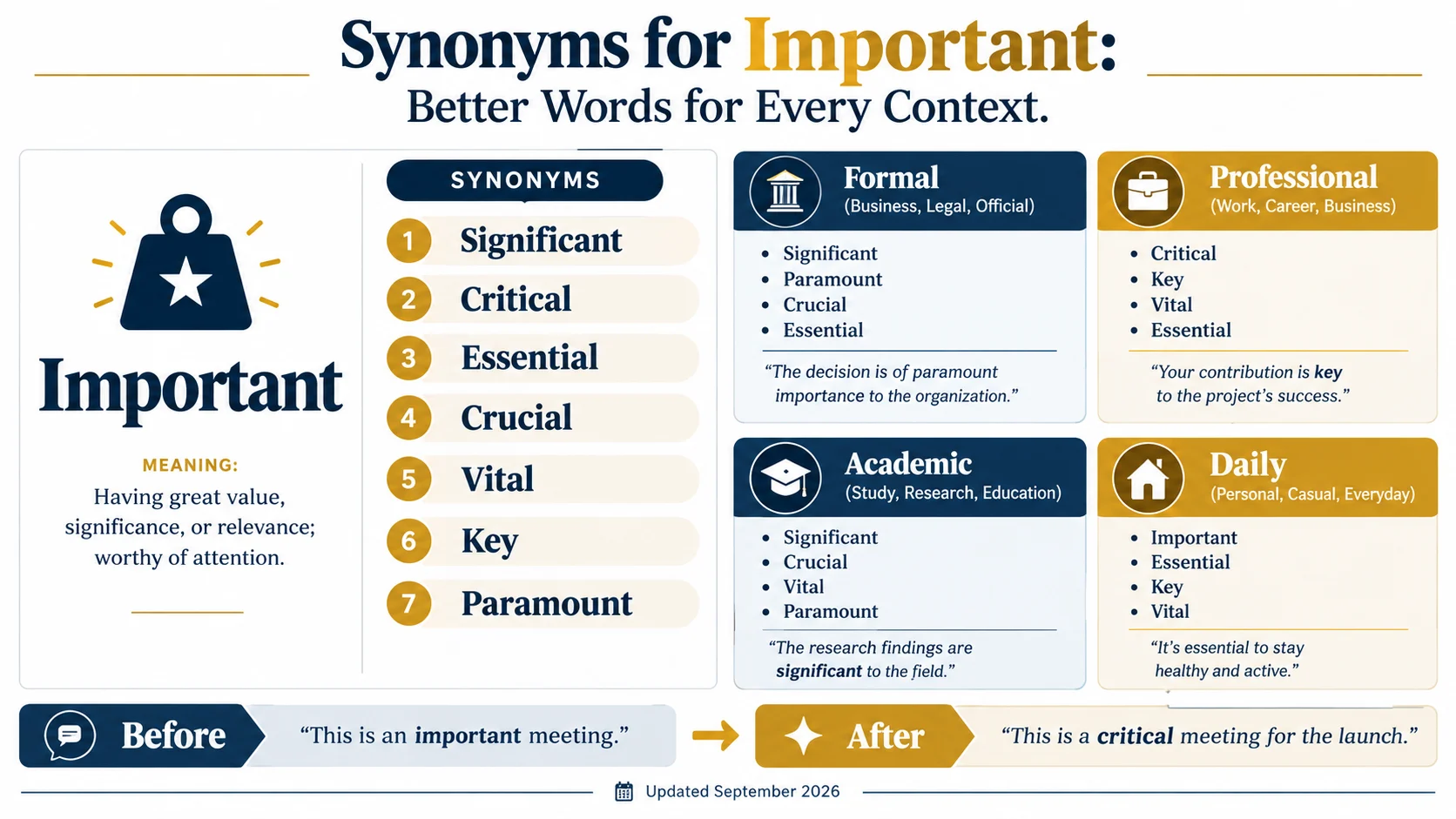
The best synonym for important depends on context. For professional writing, use significant, critical, or essential. In academic work, choose crucial, paramount, or fundamental. For everyday conversation, key, major, or big work well without sounding formal.
What Does Important Mean?
Definition
Important describes something that carries weight, value, or consequence. It signals that a person, idea, event, or decision matters more than ordinary things around it. The word comes from the Latin importare, meaning “to bring in” or “to carry weight,” which explains why we still associate it with significance and consequence.
The word works across nearly every domain. A doctor might call a diagnosis important. A teacher might call a deadline important. A manager might call a client meeting important. Each use points to the same core idea: this thing deserves attention because it affects outcomes.
Common Uses
| Usage | What It Signals | Example |
|---|---|---|
| Personal matters | Emotional or life weight | “This is an important day for my family.” |
| Professional tasks | Priority and consequence | “We have an important deadline Friday.” |
| Academic claims | Central to the argument | “This is an important finding in the study.” |
| Public issues | Broad social relevance | “Voting is important for every citizen.” |
| Everyday emphasis | General significance | “That’s an important point you made.” |
Best Synonyms for Important
| Synonym | Meaning | Best Used When | Example |
|---|---|---|---|
| Significant | Notable and meaningful | Data, results, changes | “The study showed significant improvement.” |
| Critical | Extremely important, urgent | Deadlines, decisions, errors | “This is a critical step in the process.” |
| Essential | Absolutely necessary | Requirements, tools, skills | “Clear communication is essential for teams.” |
| Crucial | Decisive, pivotal | Turning points, key factors | “Timing is crucial in this negotiation.” |
| Vital | Necessary for life or success | Health, safety, core functions | “Water is vital for survival.” |
| Key | Central and unlocking | Strategy, roles, insights | “She played a key role in the launch.” |
| Major | Large in scale or impact | Projects, shifts, decisions | “We made a major change to the plan.” |
| Fundamental | Basic and foundational | Principles, rights, rules | “Trust is fundamental to any partnership.” |
| Paramount | Above all others | Safety, priorities, concerns | “Patient safety is paramount.” |
| Substantial | Considerable in size or value | Investments, evidence, growth | “They made a substantial contribution.” |
Important Synonym Analysis
Significant
Meaning: Notable, measurable, or worthy of attention.
Best Used For: Research findings, business results, measurable changes.
Tone: Formal and neutral.
Difficulty: Easy.
Usage Frequency: Very Common.
Best For: Resume, essay writing, business writing.
Critical
Meaning: Extremely important because failure would cause harm.
Best Used For: Urgent decisions, high-stakes tasks, risk warnings.
Tone: Serious and direct.
Difficulty: Easy.
Usage Frequency: Very Common.
Best For: Email writing, business writing, marketing copy.
Essential
Meaning: Absolutely necessary, cannot be omitted.
Best Used For: Requirements, foundational skills, core elements.
Tone: Firm and practical.
Difficulty: Easy.
Usage Frequency: Very Common.
Best For: Resume, email writing, business writing.
Crucial
Meaning: Decisive at a turning point.
Best Used For: Strategy, timing, pivotal moments.
Tone: Strong and focused.
Difficulty: Medium.
Usage Frequency: Common.
Best For: Essay writing, business writing, marketing copy.
Vital
Meaning: Necessary for life, health, or continued success.
Best Used For: Health, safety, core operations.
Tone: Serious and warm.
Difficulty: Easy.
Usage Frequency: Common.
Best For: Email writing, business writing, essay writing.
Paramount
Meaning: More important than anything else.
Best Used For: Safety, ethics, top priorities.
Tone: Formal and elevated.
Difficulty: Advanced.
Usage Frequency: Less Common.
Best For: Business writing, essay writing.
Synonyms by Context
Formal Writing
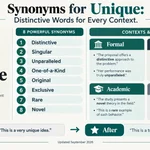
Formal writing favors words that carry weight without sounding dramatic. Choose significant, fundamental, paramount, or substantial. These terms appear often in reports, policy documents, and official statements because they signal measured importance rather than emotional emphasis.
- “The committee identified significant gaps in the proposal.”
- “Transparency is fundamental to public trust.”
Professional Writing
In business emails, proposals, and memos, clarity beats decoration. Use critical, essential, key, or vital. These words tell readers what to prioritize without slowing them down.
- “This is a critical update for all department heads.”
- “Clear documentation is essential for compliance.”
Academic Writing
Academic prose demands precision and restraint. Choose significant, crucial, fundamental, or substantial. These terms fit research claims, literature reviews, and theoretical arguments without overstating the case.
- “The results revealed a significant correlation between the variables.”
- “This framework is fundamental to the study’s methodology.”
Daily Conversation
In everyday speech, keep it natural. Key, major, big, and really matters fit casual exchanges better than formal vocabulary.
- “That’s a key point we shouldn’t ignore.”
- “Getting enough sleep is major for your health.”
Professional Alternatives for Important
When you write for work, choose words that signal priority without sounding inflated.
| Word | Why It Works | Example |
|---|---|---|
| Priority | Signals ranked importance | “This is our top priority this quarter.” |
| High-impact | Emphasizes measurable effect | “We need high-impact solutions.” |
| Mission-critical | Fits operations and tech | “This is a mission-critical system.” |
| Strategic | Ties importance to long-term goals | “This is a strategic decision.” |
| Material | Legal and financial precision | “The discrepancy is material to the audit.” |
Simple Alternatives for Important
Sometimes plain words serve you best. These alternatives work well when you want to be understood instantly.
| Simple Word | Example |
|---|---|
| Key | “That’s a key detail.” |
| Big | “This is a big deal for the team.” |
| Main | “The main point is simple.” |
| Real | “This is a real problem.” |
| Serious | “We face a serious challenge.” |
Stronger Alternatives for Important
When you need to raise the intensity, choose words that carry more weight.
| Stronger Word | Intensity | Example |
|---|---|---|
| Crucial | High | “This is a crucial moment for the company.” |
| Vital | High | “Your feedback is vital to our success.” |
| Paramount | Very High | “Safety is paramount on every job site.” |
| Indispensable | Very High | “She is indispensable to the project.” |
| Pivotal | Very High | “This was a pivotal decision in our history.” |
Difference Between Similar Synonyms
Important and significant often appear together in writing, but they are not twins. Important means something matters. Significant means something matters and is measurable or noticeable. A significant result can be proven. An important result simply matters.
Critical and crucial both point to high stakes, but critical leans toward urgency and risk. Crucial leans toward decision points. A critical error must be fixed now. A crucial choice determines what happens next.
Essential and vital both mean necessary, but essential focuses on requirement while vital focuses on survival or continued health. Water is vital. A passport is essential for international travel.
Paramount sits above all of these. It means nothing matters more. Use it sparingly, because it claims the top position.
Understanding these distinctions helps you pick the word that fits your sentence instead of the first one you find.
Opposite Words (Antonyms)
| Antonym | Meaning | Example |
|---|---|---|
| Trivial | Of little value or importance | “The complaint was trivial.” |
| Minor | Small in scale or impact | “It was a minor setback.” |
| Insignificant | Not worth attention | “The difference was insignificant.” |
| Negligible | Too small to matter | “The risk is negligible.” |
| Unimportant | Lacking significance | “That detail is unimportant.” |
| Irrelevant | Not connected to the matter | “His comment was irrelevant.” |
FAQs
What is another word for important?
Significant, critical, essential, crucial, vital, and key are the most common replacements. The right choice depends on whether you mean “necessary,” “urgent,” or “notable.
What is a formal synonym for important?
Significant, fundamental, paramount, and substantial work best in formal writing. They signal weight without sounding casual.
What is a professional alternative for important?
Use critical, essential, priority, high-impact, or strategic. These fit resumes, business emails, and reports.
What word can replace important in a resume?
Replace “important” with key, critical, essential, or strategic. For example, “Played an important role” becomes “Played a key role” or “Delivered critical support.”
Conclusion
Important is one of the most overused words in English. It appears in resumes, essays, emails, and speeches so often that it loses force. The fix is simple: choose a synonym that matches your context. Use significant for research. Use critical for urgency. Use essential for requirements. Use key for strategy. Use paramount when nothing else comes close.
Good writing is not about using the biggest word. It is about using the right word at the right moment. Keep this guide nearby when you edit, and you will stop repeating the same term while making every sentence sharper.

Charlotte Wilson is a language writer passionate about word meanings, synonyms, and clear communication. She creates accurate and engaging content to help readers expand their vocabulary and language skills.



1 thought on “Synonyms for Important | 60+ Stronger Alternatives”