Words give us precision. They shape how others perceive our message and influence the clarity of our thoughts. When you search for synonyms for something, you’re likely trying to avoid repetition, find a more precise term, or match your tone to a specific audience.
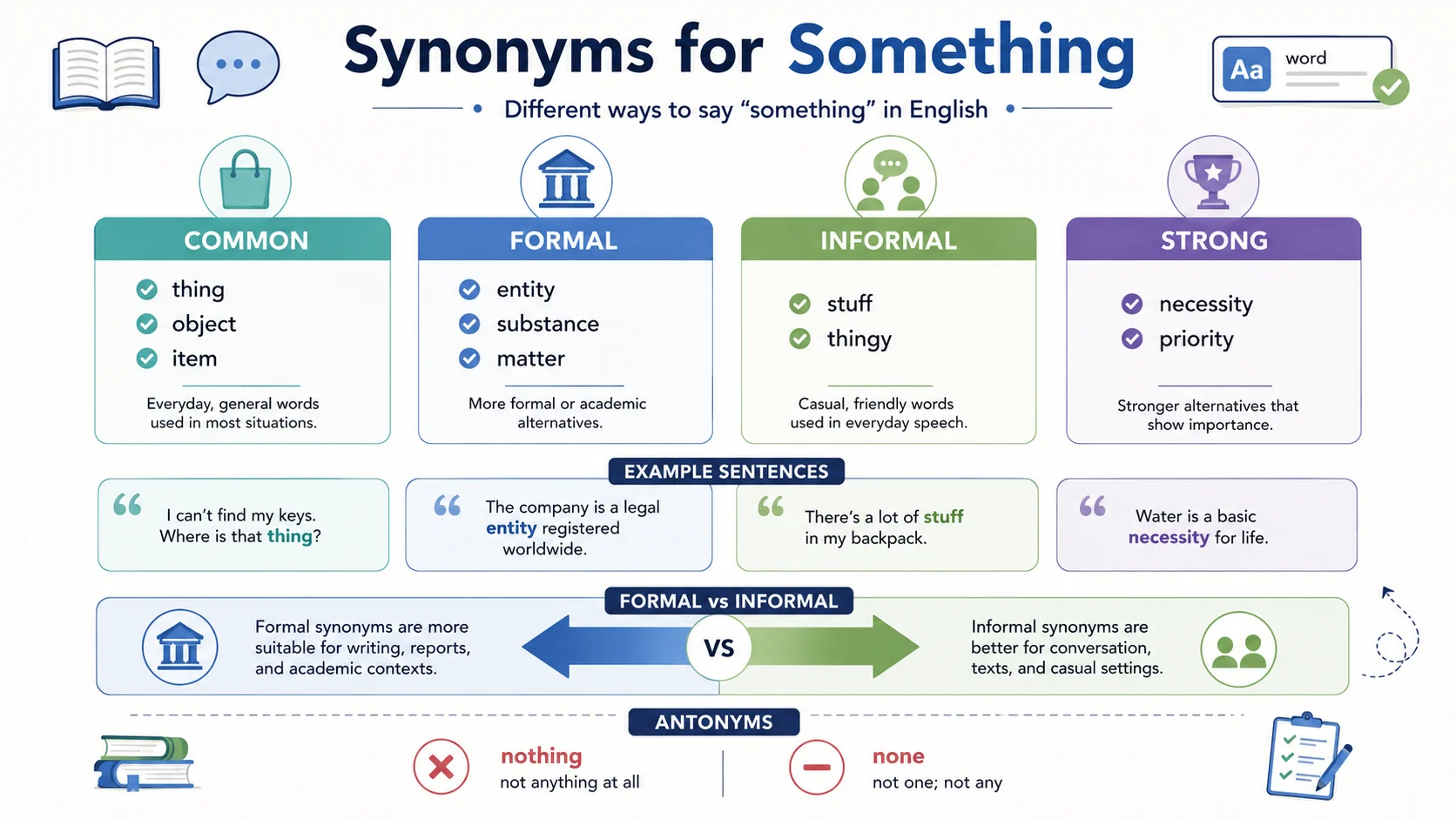
The best synonyms for something depend on what you’re actually describing. Common alternatives include thing, object, item, entity, element, and factor. But the right choice varies based on formality, context, and whether you’re referring to a physical item, an abstract concept, or an unspecified matter.
Best Synonyms for Something
If you need a direct replacement for something, consider these top options:
- Thing – the most natural, everyday alternative
- Object – works for physical items you can see or touch
- Item – ideal for lists, inventories, or countable units
- Entity – suits formal or abstract references to beings or organizations
- Element – fits when discussing parts of a whole or essential components
- Factor – works when referring to causes, influences, or considerations
Your choice depends heavily on whether the something is physical, abstract, countable, or part of a larger system.
What Does Something Mean?
Something is a pronoun and noun used to refer to an unspecified or unknown thing, object, or matter.
At its core, the word signals that the speaker or writer is referring to a particular thing without naming it directly. It’s intentionally vague, which makes it useful for everyday conversation but limiting when you need precision.
Simple Definition
Something (pronoun): An unspecified or unknown thing.
Something (noun): A thing that is unspecified, unknown, or not named.
Part of Speech
- Pronoun: “I need something to eat.”
- Noun: “There’s a something about her that feels familiar.”
Common Usage
People use something constantly in spoken English. It fills gaps when the exact word doesn’t come to mind, when the specific term doesn’t matter, or when you want to keep the statement vague on purpose.
Example Sentences
- “Can you hand me something to write with?”
- “There’s something strange about that house.”
- “She always finds something positive in every situation.”
Core Meaning of Something
The fundamental idea behind something is indefiniteness. It points to existence without specifying identity. The word occupies a middle ground between nothing (absence) and everything (totality). It acknowledges that an object, idea, or matter exists but doesn’t commit to naming it.
This vagueness makes something one of the most versatile words in English. Writers and speakers use it to avoid overcomplicating sentences, to maintain mystery, or to refer to concepts that don’t have a clear label.
However, overusing something can weaken your writing. When you default to this word, you often miss opportunities to be specific, vivid, and clear. That’s exactly why people look for synonyms.
Grammar and Usage Notes
Part of Speech
Something functions primarily as a pronoun but also works as a noun in certain constructions.
Pronoun:
- “I noticed something unusual.”
- “Give me something to work with.”
Noun:
- “She has a certain something that draws people in.”
- “He’s always been a something in the art world.”
Sentence Patterns
- Something + infinitive: “I need something to read.”
- Something + adjective: “Is something wrong?”
- Something + prepositional phrase: “There’s something about the way she speaks.”
- Something + relative clause: “I want something that lasts.”
Common Collocations
- Something else – a different thing; also used to mean exceptional
- Something like – approximately or similar to
- Something of a – somewhat or rather
- Or something – used to suggest an alternative possibility
- Something to do with – related to or connected with
- Something tells me – a feeling or intuition
When Something Sounds Natural
- Casual conversation and everyday speech
- When the specific term isn’t important
- When you genuinely don’t know the exact word
- When maintaining vagueness is intentional
- When the listener can infer what you mean from context
When a Synonym Works Better
- Formal or academic writing
- When precision matters
- When you’re repeating something too often
- When the object is clearly physical and countable
- When you need to sound more professional or authoritative
- When the vagueness would confuse the reader
Best Synonyms for Something
This table highlights the most useful synonyms for something, organized by meaning, tone, and best use case.
| Synonym | Meaning | Tone | Best Use Case | Example Sentence |
|---|---|---|---|---|
| Thing | An unspecified object or matter | Neutral, everyday | Casual conversation, general writing | “Grab that thing on the counter for me.” |
| Object | A physical item you can see or touch | Neutral to formal | Describing physical items, philosophical contexts | “The object on the table appears to be antique.” |
| Item | A single unit or piece | Neutral, practical | Lists, inventories, shopping, countable units | “We need to order each item separately.” |
| Entity | A being, organization, or distinct unit | Formal | Legal, business, philosophical, or technical writing | “The corporation is treated as a legal entity.” |
| Element | A component or part of a larger whole | Formal to neutral | Science, design, analysis, describing parts | “Trust is a crucial element in any relationship.” |
| Factor | A cause, influence, or consideration | Formal | Decision-making, analysis, explanations | “Cost was a major factor in our decision.” |
| Matter | A subject, concern, or physical substance | Formal | Formal discussions, legal matters, physics | “We need to address this matter immediately.” |
| Substance | Physical material or essential content | Formal | Scientific writing, philosophical discussions | “The substance of his argument was compelling.” |
Common Synonyms for Something
These everyday synonyms work well in most writing and conversation. They’re neutral in tone and widely understood.
Thing
Meaning: The most direct and common alternative. Thing refers to any unspecified object, idea, action, or matter.
Best Context: Daily conversation, informal writing, and general use. It’s the safest replacement when you need a simple, neutral word.
Example: “I forgot the most important thing on my list.”
Object
Meaning: A physical item that you can see, touch, or perceive with your senses. In philosophy, it also refers to anything perceived by the mind.
Best Context: Describing physical items, museum displays, philosophical discussions, or when you want to sound slightly more formal than thing.
Example: “The object in the display case dates back to the 12th century.”
Item
Meaning: A single unit or piece, often part of a collection or list.
Best Context: Lists, inventories, shopping, menu descriptions, or any situation where you’re counting or categorizing individual units.
Example: “Please check each item before we finalize the shipment.”
Element
Meaning: A fundamental component, part, or aspect of a larger system or whole.
Best Context: Discussions about systems, design, science, analysis, or any topic where you’re breaking something down into its parts.
Example: “Storytelling is a key element of effective marketing.”
Factor
Meaning: A circumstance, cause, or influence that contributes to an outcome or situation.
Best Context: Decision-making, analysis, research, problem-solving, and explanations of why things happen.
Example: “Weather conditions are a major factor in crop yields.”
Formal Synonyms for Something
When you need to elevate your language in academic papers, business reports, legal documents, or professional communications these formal alternatives offer more precision and authority.
Entity
Meaning: A being, organization, or distinct unit that has its own existence or identity.
Best Context: Legal documents, business writing, philosophical discussions, and any reference to organizations, corporations, or separate units.
Tone: Highly formal and precise. Use when referring to corporations, institutions, or philosophical concepts of existence.
Example: “The nonprofit operates as a separate legal entity from its founders.”
Substance
Meaning: The physical material of which something is made; also refers to the essential or meaningful content of something.
Best Context: Scientific writing, philosophical discussions, legal descriptions, and when referring to the core meaning or importance of something.
Tone: Formal and weighty. Implies material reality or significant content.
Example: “The substance of the agreement remains unchanged despite the revisions.”
Matter
Meaning: A subject, concern, or situation requiring attention; also refers to physical substance.
Best Context: Formal discussions, legal matters, business meetings, and any situation where you’re addressing a serious topic.
Tone: Formal and serious. Often used when discussing issues that require action or resolution.
Example: “The board will review this matter at the next meeting.”
Component
Meaning: A part or element of a larger system or whole.
Best Context: Technical writing, engineering, business analysis, academic papers, and when discussing how things are assembled or structured.
Tone: Technical and precise. Implies that the larger whole depends on its parts.
Example: “Each component of the system must be tested before integration.”
Phenomenon
Meaning: A fact, occurrence, or observable event, especially one that is unusual or scientifically interesting.
Best Context: Scientific writing, academic discussions, and when describing events or processes that are observable and noteworthy.
Tone: Formal and intellectual. Best reserved for observable events or patterns.
Example: “The phenomenon has puzzled researchers for decades.”
Aspect
Meaning: A particular part, feature, or quality of something.
Best Context: Analysis, description, discussion, and when examining something from different angles.
Tone: Formal and analytical. Implies a multidimensional view.
Example: “We examined every aspect of the proposal before making a decision.”
Informal Synonyms for Something
These casual alternatives fit perfectly in conversations, friendly emails, social media posts, and personal writing where you want to keep the tone light and natural.
Thingy / Thingamajig
Meaning: A playful or dismissive term for an object whose name you can’t remember or don’t know.
Best Context: Very casual conversation, humorous writing, and situations where the exact term truly doesn’t matter.
Tone: Playful, informal, slightly self-deprecating. Use with friends or in casual contexts.
Example: “Can you hand me that thingy on the shelf?”
Stuff
Meaning: A general term for unspecified things, materials, or ideas. Can refer to physical objects or abstract matters.
Best Context: Casual conversation, informal writing, and when referring to a collection of items rather than a single thing.
Tone: Very casual and friendly. Avoid in professional or formal contexts.
Example: “We need to organize all this stuff before the move.”
Whatchamacallit
Meaning: A humorous placeholder for something whose name escapes you.
Best Context: Playful conversation, storytelling, and situations where you’re deliberately being casual.
Tone: Playful and humorous. Best used in relaxed social situations.
Example: “Pass me the whatchamacallit the thing that opens bottles.”
Kind of / Sort of
Meaning: Used to indicate vagueness or approximation; also used to soften statements.
Best Context: Casual speech, friendly writing, and situations where you want to sound less definite.
Tone: Very casual and conversational.
Example: “It’s kind of something you’d expect from him.”
Something-or-other
Meaning: An indefinite substitute for something you can’t or won’t name.
Best Context: Casual conversation and informal writing.
Tone: Casual and dismissive. Suggests the specific term isn’t important.
Example: “He’s working on some software something-or-other.”
Strong Synonyms for Something
Some synonyms carry more weight, intensity, or emphasis than something. These words add power to your writing and convey stronger meaning.
Necessity
Meaning: A thing that is essential, required, or unavoidable.
Best Context: Discussions about requirements, basic needs, or mandatory elements.
Tone: Strong and emphatic. Use when you mean something absolutely required.
Example: “Reliable transportation is a necessity in this city.”
Priority
Meaning: Something considered more important than other things.
Best Context: Decision-making, time management, project planning.
Tone: Strong and decisive. Emphasizes importance and urgency.
Example: “Patient safety is our highest priority.”
Imperative
Meaning: An essential or urgent requirement.
Best Context: Formal writing, discussions about obligations, and any situation where something is absolutely required.
Tone: Very strong and formal. Use sparingly for maximum impact.
Example: “Following these protocols is an imperative for all staff.”
Fundamental
Meaning: A core principle, basic element, or essential part.
Best Context: Discussions about basics, foundations, or what something depends on.
Tone: Strong and foundational. Implies something cannot be changed or removed.
Example: “Trust is fundamental to any successful team.”
Mild Synonyms for Something
These softer alternatives work well when you want to downplay, minimize, or keep things neutral and gentle.
Aspect
Meaning: A particular part or feature of something.
Best Context: Balanced analysis, neutral descriptions, and when you want to avoid strong judgment.
Tone: Neutral and analytical. Doesn’t carry strong positive or negative weight.
Example: “We need to consider every aspect of the proposal.”
Component
Meaning: A part that combines with others to form a whole.
Best Context: Technical, design, or structural descriptions.
Tone: Neutral and practical. Focuses on function rather than importance.
Example: “The training component of the program starts next month.”
Feature
Meaning: A distinctive characteristic or attribute.
Best Context: Describing products, services, people, or places.
Tone: Positive and neutral. Often implies something desirable but can be neutral.
Example: “The most useful feature of the app is its simplicity.”
Detail
Meaning: An individual fact, piece of information, or minor element.
Best Context: Descriptions, explanations, and when focusing on smaller pieces.
Tone: Neutral and precise. Implies specificity without judgment.
Example: “Let’s go through every detail of the agreement.”
Synonyms for Something by Context
The right synonym depends on where you’re writing and who you’re writing for. These context-specific recommendations will help you choose wisely.
Everyday Conversation
In casual speech, keep it simple. Thing, stuff, and occasionally object or item work best. You’re not trying to impress anyone you’re communicating quickly and naturally.
Best Choices: thing, stuff, item, object
Example: “I need to pick up a few things from the store.”
Professional Writing
Business emails, reports, and professional documents demand clarity and a certain level of formality. Choose words that sound competent and precise.
Best Choices: item, element, factor, component, aspect
Example: “Customer feedback was the deciding factor in our redesign.”
Academic Writing
Universities and scholarly publications expect precision and formal language. Avoid vague terms and choose specific synonyms that show you know what you’re talking about.
Best Choices: entity, phenomenon, substance, component, element
Example: “The researchers analyzed every component of the experimental framework.”
Creative Writing
This is where you can have fun. Use something and its synonyms to create mood, mystery, or character voice. Play with thing, object, matter, and even the occasional whatchamacallit if it suits your narrator.
Best Choices: object, matter, substance, thing, phenomenon
Example: “There was a presence in the room an object of unusual power.”
Marketing Copy
Persuasive writing needs words that resonate with readers. Choose synonyms that emphasize value, benefit, and importance.
Best Choices: feature, element, factor, priority, necessity
Example: “Easy returns are a feature our customers appreciate most.”
Emotional Expression
When you’re expressing feelings or describing personal experiences, use words that match the emotional weight of the situation.
Best Choices: matter, substance, phenomenon, thing
Example: “There’s a tenderness about her that I can’t quite describe.”
Another Word for Something in a Sentence
Real examples help you see how synonyms work in natural writing. Here are 15 sentences using different alternatives to something.
- She grabbed the nearest object and threw it at the window.
- We need to discuss one more matter before the meeting ends.
- Each item in the collection has been carefully cataloged.
- Trust is the essential element of their partnership.
- Budget was the deciding factor in the final decision.
- The corporation is a legal entity with its own rights and obligations.
- The substance of his argument was impossible to deny.
- That feature alone makes the product worth buying.
- We’re working on a new project thingy that might change everything.
- He’s always had a certain something-or-other about him.
- The training component of the program is particularly intensive.
- Sun exposure is a significant factor in skin damage.
- She keeps all her craft stuff in the spare room.
- Water is a basic necessity for all living things.
- The phenomenon was first documented in the 1970s.
Something Synonyms Compared
Some synonyms are so similar that choosing between them can be tricky. These comparisons will help you make the right call.
Thing vs. Object
Thing is the broadest and most casual of the two. Object is more specific and slightly more formal, referring almost exclusively to physical items you can see and touch.
- “Pass me that thing.” (anything at all)
- “Pass me that object.” (a specific physical item)
Item vs. Element
Item implies a countable unit in a set. Element suggests a fundamental part of a whole.
- “Check each item on the shopping list.” (individual units)
- “Patience is an element of good teaching.” (essential part)
Factor vs. Component
Factor points to influences or causes. Component points to parts that make up a whole.
- “Cost was the main factor.” (influence)
- “The engine is a major component of the car.” (part)
Entity vs. Substance
Entity emphasizes existence and identity. Substance emphasizes material or essential content.
- “The church is a charitable entity.” (organization)
- “The substance of the complaint was about safety.” (core content)
Matter vs. Aspect
Matter suggests a subject requiring attention. Aspect suggests a perspective or part.
- “We need to address this matter.” (issue needing action)
- “That’s an important aspect to consider.” (part of the whole)
Words Similar to Something
These words belong to the same general category as something but work in more specific situations. They’re related but not always direct replacements.
Anything
Refers to any thing, regardless of what it is. The opposite of nothing.
Why it’s related: Both refer to unspecified things. The difference is openness something suggests a particular existence, while anything suggests total openness.
When it’s useful: “I’ll eat anything.” (openness) vs. “I’ll eat something.” (specific but unspecified meal)
Everything
All things, the entirety of a set.
Why it’s related: Both are indefinite pronouns about things. The difference is scope everything covers all, while something covers only one or part.
When it’s useful: “She gave everything to the cause.” (all) vs. “She gave something to the cause.” (some amount)
Nothing
The absence of anything.
Why it’s related: It’s the logical opposite of something. They exist on the same spectrum of existence.
When it’s useful: “There’s nothing in the box.” (absence) vs. “There’s something in the box.” (presence)
What
Used in questions to ask about an unidentified thing.
Why it’s related: Both refer to unknown or unspecified things. The difference is function what asks, while something refers.
When it’s useful: “What did you find?” vs. “I found something.”
One
Used as a pronoun to refer to an unspecified person or thing.
Why it’s related: Both can replace nouns when the specific identity doesn’t matter.
When it’s useful: “Choose the one you like best.” vs. “Choose something you like.”
Antonyms of Something
These words represent the absence or opposite of something.
Nothing
Meaning: The absence of anything; not a single thing.
Example Sentence: “There was nothing in the room but dust.”
None
Meaning: Not any; no single thing or person.
Example Sentence: “We have none left in stock.”
Naught / Nought
Meaning: Nothing; zero.
Example Sentence: “All their efforts came to naught.”
Null
Meaning: Having no value or effect; non-existent.
Example Sentence: “The contract was declared null and void.”
How to Choose the Right Synonym for Something
Choosing the right synonym isn’t complicated, but it does require you to think about a few key factors. Here’s what to consider:
Match the Context
Where are you writing? Academic papers demand formal synonyms. Text messages to friends can be as casual as you want. Social media posts fall somewhere in between.
Match the Tone
Ask yourself: how serious is this? Legal documents need precision. Creative writing can be playful. Marketing materials need energy.
Check the Intensity
Are you emphasizing importance? Priority and necessity carry weight. Aspect and detail are neutral. Use intensity to match your message.
Think About Your Reader
Who is reading this? A general audience appreciates simple words like thing and item. Industry experts understand entity, component, and phenomenon.
Check Whether the Synonym Is Exact or Only Related
Some words feel similar but change your meaning. Object is physical. Factor is about cause. Don’t use them interchangeably.
Keep the Sentence Natural
Read the sentence aloud. Does it sound like something you’d actually say? If a formal synonym feels awkward, use a simpler word.
Use Simple Words When Clarity Matters
When the goal is to be understood, choose thing or item. Reserve formal synonyms for situations where they add value.
Common Mistakes When Using Synonyms for Something
Even experienced writers make mistakes when substituting synonyms. Here are the most common errors and how to avoid them.
Choosing a Word with the Wrong Tone
Using entity in a casual email sounds pretentious. Using stuff in a legal document sounds unprofessional. Match the tone to the situation.
Example: “I need to discuss that stuff from the meeting.” → “I need to discuss that matter from the meeting.”
Using a Synonym That Is Too Strong
Words like necessity, imperative, and priority carry weight. Using them casually diminishes their impact.
Example: “We have a necessity for snacks.” → “We have a need for snacks.”
Using a Formal Word in Casual Writing
Entity, component, and phenomenon feel out of place in friendly conversations.
Example: “That phenomenon at the party was hilarious.” → “That thing at the party was hilarious.”
Using a Casual Word in Professional Writing
Stuff, thingy, and whatchamacallit don’t belong in business communications.
Example: “We need to review that stuff.” → “We need to review those items.”
Replacing Something Without Checking Meaning
Object means physical. Factor means influence. Matter means subject. Don’t use them interchangeably.
Example: “The factor on the table” → “The object on the table”
Treating Related Words as Exact Synonyms
Anything and everything are related but don’t replace something in every sentence.
Example: “I need anything to eat.” (wrong, unless you mean literally anything) vs. “I need something to eat.” (right)
Making the Sentence Sound Unnatural
Read your writing aloud. If a synonym feels forced, it probably is.
Example: “The entity in my pocket is a key.” → “The thing in my pocket is a key.”
Quick Synonym List for Something
Common Synonyms
- Thing
- Object
- Item
- Element
- Factor
- Aspect
Formal Synonyms
- Entity
- Substance
- Matter
- Component
- Phenomenon
- Feature
Informal Synonyms
- Stuff
- Thingy
- Thingamajig
- Whatchamacallit
- Kind of / sort of something
- Something-or-other
Strong Synonyms
- Necessity
- Priority
- Imperative
- Fundamental
Mild Synonyms
- Aspect
- Component
- Feature
- Detail
Related Words
- Anything
- Everything
- Nothing
- What
- One
FAQs
What is the best synonym for something?
The best synonym depends entirely on context. For everyday use, thing is the most natural replacement. In formal writing, entity or matter work better. When listing countable items, item is the clear choice. Consider your audience, purpose, and the specific meaning you want to convey.
What is another word for something in a professional setting?
In business or professional writing, consider item, element, component, factor, or matter. These sound competent and precise without being overly formal. For legal or philosophical contexts, entity and substance are excellent options.
What is a more formal word for something?
Entity, substance, matter, component, and phenomenon are formal synonyms for something. They work well in academic papers, legal documents, and professional communications. Each carries a specific shade of meaning, so choose the one that fits your exact situation.
What is an informal synonym for something?
Stuff, thingy, thingamajig, and whatchamacallit are all informal alternatives. Stuff is the most useful for everyday conversation and casual writing. The others are playful and best used in very relaxed situations with friends.
What is a stronger word for something?
Necessity, priority, imperative, and fundamental are stronger synonyms. They carry more weight and emphasize importance. Use them when you need to communicate that something is essential, urgent, or foundational.
What is a milder word for something?
Aspect, component, feature, and detail are milder alternatives. They’re neutral and precise without adding intensity. Use them when you want to describe parts or qualities without being overly emphatic.
What words are similar to something but not exact synonyms?
Anything, everything, nothing, what, and one are related to something but don’t replace it in every context. They’re all indefinite pronouns that refer to unspecified things, but they differ in scope, function, or meaning. Use them carefully when the situation fits.
What is the opposite of something?
Nothing, none, naught, and null are antonyms of something. They represent the absence of any thing, zero, or non-existence. Nothing is the most direct and useful opposite.
How do I choose the right synonym for something?
Consider context, tone, intensity, and your reader. Match the formality level to the situation. Read the sentence aloud to check if it sounds natural. And when in doubt, choose thing or item they work in most situations without sounding wrong.
Conclusion
Finding the right word isn’t just about replacing something with a synonym. It’s about matching your language to your meaning, context, and audience. The best choice depends on whether you’re talking about a physical object, an abstract concept, or an important matter.
For casual writing, thing, item, and stuff work beautifully. For formal contexts, entity, substance, and matter elevate your writing. And for everything in between, element, component, factor, and aspect offer precise, flexible alternatives.
Remember: the goal isn’t to avoid something altogether. It’s to use the right word at the right time. When vagueness serves your purpose, something is perfect. When you need precision, one of the many alternatives above will give your writing the clarity it deserves.

Harry Edwards is a language writer specializing in word meanings, synonyms, and language usage. He creates clear, accurate, and engaging content to help readers improve their vocabulary and communication skills.


16 thoughts on “Synonyms for Something| Meaning, Examples and Better Word Choices For 2026”