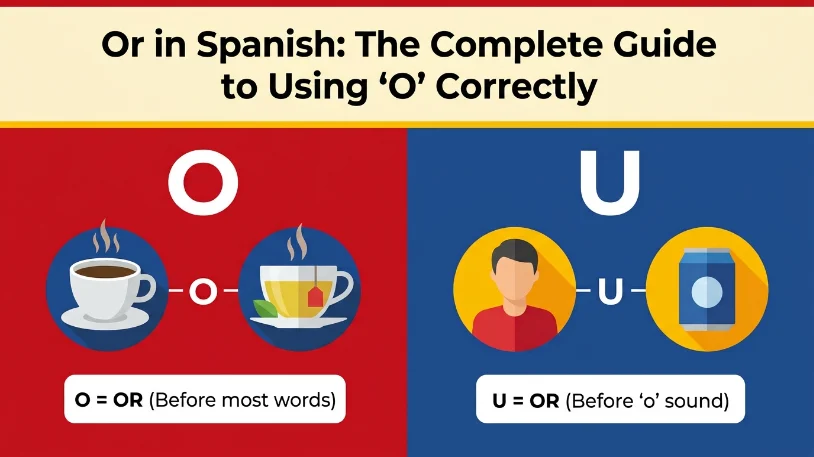
The word for “or” in Spanish is o. It is a coordinating conjunction used to present alternatives or choices. When “o” comes before a word that begins with the “o” sound (including words starting with “o” or “ho”), it changes to u to avoid awkward pronunciation. For example, “uno u otro” means “one or another.
Have you ever started learning Spanish and wondered how to say “or”? The answer is simple: use the letter “o.” This tiny word appears constantly in Spanish conversation. You will need it to make choices, ask questions, and connect ideas. Getting it right helps you sound more natural and fluent.
The Spanish word “o” works just like the English word “or.” It connects two or more options. For example, “¿Quieres café o té?” means “Do you want coffee or tea?” This simple structure appears in everyday conversations, business meetings, and written Spanish.
However, Spanish has a special rule that English does not. When “o” comes before a word that starts with the “o” sound, it changes to “u.” This rule prevents awkward pronunciation and makes the language flow more smoothly. Many Spanish learners find this rule confusing at first. They might forget to make the change or apply it incorrectly.
This article clears up the confusion once and for all. You will learn the basic rules, see real examples, and discover common mistakes to avoid. By the end, you will use “or in Spanish” with confidence. Good Spanish depends on getting these small details right.
Key Takeaway
The main takeaway is that “o” in Spanish means “or.” It connects alternatives and choices. When “o” appears before a word starting with “o” or “ho,” it changes to “u” to avoid awkward pronunciation. This rule applies in both formal and informal Spanish. Remember that this change only happens before words that begin with the “o” sound. For all other words, use “o” as usual.
Definitions and Explanations
What Does “Or” Mean in Spanish?
“O” is a coordinating conjunction in Spanish. It means “or” in English. People use it to connect two or more alternatives or choices. It is one of the most common words in the Spanish language.
For example, “¿Prefieres el rojo o el azul?” means “Do you prefer red or blue?” The word “o” connects the two color options. Voy a la playa o a la montaña” means “I am going to the beach or to the mountains.” The word “o” connects the two destination options.
Spanish speakers use “o” constantly. It appears in questions, statements, and commands. It is essential for everyday communication. Without it, you could not express choices or alternatives clearly.
| English | Spanish | Part of Speech |
| Or | O | Coordinating conjunction |
| And | Y | Coordinating conjunction |
| But | Pero | Coordinating conjunction |
The Special Rule: When “O” Becomes “U”
Spanish has a special pronunciation rule. When “o” comes before a word that begins with the “o” sound, it changes to “u.” This change prevents the awkward repetition of the “o” sound. It makes the sentence flow more smoothly.
The rule applies in two situations:
- Before words that start with the letter “o” (like “oscuro” meaning “dark”)
- Before words that start with “ho” (like “horno” meaning “oven”) because the “h” is silent
For example, “uno u otro” means “one or another.” You would not say “uno o otro” because the repeated “o” sounds awkward. The change to “u” creates a smoother pronunciation. “¿Quieres agua u horchata?” means “Do you want water or horchata?” The change to “u” before “horchata” follows the rule.
| Condition | Example | Translation |
| Before “o” sound | “uno u otro” | “one or another” |
| Before “ho” sound | “agua u horchata” | “water or horchata” |
| Before other sounds | “café o té” | “coffee or tea” |
When the Rule Does NOT Apply
The rule only applies when the next word begins with the “o” sound. It does not apply in other situations.
The rule does NOT apply:
- When the word starts with a consonant (like “casa” meaning “house”)
- When the word starts with a vowel other than “o” (like “a” or “e”)
- When the word starts with “o” but has a different sound (rare)
For example, “¿Quieres pan o tortilla?” means “Do you want bread or tortilla?” The word “tortilla” starts with “t,” so you use “o.” You would not say “u” here because the rule does not apply.
| Situation | Correct Form | Incorrect Form |
| Before consonant | “o casa” | Not applicable |
| Before “a” sound | “o agua” | Not applicable |
| Before “o” sound | “u otro” | “o otro” (incorrect) |
The Pronunciation Rule in Detail
The reason for this rule is purely pronunciation. In Spanish, saying “o o” (or “o otro”) sounds awkward and clumsy. The two “o” sounds blend together. Spanish speakers naturally prefer to avoid this repetition.
Changing “o” to “u” solves the problem. “U otro” sounds much smoother. The “u” sound provides contrast and clarity. The listener can clearly hear that there are two alternatives.
This rule is similar to the rule for “y” becoming “e” in Spanish. When “y” (meaning “and”) comes before an “i” sound, it changes to “e.” For example, “agua e hielo” means “water and ice.” The change prevents the awkward repetition of the “i” sound.
| Rule | Change | Example |
| “o” before “o” sound | “o” → “u” | “u otro” |
| “y” before “i” sound | “y” → “e” | “e hielo” |
Advantages and Disadvantages
Understanding this rule offers clear advantages for Spanish learners. Getting it wrong can create problems. This section explores both sides.
Advantages of Using the Correct Form
Using the correct form improves your Spanish in several ways.
- Better pronunciation: The “u” form sounds more natural and fluent. Spanish speakers will understand you more easily.
- More native-like speech: Using the rule correctly makes you sound like a native speaker. It shows that you have mastered an important detail.
- Clearer communication: The correct form avoids awkward repetition. Your listener can hear the alternatives clearly.
- Respect for the language: Using the rule shows that you care about correct Spanish. It demonstrates your commitment to learning the language properly.
- Confidence: Knowing the rule gives you confidence in your Spanish. You will not have to hesitate or second-guess yourself.
Disadvantages of Using the Wrong Form
Using the wrong form can create problems for your communication.
- Awkward pronunciation: Saying “o otro” sounds clumsy and unnatural. It can make you sound less fluent.
- Confusion: Your listener might have to work harder to understand you. The repeated “o” sounds can blend together.
- Unprofessional: In formal settings, using the wrong form can make you appear less educated in Spanish.
- Embarrassment: Making this mistake in conversation can be embarrassing. It can undermine your confidence as a Spanish speaker.
- Inconsistency: Using the wrong form makes your Spanish inconsistent. It suggests you have not mastered the language fully.
| Aspect | Using “U” Correctly | Using “O” Incorrectly |
| Pronunciation | Smooth, natural | Awkward, repetitive |
| Fluency | Native-like | Non-native |
| Professionalism | Professional | Less professional |
| Confidence | High | Lower |
| Communication | Clear | Can be confusing |
Real-World Examples
Seeing these words used correctly in real-world contexts helps solidify the rule.
Examples of “O” in Action (No Change Needed)
- “¿Quieres café o té?” This means “Do you want coffee or tea?” The word “té” starts with “t,” so no change is needed.
- Voy a la tienda o al mercado.” This means “I am going to the store or to the market.” The word “mercado” starts with “m,” so no change is needed.
- “¿Prefieres el rojo o el azul?” This means “Do you prefer red or blue?” The word “azul” starts with “a,” so no change is needed.
- Podemos ir hoy o mañana.” This means “We can go today or tomorrow.” The word “mañana” starts with “m,” so no change is needed.
- “Muchos pasan cinco o más horas al día en Internet.” This means “Many spend five or more hours a day on the Internet.”
Examples of “U” in Action (Change Needed)
- uno u otro” This means “one or another.” The word “otro” starts with “o,” so “o” changes to “u.
- “¿Quieres agua u horchata?” This means “Do you want water or horchata?” The word “horchata” starts with “h” + “o,” so “o” changes to “u.”
- siete u ocho” This means “seven or eight.” The word “ocho” starts with “o,” so “o” changes to “u.
- “¿Vas a la playa u olas?” This means “Are you going to the beach or waves?” The word “olas” starts with “o,” so “o” changes to “u.”
Contrasting Examples
Seeing these words side by side shows the difference clearly.
| Sentence | Translation | Why? |
| “café o té” | “coffee or tea” | “té” starts with “t” |
| “uno u otro” | “one or another” | “otro” starts with “o” |
| “agua o hielo” | “water or ice” | “hielo” starts with “h” + “i” (not “o”) |
| “agua u horchata” | “water or horchata” | “horchata” starts with “h” + “o” |
Real-Life Scenarios
Here are some realistic scenarios where you might use “or in Spanish.”
Scenario 1: Ordering Food
Customer: “¿Tienen café o té?” (Do you have coffee or tea?)
Waiter: “Tenemos los dos.” (We have both.)
Scenario 2: Making Plans
Friend 1: “¿Vamos al cine o al parque?” (Are we going to the cinema or the park?)
Friend 2: “Al parque.” (To the park.)
Scenario 3: Choosing Options
Parent: “¿Quieres leche u horchata?” (Do you want milk or horchata?)
Child: “Horchata, por favor.” (Horchata, please.)
Scenario 4: Giving Directions
Person: “Tome la calle principal o la secundaria.” (Take the main street or the secondary street.)
Other: “Gracias.” (Thank you.)
Regional and Global Usage
The rule for “o” and “u” is consistent across all Spanish-speaking regions.
Global Spanish Consistency
Spanish speakers worldwide follow the same rule. Whether you are speaking with someone from Spain, Mexico, Argentina, or any other Spanish-speaking country, the rule is identical. “O” becomes “u” before the “o” sound. This consistency makes the rule easy to learn and apply.
Regional Variations
There are no significant regional variations for this rule. However, some Spanish speakers might apply the rule slightly differently in certain contexts. For example, some speakers might use “u” before words that start with “o” even in casual speech. Others might use “o” more loosely in very informal contexts. The rule is standard across all regions.
| Region | Rule | Example |
| Spain | Standard | “uno u otro” |
| Mexico | Standard | “uno u otro” |
| Argentina | Standard | “uno u otro” |
| Colombia | Standard | “uno u otro” |
| All regions | Standard | “uno u otro” |
Formal vs. Informal Usage
The rule applies in both formal and informal Spanish. However, the rule is more strictly observed in formal writing and speech. In very casual conversation, some speakers might occasionally use “o” before “o” sounds. However, this is generally considered informal or careless.
| Context | Rule | Example |
| Formal writing | Strict | “uno u otro” |
| Formal speech | Strict | “uno u otro” |
| Informal writing | Usually strict | “uno u otro” |
| Casual speech | Usually strict | “uno u otro” |
Common Mistakes
This section highlights the most frequent errors people make with this rule. Learning about them will help you avoid them.
Mistake 1: Forgetting to Change “O” to “U”
This is the most common error. Spanish learners forget to change “o” to “u” before the “o” sound. They say “uno o otro” when they should say “uno u otro.” The sentence sounds awkward and unnatural.
Correction: Always check if the next word starts with “o” or “ho.” If it does, change “o” to “u.” This simple check will eliminate most errors.
Mistake 2: Changing “O” to “U” Incorrectly
Some learners change “o” to “u” in situations where the rule does not apply. For example, they might say “café u té” when they should say “café o té.” This is incorrect because “té” starts with “t,” not with the “o” sound.
Correction: Only change “o” to “u” when the next word starts with “o” or “ho.” Do not apply the rule to words that start with other letters or sounds.
Mistake 3: Confusing “O” with “U” in Writing
Some learners confuse the two forms in writing. They might write “u” when they mean “o” or vice versa. This can happen because they do not fully understand the rule or because they type too quickly.
Correction: Proofread your writing for this specific rule. Check whether you have used “o” or “u” correctly. A quick review can catch and correct errors.
| Incorrect | Correct | Reason |
| “o otro” | “u otro” | “otro” starts with “o” |
| “u té” | “o té” | “té” starts with “t” |
| “o once” | “u once” | “once” starts with “o” |
| “u agua” | “o agua” | “agua” starts with “a” (not “o”) |
Exercises
Test your knowledge with these exercises.
Exercise 1: Fill in the Blank
Choose “o” or “u” to complete each sentence.
- ¿Quieres café _____ té?
- Prefiero uno _____ otro.
- ¿Vamos al cine _____ al teatro?
- ¿Quieres agua _____ horchata?
- Tengo siete _____ ocho años.
- ¿Comes carne _____ pescado?
- Voy a la playa _____ a las olas.
- ¿Estudias español _____ italiano?
Exercise 2: Identify the Error
Each sentence has a mistake. Identify the incorrect word and correct it.
- “¿Quieres té u café?”
- “Prefiero uno o otro.”
- “¿Vamos a la playa u olas?”
- “Tengo cinco u seis años.”
Exercise 3: Choose the Correct Form
Select the correct word to complete each sentence.
- “¿Quieres leche ____ horchata?” (o/u)
- “Voy a la tienda ____ al mercado.” (o/u)
- “¿Prefieres el rojo ____ el azul?” (o/u)
- “Uno ____ otro, no importa.” (o/u)
Answer Key
Exercise 1 Answers:
- o (té starts with “t”)
- u (otro starts with “o”)
- o (teatro starts with “t”)
- u (horchata starts with “ho”)
- u (ocho starts with “o”)
- o (pescado starts with “p”)
- u (olas starts with “o”)
- o (italiano starts with “i”)
Exercise 2 Corrections:
- “¿Quieres té o café?” (té starts with “t”)
- “Prefiero uno u otro.” (otro starts with “o”)
- “¿Vamos a la playa u olas?” (olas starts with “o”)
- “Tengo cinco o seis años.” (seis starts with “s”)
Exercise 3 Answers:
- u (horchata starts with “ho”)
- o (mercado starts with “m”)
- o (azul starts with “a”)
- u (otro starts with “o”)
Related Concepts and Comparisons
Understanding how this rule relates to other concepts helps build a complete picture.
“O” vs. “U” in Spanish
This is the core distinction covered in this guide. “O” means “or” in most situations. “U” is the form used before words that start with the “o” sound. The choice depends entirely on the following word.
“O … O” vs. “O bien … O bien”
Spanish also has correlative conjunctions for expressing “either … or.” The structure “o … o” or “o bien … o bien” translates to “either … or” in English.
For example:
- “Tenemos dos opciones, o vamos en tren o vamos en autobús.” (We have two options, either going by train or going by bus.)
- “No podemos invitar a tanta gente, o bien invitamos a la familia o bien invitamos a los amigos.” (We can’t invite so many people, either we invite the family or we invite friends.)
This structure emphasizes that you are presenting two clear alternatives. It can also be mixed, such as “o … o bien” or “o bien … o.”
“Y” vs. “E” in Spanish
Spanish has a similar rule for “y” (meaning “and”). When “y” comes before a word that starts with the “i” sound, it changes to “e.” For example, “agua e hielo” means “water and ice.” This prevents the awkward repetition of the “i” sound. This is the same logic as the “o” to “u” rule.
| Conjunction | Meaning | Change Rule | Example |
| O | Or | Becomes “u” before “o” sound | “uno u otro” |
| Y | And | Becomes “e” before “i” sound | “agua e hielo” |
The Spanish Alphabet and Pronunciation
Understanding Spanish pronunciation helps with this rule. The Spanish alphabet has 27 letters. The vowels are:
| Vowel | Pronunciation (English) | Pronunciation (Spanish) |
| A | “ah” | “a” |
| E | “eh” | “e” |
| I | “ee” | “i” |
| O | “oh” | “o” |
| U | “oo” | “u” |
The Silent “H” in Spanish
The letter “h” in Spanish is always silent. This means that “ho” sounds exactly like “o.” Therefore, words that start with “ho” trigger the change from “o” to “u.” For example, “horchata” starts with “ho,” which sounds like “o.” So you say “u horchata,” not “o horchata.”
FAQs
What does “or” mean in Spanish?
“Or” in Spanish is “o.” It is a coordinating conjunction used to present alternatives or choices. For example, “¿Café o té?” means “Coffee or tea?”
When does “o” change to “u” in Spanish?
“O” changes to “u” before words that start with the “o” sound. This includes words that start with “o” and words that start with “ho” (because the “h” is silent). For example, “uno u otro” and “agua u horchata.”
Why does “o” change to “u” in Spanish?
The change prevents awkward pronunciation. Saying “o otro” repeats the “o” sound, which sounds clumsy. Changing to “u otro” creates a smoother flow. This is similar to how English uses “an” instead of “a” before vowel sounds.
Is it “o” or “u” before “otro”?
It is “u” before “otro.” The correct phrase is “uno u otro” meaning “one or another.” The word “otro” starts with “o,” so the change is required. Saying “uno o otro” would be incorrect.
Is it “o” or “u” before “horchata”?
It is “u” before “horchata.” The correct phrase is “agua u horchata” meaning “water or horchata.” The word “horchata” starts with “ho,” which sounds like “o.” Therefore, the change is required.
Does the “o” to “u” rule apply in all Spanish-speaking countries?
Yes, the rule applies in all Spanish-speaking countries. It is a standard rule of Spanish grammar. There are no significant regional variations. Whether you are in Spain, Mexico, or Argentina, the rule is the same.
Does the “o” to “u” rule apply in formal writing?
Yes, the rule applies in formal writing. It is considered a standard rule of Spanish grammar. Using “o” instead of “u” before the “o” sound is considered a mistake in formal writing.
Does the rule apply to words that start with “ho”?
Yes, the rule applies to words that start with “ho.” In Spanish, the “h” is silent, so “ho” sounds like “o.” Therefore, words like “horno” (oven) and “horchata” trigger the change.
What is the rule for “y” becoming “e” in Spanish?
The rule for “y” is similar. “Y” changes to “e” before words that start with the “i” sound. This includes words that start with “i” and words that start with “hi” (because the “h” is silent). For example, “agua e hielo” means “water and ice.”
Are there any exceptions to the “o” to “u” rule?
The rule is very consistent. However, some speakers might not apply the rule in extremely casual speech. In formal and standard Spanish, the rule applies consistently. There are no significant exceptions.
How do I remember when to use “o” and when to use “u”?
Remember the rule: if the next word starts with “o” or “ho,” use “u.” For all other words, use “o.” You can also remember that “u” is the more unusual form, so it appears only in specific situations.
Conclusion
This guide has clarified the simple but important rule for using “or in Spanish.” “O” means “or” and connects alternatives. When “o” comes before a word that starts with the “o” sound, it changes to “u.” This rule prevents awkward pronunciation and makes Spanish sound smoother and more natural.
The best practical advice is to always check the next word when using “o.” If the next word starts with “o” or “ho,” use “u.” For all other words, use “o.” This simple rule works every time. With practice, this distinction will become automatic.
Learning Spanish takes time and effort. However, mastering small details like this rule makes a big difference. It helps you sound more native-like and confident. Now you have the knowledge to use “or in Spanish” correctly every time.