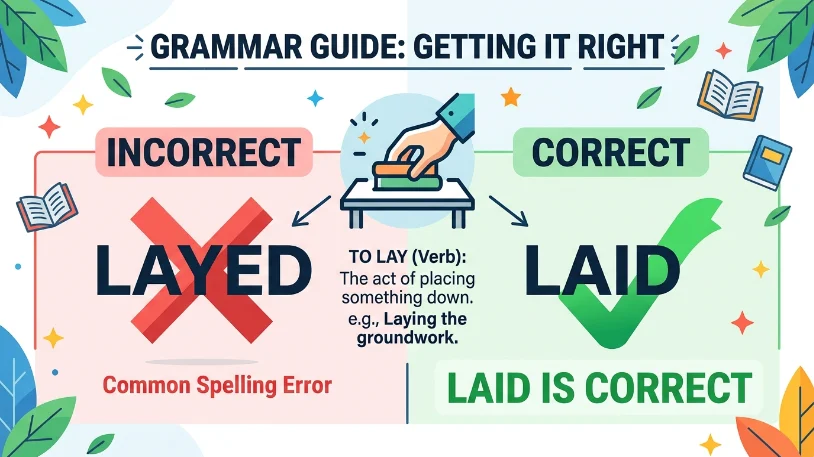
The correct past tense of “lay” is always laid, not “layed.” “Layed” is an archaic spelling that is no longer used in modern English. Remember, you lay something down today, and you laid it down yesterday.
Have you ever paused while writing, unsure whether to type “layed” or “laid”? You are not alone. This is one of the most common grammar questions in the English language. The confusion is understandable. Many verbs form their past tense by simply adding “-ed,” so “layed” seems logical at first glance.
However, English is full of irregular verbs, and “lay” is one of them. It is an irregular verb, meaning its past tense does not follow the standard pattern of simply adding “-ed” to the end of the word . Using the incorrect “layed” can undermine the credibility of your writing, whether you are sending a professional email or drafting a report.
This guide will clear up the confusion once and for all. By the time you finish reading, you will never second-guess yourself again. We will explore the difference between “layed” and “laid,” provide clear examples, and give you practical tips to remember the correct form. Ultimately, we will see how to use both “layed” and “laid” correctly.
Here is the central truth of this topic: “Layed” is not a correct word in modern English. You should always use “laid” as the past tense of the verb “lay” .
The primary reason for this rule is that “lay” is an irregular verb. Unlike regular verbs that form their past tense by adding “-ed,” irregular verbs have unique forms that must be memorized. The proper conjugation sequence for “lay” is: lay (present) – laid (past) – laid (past participle) .
| Verb Type | Present Tense | Past Tense | Past Participle |
| Regular Verb (e.g., Play) | Play | Played | Played |
| Irregular Verb (e.g., Lay) | Lay | Laid | Laid |
As shown in the table above, the verb “lay” does not follow the rules of a regular verb. Therefore, its past tense is never “layed.”
Definition and Explanation
What Does “Laid” Mean?
Laid” is the standard past tense and past participle form of the verb “to lay.” The verb “to lay” means to put or place something down gently or carefully . It is a transitive verb, meaning it must have a direct object. In other words, you cannot just “lay”; you must “lay something” .
For example, consider the sentence, “She laid the baby in the crib.” The baby is the direct object. The action of laying is done to the baby. Here are more examples:
- I laid my keys on the counter.
- The workers laid the foundation for the new building.
- The hen has laid six eggs this week.
In each instance, “laid” is used to describe an action that has already been completed, and there is always a direct object receiving the action.
What About “Layed”?
“Layed” is an archaic form that was occasionally used in older English texts . However, in contemporary English, it is considered a misspelling of “laid” and is not used in standard writing . Because “lay” is an irregular verb, it does not take the “-ed” suffix to form its past tense .
The most common error is applying the standard rule of regular verbs to “lay.” For instance, because the past tense of “play” is “played,” it is a natural, albeit incorrect, assumption that the past tense of “lay” should be “layed” .
| Word | Status | Usage Example |
| Laid | Correct in Modern English | “The team laid the groundwork for the project.” |
| Layed | Incorrect/Archaic | “The team layed the groundwork for the project.” |
Advantages and Disadvantages of Correct Usage
Advantages of Using “Laid” Correctly
- Professionalism: Using the correct spelling demonstrates a strong command of the English language. This creates a positive impression in professional and academic settings.
- Clarity: When you use the correct word, your meaning is clear. It removes any confusion for the reader and ensures your message is understood.
- Credibility: Proper grammar builds trust and shows that you pay attention to detail. This can be invaluable in written communications, from emails to legal documents.
Disadvantages of Using “Layed” Incorrectly
- Loss of Credibility: A simple spelling mistake can undermine your authority on a subject. It can distract readers from your message and cause them to question your expertise.
- Unprofessional Impression: “Layed” is a glaring error that stands out to anyone familiar with English grammar. It can make your writing appear sloppy or careless.
- Misunderstanding: While the meaning is usually still clear, the error can cause a moment of confusion for the reader, who may wonder if you meant something else.
Real-World Examples
Seeing “laid” used in context is the best way to understand its proper application. Here are several examples from the search results, showcasing how the word is used in real-world scenarios.
Example 1: Physical Placement
- “The designer laid the fabric over my shoulders” . This demonstrates the physical action of putting something down.
- “She laid the baby in his cot” . This is a common example of placing a living thing in a resting position.
Example 2: Professional and Construction Context
- “The mason laid the bricks carefully” . This is an example from the trades, showing the careful placement of materials.
- “The workers laid the carpet in the living room yesterday” . This provides another example of placing material in a specific location.
- “The workers laid the foundation for the new house” . This can be a physical or metaphorical usage.
Example 3: Common Idioms and Phrases
- “I was laid off last spring” . This is a very common phrasal verb meaning to lose one’s job.
- “She laid out the entirety of her new clothes on the bed” . This means to arrange or spread something out.
- “The table was laid with fine china” . This is a traditional way to describe a formal table setting.
Example 4: Figurative and Abstract Uses
- “The planners laid out the diagrams for the structure” . This is using “laid out” to mean prepared or presented a plan.
- “They laid the groundwork for future success” . This is a figurative usage, meaning they prepared the conditions for something to happen.
Regional and Global Usage
When discussing regional or global usage of “laid” versus “layed,” it is important to note that the rule is universal across all dialects of English. Whether you are in the United States, the United Kingdom, Australia, or any other English-speaking region, “laid” is the accepted standard, and “layed” is considered incorrect .
There are no regional variations or differences in usage. The distinction is a fundamental rule of English grammar that applies globally. The error is not specific to any region either; it is a common mistake made by both native and non-native speakers alike, often due to the confusion surrounding the verb’s irregular conjugation .
- US English: “Laid” is the standard past tense of “lay.” “Layed” is a spelling error.
- UK English: “Laid” is the standard past tense of “lay.” “Layed” is a spelling error.
- Australian English: “Laid” is the standard past tense of “lay.” “Layed” is a spelling error.
The only exception to this is in historical texts, where “layed” might occasionally appear as an older spelling that is no longer in use . For any contemporary, professional, or academic writing, “laid” is always the correct choice.
Common Mistakes
One of the biggest sources of confusion is the “lie vs. lay” conundrum. While “layed” is a misspelling of “laid,” people frequently use “laid” when they should be using “lay” or “lain” (the past tense and past participle of “lie”). This confusion arises because the two verbs have similar meanings, and their past tenses overlap.
- Lie means to recline or rest. It is intransitive, meaning it does not take a direct object. You lie down. (Past tense: lay, Past participle: lain)
- Lay means to put something down. It is transitive and requires a direct object. You lay something down. (Past tense: laid, Past participle: laid)
Here are common mistakes that often accompany the “layed” vs “laid” issue:
Mistake 1: Using “Layed” Instead of “Laid”
- Incorrect: “She layed the blanket on the bed.”
- Correct: “She laid the blanket on the bed.”
- Explanation: “Laid” is the correct past tense form of “lay.”
Mistake 2: Using “Laid” When “Lay” (Past Tense of Lie) is Needed
- Incorrect: “I laid down for a nap.”
- Correct: “I lay down for a nap.”
- Explanation: You lay yourself down, but you lay an object down. Since “I” is the subject and no object is being laid, this is a misuse.
Mistake 3: Using “Lain” Instead of “Laid” in Perfect Tenses
- Incorrect: “I have lain the book on the table.”
- Correct: “I have laid the book on the table.”
- Explanation: “Laid” is the past participle of “lay.” “Lain” is the past participle of “lie.”
Mistake 4: Using “Laid” Instead of “Lain”
- Incorrect: “She has laid in bed all day.”
- Correct: “She has lain in bed all day.”
- Explanation: When someone reclines, use “lie.” Its past participle is “lain.”
Exercises with Answers
Let us put your new knowledge into practice. Complete the following exercises to test your understanding of when to use “laid” or “layed.” Remember, the correct choice is always laid in modern English.
Exercise 1: Fill in the Blanks
Choose the correct form of the verb to fill in the blank.
- The hen ________ an egg this morning. (laid / layed)
- The workers ________ the asphalt for the new road. (laid / layed)
- He ________ his keys on the kitchen counter. (laid / layed)
- The company ________ off 20 employees last month. (laid / layed)
- The carpet was ________ in the living room. (laid / layed)
- She ________ the table for dinner. (laid / layed)
- The magazine ________ out the latest fashion trends. (laid / layed)
- The foundation for the house was ________ yesterday. (laid / layed)
Exercise 2: Identify the Error
Read the following sentences and correct the error.
- She layed the child down tenderly on the bed.
- The plot was layed out to precisely mirror the Georgian era.
- Lou’s pet hen layed her first egg at 20 weeks old.
- Robert layed down the plan so that the rest can help strategize.
Answers to Exercises
Exercise 1: Fill in the Blanks
- laid – “The hen laid an egg this morning.”
- laid – “The workers laid the asphalt for the new road.”
- laid – “He laid his keys on the kitchen counter.”
- laid – “The company laid off 20 employees last month.”
- laid – “The carpet was laid in the living room.”
- laid – “She laid the table for dinner.”
- laid – “The magazine laid out the latest fashion trends.”
- laid – “The foundation for the house was laid yesterday.”
Exercise 2: Identify the Error
- Error: layed
Correction: “She laid the child down tenderly on the bed.” - Error: layed
Correction: “The plot was laid out to precisely mirror the Georgian era.” - Error: layed
Correction: “Lou’s pet hen laid her first egg at 20 weeks old.” - Error: layed
Correction: “Robert laid down the plan so that the rest can help strategize.”
Related Concepts and Comparisons
Lay vs. Lie
The single most frequent grammatical error in English is the confusion between the verbs “lay” and “lie.” Understanding their difference is critical because it is the root cause of many “laid” vs “layed” mistakes.
The core rule is simple:
- Lay is a transitive verb, meaning it requires a direct object. You lay something down. (e.g., Please lay the book on the table.)
- Lie is an intransitive verb, meaning it does not take a direct object. You lie down (and you do it to yourself). (e.g., I need to lie down for a nap.)
The table below helps illustrate this difference :
| Verb | Meaning | Type | Present Tense | Past Tense | Past Participle |
| Lay | To put something down | Transitive (has an object) | Lay | Laid | Laid |
| Lie | To recline or rest | Intransitive (no object) | Lie | Lay | Lain |
| Lie | To tell a falsehood | Intransitive (no object) | Lie | Lied | Lied |
“Lied” vs. “Laid”
Another common source of confusion is the past tense of the verb “lie” when it means “to tell a falsehood.” The past tense of this verb is “lied” .
- “She lied to me about her age.” (To tell a falsehood)
- “He laid the money on the table.” (To put something down)
This is a separate verb with a different meaning. While “layed” is a misspelling of “laid,” “lied” is a completely different word.
Frequently Asked Questions
Is layed a word in standard English?
No, “layed” is not considered a word in standard modern English. It is an archaic spelling that is no longer used. The correct past tense and past participle of “lay” is “laid” .
Is it “layed out” or “laid out”?
The correct phrase is “laid out.” You would never use “layed out” in correct English. For example, you would say, “The plans were laid out on the table” .
Is it “layed off” or “laid off”?
The correct phrase is “laid off.” This is a common phrasal verb meaning to lose one’s job. “Layed off” is always incorrect .
Is it “layed down” or “laid down”?
The correct phrase is “laid down.” If you lay something down, you “laid it down.” For example, “She laid down the law” or “He laid the baby down” .
What is the meaning of “laid”?
“Laid” is the past tense and past participle of the verb “lay,” which means to put or place something down gently or carefully. It is a transitive verb, so it must have a direct object .
Why do people say “layed” instead of “laid”?
People make this mistake because they assume “lay” follows the rules of a regular verb by adding “-ed” for its past tense. However, “lay” is an irregular verb, so its conjugation is different .
Is “layed” ever correct in any context?
“Layed” is sometimes seen in very old or historical texts as an archaic spelling. However, for all modern purposes and standard writing, it is incorrect and should be avoided .
What is the difference between “lay” and “lie”?
“Lay” means to put something down and requires a direct object (you lay something down). “Lie” means to recline and does not take a direct object (you lie down). This distinction is crucial for correct grammar .
Is it “laid in bed” or “lay in bed”?
Both can be correct, depending on the context. If you placed an object in the bed, you “laid it in bed.” If you are talking about yourself reclining, the past tense of “lie” is “lay,” so you “lay in bed” (e.g., “I lay in bed all morning”) .
How can I remember the difference between “lay” and “lie”?
Try using the mnemonic: “pLAce” for “lay” and “recLIne” for “lie.” You “lay” an object down, which is like pLAcing it. You “lie” down, which is like recLIning .
Conclusion
The distinction between “layed” and “laid” is not a matter of preference but a fundamental rule of English grammar. “Layed” is a relic of the past, a historical spelling that has no place in modern writing . When you need the past tense of the verb “lay,” the correct and only acceptable choice is laid.
This guide has shown you that “lay” is an irregular verb and that it requires a direct object. Understanding its relationship with its simpler counterpart “lie” is also crucial, as the two are often confused.
Key takeaways to remember:
- Always use “laid” as the past tense of “lay.”
- The word “layed” is incorrect in modern English.
- Remember that “lay” is transitive; you must “lay something” down.
- Confusing “lay” and “lie” is a common pitfall, so be mindful of whether you are placing an object or reclining.
By keeping these simple rules in mind, you can avoid a common spelling error that could undermine your writing’s professionalism and clarity. Use “laid” confidently, and you will be on the path to grammatical mastery.