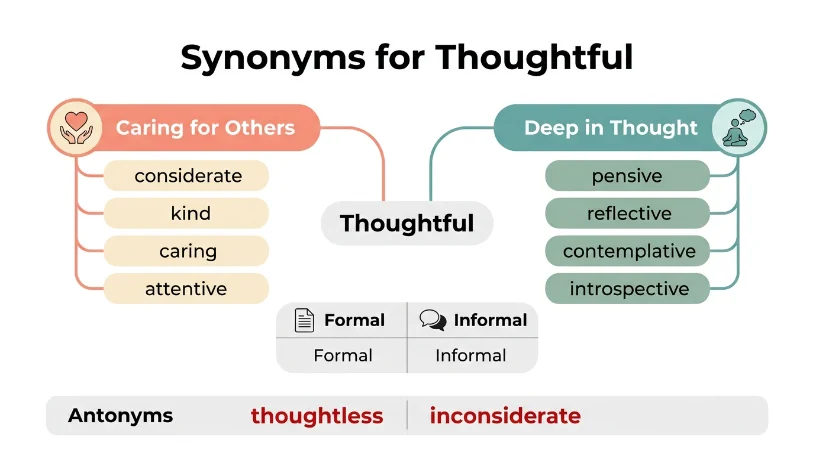
The best synonyms for thoughtful fall into two main categories. Are you looking for a word that means kind and considerate toward others? Then considerate, caring, or attentive might be your best bet. Or are you describing someone who is deep in thought or reflective? In that case, pensive, contemplative, or introspective are stronger choices. Common go-to synonyms include considerate, pensive, kind, and reflective. But the right pick depends entirely on whether you’re describing a person’s character, a temporary mood, or a specific action. This guide explores every major synonym for thoughtful organized by meaning, tone, and intensity so you can choose the perfect word with confidence.
Best Synonyms for Thoughtful
The best synonyms for thoughtful are considerate, pensive, reflective, and kind. For the “caring about others” meaning, choose considerate, attentive, or empathetic. For the “deep in thought” meaning, choose pensive, contemplative, or introspective. Your choice depends on the context, tone, and what you’re trying to convey.
What Does Thoughtful Mean?
Thoughtful is a versatile adjective with two primary meanings. It can describe someone who is considerate and caring toward others, or it can describe someone who is absorbed in deep, serious thinking.
Simple definition: Showing careful consideration for others or engaging in deep, reflective thinking.
Part of speech: Adjective
Common usage:
- Describing a considerate action: “That was a thoughtful gesture.”
- Describing a reflective mood: “She sat in a thoughtful silence.”
- Describing a person’s character: “He’s a thoughtful and kind individual.”
Example sentences:
- “My colleague left a thoughtful note on my desk wishing me well.”
- “The professor paused, looking thoughtful before answering the complex question.”
Core Meaning of Thoughtful
The word thoughtful sits at the intersection of empathy and reflection. It captures two distinct but equally valuable human qualities.
The “caring” meaning. At its heart, this version of thoughtful is about awareness of others. A thoughtful person notices the needs, feelings, and circumstances of the people around them. They don’t just think about themselves; they consider how their words and actions affect others. This kind of thoughtfulness shows up in small gestures holding a door, sending a thank-you note, offering help without being asked. It’s empathy in action.
The “reflective” meaning. This version of thoughtful describes the internal state of being lost in thought. A thoughtful person in this sense is mentally engaged, weighing ideas, pondering questions, or considering a problem from multiple angles. The focus is inward rather than outward. You might look thoughtful while reading a challenging book, planning a project, or remembering a past event.
The connection between the two. Interestingly, these two meanings are related. Both involve thinking but in one case, the thinking is directed outward toward others, and in the other, it’s directed inward toward ideas and feelings. A truly thoughtful person often combines both: they think deeply about the world and use that thinking to act with care and consideration.
Grammar and Usage Notes
Understanding the grammatical behavior of thoughtful helps you use it naturally.
Part of speech: Adjective. It modifies nouns and can follow linking verbs.
Common sentence patterns:
- Subject + linking verb + thoughtful: “She is thoughtful.”
- Article + thoughtful + noun: “a thoughtful person,” “a thoughtful gesture”
- Thoughtful + preposition: “thoughtful of you,” “thoughtful about the issue”
Common phrases and collocations:
- thoughtful of you: “That was thoughtful of you to call.”
- thoughtful gesture: “She made a thoughtful gesture by bringing soup.”
- thoughtful silence: “He responded with a thoughtful silence.”
- thoughtful look: “She gave me a thoughtful look.”
- deeply thoughtful: “He was deeply thoughtful about the decision.”
When thoughtful sounds natural:
- When describing a kind action or a caring person
- When describing someone who appears to be thinking deeply
- In both formal and informal writing
- As a sincere compliment
When a synonym may work better:
- When you need to specify that the person is caring (use considerate)
- When you need to specify that the person is thinking deeply (use pensive)
- When you’re writing about empathy (use empathetic)
- When you need a more formal term for reflection (use contemplative)
- When you want to avoid the possible ambiguity of the dual meanings
Best Synonyms for Thoughtful
| Synonym | Meaning | Tone | Best Use Case | Example Sentence |
|---|---|---|---|---|
| Considerate | Concerned about the feelings of others | Warm, sincere | Describing kind, caring actions or people | It was very considerate of you to drive me home. |
| Pensive | Engaged in deep, often sad, thought | Literary, introspective | Describing a quiet, reflective mood | He stared out the window with a pensive expression. |
| Reflective | Engaged in serious contemplation | Formal, neutral | Academic or philosophical contexts | She took a reflective pause before answering. |
| Kind | Having a generous, caring nature | Warm, simple | Everyday descriptions of good people | My grandmother was the kindest person I knew. |
| Contemplative | Deeply thoughtful about a subject | Formal, intellectual | Philosophical, religious, or analytical contexts | The monks led a contemplative life of prayer and study. |
| Empathetic | Understanding and sharing others’ feelings | Sincere, modern | Discussions of emotional intelligence | She was empathetic to her friend’s struggles. |
| Attentive | Quick to notice others’ needs and act on them | Active, practical | Customer service, personal relationships | The attentive waiter refilled our glasses without being asked. |
| Introspective | Examining one’s own thoughts and feelings | Psychological, inward | Personal growth, therapy, self-reflection | The journaling exercise made her more introspective. |
| Caring | Showing concern for others | Warm, everyday | General compliments and character descriptions | The nurses at that hospital are incredibly caring. |
| Deliberate | Done with careful, unhurried thought | Formal, measured | Decision-making, planning, careful actions | She made a deliberate choice to change careers. |
| Wistful | Yearning or nostalgic, mildly sad thinking | Emotional, poetic | Describing a slightly sad, reflective mood | He gave a wistful sigh when he saw the old photographs. |
| Thoughtful | Considerate or reflective (the original word) | Neutral | General use | That’s a thoughtful idea. |
Common Synonyms for Thoughtful
These are the everyday alternatives you’ll hear in conversation and encounter in regular writing.
Considerate
Meaning: Kind and attentive to the needs and feelings of others.
Best context: When you want to compliment someone’s caring behavior.
Example: “The hotel staff were very considerate and made our stay comfortable.”
Reflective
Meaning: Engaged in quiet, serious thought.
Best context: Describing someone weighing a decision or pondering a topic.
Example: “After the lecture, the students were quiet and reflective.”
Kind
Meaning: Having or showing a friendly, generous, and considerate nature.
Best context: Everyday situations where you want to describe a good person.
Example: “He was always kind to the new employees.”
Caring
Meaning: Displaying concern and kindness toward others.
Best context: Describing people in helping professions or personal relationships.
Example: “My aunt is a caring person who always remembers everyone’s birthday.”
Attentive
Meaning: Paying close attention to someone and responding to their needs.
Best context: Service situations, parenting, or any role requiring watchfulness.
Example: “The attentive nurse noticed the patient’s discomfort immediately.”
Pensive
Meaning: Engaged in deep, often mildly sad, thought.
Best context: Creative writing or describing someone in a quiet, introspective moment.
Example: “She sat by the window, looking pensive and distant.”
Contemplative
Meaning: Deeply thoughtful, often about serious or spiritual matters.
Best context: Religious, philosophical, or intellectual discussions.
Example: “The artist spent years in a contemplative retreat.”
Empathetic
Meaning: Able to understand and share the feelings of others.
Best context: Modern discussions of emotional intelligence and relationships.
Example: “Her empathetic response made the grieving family feel understood.”
Formal Synonyms for Thoughtful
When you’re writing academic papers, business documents, or professional communications, these formal alternatives will serve you well.
Reflective
A sophisticated choice that suggests careful, serious consideration. It implies depth and maturity of thought.
Example: “The committee’s reflective approach to the budget resulted in a fair and sustainable plan.”
Contemplative
This word carries an intellectual, often spiritual weight. It suggests prolonged and focused thinking, sometimes with a sense of reverence.
Example: “The conference provided a contemplative space for leaders to discuss the ethics of AI.”
Deliberate
When thoughtful means “carefully considered,” deliberate is a strong formal choice. It implies intentionality and measured judgment.
Example: “The board made a deliberate decision to delay the launch until the data was verified.”
Attentive
In professional contexts, attentive describes someone who is watchful, responsive, and detail-oriented. It’s especially useful in client service and management.
Example: “Our attentive staff ensures every guest feels welcomed and valued.”
Considerate
While common, considerate works well in formal writing when you’re discussing professional courtesy or ethical behavior.
Example: “The company’s policy on leave is considerate of employees’ diverse needs.”
Empathetic
This term has gained academic and professional currency in fields like psychology, leadership, and healthcare. It suggests a deep, practiced understanding of others.
Example: “Effective leaders are empathetic and responsive to their team’s concerns.”
Judicious
When thoughtful means “showing good judgment,” judicious is an excellent formal synonym. It implies wisdom and careful decision-making.
Example: “The judge’s judicious ruling reflected her thoughtful analysis of the case.
Informal Synonyms for Thoughtful
For everyday conversation, social media, and personal writing, these alternatives feel natural and approachable.
Kind
Simple, warm, and universally understood. It’s the go-to word when you want to call someone a good person.
Example: “She sent me a kind message when I was feeling down.”
Caring
This word has a nurturing, family-oriented feel. It’s perfect for describing friends, partners, and family members.
Example: “My neighbor is so caring she waters my plants when I’m away.”
Nice
While a bit generic, nice is the ultimate everyday word for describing considerate behavior. It lacks weight but is perfectly natural in casual contexts.
Example: “It was nice of you to help me move.”
Sweet
Sweet suggests thoughtfulness with a touch of charm or affection. It’s often used for small, unexpected gestures.
Example: “That was such a sweet thing to say.”
Deep
In casual speech, deep describes someone who thinks a lot or has profound thoughts. It’s a compliment but also somewhat vague.
Example: “He’s pretty deep he’s always analyzing everything.”
Lost in thought
This phrase is the informal way to describe a pensive or reflective state. It’s vivid and immediately understandable.
Example: “Sorry, I was lost in thought what did you say?”
Careful
When thoughtful means “taking care,” careful is a natural informal substitute. It emphasizes deliberation and caution.
Example: “She’s a careful planner and never misses a detail.”
Strong Synonyms for Thoughtful
Sometimes you need a word that adds weight, intensity, or emotional depth. These stronger alternatives do exactly that.
Profound
When thoughtful means “deeply reflective,” profound adds depth and significance. It implies that the thinking touches on important truths.
Example: “His profoundly thoughtful insights changed how I view the problem.”
When to use: When you want to emphasize the depth and importance of the thinking.
When it’s too strong: When describing everyday consideration or casual thinking.
Perceptive
A perceptive person picks up on things others miss. This goes beyond simple thoughtfulness to suggest keen insight.
Example: “Her perceptive comment about the team’s morale showed just how thoughtful she really was.”
When to use: When you want to highlight awareness and understanding.
When it’s too strong: When the thoughtfulness is more about action than insight.
Compassionate
This word combines thoughtfulness with a deep, active desire to help. It’s stronger than just being nice or considerate.
Example: “The doctor’s compassionate care made a difficult time more bearable.”
When to use: In contexts involving suffering, hardship, or deep emotional support.
When it’s too strong: In casual or everyday situations that don’t call for such weight.
Solemn
When thoughtful suggests a serious, grave, or earnest state of mind, solemn adds a layer of gravity.
Example: “The memorial service was filled with solemn reflection.”
When to use: In formal or ceremonial contexts, or when describing serious topics.
When it’s too strong: For everyday reflection or simple consideration.
Ruminative
This term suggests the kind of deep, obsessive, or extended thinking that goes beyond casual reflection.
Example: “His ruminative personality often kept him awake at night.”
When to use: In psychological contexts or when describing extended, sometimes anxious, thought.
When it’s too strong: For lighter moments of reflection.
Mild Synonyms for Thoughtful
When you want to soften your language or describe a lighter, less intense version of thoughtfulness, these milder alternatives work well.
Kind Of Thoughtful
This phrase hedges a compliment, making it sound less intense or more casual.
Example: “It was kind of thoughtful of him to check in.”
When to use: When you don’t want to sound overly effusive.
When it’s too mild: When you genuinely want to give a strong compliment.
A Little Reflective
Softens the intensity of reflection, suggesting a brief or surface-level moment of thought.
Example: “He became a little reflective after reading the old letters.”
When to use: For describing a mild or fleeting mood.
When it’s too mild: When the reflection is deep and significant.
Thoughtful-ish
This informal, playful construction is useful in very casual speech to approximate the meaning without committing to it.
Example: “I was feeling thoughtful-ish, so I stayed home.”
When to use: Only in the most informal contexts.
When it’s too mild: In any serious or formal writing.
Gentle
While not a direct synonym, gentle can describe a mild, considerate manner that falls under the umbrella of thoughtfulness.
Example: “He’s a gentle person who always thinks before speaking.”
When to use: Describing a soft, considerate personality.
When it’s too mild: When thoughtfulness also involves strength or action.
Kinda Pensive
This casual, almost apologetic way to describe a reflective mood is perfect for conversation.
Example: “I was kinda pensive today, just thinking about stuff.”
When to use: In everyday speech when you don’t want to sound dramatic.
When it’s too mild: When the reflection is actually serious.
Synonyms for Thoughtful by Context
The best synonym for thoughtful shifts dramatically depending on the setting. Here’s how to choose for specific contexts.
Everyday Conversation
In casual speech, simplicity and warmth rule. You’ll want words that feel natural and unpretentious. Considerate, kind, caring, and nice are your go-to choices for describing people and their actions. For describing someone lost in thought, pensive or the phrase lost in thought work perfectly.
Example: “It was kind of you to help with the dishes.”
Professional Writing
Business emails, memos, and client communications demand a polished, respectful tone. Considerate, attentive, and reflective are all professional choices. Deliberate works well for decision-making contexts. Empathetic is valuable when discussing customer relations or leadership.
Example: “The team’s considerate approach to client feedback strengthened our relationship.”
Academic Writing
In research papers and essays, precision and formality are paramount. Reflective, contemplative, and introspective are strong choices for psychological, literary, or philosophical topics. Deliberate works for methodology sections. Perceptive is excellent for analysis.
Example: “The study employed a reflective methodology to capture participants’ lived experiences.”
Creative Writing
Fiction and poetry give you freedom to play with tone and atmosphere. Pensive, wistful, contemplative, and introspective add emotional depth. Meditative and ruminative can create a more introspective mood. Use these to show character interiority or set a reflective tone.
Example: “She paused, a pensive look crossing her face, as if the answer were hiding in the distance.”
Marketing Copy
When you’re writing to build trust and connection, choose words that feel genuine and warm. Thoughtful itself works well, as do caring, attentive, and considerate. In marketing, you want to position your brand or product as understanding and responsive to customer needs.
Example: “Our thoughtful customer service team is here to help you 24/7.”
Emotional Expression
When you’re describing feelings your own or someone else’s choose words that match the emotional weight. Pensive and wistful work for softer, nostalgic moods. Solemn and contemplative are better for serious or deeply emotional moments. Compassionate and empathetic are ideal for moments of shared emotion.
Example: “He was pensive all evening, quietly working through the difficult news.”
Personal Communication
Letters, emails to friends, and personal messages allow for a relaxed, authentic tone. Sweet, caring, and kind are natural choices. Lost in thought or pensive are great for describing your own or someone else’s mood.
Example: “You’re always so caring thank you for being there for me.”
Another Word for Thoughtful in a Sentence
Here are 15 natural example sentences using different synonyms for thoughtful in realistic contexts.
- The considerate driver waited for me to cross the street before turning.
- She sat in the garden, looking pensive as the sun set behind the trees.
- His reflective remarks at the meeting gave everyone something to think about.
- The host left a kind note and a basket of goodies in the guest room.
- The philosopher’s contemplative writings explore the nature of existence.
- Good managers are empathetic and understand their employees’ challenges.
- Our attentive waiter brought extra napkins before we even had to ask.
- The therapy session helped her become more introspective.
- The nurses at that clinic are genuinely caring and professional.
- She made a deliberate effort to include everyone in the conversation.
- Looking at his old photographs, he grew wistful and a little sad.
- You can always count on Mike for thoughtful advice when you’re stuck.
- The judge’s judicious ruling considered both sides of the argument.
- His perceptive observation about the team’s dynamic was absolutely correct.
- The compassionate teacher stayed late to help students who were struggling.
Thoughtful Synonyms Compared
Not all synonyms for thoughtful are interchangeable. Here’s how the closest alternatives differ.
Considerate vs. Kind vs. Caring
All three describe positive, people-oriented qualities, but they have distinct shades.
- Considerate specifically means being mindful of others’ needs and feelings, often translating into action. A considerate person notices when you’re tired and offers to drive. It’s active and practical.
- Kind is broader and more innate. It describes a generous, good-natured disposition. A kind person is warm-hearted in general, not just in specific situations.
- Caring is the most emotional of the three. It implies a deep, active concern for others’ well-being, often involving an emotional investment. A caring person worries about you when you’re sick.
Verdict: Choose considerate for actions, kind for character, and caring for emotional concern.
Pensive vs. Reflective vs. Contemplative
These are the “deep in thought” synonyms, but they differ in intensity and focus.
- Pensive suggests deep thought tinged with a mild sadness or longing. It’s the word for someone staring out a rainy window, lost in memory. The mood is quiet and slightly melancholic.
- Reflective is more neutral. It simply means engaged in serious thought, often about past experiences or ideas. It’s the safe, all-purpose choice for describing introspection.
- Contemplative implies a deeper, more focused, and sometimes spiritual form of thinking. It suggests pondering profound questions, often with a sense of calm or devotion. It’s the most intense and formal of the three.
Verdict: Use pensive for wistful moods, reflective for general introspection, and contemplative for deep, intellectual, or spiritual thought.
Empathetic vs. Sympathetic
These are often confused, but they’re not the same.
- Empathetic is about understanding and sharing someone’s feelings putting yourself in their shoes. It’s a deeper, more cognitive form of connection.
- Sympathetic is about feeling pity or concern for someone’s misfortune. It’s a reaction to someone else’s distress but doesn’t necessarily involve sharing their emotional state.
Verdict: Empathetic is closer to thoughtful in the “considerate” sense because it involves active understanding. Sympathetic is more about feeling sorry for someone.
Deliberate vs. Intentional
Both are formal synonyms when thoughtful means “carefully considered.”
- Deliberate emphasizes the care, slowness, and unhurried nature of the thinking or action. It often implies that the person weighed their options.
- Intentional emphasizes that the action was done on purpose, not by accident. It’s more about the decision to act than the thought process behind it.
Verdict: Use deliberate when you want to emphasize careful thinking; use intentional when you want to emphasize purposeful action.
Words Similar to Thoughtful
These words belong to the same semantic field as thoughtful but aren’t always direct replacements. Understanding the differences prevents misuse.
Mindful
Mindful is related to thoughtful in the sense of “being aware.” However, mindful often implies a focused awareness of the present moment, stemming from meditation and psychology. It’s less about thinking about others and more about being conscious of your own thoughts and surroundings.
When it’s useful: When you want to emphasize presence and awareness, especially in wellness contexts.
Why it’s not always a direct replacement: Thoughtful can mean “considerate of others,” which mindful doesn’t always imply.
Introspective
Introspective is a specific subset of reflective thinking it means looking inward at your own feelings, thoughts, and motivations. It’s related to thoughtful but is more psychologically focused.
When it’s useful: When you’re describing self-examination or personal growth.
Why it’s not always a direct replacement: Thoughtful can be directed outward (toward others), while introspective is always inward.
Meditative
Meditative suggests a calm, focused, and sometimes spiritual form of thinking or stillness. It’s deeper and more centered than casual reflection.
When it’s useful: In spiritual or wellness contexts, or when describing a peaceful, focused state.
Why it’s not always a direct replacement: Thoughtful doesn’t require calmness or spiritual focus; it can involve worry, planning, or social awareness.
Wistful
Wistful describes a reflective mood that involves a gentle longing or sadness, often for the past. It’s a specific emotional flavor of pensiveness.
When it’s useful: When you want to describe nostalgic, slightly sad reflections.
Why it’s not always a direct replacement: Thoughtful can describe many different kinds of thinking, not just nostalgic ones.
Careful
Careful is related when thoughtful means “taking care.” However, careful is more about caution and avoiding mistakes, while thoughtful is more about consideration and depth.
When it’s useful: When you’re describing a cautious or meticulous approach.
Why it’s not always a direct replacement: Careful lacks the emotional and interpersonal dimensions of thoughtful.
Wise
Wisdom often requires thoughtfulness, but wise is a larger, more holistic term. It implies good judgment based on knowledge and experience, not just a thoughtful disposition.
When it’s useful: When you want to praise someone’s judgment and insight.
Why it’s not always a direct replacement: You can be thoughtful without being wise, and wise without being particularly thoughtful in the moment.
Antonyms of Thoughtful
Understanding the opposites of thoughtful clarifies what it truly means.
| Antonym | Meaning | Example Sentence |
|---|---|---|
| Thoughtless | Failing to consider others or think carefully | His thoughtless comment upset everyone. |
| Inconsiderate | Not caring about others’ feelings or needs | It was inconsiderate of her to be so late. |
| Selfish | Concerned only with one’s own needs | His selfish actions hurt the entire team. |
| Careless | Lacking attention, caution, or concern | The careless mistake cost the company thousands. |
| Unkind | Not kind; harsh or cruel | The unkind remark ruined her day. |
| Foolish | Lacking good sense or judgment | His foolish decision had disastrous consequences. |
| Unthinking | Acting without considering consequences | In an unthinking moment, she agreed to something she regretted. |
| Oblivious | Unaware of what’s happening around one | He was oblivious to the tension in the room. |
| Hasty | Done with excessive speed and without thought | Her hasty response only made things worse. |
How to Choose the Right Synonym for Thoughtful
Selecting the perfect synonym for thoughtful comes down to a few simple considerations.
Decide which meaning you intend. Are you describing consideration for others or deep internal thought? If you mean “kind and considerate,” lean toward considerate, caring, kind, or attentive. If you mean “deep in thought,” lean toward pensive, reflective, introspective, or contemplative. Getting this distinction right is the most important step.
Match the context. A business email calls for formality; a text to a friend doesn’t. Choose a word that fits the setting. Deliberate and reflective work in formal writing; kind and sweet are perfect for casual conversation.
Match the tone. Think about how you want the reader to feel. Compassionate evokes warmth and concern. Profound suggests intellectual depth. Wistful creates a quiet, nostalgic mood. Choose a word that sets the right emotional tone.
Check the intensity. Are you describing a mild thought or a deep meditation? A simple kindness or a profound act of compassion? Use stronger words for stronger situations and milder words for lighter ones. Contemplative is stronger than reflective, which is stronger than lost in thought.
Think about your reader. Will they understand the word you’ve chosen? Will it sound natural to them? Avoid overly formal words in casual contexts and overly casual words in formal ones. Your reader’s expectations matter.
Check whether the synonym is exact or only related. Mindful is related but not always a direct replacement. Wise is similar but broader. Make sure the word actually means what you want to say.
Keep the sentence natural. Read your sentence aloud with the new word. Does it flow? Does it sound like something a real person would say? If it feels forced, try a different word.
Use simple words when clarity matters. When in doubt, reach for the clearest, simplest word. Considerate and kind are almost always safe choices for the “caring” meaning. Pensive and reflective are reliable for the “thinking” meaning.
Common Mistakes When Using Synonyms for Thoughtful
Even skilled writers stumble when replacing thoughtful. Here are the most common mistakes and how to avoid them.
Choosing the wrong meaning. Using pensive when you mean “kind” is a common error. If someone is a thoughtful person in the sense that they’re caring, don’t call them pensive that describes a temporary mood, not a character trait. Always check which meaning you intend.
Using a synonym that’s too strong. Compassionate carries more weight than thoughtful. If you say a casual acquaintance is compassionate, you might sound like you’re exaggerating. Match the intensity to the situation.
Using a formal word in casual writing. “I appreciate your contemplative message” sounds stiff in a text to a friend. “That was kind of you” sounds much more natural. Save formal words for formal contexts.
Using a casual word in professional writing. “Our team is pretty caring” might be too informal for a quarterly report. “Our team demonstrates a considerate approach” sounds more professional.
Replacing thoughtful without checking meaning. Wistful is not a synonym for considerate. If you use it incorrectly, you’ll confuse your reader. Make sure you understand the exact meaning of the synonym you choose.
Treating related words as exact synonyms. Mindful and thoughtful are related but not identical. Using them interchangeably can create confusion, especially in wellness or professional contexts.
Making the sentence sound unnatural. Forcing a fancy synonym into a simple sentence creates awkward phrasing. If the sentence sounds better with thoughtful, leave it. Not every instance of thoughtful needs to be replaced.
Quick Synonym List for Thoughtful
Common Synonyms
- Considerate
- Kind
- Caring
- Reflective
- Attentive
- Pensive
Formal Synonyms
- Reflective
- Contemplative
- Deliberate
- Attentive
- Considerate
- Empathetic
- Judicious
Informal Synonyms
- Kind
- Caring
- Sweet
- Nice
- Deep
- Lost in thought
Strong Synonyms
- Profound
- Perceptive
- Compassionate
- Solemn
- Ruminative
Mild Synonyms
- Kind of thoughtful
- A little reflective
- Thoughtful-ish
- Gentle
- Kinda pensive
Related Words
- Mindful
- Introspective
- Meditative
- Wistful
- Careful
- Wise
FAQs
What is the best synonym for thoughtful?
The best synonym depends on the meaning. For “considerate of others,” considerate is the closest match. For “deep in thought,” pensive and reflective are excellent choices. Your context and tone determine the ideal pick.
What is another word for thoughtful?
Common alternatives include considerate, kind, caring, reflective, pensive, attentive, and contemplative. The right one depends on whether you’re describing a caring person or someone engaged in deep thinking.
What is a formal synonym for thoughtful?
Formal synonyms include reflective, contemplative, deliberate, judicious, and empathetic. These work well in academic, business, and professional contexts.
What is an informal synonym for thoughtful?
Informal synonyms include kind, caring, sweet, nice, deep, and the phrase lost in thought. These feel natural in conversation and personal writing.
What is a stronger word for thoughtful?
Stronger alternatives include profound, perceptive, compassionate, solemn, and ruminative. These words add weight, depth, and emotional intensity.
What is a milder word for thoughtful?
Milder alternatives include kind of thoughtful, a little reflective, thoughtful-ish, gentle, and kinda pensive. These soften the intensity or formality of the statement.
What words are similar to thoughtful?
Related words include mindful, introspective, meditative, wistful, careful, and wise. These share the semantic field but aren’t always direct synonyms for thoughtful.
What is the opposite of thoughtful?
Antonyms include thoughtless, inconsiderate, selfish, careless, unkind, foolish, unthinking, oblivious, and hasty. These describe people who don’t think of others or who act without consideration.
How do I choose the right synonym for thoughtful?
First decide whether you mean “considerate of others” or “deep in thought.” Then consider your context, tone, and intensity. Match the formality of the word to the setting, and make sure the word actually means what you intend.
Conclusion
Thoughtful is a beautifully flexible word with two equally important meanings: caring deeply about others and thinking deeply about the world. The best synonym depends on which meaning you intend, the context you’re writing in, and the tone you want to strike. For the caring side, considerate, kind, and caring are your strongest and most reliable choices. For the reflective side, pensive, reflective, and contemplative offer precision and depth. With the options in this guide, you can write with clarity, confidence, and exactly the right word for every situation.