The best synonyms for insight depend on how you’re using the word. Are you describing a deep understanding of a complex situation (“She has great insight into human behavior”), a sudden moment of clarity (“I had an insight about the problem”), or the ability to perceive things others miss (“His insight saved the project”)? Common go-to alternatives include understanding, perception, awareness, discernment, and revelation. But the right choice shifts with each meaning. This guide breaks down every major synonym for insight, organized by meaning, tone, and context, so you can pick the perfect word every time.
Best Synonyms for Insight
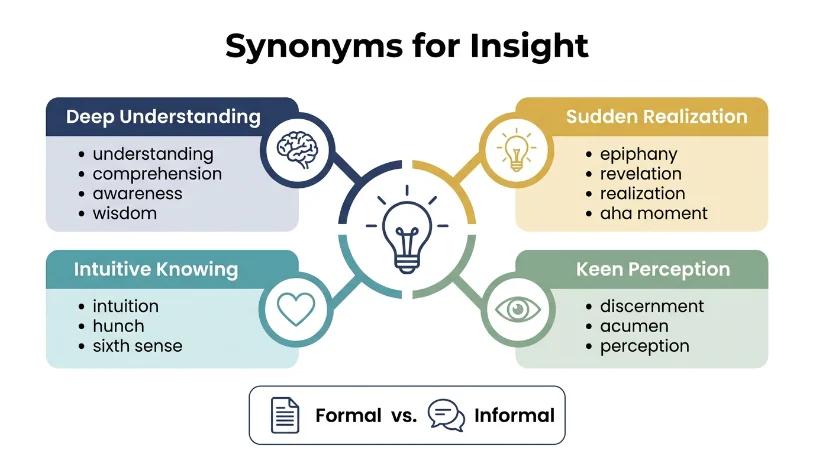
The best synonyms for insight are understanding, perception, awareness, discernment, and revelation. However, the right choice depends on tone, context, and intensity. For deep comprehension, try understanding or knowledge. For the ability to perceive clearly, use perception or discernment. For a sudden realization, revelation or epiphany work well. For intuitive grasp, intuition or sixth sense are your best bets.
What Does Insight Mean?
At its core, insight refers to the ability to see into a situation or understand something deeply and clearly. It often involves grasping the true nature of something that isn’t immediately obvious. The word can function as a noun in all its forms.
Simple definition: The capacity to gain an accurate and deep understanding of someone or something.
Part of speech: Noun
Common usage:
- As a general concept: “Her insight into the market trends was invaluable.”
- As a specific realization: “I had an insight while I was walking.”
- As a personal quality: “He’s known for his insight and wisdom.”
Example sentences:
- “The therapist offered insight into the patient’s behavior.”
- “Her insight helped us solve the problem quickly.”
Core Meaning of Insight
The word insight carries several distinct but related meanings, and understanding these nuances is key to choosing the right synonym.
Deep understanding. This is the most common use. Insight refers to a profound, clear grasp of a situation, person, or concept. It’s not just knowing something it’s seeing the underlying truth or pattern. “His insight into the company’s culture came from years of experience.”
Sudden realization. Insight can also mean a moment of clarity or an “aha” moment when something suddenly becomes clear. “I had an insight about my career path during the lecture.”
Perceptiveness. The word can describe a person’s ability to see things clearly and intuitively. It’s a quality of wisdom and sharp observation. “She’s a therapist with remarkable insight.”
Intuitive grasp. Sometimes insight means understanding something without relying on conscious reasoning a gut feeling or instinct that turns out to be right. “His insight into people’s motives was almost uncanny.”
Revelation. In some contexts, insight can mean discovering a truth that was previously hidden, almost like uncovering a secret. “The research provided new insight into the disease.”
Grammar and Usage Notes
Understanding how insight functions grammatically helps you replace it correctly.
Part of speech: Noun (countable and uncountable)
Common sentence patterns:
- As the subject: “Insight is essential for good leadership.”
- With a preposition: “Insight into the problem”
- As an object: “She gained insight from the experience.”
- As a quality: “He has great insight.”
Common collocations and phrases:
- gain insight: “I gained insight into the process.”
- provide insight: “The data provided insight into customer behavior.”
- offer insight: “The expert offered insight on the topic.”
- insight into: “Her insight into human nature is remarkable.”
- moment of insight: “He had a moment of insight that changed his approach.”
- deep insight: “She has deep insight into the political landscape.”
- valuable insight: “His advice gave me valuable insight.”
When insight sounds natural:
- In discussions of learning, wisdom, or understanding
- When describing someone’s perceptiveness
- In professional and academic contexts
- When talking about moments of clarity or realization
When a synonym may work better:
- When you need a more formal academic term (use comprehension)
- When you want to emphasize instinct (use intuition)
- When you’re describing a sudden realization (use revelation)
- When you want to emphasize practical understanding (use know-how)
- When you’re writing for a casual audience (use sense or idea)
A note on countability: Insight can be countable (“several insights”) when referring to specific realizations or pieces of understanding. It can also be uncountable (“great insight”) when referring to the quality or ability in general. Some synonyms don’t share this flexibility. Epiphany is almost always countable; wisdom is usually uncountable.
Best Synonyms for Insight
| Synonym | Meaning | Tone | Best Use Case | Example Sentence |
|---|---|---|---|---|
| Understanding | Deep comprehension | Neutral to formal | General deep grasp of a topic | She has a thorough understanding of the issue. |
| Perception | Awareness through senses or intuition | Formal | Recognizing subtle details or patterns | His perception of the situation was spot on. |
| Awareness | Consciousness or knowledge of something | Neutral | Being informed or cognizant | Public awareness of the issue has grown. |
| Discernment | The ability to judge well | Formal, sophisticated | Making fine distinctions or good judgments | Her discernment in hiring decisions is unmatched. |
| Revelation | A surprising and previously unknown fact | Formal, dramatic | Sudden disclosure or realization | The document was a revelation about the company’s past. |
| Epiphany | A sudden, striking realization | Literary, dramatic | Moment of clarity or life-changing insight | He had an epiphany and quit his job. |
| Intuition | Understanding without conscious reasoning | Neutral to casual | Gut feelings or instinctive knowing | Her intuition told her something was wrong. |
| Wisdom | Accumulated knowledge and good judgment | Formal, elevated | Deep, life-experience-based understanding | His wisdom guided the young team. |
| Comprehension | Full understanding of something | Formal, academic | Complex concepts or intellectual grasp | The course improved her comprehension of physics. |
| Realization | Becoming fully aware of something | Neutral | When something becomes clear or apparent | The realization that he was wrong came slowly. |
| Know-how | Practical knowledge or skill | Casual, practical | Hands-on understanding or expertise | She has the know-how to fix the system. |
Common Synonyms for Insight
These are the everyday alternatives you’ll hear in conversation and see in regular writing.
Understanding
Meaning: The ability to comprehend something thoroughly.
Best context: When you want a straightforward, neutral replacement for insight.
Example: “His understanding of the client’s needs made the project a success.”
Awareness
Meaning: Knowledge or perception of a situation or fact.
Best context: When you’re referring to being informed or conscious of something.
Example: “The campaign raised awareness about mental health issues.”
Perception
Meaning: The ability to see, hear, or become aware of something through the senses or intuition.
Best context: When you want to emphasize how someone interprets or recognizes subtle details.
Example: “Her perception of the team’s dynamics was incredibly accurate.”
Intuition
Meaning: The ability to understand something instinctively, without the need for conscious reasoning.
Best context: When the insight comes from a gut feeling rather than analysis.
Example: “My intuition told me not to trust that deal.”
Realization
Meaning: An act of becoming fully aware of something as a fact.
Best context: When describing the moment something becomes clear.
Example: “The realization that she had been wrong was humbling.”
Revelation
Meaning: A surprising and previously unknown fact, especially one that is made known in a dramatic way.
Best context: When the insight is surprising or eye-opening.
Example: “The CEO’s speech was a revelation about the company’s future plans.”
Know-how
Meaning: Practical knowledge or expertise in a particular area.
Best context: When the insight is hands-on and practical rather than theoretical.
Example: “She has the technical know-how to solve the problem.”
Aha Moment
Meaning: A moment of sudden insight or discovery.
Best context: Very casual, when describing a moment of clarity.
Example: “I had an aha moment and finally understood the math problem.”
Formal Synonyms for Insight
When you’re writing academic papers, business reports, or professional correspondence, these formal alternatives will serve you well.
Comprehension
A strong, academic term for full understanding. It implies a thorough grasp of complex material and works well in scholarly writing.
Example: “The study aimed to improve students’ comprehension of historical events.”
Discernment
This elegant word refers to the ability to judge well and make fine distinctions. It’s particularly useful when you want to emphasize good judgment or taste.
Example: “His discernment in selecting the right strategy was crucial to the outcome.”
Penetration
In formal contexts, penetration can mean the ability to see deeply into something, often used in academic or intellectual discussions.
Example: “Her penetration into the philosophical question revealed new perspectives.”
Percipience
A sophisticated term meaning keen perception or insight. It’s rare but powerful in formal writing.
Example: “The critic’s percipience made her reviews particularly valuable.”
Acumen
This word refers to the ability to make good judgments and quick decisions, especially in a particular domain like business or politics.
Example: “His financial acumen turned the struggling company around.”
Cognizance
A formal word for awareness or knowledge of something. It’s often used in legal or official contexts.
Example: “The committee had full cognizance of the risks involved.”
Forethought
This implies insight that involves anticipating future needs or consequences. It’s about having the wisdom to plan ahead.
Example: “Her forethought prevented many potential problems.”
Sagacity
A literary and formal term for wisdom and sound judgment. It suggests deep, thoughtful understanding.
Example: “The elder’s sagacity was respected by all in the community.”
Informal Synonyms for Insight
For everyday conversation, text messages, social media, and casual writing, these alternatives feel natural and relaxed.
Aha Moment
This phrase is playful and vivid. It perfectly captures the moment a sudden insight strikes.
Example: “I had an aha moment when I realized I could combine the two ideas.”
Clue
In casual contexts, clue can mean an insight or hint about something, especially when you’re starting to understand.
Example: “I finally got a clue about what she was trying to say.”
Idea
Simple and direct. Idea often replaces insight when the understanding isn’t deeply profound but is still helpful.
Example: “I have an idea about how we can fix this.”
Hunch
This implies an intuitive insight that isn’t fully backed by evidence. It’s perfect for gut feelings.
Example: “My hunch was right the deal fell through.”
Sixth Sense
This playful term describes an uncanny ability to know or perceive things without logical explanation.
Example: “My sixth sense told me not to go to that party.”
Inside Info
Very casual slang for privileged or insightful information not available to everyone.
Example: “Thanks for the inside info; it helped me prepare.”
Nitty-Gritty
This phrase refers to the practical, insightful details of a situation. It’s very informal.
Example: “She knows the nitty-gritty of the production process.”
Lowdown
This slang term means the full, revealing story or insight about something.
Example: “Give me the lowdown on what really happened.”
Two Cents
Used as a humble way to offer an insight or opinion, often unsolicited.
Example: “Can I give you my two cents on that idea?”
Strong Synonyms for Insight
Sometimes you need a word that carries more weight, drama, or depth than insight. These stronger alternatives add power to your writing.
Epiphany
A sudden, striking, and often life-changing realization. It’s the strongest word for a moment of insight.
Example: “He had an epiphany in the middle of the night and completely changed his career path.”
When to use: When you want to emphasize the dramatic, transformative nature of the insight.
When it’s too strong: In everyday conversations about minor realizations. Not every good idea is an epiphany.
Revelation
This word suggests that the insight was previously hidden and is now being dramatically revealed. It often carries a sense of surprise or shock.
Example: “The book was a revelation, changing how I think about history.”
When to use: When you want to highlight the surprising or impactful nature of the insight.
When it’s too strong: For mundane realizations or incremental understanding.
Enlightenment
This implies a profound level of insight that brings clarity and often a sense of peace or liberation. It carries spiritual or intellectual weight.
Example: “Traveling through Asia brought him a sense of enlightenment.”
When to use: In philosophical, spiritual, or profound personal transformation contexts.
When it’s too strong: For practical insights at work or school.
Penetrating Insight
The adjective penetrating adds intensity, suggesting the insight goes beyond the surface into the very core of an issue.
Example: “Her penetrating insight into the conflict resolved the debate.”
When to use: When you want to emphasize depth and thoroughness.
When it’s too strong: For routine or everyday understanding.
Keen Perception
This phrase emphasizes sharpness and acuteness. It suggests the person who has the insight is unusually observant.
Example: “His keen perception detected the subtle shift in the market.”
When to use: When you’re praising someone’s observational skills.
When it’s too strong: For general, average understanding.
Vision
In a strong sense, vision means the ability to think about the future with insight and imagination. It’s more than understanding the present it’s seeing what could be.
Example: “The CEO’s vision transformed the industry.”
When to use: When the insight involves foresight or innovation.
When it’s too strong: For understanding that’s purely about the present or past.
Mild Synonyms for Insight
When you want to soften your language, downplay a realization, or sound humble, these milder alternatives work beautifully.
Idea
This is the gentlest, most unassuming synonym. It suggests a thought or notion that may not be fully developed.
Example: “I have an idea about what went wrong.”
When to use: When you don’t want to sound boastful about your understanding.
When it’s too mild: When you actually have deep, well-founded knowledge.
Notion
Slightly more tentative than idea, a notion is a vague or imperfect understanding.
Example: “She had only a notion of what the project entailed.”
When to use: When the understanding is partial or speculative.
When it’s too mild: When you have a clear, accurate picture.
Impression
This suggests a general feeling or belief that may not be fully substantiated a mild form of insight.
Example: “I got the impression that he wasn’t being truthful.”
When to use: When your understanding is based on observation but lacks conclusive evidence.
When it’s too mild: When you have concrete, confirmed knowledge.
Glimmer
A glimmer of understanding is a faint, small sign of insight just a hint of clarity.
Example: “I caught a glimmer of what she was trying to say.”
When to use: When you’re just starting to understand something.
When it’s too mild: When you have a complete, solid understanding.
Hint
This suggests a mild, incomplete insight just a suggestion or clue.
Example: “The data gave a hint about the cause of the problem.”
When to use: When you have partial information.
When it’s too mild: When you have decisive evidence or full knowledge.
Sense
A sense is an intuitive feeling that falls short of a fully formed insight. It’s mild and somewhat vague.
Example: “I have a sense that we’re heading in the wrong direction.”
When to use: When describing an intuition or gut feeling.
When it’s too mild: When you have a clear, logical understanding.
Inkling
This is a mild, vague suspicion or slight understanding. It’s as soft as synonyms get.
Example: “I didn’t have the faintest inkling of what was going on.”
When to use: When you admit you barely understand something.
When it’s too mild: When you have a fairly clear idea.
Synonyms for Insight by Context
The best synonym for insight depends heavily on where and how you’re writing. Here’s how to choose based on context.
Everyday Conversation
In casual speech, clarity and naturalness matter most. Stick with simple, familiar words like idea, realization, hunch, and clue. These sound natural and won’t make you sound like a professor.
Example: “I had a realization about why we keep messing up.” (Instead of: “I had an insight about why we keep messing up.”)
Professional Writing
Business emails, memos, and reports call for a balance of professionalism and clarity. Understanding, awareness, perception, and know-how strike the right tone formal enough to be taken seriously but not so stiff that you sound unnatural.
Example: “His understanding of the market gave us a competitive advantage.” (Instead of: “His insight gave us a competitive advantage.”)
Academic Writing
In research papers, essays, and scholarly articles, precision and formality are paramount. Comprehension, discernment, penetration, and acumen are your best choices. Avoid casual alternatives like hunch or aha moment.
Example: “The study aimed to test the participants’ comprehension of the complex concepts.” (Instead of: “The study aimed to test the participants’ insight into the complex concepts.”)
Creative Writing
Fiction, poetry, and creative nonfiction give you more freedom to play with tone. Epiphany, revelation, enlightenment, and glimmer can add color and drama to your prose.
Example: “In that moment, an epiphany washed over her she had been running from the wrong thing all along.” (Instead of: “In that moment, she had an insight.”)
Marketing Copy
When you’re writing to persuade, choose words that sound confident and compelling. Vision, understanding, awareness, and know-how can make your product or service sound more valuable.
Example: “Our team has the know-how to streamline your operations.” (Instead of: “Our team has insight into your operations.”)
Emotional Expression
When you’re describing feelings, moods, or personal experiences, choose words that match the emotional weight. Epiphany and revelation work for intense realizations; sense and impression for more subtle ones.
Example: “The loss gave me a profound revelation about what truly matters.” (Instead of: “The loss gave me insight into what matters.”)
Technical Writing
Manuals, instructions, and technical documentation demand precision. Understanding and knowledge are your safest bets. Use awareness when referring to user awareness of system states.
Example: “The user manual provides a comprehensive understanding of the software features.” (Instead of: “The user manual provides insight into the software features.”)
Personal Communication
Letters, emails to friends, and personal messages allow for a relaxed tone. Idea, hunch, sense, and clue feel warm and natural.
Example: “I have a feeling you’re going to love this.” (Instead of: “I have an insight that you’re going to love this.”)
Another Word for Insight in a Sentence
Here are 15 natural example sentences using different synonyms for insight in realistic contexts.
- Her understanding of the client’s needs secured the deal.
- The documentary raised awareness about climate change.
- His perception of the room’s tension was immediate.
- The investor’s financial acumen saved the company millions.
- I had an epiphany about my career direction during the flight.
- The CEO’s speech was a revelation about the upcoming merger.
- She has the technical know-how to fix the system.
- My intuition told me not to trust that contractor.
- The workshop improved the team’s comprehension of the new software.
- The realization that he was the problem came as a shock.
- I have a hunch that the deal is going to fall through.
- Her discernment in picking the right team members was legendary.
- The book gave me a glimmer of understanding about the subject.
- I have a sense that we’re on the right track now.
- His wisdom comes from decades of experience in the industry.
Insight Synonyms Compared
Not all synonyms for insight are created equal. Here’s how closely related alternatives differ in meaning, tone, and use.
Understanding vs. Comprehension vs. Awareness
All three refer to knowing or grasping something, but they differ in depth and focus.
- Understanding is the most versatile. It implies a thorough grasp, often acquired through experience. “She has a good understanding of the topic” works in almost any context.
- Comprehension is more intellectual and academic. It emphasizes the mental process of grasping complex ideas. “His comprehension of the theory was tested on the exam” sounds formal and scholarly.
- Awareness is the lightest of the three. It means simply being conscious of something, not necessarily understanding it deeply. “I have awareness of the issue” means you know it exists, not that you understand it fully.
Verdict: Choose understanding for general use, comprehension for academic contexts, and awareness when you mean simple knowledge of existence.
Intuition vs. Hunch vs. Sixth Sense
These synonyms emphasize the instinctive, non-logical nature of the insight.
- Intuition is the most formal and respected. It suggests a legitimate form of knowing that comes from experience or subconscious processing. “Her intuition about the market was spot on” implies she knew through expertise.
- Hunch is more casual and less reliable. It suggests a guess that might be right. “I have a hunch we’ll win” is a feeling, not a certainty.
- Sixth Sense is the most playful and mystical. It implies an almost supernatural ability to perceive things. “His sixth sense for trouble kept him safe” suggests something beyond normal intuition.
Verdict: Use intuition when you want to sound credible, hunch in casual conversation, and sixth sense when you want to be colorful.
Epiphany vs. Revelation vs. Realization
These words describe moments of clarity, but with different intensities.
- Epiphany is the most dramatic. It suggests a sudden, transformative moment. “His epiphany changed his life” implies a major shift.
- Revelation is also dramatic but focuses on the information being revealed. It often comes from an outside source. “The book was a revelation” means the information itself was eye-opening.
- Realization is the most neutral and common. It describes the moment something becomes clear, often through gradual understanding. “The realization came slowly” suggests a process, not a flash.
Verdict: Reserve epiphany for life-changing moments, revelation for surprising discoveries, and use realization for everyday clarity.
Discernment vs. Wisdom vs. Sagacity
These formal synonyms emphasize good judgment and deep understanding.
- Discernment focuses on the ability to distinguish fine details and make good choices. It’s about taste and judgment. “Her discernment in wine selection was impressive.”
- Wisdom is broader and more comprehensive. It implies accumulated knowledge and good judgment over time. “His wisdom guided the council.”
- Sagacity is the most literary and elevated. It suggests profound wisdom, often associated with age or deep reflection. “The elder’s sagacity was his greatest asset.”
Verdict: Use discernment for taste or judgment, wisdom for broad, experienced understanding, and sagacity for very formal or literary contexts.
Words Similar to Insight
These words belong to the same semantic field as insight but aren’t always direct replacements. Understanding the differences helps you use them correctly.
Foresight
Foresight is the ability to predict or anticipate future events. It’s similar to insight in that it involves understanding, but it specifically relates to the future. You can have insight into the past or present, but foresight is always about what’s coming.
When it’s useful: When the understanding involves prediction or planning for the future.
Hindsight
This is the opposite of foresight the understanding of a situation only after it has happened. “Hindsight is 20/20” means you understand things clearly only in retrospect.
When it’s useful: When describing lessons learned after the fact.
Perspective
Perspective refers to a particular point of view or way of looking at things. It’s related to insight because both involve seeing things, but perspective is about the frame of reference, while insight is about the content of the understanding.
When it’s useful: When you want to emphasize the viewpoint rather than the depth of understanding.
Grasp
Grasp means understanding or comprehension, often of a concept or idea. It’s similar to insight but suggests a firm hold on the understanding.
When it’s useful: When you want a simple, active verb or noun for understanding.
Penetration
In intellectual contexts, penetration means the ability to go deeply into a subject. It’s a formal and somewhat intense synonym for insight.
When it’s useful: In formal writing when you want to emphasize depth and thoroughness.
Keenness
Keenness refers to sharpness of perception or understanding. It’s related to insight but focuses on the sharpness, not the content of the understanding.
When it’s useful: When you want to highlight acuity or sharp observation.
Clarity
Clarity is about the quality of being clear and easy to understand. While insight often brings clarity, the two words aren’t interchangeable. You can have clarity without having deep insight.
When it’s useful: When you want to emphasize the clearness of the understanding rather than its depth.
Appreciation
In one sense, appreciation means understanding the value or significance of something. It’s a milder, more emotional form of insight.
When it’s useful: When the understanding involves recognizing worth or quality.
Recognition
This means acknowledging or identifying something as real or true. It’s a simpler, more basic form of insight.
When it’s useful: When the insight is about identifying something that was already there.
Antonyms of Insight
Understanding what insight isn’t helps clarify what it is. Here are the main antonyms.
| Antonym | Meaning | Example Sentence |
|---|---|---|
| Ignorance | Lack of knowledge or information | His ignorance of the situation caused the mistake. |
| Incomprehension | Failure to understand | Her incomprehension of the instructions led to errors. |
| Naivety | Lack of experience or wisdom | His naivety made him vulnerable to scams. |
| Foolishness | Lack of good sense or judgment | The decision was pure foolishness. |
| Obliviousness | Lack of awareness or notice | Her obliviousness to the danger was alarming. |
| Misunderstanding | Failure to interpret correctly | The misunderstanding cost them the contract. |
| Stupidity | Lack of intelligence or understanding | The plan was doomed by sheer stupidity. |
| Dullness | Lack of sharpness or keen perception | The dullness of his observation missed the key point. |
| Confusion | Lack of clarity or order | The confusion prevented any real progress. |
How to Choose the Right Synonym for Insight
Choosing the right synonym isn’t complicated, but it does require you to think about a few key factors.
Match the context. Where are you writing? Academic papers demand formality; text messages don’t. Choose a synonym that fits the setting. Comprehension belongs in a research paper; hunch belongs in a conversation.
Match the tone. Think about how you want to sound. Formal? Casual? Authoritative? Humble? Each synonym carries its own emotional weight. Epiphany sounds dramatic and powerful; notion sounds modest and uncertain.
Check the intensity. Are you describing a life-changing realization or a mild suspicion? Choose a synonym that matches the intensity you intend. Revelation is stronger than insight; glimmer is milder.
Think about your reader. Will they understand the word? Will it sound natural to them? Avoid overly formal words in casual contexts and overly casual words in formal ones. Your reader’s expectations matter.
Check whether the synonym is exact or only related. Not every word in this guide is a perfect replacement for insight in every use. Foresight specifically refers to future understanding. Awareness is simpler and shallower. Make sure the synonym actually means what you want to say.
Keep the sentence natural. Read your sentence aloud with the new word. Does it flow? Does it sound like something a real person would say? If it feels forced or awkward, try a different synonym.
Use simple words when clarity matters. When in doubt, choose the simplest, clearest word. Understanding and realization are almost always safe choices that readers will understand instantly.
Common Mistakes When Using Synonyms for Insight
Even experienced writers make mistakes when replacing insight. Here are the most common pitfalls and how to avoid them.
Choosing a word with the wrong tone. Using comprehension in a text message (“My comprehension of the game is low”) sounds stiff and unnatural. Using hunch in an academic paper (“The hunch guided the research”) sounds too casual. Match the tone to the context.
Using a synonym that is too strong. Epiphany implies a life-changing moment. If you only mean a minor realization, you’ll sound like you’re exaggerating. “I had an epiphany about where I left my keys” is overkill.
Using a formal word in casual writing. “I had a profound comprehension of the joke” sounds ridiculous in conversation. “I finally understood the joke” is more natural.
Using a casual word in professional writing. “The team has great know-how” might be too informal for a report. “The team has strong expertise” sounds more professional.
Replacing insight without checking meaning. Foresight means insight about the future, not the present. If you say “his foresight into the current problem,” you’re using the word incorrectly.
Treating related words as exact synonyms. Perspective means a particular point of view. It’s not the same as deep understanding. If you say “her perspective on the situation” when you mean “her insight,” you’re implying a viewpoint, not necessarily understanding.
Making the sentence sound unnatural. Forcing a synonym into a sentence where it doesn’t belong creates awkward phrasing. If the sentence sounds better with insight, leave it.
Overusing synonyms. Replacing every instance of insight with a different word can make your writing feel forced. Sometimes insight is simply the right word. Use synonyms when they improve clarity or tone, not just for the sake of variety.
Quick Synonym List for Insight
Common Synonyms
- Understanding
- Awareness
- Perception
- Realization
- Intuition
- Know-how
Formal Synonyms
- Comprehension
- Discernment
- Acumen
- Penetration
- Percipience
- Cognizance
- Sagacity
Informal Synonyms
- Aha moment
- Hunch
- Idea
- Clue
- Sixth sense
- Inside info
- Lowdown
Strong Synonyms
- Epiphany
- Revelation
- Enlightenment
- Vision
- Penetrating insight
- Keen perception
Mild Synonyms
- Idea
- Notion
- Impression
- Glimmer
- Hint
- Sense
- Inkling
Related Words
- Foresight
- Hindsight
- Perspective
- Grasp
- Clarity
- Appreciation
- Recognition
FAQs
What is the best synonym for insight?
The best synonym depends on your context. For deep understanding, understanding or comprehension are top choices. For the ability to see clearly, perception and discernment work well. For sudden clarity, revelation and epiphany are excellent. For instinctive knowing, intuition is your best bet. Choose based on your tone and what you’re trying to say.
What is another word for insight?
Common alternatives include understanding, perception, awareness, discernment, revelation, intuition, and realization. The right one depends on whether you’re referring to deep comprehension, a sudden realization, or the ability to perceive clearly.
What is a formal synonym for insight?
Formal synonyms include comprehension (for intellectual understanding), discernment (for good judgment), acumen (for practical savvy), penetration (for deep inquiry), percipience (for keen perception), and sagacity (for profound wisdom). These work well in academic, business, and professional writing.
What is an informal synonym for insight?
Informal synonyms include hunch, idea, clue, aha moment, sixth sense, inside info, and lowdown. These are perfect for conversation, text messages, social media, and casual writing.
What is a stronger word for insight?
Stronger alternatives include epiphany (sudden, transformative realization), revelation (surprising disclosure), enlightenment (deep, clarifying wisdom), and vision (insight into the future). These words emphasize that the insight is more powerful, dramatic, or profound.
What is a milder word for insight?
Milder alternatives include notion, impression, glimmer, hint, sense, and inkling. These words downplay the depth or certainty of the understanding, making your statement softer or more modest.
What words are similar to insight?
Related words include foresight (future understanding), hindsight (past understanding), perspective (point of view), grasp (comprehension), clarity (clear understanding), appreciation (recognition of value), and recognition (acknowledgment). These belong to the same semantic field but aren’t always direct replacements.
What is the opposite of insight?
The main antonyms are ignorance (lack of knowledge), incomprehension (failure to understand), naivety (lack of experience), foolishness (lack of judgment), obliviousness (lack of awareness), misunderstanding (wrong interpretation), and stupidity (lack of intelligence). These words represent the opposite ends of the understanding spectrum.
How do I choose the right synonym for insight?
Consider your context, tone, intensity, and reader. Match the formality level formal for academic and professional writing, informal for conversation. Think about whether you’re emphasizing deep understanding, sudden realization, or intuitive grasp. Read your sentence aloud with the new word to make sure it sounds natural.
Conclusion
Insight is a rich, nuanced word with many shades of meaning, and the perfect synonym depends entirely on what you’re trying to say. For deep understanding, understanding and comprehension are reliable choices. For intuitive knowing, intuition and hunch do the job well. For sudden clarity, revelation and epiphany add drama. And for sharp perception, discernment and acumen offer precision.
The key is to match your word to your context, tone, and intended intensity. Don’t force a synonym where it doesn’t belong, and don’t be afraid to stick with insight when it’s the most natural choice. With the options in this guide, you have the tools to write more precisely, sound more professional, and communicate more effectively every single time.