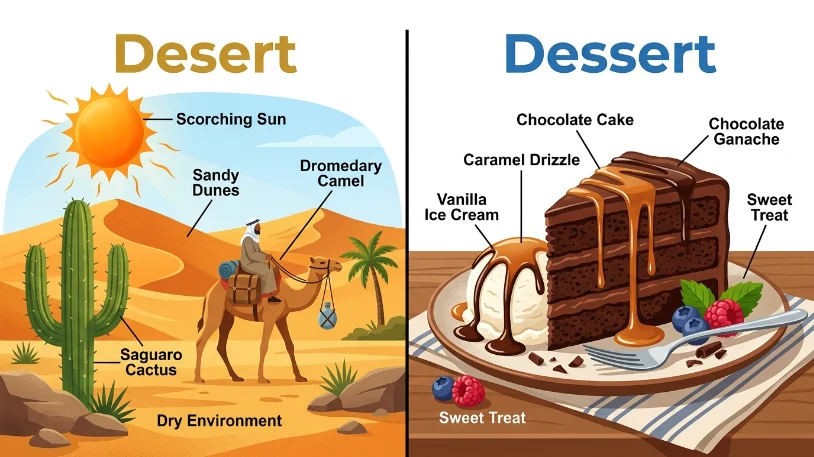
“Desert” refers to a dry, sandy region or the act of abandoning someone, while “dessert” is a sweet course eaten after a meal. The key difference lies in the number of “s” letters and their pronunciation, with “dessert” having two “s’s” and being stressed on the second syllable.
Have you ever found yourself staring at a menu, unsure whether to order a delicious “desert” or “dessert”? Perhaps you have written an email and second-guessed your spelling of this tricky word pair. You are certainly not alone in this confusion. This seemingly small spelling difference can lead to embarrassing misunderstandings in both casual and professional writing. The root of the confusion lies in the fact that both words look and sound quite similar. However, their meanings are completely different. One describes a vast, arid landscape or the act of leaving someone, while the other refers to a sweet treat. This comprehensive guide will clarify the difference between desert and dessert once and for all. By using simple explanations, real-world examples, and helpful memory tricks, you will learn to choose the right word with confidence every single time.
Key Takeaway
The most crucial point to remember from this entire discussion is simple. If you are writing about a dry, sandy landscape or the act of abandoning someone, use “desert” (one ‘s’). If you are writing about a sweet food eaten after a meal, use “dessert” (two ‘s’s). The extra “s” in “dessert” stands for “sweet” or “something extra.” Remembering this simple trick will help you avoid one of the most common spelling errors in English.
Definition and Explanation
To use these words correctly, it helps to understand their definitions and grammatical roles thoroughly.
Desert
Desert” is a word with multiple meanings and pronunciations. It can function as a noun or a verb.
As a Noun (Pronounced DEH-zert): A desert is a barren area of land with little rainfall and sparse vegetation. Deserts are often sandy, rocky, and extremely dry. The Sahara Desert is a famous example. Deserts cover approximately one-third of the Earth’s land surface. They are characterized by extreme temperatures, with scorching hot days and freezing cold nights. Deserts are home to unique plants and animals adapted to survive harsh conditions.
As a Verb (Pronounced deh-ZERT): To desert means to abandon or leave someone without support. This usage carries a negative connotation, implying betrayal or neglect. For example, a soldier who deserts their post is abandoning their duty. Similarly, a parent who deserts their family is leaving them behind. When used as a verb, the pronunciation shifts to emphasize the second syllable.
Dessert
“Dessert” (pronounced deh-ZERT) is exclusively a noun. It refers to a sweet course that concludes a meal. Desserts include a wide variety of treats like cake, pie, ice cream, pudding, cookies, pastries, and fruit. The tradition of eating dessert dates back to ancient civilizations, but it gained significant popularity in the 19th century when sugar became more affordable. Desserts are often considered a special indulgence or a reward after finishing a meal.
The Pronunciation Difference
Understanding the pronunciation can help you distinguish between these words.
- Desert (landscape): Pronounced “DEH-zert” with stress on the first syllable.
- Desert (abandon): Pronounced “deh-ZERT” with stress on the second syllable.
- Dessert (sweet food): Pronounced “deh-ZERT” with stress on the second syllable.
When spoken aloud, “dessert” and the verb “desert” sound identical. Only context reveals the intended meaning.
Side-by-Side Comparison
To visualize the difference between desert and dessert, review this comparison table.
| Aspect | Desert (Noun) | Desert (Verb) | Dessert |
| Part of Speech | Noun | Verb | Noun |
| Pronunciation | DEH-zert (first syllable stressed) | deh-ZERT (second syllable stressed) | deh-ZERT (second syllable stressed) |
| Meaning | A dry, barren landscape | To abandon or leave | A sweet course after a meal |
| Example | “The Sahara Desert is vast.” | “He chose to desert his post.” | “I ordered chocolate cake for dessert.” |
Advantages and Disadvantages
While it might seem unusual to consider “advantages” and “disadvantages” for a grammar rule, understanding these can help reinforce the lesson.
Correct Usage
Advantages
- Clarity: Using the correct spelling ensures your reader understands your intended meaning immediately.
- Professionalism: Correct spelling demonstrates attention to detail and strong writing skills.
- Credibility: Avoiding common errors enhances your reputation as a competent communicator.
Disadvantages
- Memory Burden: You must remember multiple rules and exceptions.
- Context Dependence: The correct choice depends entirely on context, which requires careful thought.
Incorrect Usage
Disadvantages
- Confusion: Your reader might misunderstand your message entirely.
- Embarrassment: Spelling “dessert” as “desert” can make you appear careless.
- Loss of Meaning: An otherwise excellent piece of writing can be undermined by this simple error.
Real-World Examples
Seeing the difference between desert and dessert in common contexts makes the distinction easier to grasp.
Desert in Action
As a Noun (Landscape)
- “The camel trekked across the scorching desert for three days.”
- “The Atacama Desert is the driest place on Earth.”
- “Cacti are the most recognizable plants in the desert.”
- “The desert sun beat down relentlessly on the travelers.”
- “The Bedouin people have adapted to live in the desert for centuries.”
As a Verb (Abandon)
- “The captain threatened to desert his ship during the storm.”
- “Despite the hardships, he vowed never to desert his friends.”
- “The politician was accused of deserting his constituents.”
- “The soldier faced a court-martial after attempting to desert his post.”
- “A true leader never deserts their team in times of crisis.”
Dessert in Action
- “For dessert, we enjoyed a decadent chocolate soufflé.”
- “The restaurant is famous for its exquisite dessert menu.”
- “She baked a delicious apple pie for dessert.”
- “The children were excited to eat ice cream for dessert.”
- “After the main course, the waiter brought out a dessert cart.”
- “Sugar-free desserts are becoming increasingly popular among health-conscious consumers.”
- “The dessert was beautifully presented with a drizzle of caramel sauce.”
Regional and Global Usage
The distinction between desert and dessert holds true across all English-speaking regions. However, there are some interesting cultural variations worth noting.
Dessert Culture Around the World
Different cultures have unique dessert traditions that reflect local ingredients and customs.
| Region | Popular Desserts | Characteristics |
| Europe | Pastries, cakes, tarts, gelato | Rich, buttery, and often featuring chocolate or fruit |
| North America | Apple pie, chocolate chip cookies, cheesecake | Comfort foods, often indulgent and sweet |
| Asia | Mochi, red bean paste, mango sticky rice | Less sweet, often using rice or beans as bases |
| Middle East | Baklava, halva, kunafa | Honey and nuts, often with floral flavors like rose or orange blossom |
| South America | Flan, dulce de leche, alfajores | Caramel and dairy, with Spanish influences |
Desert Regions of the World
Deserts exist on every continent and cover about 20% of Earth’s land. Some notable deserts include:
- Sahara Desert (Africa) – The largest hot desert in the world
- Arabian Desert (Middle East) – A vast desert covering most of the Arabian Peninsula
- Gobi Desert (Asia) – A cold desert spanning northern China and Mongolia
- Kalahari Desert (Africa) – A semi-arid sandy savanna in Southern Africa
- Sonoran Desert (North America) – A hot desert covering parts of Mexico and the United States
- Antarctic Desert (Antarctica) – The largest cold desert on Earth
Common Mistakes and Corrections
The most frequent mistake is using “desert” when “dessert” is the intended word. Here are the common errors and their fixes.
| Common Mistake | Correction | Explanation |
| “I would like a sweet desert, please.” | “I would like a sweet dessert, please.” | The context is about food, not a landscape. |
| “He ate the entire desert.” | “He ate the entire dessert.” | The context is eating a sweet course, not consuming land. |
| “The Sahara dessert is enormous.” | “The Sahara desert is enormous.” | The Sahara is a dry landscape, not a sweet food. |
| “She made a delicious desert.” | “She made a delicious dessert.” | She baked a sweet treat, not a landscape. |
| “The camel ate the chocolate desert.” | “The camel ate the chocolate dessert.” | This example shows the absurdity of confusing the two words. |
| “The soldier decided to dessert his country.” | “The soldier decided to desert his country.” | The action is about abandoning, not serving sweet food. |
Memory Tricks and Mnemonics
To help remember the difference between desert and dessert, try these simple memory devices.
The Two S’s Rule
- Dessert has two ‘s’s because you always want two servings of something sweet.
- Dessert has two ‘s’s because it is so sweet.
- Dessert has two ‘s’s because it’s second (served after the main course).
The One S Rule
- Desert has one ‘s’ because you only want one serving of sand.
- Desert has one ‘s’ because it is sandy.
- Desert has one ‘s’ because it is a single, barren landscape.
The Strawberry Shortcake Trick
“Strawberry Shortcake has two S’s: one for strawberry and one for shortcake. That’s why dessert has two S’s, because it’s twice as nice!”
The Verb Pronunciation Trick
When “desert” means to abandon, it’s pronounced like “dessert.” Only context and careful reading can distinguish them. Remember, if you’re abandoning something, you’re leaving it. Both “abandon” and “desert” (verb) end with the stress on the second syllable.
Exercises with Answers
Practice makes perfect. Test your knowledge with these exercises.
Fill-in-the-Blanks
- The Sahara is the largest hot _______ in the world.
- For _______, we had a delicious chocolate mousse.
- He threatened to _______ his post if conditions worsened.
- The children eagerly awaited the _______ course.
- The _______ sun beat down on the travelers.
- She baked a wonderful apple pie for _______.
- The soldier was charged with _______ during wartime.
- The camels are perfectly adapted to life in the _______.
- Please save room for _______ after dinner.
- The Gobi is a cold _______ in Asia.
Answer Key
- desert (A large area of land with little rainfall)
- dessert (A sweet course eaten after a meal)
- desert (To abandon, as in leaving a post)
- dessert (The sweet course at the end of a meal)
- desert (The sun that shines in a dry region)
- dessert (A sweet baked good eaten after a meal)
- deserting (The act of abandoning military duty)
- desert (The habitat where camels live)
- dessert (The sweet course after a meal)
- desert (A cold, dry region in Asia)
Choose the Correct Word
- The (desert/dessert) is a harsh and unforgiving environment.
- She ordered tiramisu for (desert/dessert).
- The general warned that anyone who (deserts/desserts) will face consequences.
- We enjoyed a delectable (desert/dessert) after our meal.
- The cactus is a symbol of the (desert/dessert).
Answer Key
- desert
- dessert
- deserts
- dessert
- desert
Related Concepts or Comparisons
Understanding the difference between desert and dessert leads naturally to exploring other commonly confused word pairs.
Other Tricky Word Pairs
English contains many words that are commonly confused due to similar spelling or pronunciation. Here are a few examples:
| Word Pair | Difference |
| Accept vs. Except | Accept means to receive; except means to exclude. |
| Affect vs. Effect | Affect is usually a verb meaning to influence; effect is usually a noun meaning a result. |
| Principle vs. Principal | Principle means a basic truth; principal means first in importance or a school leader. |
| Stationary vs. Stationery | Stationary means not moving; stationery means writing materials. |
| Compliment vs. Complement | Compliment means praise; complement means to complete or enhance. |
Semantic Similarities
- Just deserts: This phrase is pronounced “just deserts” (like desserts) but refers to getting what you deserve, often punishment. This phrase is a common source of confusion because it sounds like “just desserts.”
- Dessertspoon: A dessertspoon is a spoon used for eating dessert. It is larger than a teaspoon but smaller than a tablespoon.
FAQs
What is the main difference between desert and dessert?
The main difference is meaning. Desert (one ‘s’) refers to a dry, barren landscape or the act of abandoning someone. Dessert (two ‘s’s) refers to a sweet course eaten after a meal.
How do you remember the difference between desert and dessert?
Use the memory trick: dessert has two “s”s because you want two servings of something sweet. Alternatively, think of dessert as “super sweet” (two “s”s for super sweet). Desert has one “s” because it’s just “sandy.”
Is the pronunciation of desert and dessert different?
Yes, the pronunciation differs based on meaning. Desert (landscape) is pronounced “DEH-zert” with stress on the first syllable. Dessert (sweet food) and desert (abandon) are pronounced “deh-ZERT” with stress on the second syllable.
What does “just deserts” mean?
“Just deserts” means receiving what one deserves, often punishment or reward. It is pronounced “just deserts” like “desserts” but spelled with one “s.” This phrase comes from the word “desert” meaning “worthiness,” not the landscape or sweet food.
How can I use desert and dessert correctly in a sentence?
Use desert when describing a dry area or abandoning someone: “The explorer crossed the desert.” Use dessert when referring to sweet food: “We ate chocolate cake for dessert.” Consider the context to determine the correct spelling.
What are some common mistakes when using desert and dessert?
The most common mistake is using “desert” when “dessert” is needed, such as writing “I had cake for desert.” Another mistake is using “dessert” to refer to the Sahara, as in “the Sahara dessert.” Both errors can cause confusion.
Are there any exceptions to the desert/dessert rule?
The main exception is the phrase “just deserts,” where the word is spelled with one “s” but pronounced like “dessert.” Additionally, desert can be a verb meaning “to abandon,” as in “desert one’s post.” These exceptions require careful attention to context.
What is the plural form of desert and dessert?
The plural form of desert (landscape) is “deserts,” as in “the deserts of the world.” The plural form of dessert (sweet food) is “desserts,” as in “the restaurant offers many desserts.” The spelling pattern remains consistent.
Why are desert and dessert commonly confused?
Desert and dessert are commonly confused because they differ by only one “s” and have similar pronunciation (in some cases). People often rush when writing and miss the subtle difference, leading to errors.
What is a dessertspoon?
A dessertspoon is a spoon used for eating dessert. It is larger than a teaspoon but smaller than a tablespoon. It holds approximately 10 milliliters. The term relates to the sweet course, “dessert,” not the dry landscape.
Conclusion
The choice between desert and dessert represents one of the most common spelling dilemmas in English. Yet, as this comprehensive guide has shown, the distinction is straightforward once you understand the rules. Remember that “desert” (one ‘s’) refers to a dry, barren landscape or the act of abandoning someone. Conversely, “dessert” (two ‘s’s’) refers to the sweet course consumed after a meal. The memory trick of two “s”s for “super sweet” can help solidify this distinction in your mind.
Professional writing requires attention to detail, and mastering these commonly confused words will significantly enhance your credibility as a communicator. When writing, always pause to consider the context. Are you describing a landscape, an action, or a sweet treat? This simple question will guide you to the correct spelling.
Moving forward, apply the techniques and memory aids presented here. Practice using both words correctly in sentences. Eventually, the correct choice will become second nature. Your readers will appreciate the clarity, and your writing will convey professionalism and precision. Remember, a small spelling difference can make a big impact on your message.