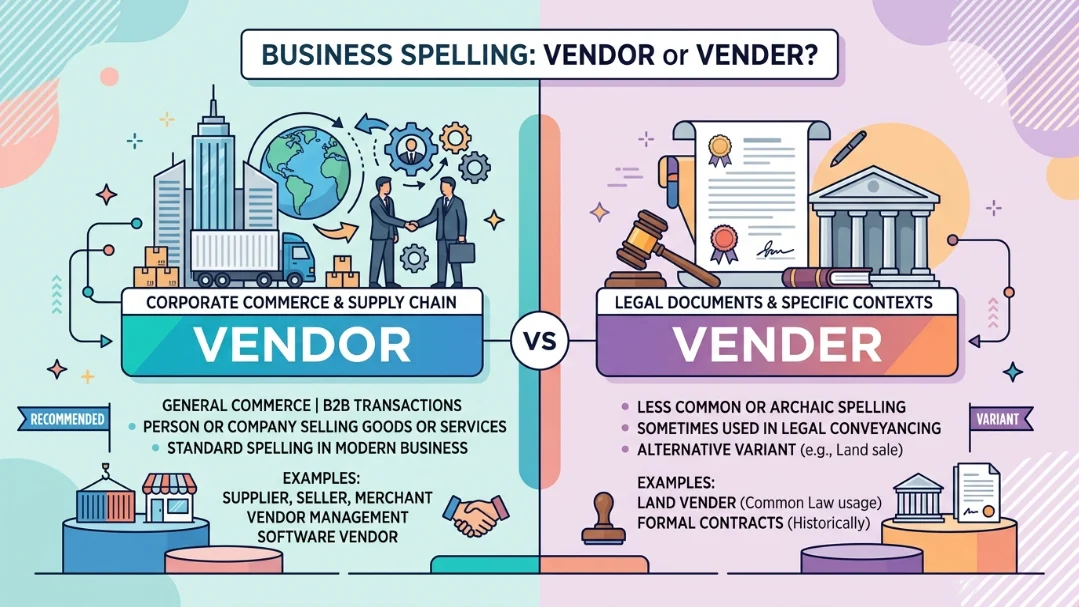
The difference between vender and vendor is simple. Vendor is the standard and preferred spelling in modern English for someone who sells goods or services. Vender is an archaic alternative spelling that appears rarely in contemporary writing, though some dictionaries still list it as a variant. Use vendor for all professional and everyday contexts.
Have you ever paused while writing a business document and wondered if you should type vender or vendor? This small difference trips up many professionals. The two words look almost identical, but only one is correct in modern English. Getting it wrong can make your writing look outdated or careless.
This confusion matters more than you might think. Business professionals use these words constantly. You will need them in contracts, invoices, emails, and reports. Using the correct spelling shows attention to detail and professionalism. It also helps you communicate clearly with clients, suppliers, and colleagues.
The challenge comes from the word’s history. Vender was once a common spelling in English. However, over time, vendor became the standard form. Many people still see vender in old documents or encounter it in other languages. This creates uncertainty about which spelling to use.
This article clears up the confusion once and for all. You will learn the definitions, see real examples, and discover why vendor is the right choice. By the end, you will never second-guess this spelling again. Good business writing depends on getting these details right.
The main takeaway is that vendor is the correct and standard spelling in modern English. Vender is an archaic variant that rarely appears in contemporary writing. Use vendor for all professional, academic, and everyday contexts. The word vendor refers to a person or company that sells goods or services. For example, “Our vendor provides office supplies” is correct. “Our vender provides office supplies” is outdated and incorrect in modern usage.
Definitions and Explanations
What Does “Vendor” Mean?
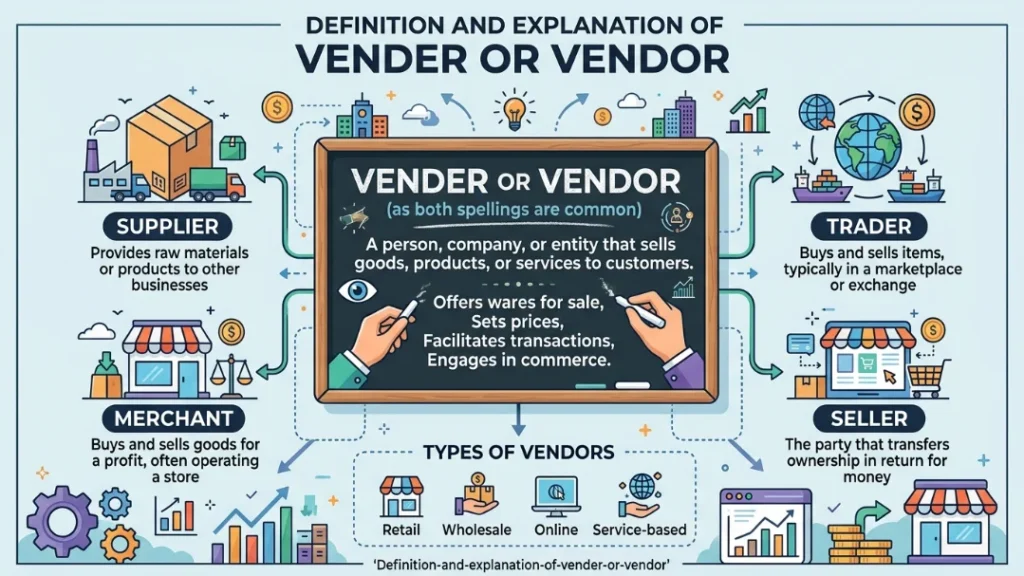
Vendor is a noun that refers to a person or company that sells goods, services, or products. It describes anyone who engages in commerce. This is the standard and preferred spelling in modern English.
Vendors appear in many contexts. A food vendor sells food at a market or event. A software vendor sells computer programs. A street vendor sells items from a cart or stall. A business vendor supplies products to other companies. In all these cases, vendor is the correct term.
The word vendor comes from the Latin word vendere, which means “to sell.” This Latin root appears in many English words related to selling, such as vend and vendible. The *-or* suffix is common in English for people who perform actions, like actor (one who acts) and doctor (one who doctors or treats).
What Does “Vender” Mean?
Vender is an alternative spelling of vendor. It means exactly the same thing: a person or company that sells goods or services. The difference is purely a matter of spelling, not meaning.
However, vender is considered archaic or outdated in modern English. It was more common in older English, but it has largely fallen out of use. Many dictionaries list vender as a variant spelling, but they mark it as less common or obsolete.
In contemporary writing, you should almost always use vendor. Using vender can make your writing look old-fashioned or careless. It might also confuse readers who are not familiar with the archaic spelling.
| Term | Meaning | Modern Usage | Recommended? |
| Vendor | One who sells goods or services | Very common | Yes |
| Vender | One who sells goods or services | Rare, archaic | No |
Why the Confusion Exists
The confusion between vender and vendor has several causes. One cause is history. In older English, both spellings appeared. People were less consistent with spelling before dictionaries standardized the language. Over time, vendor became the preferred spelling.
Another cause is other languages. In Spanish, the word for “to sell” is vender. A Spanish-speaking person might naturally write vender in English. This is a common error for non-native speakers.
A third cause is pronunciation. Both spellings sound nearly identical when spoken. You cannot hear the difference between vender and vendor. This makes it easy to mix up the spellings when writing.
| Cause of Confusion | Explanation |
| Historical usage | Both spellings appeared in older English |
| Other languages | Spanish uses vender for “to sell” |
| Pronunciation | Both sound almost identical |
| Lack of awareness | Many people do not know which is correct |
The Latin Root Connection
Understanding the Latin root helps clarify why vendor is preferred. The word comes from the Latin vendere, meaning “to sell.” Many English words from Latin use the *-or* suffix for people. Examples include:
- Actor (one who acts)
- Doctor (one who doctors)
- Director (one who directs)
- Investor (one who invests)
- Vendor (one who vends or sells)
The *-er* suffix also exists in English, but it is often for different purposes. The pattern of *-or* for people who perform actions is well established. This pattern supports the use of vendor over vender.
Advantages and Disadvantages
Using the correct spelling offers clear advantages. Getting it wrong can create problems. This section explores both sides.
Advantages of Using “Vendor”
- Professionalism: Using vendor shows that you know standard English spelling. It signals attention to detail and professionalism.
- Clarity: Your readers will recognize vendor immediately. They will not pause to wonder if you meant something different.
- Consistency: Most style guides and dictionaries prefer vendor. Using it keeps your writing consistent with standard English.
- Trust: Accurate spelling builds trust with readers. It shows that you care about your writing and respect your audience.
- Compliance: Many business documents, contracts, and official forms use vendor. Using the correct spelling ensures your documents are standard.
Disadvantages of Using “Vender”
- Outdated appearance: Vender looks old-fashioned. It can make your writing seem stuck in the past.
- Confusion: Some readers might not recognize vender. They might think it is a typo or a different word.
- Unprofessional: Using an archaic spelling can make you look careless or uninformed.
- Inconsistency: Most modern writing uses vendor. Using vender makes your writing inconsistent with standard practice.
- Compatibility: Some spell-checkers might flag vender as an error. This can create unnecessary problems.
| Aspect | Vendor | Vender |
| Modern usage | Very common | Very rare |
| Professional perception | Professional | Outdated |
| Dictionary status | Standard | Archaic variant |
| Spell-check recognition | Yes | Sometimes flagged |
| Recommended | Yes | No |
Real-World Examples
Seeing vendor used correctly in real-world contexts helps solidify the spelling.
Examples of “Vendor” in Professional Settings
- “Our company has partnered with a new software vendor.” This describes a provider of software.
- “The vendor delivered the supplies on time.” This describes a supplier.
- “We need to negotiate better terms with our vendors.” This describes multiple suppliers.
- “The street vendor sold fresh fruit every morning.” This describes a seller at a market.
- “The event organizer hired a catering vendor.” This describes a food service provider.
- “The vendor’s invoice arrived late.” This describes a bill from a supplier.
Examples of “Vendor” in Different Contexts
| Context | Example Sentence |
| Technology | “The hardware vendor released a new product.” |
| Retail | “The vendor at the fair sold handmade crafts.” |
| Business | “We are evaluating several potential vendors.” |
| Events | “The wedding vendor provided excellent service.” |
| Food | “The food vendor had a long line of customers.” |
Common Phrases with “Vendor”
- “Vendor management”: The process of managing supplier relationships.
- “Vendor selection”: The process of choosing a supplier.
- “Vendor agreement”: A contract with a supplier.
- “Vendor invoice”: A bill from a supplier.
- “Vendor relationship”: The connection between a company and its suppliers.
- “Vendor performance”: How well a supplier meets expectations.
Regional and Global Usage
The preference for vendor is consistent across all English-speaking regions.
Global English Consistency
English speakers worldwide use vendor as the standard spelling. This includes the United States, the United Kingdom, Canada, Australia, and other English-speaking countries. The spelling does not vary by region. This consistency makes vendor the safe choice for international business.
American English
In American English, vendor is the clear standard. Vender appears only in archaic or historical contexts. American dictionaries, such as Merriam-Webster, list vendor as the primary spelling and vender as a variant.
British English
British English also prefers vendor. The Oxford English Dictionary lists vendor as the standard spelling. Vender appears rarely in modern British writing. The pattern is the same as in American English.
| Region | Preferred Spelling | Variant |
| United States | Vendor | Vender (archaic) |
| United Kingdom | Vendor | Vender (archaic) |
| Canada | Vendor | Vender (archaic) |
| Australia | Vendor | Vender (archaic) |
| New Zealand | Vendor | Vender (archaic) |
A Note on Legal and Formal Documents
In legal and formal documents, vendor is almost always used. Contracts, purchase agreements, and official forms use vendor. Using vender in a legal document could cause confusion or appear unprofessional. Always use vendor in these contexts.
Use in Other Languages
The confusion between vender and vendor can be more common for non-native speakers. In Spanish, vender means “to sell.” A Spanish speaker might naturally use vender in English. In French, vendeur means “seller.” This can also cause confusion.
| Language | Word for “To Sell” | Word for “Seller” |
| English | To sell | Vendor |
| Spanish | Vender | Vendedor |
| French | Vendre | Vendeur |
| Latin | Vendere | Venditor |
Common Mistakes
This section highlights the most frequent errors people make with these words. Learning about them will help you avoid them.
Mistake 1: Using “Vender” in Modern Writing
This is the most common error. People use vender when they mean vendor. The mistake often happens because people see vender in old documents or confuse it with other languages. However, vender is outdated in modern English.
Correction: Always use vendor in modern English writing. If you are unsure, check a dictionary. Most dictionaries will list vendor as the preferred spelling.
Mistake 2: Using “Vendor” and “Vender” Interchangeably
Some people think the two spellings are interchangeable. They might switch between them in the same document. This inconsistency looks unprofessional.
Correction: Choose vendor and stick with it throughout your writing. Consistency is important for professional communication.
Mistake 3: Confusing “Vendor” with Other Words
People sometimes confuse vendor with other similar words. For example, vender is a common misspelling. Vendee is a different word meaning “buyer.” Vendible means “sellable.” These words are related but have different meanings.
Correction: Learn the meanings of related words. Vendor is the person selling. Vendee is the person buying. Vendible is the product that can be sold.
| Word | Meaning | Correct? |
| Vendor | One who sells | Yes |
| Vender | Variant spelling | No (archaic) |
| Vendee | One who buys | Yes (different meaning) |
| Vendible | Able to be sold | Yes (adjective) |
Related Concepts and Comparisons
Understanding how vendor relates to other terms helps build a complete picture.
Vendor vs. Supplier
These two terms are often used interchangeably, but they have subtle differences.
- Vendor: Generally refers to a seller in a business-to-consumer context. A vendor sells products or services directly to customers or businesses.
- Supplier: Often refers to a business that provides raw materials or components to other businesses. Suppliers are usually part of a supply chain.
| Term | Focus | Context |
| Vendor | Seller, often retail or service | Business-to-business, business-to-consumer |
| Supplier | Provider of materials or components | Supply chain, manufacturing |
Vendor vs. Seller
These terms are very similar, but seller is more general.
- Vendor: Often implies a business or professional seller.
- Seller: Can refer to anyone selling anything, including individuals selling used items.
| Term | Formality | Usage |
| Vendor | More formal, professional | Business, commerce |
| Seller | Less formal, general | Any selling situation |
Vendor vs. Merchant
These terms are related but have different historical connotations.
- Vendor: A seller of goods or services, often at a market or event.
- Merchant: Historically, a wholesale trader. In modern usage, a merchant sells goods in a shop or online.
| Term | History | Modern Usage |
| Vendor | Seller, often retail | Wide usage |
| Merchant | Wholesale trader | Often retail, e-commerce |
Vendor in Technology
In technology, a vendor refers to a company that sells software, hardware, or services. Tech vendors include companies like Microsoft, Apple, and Amazon. The term is standard in the tech industry.
- “We use Microsoft as our software vendor.”
- “Our hardware vendor provides servers and networking equipment.”
- “The cloud vendor offers hosting services.”
Exercises
Test your knowledge with these exercises.
Exercise 1: Fill in the Blank
Choose vendor or vender to complete each sentence.
- Our company has a new software _________.
- The street _________ sold delicious tacos.
- Please contact the _________ about the invoice.
- We are evaluating several potential _________.
- The _________ delivered the supplies on time.
- The wedding _________ provided flowers and decorations.
- Our main _________ is located in Chicago.
- The food _________ had the longest line at the fair.
Exercise 2: Identify the Error
Each sentence has a mistake. Identify the incorrect word and correct it.
- “We need to find a new vender for office supplies.”
- “The vender’s contract expires next month.”
- “Our software vender has excellent customer support.”
- “Please contact the vender to arrange delivery.”
Exercise 3: Choose the Correct Form
Select the correct word to complete each sentence.
- “The _________ is offering a discount.” (Vendor/Vender)
- “Our _________ relationship has been excellent.” (vendor/vender)
- “She works as a _________ at the market.” (vendor/vender)
- “The _________ shipped the order yesterday.” (vendor/vender)
Answer Key
Answers of Exercise 1:
- Vendor (standard spelling)
- Vendor (standard spelling)
- Vendor (standard spelling)
- Vendors (standard spelling)
- Vendor (standard spelling)
- Vendor (standard spelling)
- Vendor (standard spelling)
- Vendor (standard spelling)
Exercise 2 Corrections:
- “We need to find a new vendor for office supplies.” (Use vendor)
- “The vendor’s contract expires next month.” (Use vendor)
- “Our software vendor has excellent customer support.” (Use vendor)
- “Please contact the vendor to arrange delivery.” (Use vendor)
Exercise 3 Answers:
- Vendor (standard)
- vendor (standard)
- vendor (standard)
- vendor (standard)
FAQs
What is the difference between vendor and vender?
There is no difference in meaning. Vendor is the standard and preferred spelling in modern English. Vender is an archaic variant that rarely appears in contemporary writing.
Is vender a word?
Yes, vender is a word, but it is an archaic spelling of vendor. Most dictionaries list it as a variant or obsolete form. It is not recommended for modern writing.
Why do people use vender instead of vendor?
People use vender for several reasons. Some see it in older documents. Others confuse it with other languages, like Spanish vender. Some simply do not know the correct spelling. However, vendor is always the preferred choice.
Which is correct: vendor or vender?
Vendor is the correct spelling in modern English. Vender is an outdated variant. Use vendor for all professional and everyday writing.
Is vendor an English word?
Yes, vendor is a standard English word. It has been in use since the 16th century. It comes from the Latin word vendere, meaning “to sell.”
What is the plural of vendor?
The plural of vendor is vendors. For example, “We work with many vendors.” The plural of vender would be venders, but this is not recommended.
How do you pronounce vendor?
Vendor is pronounced as “VEN-der.” The first syllable sounds like “ven” (rhymes with “pen”). The second syllable sounds like “der” (rhymes with “her”). It has two syllables.
Is vendor a noun or a verb?
Vendor is a noun. It refers to a person or company that sells goods or services. The verb form is vend, meaning “to sell.” For example, “They vend products at the market.
What is the difference between a vendor and a supplier?
A vendor is generally a seller of goods or services. A supplier often provides raw materials or components to businesses. However, the terms are often used interchangeably in business contexts.
What is a vendor in business?
In business, a vendor is a person or company that sells products or services to another company. They are also called suppliers or sellers. Business vendors provide everything from office supplies to software.
Should I use vendor or vender on a website?
Always use vendor on a website. Vender looks outdated and unprofessional. Using vendor ensures your website appears modern and credible to visitors.
Is vender ever correct in modern English?
Vender is very rarely correct in modern English. It only appears in historical contexts or in quotations from older texts. For all modern writing, use vendor.
Conclusion
This guide has clarified the simple but important spelling difference between vender and vendor. Vendor is the standard and preferred spelling in modern English. Vender is an archaic variant that you should avoid in contemporary writing. The word vendor refers to a person or company that sells goods or services.
The best practical advice is to always use vendor in your writing. This spelling is recognized worldwide and appears in all major dictionaries. It is the professional choice for business, academic, and everyday communication. If you are unsure, remember that vendor follows the pattern of other words for people who perform actions, like actor and director.
Good writing depends on these small but important details. Getting your spelling right shows attention to detail and professionalism. Now you have the knowledge to choose the correct word every time. Use this guide as a reference whenever you are unsure. Over time, the correct spelling will become second nature to you.